

Physical therapy billing looks simple on the surface. You treat the patient. You submit the claim. You get paid.
But anyone who has actually billed PHYSICAL THERAPY services knows that reality plays out very differently.
Time-based rules, strict documentation, modifier requirements, payer edits, and frequent denials make physical therapy one of the most heavily audited therapy specialties in the U.S. A single missed unit, an incorrect Physical Therapy pairing, or weak documentation can turn a clean visit into a delayed or denied claim.
This guide breaks down physical therapy codes, how they are billed, how payers review them, and how to protect reimbursement.
Why Physical Therapy Billing Is Different From Other Specialties
Physical therapy billing is based on time, function, and medical necessity, not solely on procedures. That difference alone changes how claims are reviewed.
Unlike surgical or diagnostic services, most physical therapy codes fall under timed therapy codes. Medicare and many commercial payers require providers to follow the 8-minute rule, not a flat unit system. This creates constant pressure to document accurately and bill precisely.
Another challenge is utilization scrutiny. Payers closely track how often specific physical therapy codes are billed together, how often they appear per visit, and how long a patient stays in therapy. Overuse patterns quickly trigger audits or payment reductions.
Industry data shows that therapy services face denial rates as high as 10–15%, mainly due to unit miscalculations, missing modifiers, or insufficient functional documentation. That makes coding accuracy a revenue issue, not just a compliance one.
Physical therapy PHYSICAL THERAPYCode Categories
Physical therapy codes generally fall into four major categories. Each category has its own billing rules and payer expectations.
Evaluation and Re-Evaluation Codes
These codes describe the initial assessment and follow-up assessments of a patient’s condition.
Common evaluation physical therapy codes include:
- 97161 – Low complexity evaluation
- 97162 – Moderate complexity evaluation
- 97163 – High complexity evaluation
- 97164 – Re-evaluation
Evaluation codes are untimed and billed once per date of service. However, documentation must support the selected complexity level. Auditors often downgrade evaluations when history, examination, or clinical decision-making does not match the billed code.
Medicare allows one evaluation per episode unless a significant change in condition justifies a re-evaluation.
Therapeutic Procedures (Timed Codes)
This category drives most Physical Therapy revenue and also causes most denials. These codes are billed in 15-minute units and must follow the 8-minute rule.
Common examples include:
- 97110 – Therapeutic exercises
- 97112 – Neuromuscular reeducation
- 97116 – Gait training
- 97140 – Manual therapy
- 97530 – Therapeutic activities
Each unit must reflect direct one-on-one patient contact. Grouping time, estimating minutes, or overlapping treatments puts claims at risk.
Modalities
Modalities can be timed or untimed, depending on the service.
Untimed modalities include:
- 97010 – Hot/cold packs
- 97014 / G0283 – Electrical stimulation (unattended)
Timed modalities include:
- 97035 – Ultrasound
- 97032 – Electrical stimulation (manual)
Many payers limit or bundle modalities. Medicare, for example, considers hot/cold packs bundled and non-payable.
Physical Performance Testing and Specialized Services
These codes cover functional testing and performance measurement.
Examples include:
- 97750 – Physical performance test
- 97755 – Assistive technology assessment
These services often require detailed reports and apparent medical necessity. Payers frequently deny them when documentation lacks measurable outcomes.
The 8-Minute Rule for Physical Therapy
The 8-minute rule determines how many units of timed physical therapy codes can be billed per visit.
Here is how Medicare calculates units:
- 8–22 minutes = 1 unit
- 23–37 minutes = 2 units
- 38–52 minutes = 3 units
- 53–67 minutes = 4 units
Each minute must be face-to-face. If a therapist performs 10 minutes of exercise and 7 minutes of manual therapy, only one unit total can be billed.
Commercial payers vary. Some follow the 8-minute rule. Others follow a per-code unit rule, allowing one unit per physical therapy code once 15 minutes is met. Verifying payer policy upfront prevents underbilling or overbilling.
Modifiers in Physical Therapy Billing
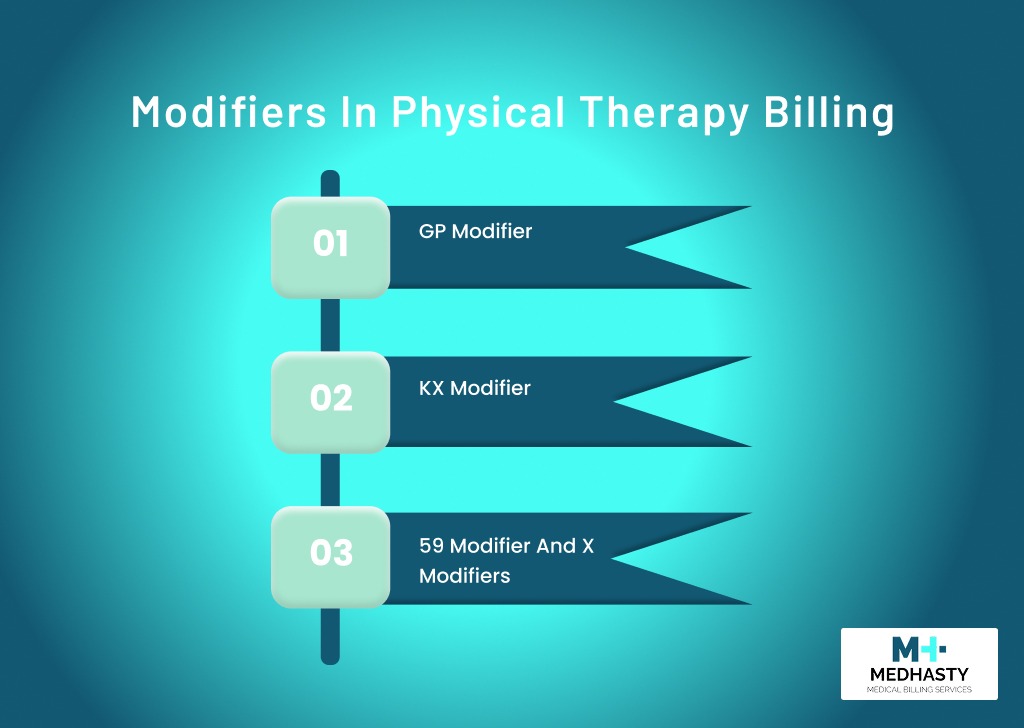
Modifiers are not optional in physical therapy billing. They are payment triggers.
GP Modifier
The GP modifier indicates that services were provided under a physical therapy plan of care.
Medicare requires the GP modifier on all physical therapy codes, including evaluations and modalities. Missing this modifier leads to automatic denials.
KX Modifier
The KX modifier is used when therapy services exceed Medicare’s annual therapy threshold.
By appending KX, the provider certifies that services remain medically necessary. Claims without KX after the threshold are denied outright.
Improper use of KX is a common audit target, so documentation must clearly justify ongoing care.
59 Modifier and X Modifiers
The 59 modifier (or XE, XS, XP, XU) is used to bypass National Correct Coding Initiative edits when two services are distinct.
For example, billing manual therapy and therapeutic exercise on the same date often requires a modifier if performed on separate body regions.
Improper modifier use raises red flags, so clinical separation must be well documented.
Medicare Billing Rules for Physical Therapy Codes
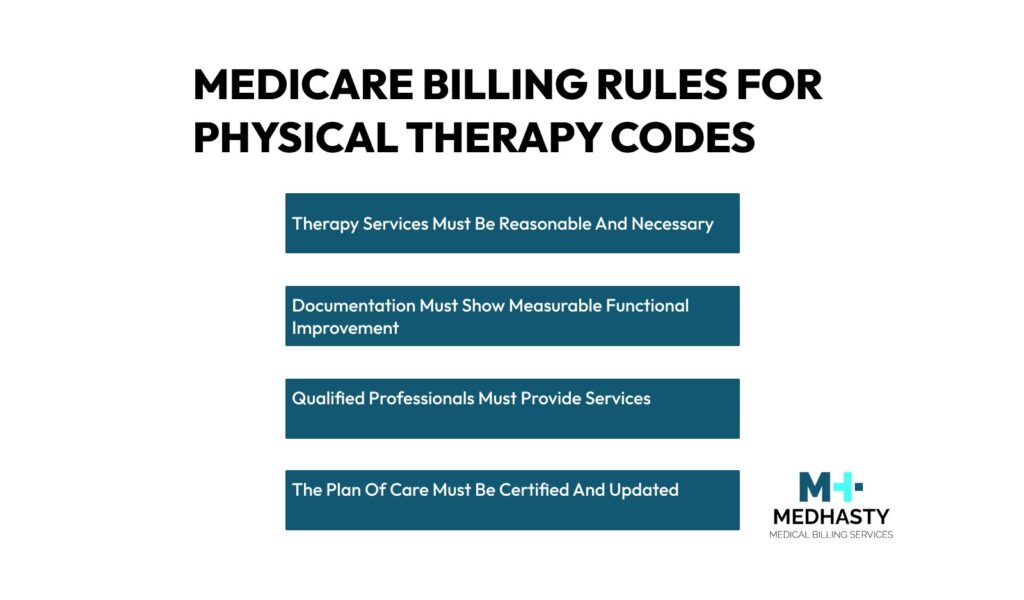
Medicare remains the strictest payer for physical therapy services.
Key Medicare rules include:
- Therapy services must be reasonable and necessary
- Documentation must show measurable functional improvement
- Qualified professionals must provide services
- The plan of care must be certified and updated
Medicare also applies MPPR (Multiple Procedure Payment Reduction). When multiple therapy codes are billed on the same day, payment for secondary codes is reduced by 50%, on average.
Understanding MPPR helps practices forecast reimbursement accurately and avoid surprise underpayments.
Commercial Payer Variations You Must Watch

Commercial insurance plans often differ from Medicare, even when they appear similar.
Some common payer-specific issues include:
- Unit caps per visit
- Visit limits per year
- Prior authorization requirements
- Denial of certain modalities
- Different time calculation rules
Large payers such as UnitedHealthcare, Aetna, and Cigna regularly update their therapy policies. Practices that rely on old rules often see rising denial rates without realizing why.
Physical Therapy Code Denials and How to Prevent Them
Physical therapy denials rarely happen by accident. In most cases, they follow the same repeat patterns across Medicare, Medicaid, and commercial payers. After working with physical therapy clinics across multiple states, one thing becomes clear. Payers deny therapy claims not because services were unnecessary, but because the story was not told correctly on paper.
Let’s discuss the most common physical therapy code denials and the practical ways to prevent them before they hit your AR.
Insufficient Documentation to Support Medical Necessity
This is the number one reason physical therapy claims get denied or downcoded.
Payers do not deny because exercises were not performed. They deny because documentation fails to explain why those exercises were medically necessary and how they relate to the patient’s functional limitations.
Many PHYSICAL THERAPY notes list activities such as strengthening, stretching, or balance training. What they miss is the connection to functional deficits, such as difficulty walking, reduced range of motion affecting daily tasks, or post-surgical limitations.
From a payer’s perspective, therapy must show skilled intervention and measurable improvement. Notes that read the same visit after visit raise red flags. Medicare, in particular, expects documentation to show progress toward goals, not just ongoing treatment.
How to prevent it:
Every CPT code in physical therapy should be billed and directly tied to a functional goal. Document baseline limitations, skilled techniques used, patient response, and progress over time. Small changes in wording make a big difference during audits.
Incorrect Time-Based Unit Billing
Time-based physical therapy codes are a constant source of trouble in physical therapy billing.
Medicare follows the 8-minute rule. Many commercial payers do as well, but not all. Denials occur when the total treatment time does not match the billed units, or when time is split incorrectly across multiple physical therapy codes.
For example, billing for two units of therapeutic exercise when only 20 minutes are documented results in overbilling. On the flip side, underbilling occurs when clinics fail to bill valid units due to confusion about time calculations.
Auditors frequently request time logs when reviewing therapy claims. If minutes do not add up clearly, denials follow.
How to prevent it:
Track direct one-on-one time accurately. Allocate minutes to each physical therapy code clearly in the note. Train therapists and billers on payer-specific time rules instead of assuming all plans follow Medicare.
Data from billing audits shows that time-based errors account for nearly 20% of all physical therapy claim denials across mixed payer portfolios.
Missing or Incorrect Modifiers
Modifiers are not physical therapy in physical therapy billing. Missing even one can stop payment entirely.
The GP modifier is required on all physical therapy services billed to Medicare. Claims without it are automatically rejected.
The KX modifier becomes mandatory once a patient exceeds Medicare’s therapy threshold. Without it, claims are denied regardless of medical necessity.
The 59 modifier, or X modifiers, are often required when billing multiple therapy codes that are usually bundled.
Incorrect modifier use is just as risky as missing one. Overuse of 59 without proper clinical separation invites audits and recoupments.
How to prevent it:
Build modifier checks into your billing workflow. Ensure GP is appended consistently. Monitor therapy threshold usage weekly. Apply 59 only when documentation clearly supports separate and distinct services.
Practices that audit modifier usage monthly see a measurable drop in post-payment takebacks.
Billing Evaluation and Treatment Incorrectly on the Same Day
Many payers allow billing for an evaluation and treatment on the same date, but only when documentation supports both.
Denials occur when the evaluation note does not justify additional treatment or when treatment time overlaps with evaluation time. Payers may downcode or deny physical therapy codes entirely if they believe the session was primarily evaluative.
Medicare expects a clear separation. The evaluation establishes the plan of care. Treatment addresses specific deficits after that plan is formed.
How to prevent it:
Document evaluation components fully. Clearly note when treatment begins and what services were rendered beyond the evaluation. Avoid vague language that conflates the two.
Clinics that clearly separate eval and treatment time experience fewer same-day denials.
Exceeding Visit Limits or Authorization Rules
Commercial payers frequently impose visit caps, unit limits, or prior authorization requirements on physical therapy services.
Denials happen when clinics continue treatment after benefits are exhausted or fail to track authorization expiration dates. These denials are especially frustrating because services were often medically appropriate but contractually non-payable.
According to industry reports, authorization-related denials make up 15–18% of therapy AR for commercial plans.
How to prevent it:
Verify benefits before starting care: track authorized visits and units in real time. Reauthorize early when progress supports continued therapy. Communicate limits clearly with patients to avoid write-offs.
Failure to Show Progress or Skilled Need Over Time
Physical therapy is expected to improve function. When progress stalls, payers question ongoing treatment.
Medicare does not cover maintenance therapy unless strict criteria are met. Commercial payers also expect improvement or a justified explanation for slow progress.
Claims are denied when documentation repeats identical goals, treatments, and outcomes over extended periods.
How to prevent it:
Update goals regularly. Document objective improvements, even small ones. When progress slows, explain why continued skilled care is required. Re-evaluations should reflect meaningful clinical changes, not routine check-ins.
Clinics that perform timely re-evaluations significantly reduce the risk of long-duration denials.
Billing Non-Covered or Bundled Modalities
Payers closely scrutinize modalities.
Medicare bundles hot and cold packs and considers them non-payable.
Some commercial plans limit ultrasound or electrical stimulation unless specific criteria are met. Billing these services without verifying coverage results in denials or silent write-offs.
How to prevent it:
Know payer-specific modality rules. Use G-codes or alternative codes when required. Do not rely on “we always bill it” habits.
Final Thoughts
Physical therapy coding is not about memorizing numbers. It is about understanding payer behavior, documentation expectations, and time-based billing rules that directly affect cash flow.
Practices that treat billing as an afterthought quietly lose revenue. Practices that treat it as a clinical and financial process stay profitable and compliant.
When PHYSICAL THERAPY coding is done right, claims move faster, audits drop, and therapists spend less time correcting errors. That balance is what keeps a physical therapy practice healthy for the long run.
Need Help With Physical Therapy Billing?
Managing physical therapy billing requires more than knowing CPT codes. It demands accurate time-based billing, modifier compliance, payer-specific rules, and audit-ready documentation.
Medhasty Medical Billing is a Maryland-based medical billing company that helps physical therapy practices reduce denials, improve reimbursement, and stay fully compliant with Medicare and commercial payer guidelines.
Whether you’re struggling with the 8-minute rule, modifier usage, claim denials, or payer audits, our experienced billing team ensures your physical therapy claims are coded correctly, submitted cleanly, and paid faster.
Talk to Medhasty Medical Billing today to streamline your physical therapy billing and protect your revenue.
Frequently Asked Questions About Physical Therapy Billing Codes
What are physical therapy billing codes?
Physical therapy billing codes are CPT codes used to report evaluation, treatment, modalities, and functional testing services provided by licensed physical therapists. Most physical therapy CPT codes are time-based, meaning they are billed in 15-minute units and must meet specific documentation and payer rules. These codes allow Medicare and commercial insurers to determine coverage, reimbursement, and medical necessity for physical therapy services.
How does the 8-minute rule work in physical therapy?
The 8-minute rule is a Medicare billing guideline used to calculate how many units of time-based physical therapy CPT codes can be billed during a single visit. Under this rule, at least 8 minutes of direct one-on-one care are required to bill one unit. Additional units are billed as total treatment time increases, following Medicare’s unit thresholds. Only face-to-face skilled treatment time counts toward unit calculation, and time must be clearly documented for each billed service.
What modifiers are required for physical therapy billing?
Physical therapy billing commonly requires several modifiers to ensure claims are processed correctly. The GP modifier is required on all physical therapy services billed to Medicare to indicate they are provided under a physical therapy plan of care. The KX modifier is required when therapy services exceed Medicare’s annual therapy threshold and certifies continued medical necessity. The 59 modifier, or applicable X modifiers, may be required when billing distinct physical therapy services that are normally bundled but performed on separate body regions or during separate encounters.
Does Medicare pay for modalities in physical therapy?
Medicare covers some physical therapy modalities, but coverage is limited and payer-specific. Unattended modalities, such as hot and cold packs, are considered bundled and are not separately reimbursable by Medicare. Certain timed modalities, such as ultrasound or manual electrical stimulation, may be covered when they are medically necessary and properly documented. Coverage decisions depend on the modality, diagnosis, and supporting clinical documentation demonstrating skilled intervention.