
Every hospital billing department has seen this scenario. A patient is admitted for sepsis. Three days into the stay, creatinine levels climb, urine output drops, and the nephrologist is consulted. Acute kidney injury is now clearly part of the clinical picture. The question that lands on the coder’s desk: Is N17.9 the right code? Is there a more specific one? Does the sequence in which these diagnoses are listed on the claim actually matter?
All three questions have answers that affect payment. AKI coding in 2026 carries the same ICD-10 structure it has had, but the documentation expectations from payers, the sequencing rules under UHDDS guidelines, and the clinical specificity that separates a defensible code from an audit risk have all gotten sharper. Payers are looking more closely at hospital-acquired AKI versus AKI that brought the patient in. Severity staging is being factored into medical necessity reviews for extended stays. And N17.9 on a claim without supporting documentation is increasingly flagging for review.
This guide covers what N17.9 means, when it is the right choice versus a more specific AKI code, what the documentation needs to reflect, how AKI coding affects DRG assignment and reimbursement, and where the coding errors tend to cluster in practices and hospitals billing this diagnosis.
What Is the ICD-10 Code for Acute Kidney Injury (AKI)?
The ICD-10-CM code for acute kidney injury (AKI) is N17.9 – Acute kidney failure, unspecified. This code is commonly used by providers and billing teams relying on ICD-10 coding services for providers to ensure accurate diagnosis reporting and reimbursement.
This code is used when a provider documents acute kidney injury or acute renal failure but does not specify the underlying pathological type such as acute tubular necrosis, cortical necrosis, or medullary necrosis.
N17.9 is the most commonly used code for AKI in inpatient and hospital-based settings, especially when the diagnosis is based on clinical findings such as elevated creatinine levels and reduced urine output without further classification.
What N17.9 Describes and Where It Sits in the ICD-10 Structure
N17.9 is the ICD-10-CM code for acute kidney failure, unspecified. It sits inside category N17, which covers acute kidney failure and acute tubular necrosis. The full N17 family looks like this:
- N17.0: Acute kidney failure with tubular necrosis
- N17.1: Acute kidney failure with acute cortical necrosis
- N17.2: Acute kidney failure with medullary necrosis
- N17.8: Other acute kidney failure
- N17.9: Acute kidney failure, unspecified
N17.9 is the code assigned when the physician has documented acute kidney injury or acute kidney failure but has not specified the type of necrosis or the pathological mechanism involved. In most inpatient encounters, N17.9 ends up being the default code because acute kidney injury is the working clinical diagnosis before a specific nephrology workup confirms whether tubular necrosis is present.
That default pattern is exactly what payers and auditors are scrutinizing. A patient admitted with dehydration-related AKI that resolves with hydration is clinically different from a patient with ischemic acute tubular necrosis requiring dialysis. Both might get coded N17.9 under a loose coding practice, but the clinical picture, the resource use, the length of stay, and the DRG implications are entirely different.
According to the National Kidney Foundation, AKI affects roughly 13.3 million people worldwide annually and contributes to over 1.7 million deaths. In the US hospital setting, AKI is identified in approximately 1 in 5 ICU admissions and significantly increases both length of stay and hospital resource use. CMS and commercial payers have made AKI documentation accuracy a coding quality priority given its impact on DRG assignment and risk adjustment.
Acute Kidney Injury ICD-10 Codes (N17 Category)
| ICD-10 Code | Description |
| N17.0 | Acute kidney failure with tubular necrosis |
| N17.1 | Acute kidney failure with acute cortical necrosis |
| N17.2 | Acute kidney failure with medullary necrosis |
| N17.8 | Other acute kidney failure |
| N17.9 | Acute kidney failure, unspecified |
This classification allows coders to assign the highest level of specificity based on physician documentation and clinical findings.
When N17.9 Is the Right Code vs. When It Is Not
Appropriate Use of N17.9
N17.9 is appropriate when a physician has diagnosed acute kidney injury or acute kidney failure and the clinical documentation does not specify tubular necrosis, cortical necrosis, or medullary necrosis as the mechanism. For most community-acquired AKI in general hospital medicine, the acute kidney injury is documented as a clinical syndrome based on creatinine rise and clinical context, not a histologically confirmed necrosis type. In those cases, N17.9 is the right code and attempting to assign a more specific code without physician documentation to support it is incorrect.
N17.9 is also used when a physician documents AKI without further classification and there is no query response from the physician clarifying the mechanism. Coders cannot assign N17.0 for tubular necrosis based on clinical inference. The physician has to document it.
When a More Specific Code Should Be Used Instead
When nephrology documentation specifically identifies acute tubular necrosis as the mechanism of injury, N17.0 is the appropriate code. This happens most commonly in ischemic AKI following prolonged hypotension, septic shock, or nephrotoxic drug exposure where the consulting nephrologist characterizes the injury as ATN in their consultation note or progress notes.
When the clinical picture has been fully characterized by nephrology and a specific mechanism is documented, coders should assign the specific N17 code rather than the unspecified N17.9. The documentation drives the code. If a nephrologist writes acute tubular necrosis secondary to gentamicin toxicity in their note, N17.0 plus an adverse drug effect code is correct, not N17.9.
When to Use ICD-10 Code N17.9
N17.9 should be assigned when:
- The physician documents acute kidney injury or acute kidney failure
- No specific mechanism (e.g., tubular necrosis) is documented
- AKI is diagnosed based on clinical findings such as creatinine rise
- Nephrology consultation has not specified the injury type
When NOT to Use N17.9
Avoid using N17.9 when:
- Acute tubular necrosis is documented (use N17.0)
- A specific necrosis type is clearly identified
- Coding is based on lab interpretation without physician diagnosis
- Documentation supports a more specific ICD-10 code
Accurate code selection must always be driven by provider documentation—not clinical assumption.
AKI Staging and Why It Matters for Coding in 2026
Clinically, acute kidney injury is staged using the KDIGO criteria: Stage 1, Stage 2, and Stage 3. Stage 1 is a creatinine rise of 1.5 to 1.9 times baseline or a rise of 0.3 mg/dL or more within 48 hours. Stage 2 is a 2.0 to 2.9 times baseline creatinine rise. Stage 3 is a 3.0 times or greater rise, or a creatinine of 4.0 mg/dL or more, or initiation of renal replacement therapy.
ICD-10 does not have specific codes for KDIGO stages. N17.9 is assigned regardless of severity stage unless the documentation specifies a necrosis type that maps to N17.0, N17.1, or N17.2. However, AKI severity staging documented in the physician’s notes has a direct impact on medical necessity reviews, particularly for extended hospital stays. Payers reviewing claims for patients with a long length of stay will look at whether AKI severity justified the resource use.
When a patient has Stage 3 AKI requiring dialysis, the dialysis procedure codes get added to the claim alongside N17.9. The combination of N17.9 plus dialysis procedure codes tells the full clinical story in the claim data. When a patient has Stage 1 AKI that resolves with IV fluids in 48 hours and the claim has N17.9 as a principal diagnosis driving a high-weight DRG, payers will look at whether the AKI severity justified that DRG assignment.
Sequencing Rules for AKI: Principal vs. Secondary Diagnosis
This is where many AKI coding errors live. The sequencing of N17.9 on the claim changes the DRG assignment and the reimbursement, sometimes significantly.
When AKI Is the Principal Diagnosis
AKI is coded as the principal diagnosis when it was the condition established after study to be chiefly responsible for the admission. A patient who comes to the emergency department with decreased urine output, elevated creatinine, and confusion from uremic encephalopathy, where the AKI is the clinical reason the admission happened, would have N17.9 as the principal diagnosis. The conditions that caused the AKI, dehydration, nephrotoxic drug exposure, or hypotension, are coded as secondary diagnoses.
When AKI Is a Secondary Diagnosis
More commonly in hospital medicine, AKI develops during an admission that was initiated for a different primary reason. A patient admitted for community-acquired pneumonia develops AKI on day three. The pneumonia is the principal diagnosis. N17.9 is a secondary diagnosis coded as a complication or comorbidity that affected patient care.
This secondary diagnosis sequencing triggers the complication and comorbidity impact on the DRG. AKI, when coded as a secondary diagnosis, typically qualifies as a MCC, major complication and comorbidity, in the MS-DRG system. That MCC designation moves the case to a higher-weighted DRG tier. A hospital billing a pneumonia admission with AKI as a secondary diagnosis should be assigning the DRG that accounts for the MCC. Failing to code the AKI because it was not the primary reason for the visit leaves the MCC impact on the table.
Under the Medicare MS-DRG system, the presence of an MCC like AKI can shift a base medical DRG to the highest-weight MCC tier, sometimes increasing reimbursement by $3,000 to $8,000 per admission depending on the DRG family. Coders who skip AKI as a secondary diagnosis because it resolved during the stay are forfeiting legitimate reimbursement that the clinical complexity of the case justifies.
Hospital-Acquired vs. Community-Acquired AKI: The Documentation Distinction
Present on admission status is relevant for AKI coding. When AKI was present at the time of admission, it is flagged as POA = Yes. When AKI developed after admission, it is POA = No, meaning it was potentially a hospital-acquired condition.
Hospital-acquired AKI draws scrutiny for quality and payment purposes. CMS and accreditation bodies view hospital-acquired AKI as a potentially preventable complication in certain circumstances. When AKI is coded as POA = No, the clinical documentation should reflect the timeline clearly enough to establish when the creatinine rise occurred relative to admission. Was baseline renal function documented on admission? When was the first elevated creatinine level recorded? What was the clinical context: new nephrotoxic drug exposure, procedure-related hypotension, or progressive systemic illness?
These clinical details are not billing technicalities. They are legitimate medical record elements that describe what happened to the patient. But from a coding and billing perspective, they directly affect whether the AKI is coded as a POA condition or a hospital-acquired complication and how that affects quality reporting and payment.
Coding AKI Alongside Common Comorbidities
Acute kidney injury rarely arrives without company. The claim for an AKI encounter typically includes several additional codes that together tell the full clinical story. Coders need to know how AKI interacts with these common comorbidities and the sequencing rules that apply.
AKI and Sepsis
When sepsis causes AKI, the sepsis code sequences first. Sepsis, severe sepsis, or septic shock codes are principal, and N17.9 follows as a manifestation or complication. The code for the underlying organism or infection source also gets assigned. A sepsis claim with AKI is a complex multi-code encounter that requires careful sequencing to reflect the clinical relationship accurately.
AKI and Chronic Kidney Disease
When a patient with underlying chronic kidney disease develops an acute kidney injury on top of their CKD baseline, both conditions are coded. The acute-on-chronic presentation uses N17.9 for the acute injury plus the appropriate N18 code for the stage of CKD. The combination code for acute and chronic kidney disease, N18.9, should not be used in place of coding both N17.9 and the specific CKD stage separately. Code them together. The stage of the underlying CKD matters for clinical documentation, risk adjustment, and DRG assignment.
AKI and Diabetes
Diabetic nephropathy and AKI occurring in the same patient require both the diabetic kidney disease code and the AKI code. The AKI may be an acute exacerbation in the context of underlying diabetic kidney disease, but if the AKI represents a clinically distinct acute process, N17.9 belongs on the claim alongside E11.65 or the applicable diabetic kidney complication code. The physician documentation needs to distinguish between the chronic underlying nephropathy and the acute kidney injury for this coding to be defensible.
How N17.9 Affects Reimbursement and Risk Adjustment
AKI carries a significant HCC weight in the CMS-HCC risk adjustment model used for Medicare Advantage and ACO shared savings programs. When N17.9 is coded on inpatient claims and carries over into outpatient documentation, it contributes to the patient’s risk score. Higher risk scores translate to higher capitation payments for Medicare Advantage plans and influence the performance benchmarks for ACO providers.
Coders who consistently under-document or skip coding AKI when it was clinically present are inadvertently suppressing the risk scores of complex patients, which affects how those patients’ plans and providers are reimbursed for the true complexity of their care. Accurate coding of N17.9 when it is clinically documented is not aggressive billing. It is accurate representation of what happened to the patient.
How N17.9 Impacts Reimbursement, DRG Assignment, and Risk Adjustment
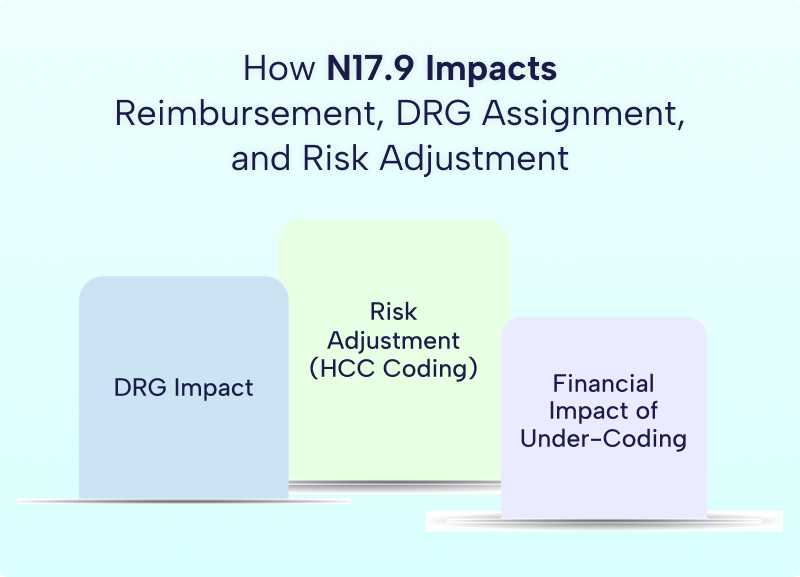
Acute kidney injury is not just a clinical condition—it is a high-impact reimbursement driver.
DRG Impact
In inpatient billing, AKI (N17.9) is typically classified as a Major Complication or Comorbidity (MCC) under the Medicare MS-DRG system.
The presence of an MCC can:
- Shift cases into higher-weight DRGs
- Increase reimbursement significantly
- Reflect higher clinical complexity
Risk Adjustment (HCC Coding)
N17.9 also plays a role in CMS-HCC risk adjustment models, particularly in Medicare Advantage plans.
Accurate AKI documentation contributes to:
- Higher Risk Adjustment Factor (RAF) scores
- More accurate patient risk profiling
- Improved reimbursement alignment with patient complexity
Financial Impact of Under-Coding
Failure to code AKI when clinically present can result in:
- Lost MCC opportunities
- Lower DRG reimbursement
- Reduced risk scores
- Inaccurate representation of patient severity
Accurate AKI coding ensures both compliance and appropriate financial outcomes.
Documentation Requirements That Every Provider Needs to Know
The AKI code is only as good as the documentation behind it. Payers reviewing N17.9 claims in 2026 are looking for specific clinical elements in the medical record.
- Physician documentation of acute kidney injury or acute kidney failure, not just laboratory values. Elevated creatinine alone does not get coded as AKI. A physician must link the lab findings to a clinical diagnosis.
- Baseline creatinine documented or referenced so the degree of change can be assessed. A creatinine of 2.1 means something different if baseline is 0.8 versus if baseline is 1.9.
- The clinical cause of the AKI identified in the physician’s note: dehydration, nephrotoxic agents, post-procedure, sepsis, obstruction, or other. The cause may generate additional codes.
- Nephrology consultation note when a consult was obtained, with the consultant’s characterization of the injury type and severity.
- Documentation of treatment instituted: IV fluids, nephrotoxic drug discontinuation, dialysis, or supportive care.
- Outcome documentation: resolved, improving, persistent, or progressed to CKD. This matters for continuity of care and affects coding of any follow-up encounters.
Maximize Reimbursement for AKI Cases with Medhasty Experts
AKI coding errors don’t just affect compliance—they directly impact your revenue. Missed MCC capture, incorrect sequencing, or weak documentation can cost thousands per admission.
Medhasty Medical Billing Services helps healthcare providers across the USA:
- Capture full DRG value
- Reduce denial rates
- Improve documentation quality
- Strengthen risk adjustment accuracy
👉 Get Your Free Revenue Cycle Audit Today
👉 Talk to a Medical Billing Specialist
Conclusion
N17.9 may appear to be a simple ICD-10 code, but its impact on reimbursement, risk adjustment, and compliance is significant. From DRG assignment to MCC capture and audit scrutiny, accurate AKI coding depends on strong documentation, correct sequencing, and coding precision.
Healthcare providers and billing teams that prioritize accurate AKI documentation and coding not only protect themselves from audits but also ensure they are fully reimbursed for the complexity of care delivered.
If your organization is facing challenges with AKI coding accuracy, denials, or missed revenue opportunities, partnering with an experienced medical billing company can make a measurable difference.
FAQs – Acute Kidney Injury ICD-10 Coding
What is the ICD-10 code for acute kidney injury?
The ICD-10 code for acute kidney injury is N17.9, which represents acute kidney failure, unspecified.
Is N17.9 always considered an MCC?
In most MS-DRG systems, AKI (N17.9) is classified as a Major Complication or Comorbidity (MCC), but classification may vary depending on payer guidelines and documentation.
Can AKI be coded as a principal diagnosis?
Yes, AKI can be the principal diagnosis if it is the primary reason for hospital admission.
What is the difference between AKI and acute tubular necrosis?
AKI is a general clinical diagnosis, while acute tubular necrosis (ATN) is a specific pathological cause of AKI coded as N17.0.
Can AKI and CKD be coded together?
Yes, both acute kidney injury (N17.9) and chronic kidney disease (N18.x) should be coded together when documented.
Does elevated creatinine automatically mean AKI?
No. A physician must document AKI. Lab values alone are not sufficient for coding.