

Every fall, Medicare releases the new numbers. Premiums change. Deductibles move. Headlines pop up saying costs are rising. Most articles throw out a few figures and call it a day.
That doesn’t help you plan.
Let’s walk you through the exact 2026 Medicare Part A and Part B premiums and deductibles, explain what they mean in real life, and show you how they affect your monthly and annual budget. No jargon. No filler. Just what you need to know.
The official numbers come from the Centers for Medicare & Medicaid Services, the federal agency that runs Medicare.
These figures are based on official 2026 Medicare premium and deductible updates released by the Centers for Medicare & Medicaid Services (CMS).
What Are the 2026 Medicare Part A and Part B Premiums and Deductibles?
The 2026 Medicare Part B standard premium is $202.90 per month, and the annual deductible is $283. The 2026 Medicare Part A hospital deductible is $1,736 per benefit period. Most beneficiaries qualify for premium-free Part A, but those who must buy in pay between $311 and $565 per month.
What Does Medicare Part A Cover in 2026?
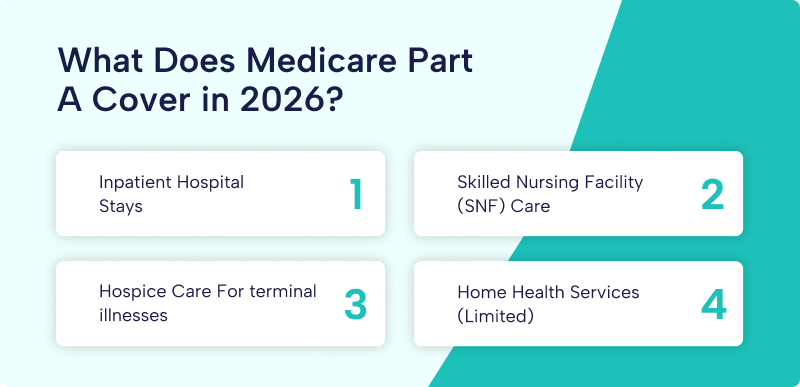
Part A is all about inpatient and facility-based care. It helps cover major health events that require a hospital or similar setting.
Covered Services are:
Inpatient Hospital Stays
• Semi-private room, meals, nursing, and hospital services
• Surgery and procedures performed in the hospital
• Medications administered during your stay
Skilled Nursing Facility (SNF) Care
• Only after a qualifying hospital stay of 3+ days
• Covers skilled nursing and rehab (like physical therapy)
• Note: Only the first 20 days are fully covered; days 21–100 involve coinsurance
Hospice Care
• For terminal illnesses
• Covers pain management, counseling, and support for family
• Patient must choose hospice instead of standard hospital care
Home Health Services (Limited)
• Short-term skilled nursing, physical therapy, or occupational therapy at home
• Patient must be homebound
What Medicare Part A Does Not Cover?
• Long-term custodial care (assistance with daily living, like bathing or dressing)
• Most outpatient care
• Routine dental, vision, or hearing
What Does Medicare Part B Cover in 2026?
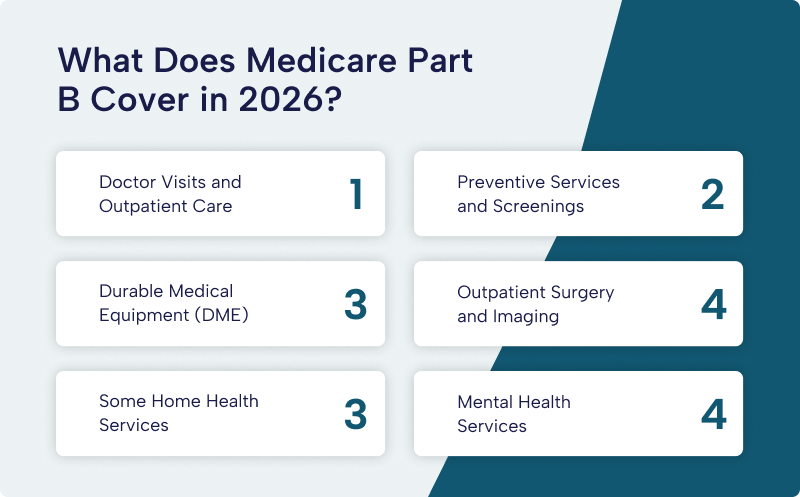
Part B picks up where Part A leaves off. It’s outpatient-focused and preventative, covering the services you see a doctor for or get outside of a hospital stay.
Covered Services:
Doctor Visits and Outpatient Care
• Primary care and specialists
• Office visits, consultations, minor procedures
Preventive Services and Screenings
• Annual wellness visit, vaccinations (flu, COVID, shingles)
• Screenings like mammograms, colonoscopies, and blood tests
Durable Medical Equipment (DME)
• Wheelchairs, walkers, oxygen equipment
• Prosthetics and some orthotics
Outpatient Surgery and Imaging
• Minor surgeries not requiring an overnight hospital stay
• Imaging (X-rays, MRIs, CT scans)
Some Home Health Services
• Only medically necessary skilled care
• Part B may pay if the patient doesn’t qualify under Part A
Mental Health Services
• Outpatient therapy and counseling
• Psychiatric consultations
What Medicare Part B Does Not Cover?
• Most dental, hearing aids, and vision exams
• Cosmetic procedures
• Long-term care.
Here’s a comparison table for Medicare Part A vs Part B coverage:
| Feature / Coverage | Part A (Hospital Insurance) | Part B (Medical Insurance) |
| Primary Focus | Inpatient & facility-based care | Outpatient & physician-based care |
| Monthly Premium | Usually $0 (based on work history); $311–$565 if buying in | $202.90 standard (2026) |
| Deductible (2026) | $1,736 per benefit period | $283 per year |
| Coinsurance | Days 61–90: $434/day; Lifetime reserve days: $868/day; SNF days 21–100: $217/day | Typically, 20% of approved services are after the deductible |
| Hospital Stays | Covered | Not covered |
| Skilled Nursing Facility (SNF) Care | Covered after a 3+ day hospital stay | Not covered |
| Home Health Services | Limited, post-hospital | Limited, medically necessary (if Part A not applicable) |
| Hospice Care | Covered | Not covered |
| Doctor Visits | Not covered | Covered |
| Outpatient Procedures | Not covered | Covered |
| Preventive Services (screenings, vaccines) | Not covered | Covered |
| Durable Medical Equipment (DME) | Not covered | Covered |
| Mental Health (outpatient) | Not covered | Covered |
| Long-Term Care | Not covered | Not covered |
| Dental, Vision, Hearing | Not covered | Not covered |
Patients can also review their benefits and coverage details directly through Medicare’s official portal.
2026 Medicare Part A Premium
Do You Pay a Monthly Premium for Part A?
Most people don’t.
If you or your spouse worked and paid Medicare taxes for at least 40 quarters (about 10 years), you get premium-free Part A.
If you didn’t work long enough, you can still buy into Part A. In 2026, here’s what that costs:
- If you worked 30 to 39 quarters: $311 per month
- If you worked fewer than 30 quarters: $565 per month
That’s a serious bill. At $565 per month, you’re paying $6,780 per year just for Part A.
Most retirees don’t face this, but if you do, you need to factor it into your retirement income plan immediately.
2026 Medicare Part A Hospital Deductible
In 2026, the Part A hospital deductible is $1,736 per benefit period.
A benefit period starts the day you’re admitted as an inpatient and ends after you’ve been out of the hospital or skilled nursing facility for 60 days in a row.
So yes, you could pay that deductible more than once in a year.
Let’s say you’re admitted in March for surgery. You pay the $1,736 deductible.
You recover and go home.
Then, in September, you’re admitted again for a different issue, and it’s been more than 60 days since your last hospital stay ended.
You pay another $1,736. That’s how benefit periods work.
What Is the Medicare Hospital Deductible in 2026?
The Medicare Part A hospital deductible in 2026 is $1,736 per benefit period. A benefit period begins the day you are admitted as an inpatient and ends after you have been out of the hospital or skilled nursing facility for 60 consecutive days.
2026 Medicare Part A Coinsurance and Lifetime Reserve Days
After you pay the deductible, here’s what happens:
Days 1 through 60 in the hospital. You pay $0 after the deductible.
Days 61 through 90
You pay $434 per day.
After day 90, you move into “lifetime reserve days.” You get 60 of these for your entire life.
You pay $868 per day during those days.
After you use up those 60 lifetime reserve days, you’re responsible for all costs.
That’s why long hospital stays can get expensive quickly without supplemental coverage.
2026 Skilled Nursing Facility (SNF) Costs
If you qualify for skilled nursing facility care after a hospital stay:
Days 1 through 20
$0 coinsurance.
Days 21 through 100
You pay $217 per day.
After day 100
Medicare stops paying.
A 30-day stay could cost roughly $2,170 out of pocket just for the coinsurance portion.
Accurate skilled nursing facility billing services are essential to properly manage Medicare benefit periods and coinsurance tracking.
2026 Medicare Part B Premium
Part B is the one most people notice because it comes out of their Social Security check every month.
2026 Standard Part B Premium
In 2026, the standard monthly Part B premium is:
$202.90 per month
That’s what most beneficiaries will pay.
Over 12 months, that’s about $2,435 in premiums alone.
This amount usually gets deducted automatically from your Social Security benefits.
How Much Is Medicare Part B in 2026?
The standard Medicare Part B premium in 2026 is $202.90 per month. Higher-income beneficiaries pay more due to Income-Related Monthly Adjustment Amount (IRMAA) surcharges determined by the Social Security Administration based on Modified Adjusted Gross Income (MAGI).
2026 Medicare Part B Annual Deductible
The annual Part B deductible in 2026 is:
$283
You pay this first before Medicare starts paying its share for most covered services.
After you meet that deductible, Medicare typically pays 80 percent of approved charges. You pay 20 percent.
That 20 percent sounds small. Sometimes it is. Sometimes it isn’t.
Here’s a simple example.
If you have an outpatient procedure that Medicare approves at $5,000:
You pay 20 percent.
That’s $1,000.
There is no out-of-pocket maximum with Original Medicare.
If you have frequent doctor visits, imaging, or chemotherapy, that 20 percent adds up fast.Strong revenue cycle management services help practices reduce patient balance write-offs and improve collections.
What Is IRMAA in 2026?
Now let’s talk about something many people don’t expect.
If your income is higher, you’ll pay more than $202.90 for Part B.
This extra charge is called IRMAA.
The Social Security Administration (SSA) determines IRMAA using your federal income tax return from two years prior.
For 2026 premiums, they generally look at your 2024 income.
If your Modified Adjusted Gross Income (MAGI) exceeds certain thresholds, you’ll pay a higher Part B premium. The higher your income, the higher the surcharge.
At the top end, high earners can pay well over $600 per month for Part B.
That’s a huge difference from the standard premium. Understanding how these adjustments affect billing and patient balances is a key part of accurate Medicare billing services, especially for practices managing high-income patient populations.
Why Many People Add Supplemental Coverage in 2026?
Original Medicare does not cap your annual out-of-pocket costs.
That’s why many people:
Buy a Medigap policy. Or enroll in a Medicare Advantage plan.
Medigap policies can cover deductibles and coinsurance. Medicare Advantage plans often include an annual out-of-pocket maximum.
But those plans come with their own rules, networks, and costs. You need to compare carefully.
2026 Medicare Cost Summary
Here’s the clean summary for 2026:
- Part A hospital deductible: $1,736 per benefit period
- Part A coinsurance days 61-90: $434 per day.
- Part A lifetime reserve days: $868 per day
- Skilled nursing coinsurance days 21 to 100: $217 per day
- Part B standard premium: $202.90 per month
- Part B annual deductible: $283
- Part B coinsurance: typically 20 percent
All figures released by the Centers for Medicare and Medicaid Services for 2026. These annual updates are formally published in the Federal Register following CMS announcements.
What These Medicare Costs Mean for Your Annual Healthcare Budget
Understanding Medicare premiums and deductibles is only the first step. The real question is how these costs translate into your yearly healthcare spending.
For most beneficiaries, the $202.90 monthly Part B premium totals over $2,400 annually. But that’s just the baseline. Once deductibles and coinsurance are added, total out-of-pocket costs can increase significantly depending on healthcare usage.
For example:
- A single hospitalization can trigger a $1,736 deductible
- Ongoing outpatient treatments can lead to repeated 20% coinsurance
- Multiple benefit periods can result in paying the Part A deductible more than once per year
Because Original Medicare does not include an out-of-pocket maximum, costs can continue to grow with increased care.
This is why many beneficiaries explore supplemental options like Medigap or Medicare Advantage plans to stabilize their healthcare expenses.
Common Medicare Cost Mistakes to Avoid in 2026
Many beneficiaries misunderstand how Medicare costs work, which can lead to unexpected financial stress.
Here are the most common mistakes:
Assuming Medicare Covers Everything
Medicare does not cover long-term care, dental, vision, or hearing services. Many essential services require additional coverage.
Ignoring Coinsurance Costs
After meeting the Part B deductible, patients still pay 20% of approved services. This can add up quickly for imaging, procedures, or chronic care.
Not Understanding Benefit Periods
The Part A deductible applies per benefit period, not per year. Multiple hospital stays can result in multiple deductibles.
Skipping Supplemental Coverage
Without Medigap or Medicare Advantage, there is no cap on out-of-pocket spending.
Underestimating IRMAA
Higher-income individuals may face significantly higher premiums due to IRMAA adjustments.
Healthcare Providers: Are Medicare Billing Errors Costing You Revenue?
Medicare billing requires precise understanding of benefit periods, deductibles, coinsurance structures, and payer-specific rules. Even small errors can lead to denied claims, delayed payments, and lost revenue.
At Medhasty Medical Billing Services, we help healthcare providers:
- Accurately bill Medicare Part A and Part B services
- Track benefit periods and patient responsibility correctly
- Reduce denials related to eligibility and documentation errors
- Improve collections and revenue cycle performance
👉 Explore our medical billing services
👉 Strengthen collections with revenue cycle management solutions
👉 Reduce claim rejections with denial management services
Get a Free Billing Assessment Today
Frequently Asked Questions
What is the Medicare Part B premium in 2026?
The standard Medicare Part B premium in 2026 is $202.90 per month. This amount applies to most beneficiaries. However, higher-income individuals may pay more due to the Income-Related Monthly Adjustment Amount (IRMAA), which is calculated by the Social Security Administration using Modified Adjusted Gross Income (MAGI) from tax returns filed two years prior.
What is the Medicare Part A deductible in 2026?
The Medicare Part A hospital deductible in 2026 is $1,736 per benefit period. A benefit period begins the day you are admitted as an inpatient in a hospital and ends after you have been out of the hospital or a skilled nursing facility for 60 consecutive days. Because deductibles apply per benefit period, it is possible to pay this amount more than once in a single calendar year.
Is Medicare Part A free in 2026?
Most beneficiaries qualify for premium-free Medicare Part A if they or their spouse worked and paid Medicare payroll taxes for at least 40 quarters (approximately 10 years). Individuals who do not meet this requirement may purchase Part A coverage. In 2026, buy-in premiums range from $311 to $565 per month, depending on work history.
Does Medicare have an out-of-pocket maximum?
Original Medicare (Part A and Part B) does not include an annual out-of-pocket maximum. Beneficiaries are responsible for deductibles and coinsurance without a spending cap. To limit financial exposure, many individuals enroll in a Medigap (Medicare Supplement Insurance) policy or a Medicare Advantage (Part C) plan, which typically includes an annual out-of-pocket maximum.
What is IRMAA and how does it affect Medicare premiums in 2026?
IRMAA stands for Income-Related Monthly Adjustment Amount. It is an additional surcharge added to Medicare Part B (and Part D) premiums for higher-income beneficiaries. The Social Security Administration determines IRMAA using Modified Adjusted Gross Income (MAGI) reported on federal tax returns from two years earlier. As income increases, the Part B premium increases in tiered brackets.
How often do Medicare premiums and deductibles change?
Medicare premiums and deductibles are typically updated once per year, with new figures announced in the fall by the Centers for Medicare & Medicaid Services (CMS). Changes reflect projected healthcare spending, inflation, and Medicare program funding needs. Updated rates usually take effect on January 1 of the following year.
What is the Medicare Part B deductible in 2026?
The Medicare Part B annual deductible in 2026 is $283. After this deductible is met, Medicare generally pays 80 percent of approved outpatient services, and the beneficiary pays the remaining 20 percent coinsurance. There is no cap on annual coinsurance under Original Medicare.
How much could Medicare cost per year in 2026?
For a beneficiary paying the standard Part B premium, annual premiums total approximately $2,435 ($202.90 × 12 months), not including deductibles or coinsurance. Depending on healthcare usage, total out-of-pocket costs can be significantly higher, especially since Original Medicare does not include an annual spending limit.
Final Thoughts
Healthcare in retirement isn’t cheap. Medicare helps a lot, but it doesn’t cover everything.
The biggest mistake I see people make is assuming Medicare equals free healthcare. It doesn’t.
Between premiums, deductibles, and 20 percent coinsurance, you need a realistic annual healthcare budget. For many retirees, that means setting aside several thousand dollars per year, even in relatively healthy years.
If you’re turning 65 in 2026 or helping a parent who is, now is the time to run the numbers. Look at your income. Estimate your likely usage. Decide whether you need supplemental coverage.
Medicare works well. But only if you understand what you’re signing up for.