
A patient checks in at a medical office. The receptionist asks for the insurance card. The patient hands it over. The receptionist photocopies both sides and hands it back. Somewhere in that process, three or four different numbers get captured and entered into the practice management system. Member ID. Group number. Policy number. Possibly a plan number. And in many practices, at least one of those numbers ends up in the wrong field.
The confusion is understandable. Insurance cards are not standardized across payers. Different insurance companies label the same information differently. What one insurer calls a Member ID, another calls a Policy Number. What one card puts at the top, another buries on the back. Front desk staff who verify insurance from dozens of carriers every week work with cards that each have their own layout and terminology.
This guide explains what the policy number is, how it differs from a member ID and a group number, where to find it on different types of insurance cards, and why getting it right matters for claims processing and eligibility verification.
What Is a Policy Number?
A policy number on an insurance card (often called a member ID or subscriber ID) is a unique identifier assigned by an insurance company to identify a patient’s coverage and process medical claims. This number is used by healthcare providers, billing teams, and insurance systems to verify eligibility and route claims correctly.
Policy Number vs Member ID vs Group Number
Understanding the difference between a policy number, member ID, and group number is essential for accurate insurance verification and medical billing. These terms are often used interchangeably by patients, but they serve different purposes in the insurance system.
Policy Number vs Member ID
In most cases, the policy number and member ID refer to the same identifier. This is the unique number assigned by the insurance company to identify the patient within their system.
Depending on the payer, this number may be labeled as:
- Member ID
- Policy Number
- Subscriber ID
Regardless of the label, this identifier is used to:
- Verify patient eligibility
- Locate coverage details
- Process and adjudicate medical claims
If this number is entered incorrectly, the insurance system will not recognize the patient, leading to claim rejections and eligibility verification failures.
What Is a Group Number?
The group number is different from the policy number. It identifies the employer or organization that provides the insurance plan.
For example:
- Two patients may both have the same insurance carrier (such as Aetna or Blue Cross Blue Shield)
- Each patient may have a different group number depending on their employer
The group number determines:
- Benefit structure
- Deductibles and copays
- Covered services
Claims submitted without the correct group number (when required) may be rejected or processed incorrectly.
Why This Distinction Matters in Medical Billing
Confusing the policy number with the group number is one of the most common data entry errors in medical billing.
When the wrong number is entered:
- Eligibility checks may fail
- Claims may be rejected or delayed
- Billing staff must rework and resubmit claims
Accurately identifying and entering both the member ID (policy number) and group number ensures smoother claim processing and reduces administrative delays.
Where to Find the Policy Number on an Insurance Card
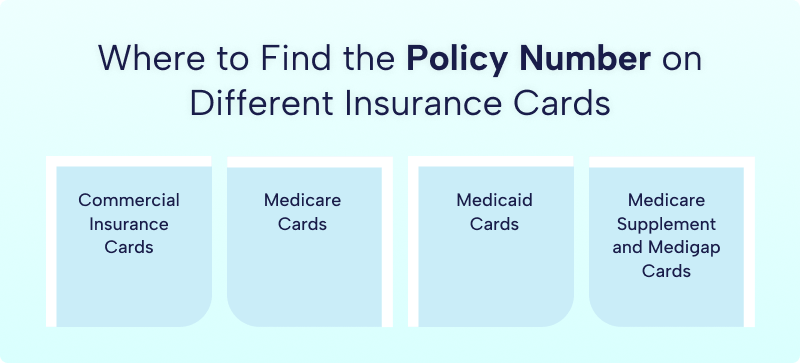
The location of the policy number on an insurance card depends on the type of insurance and the payer. While most insurance cards display this information clearly, the label and placement may vary between carriers.
Understanding where to find the correct identifier helps prevent eligibility errors and claim rejections during medical billing.
Commercial Insurance Cards
Most commercial insurance cards display the policy number (member ID) prominently on the front of the card.
It may be labeled as:
- Member ID
- Policy Number
- Subscriber ID
- ID Number
This number is typically an alphanumeric code and is often located near the top or center of the card.
In many cases, the group number appears close to the member ID and is labeled separately as “Group Number” or “Group ID.”
Some carriers, such as Blue Cross Blue Shield, include a prefix at the beginning of the member ID. This prefix is important for claims routing and should always be entered exactly as shown.
Medicare Cards
Medicare uses a unique identifier called the Medicare Beneficiary Identifier (MBI), which functions as the policy number for billing and eligibility purposes.
The MBI:
- Is an 11-character alphanumeric code
- Appears on the front of the Medicare card
- Replaced the older Health Insurance Claim Number (HICN)
Traditional Medicare cards do not include a group number, since coverage is not tied to an employer plan.
Medicaid Cards
Medicaid cards vary by state, and the policy number is typically referred to as the Member ID or Recipient ID.
Depending on the state:
- Some patients receive physical Medicaid cards
- Others are verified through electronic eligibility systems
In many cases, Medicaid managed care plans issue separate cards with their own member ID, which must be used for billing instead of the state-issued identifier.
Medigap and Secondary Insurance Cards
Patients with Medicare supplement (Medigap) plans receive a separate insurance card issued by a private insurer.
These cards include:
- A unique member ID (policy number)
- Sometimes a group number
When billing secondary insurance, the policy number on the Medigap card must be used instead of the Medicare identifier.
Why Accurate Identification Matters
Insurance cards are not standardized, and each payer uses different formats and terminology. Misidentifying the policy number or entering the wrong field into a billing system can lead to:
- Failed eligibility verification
- Claim rejections
- Delayed reimbursements
Careful review of the insurance card ensures that the correct identifier is captured and used throughout the billing process.
The Subscriber vs. the Dependent
The policy number or member ID on an insurance card may belong to the subscriber, the primary insured person, rather than the dependent receiving care. When a child is brought in for an appointment and the insurance is through a parent’s employer plan, the card may show the parent’s name as the subscriber. The child is a dependent on the policy.
How this affects billing depends on the payer. Some payers assign a unique member ID to each covered family member. The parent has one ID, each child has a different ID. Other payers use the subscriber’s ID for all dependents and distinguish between them by date of birth or relationship code on the claim.
When a dependent is being treated, the correct information to capture is the subscriber’s member ID and group number from the card, the subscriber’s date of birth and name, and the patient’s relationship to the subscriber. Entering the child’s date of birth as the subscriber’s date of birth, or using the child’s name as the subscriber name, are common data entry errors that cause eligibility verification mismatches and claim rejections.
Why Accurate Policy Number Entry Matters for Claims
Every claim submitted to an insurance company includes the member ID as a required field on the CMS-1500 claim form, specifically in Box 1a for the insured’s ID number.
If that number is wrong, mistyped, or pulled from the wrong field on the card, the payer’s adjudication system cannot locate the patient’s coverage record, and the claim is rejected.
Unlike many claim errors that can be corrected and resubmitted, an invalid member ID error requires going back to the source, checking the physical card or calling the payer’s eligibility line, confirming the correct number, correcting it in the system, and resubmitting.
Each step takes time, and when this happens across multiple patients because the front desk staff is misreading a particular carrier’s card format, the administrative time adds up quickly.
Practices that see certain payers frequently should invest a few minutes in training staff on how each carrier’s card is laid out. Where the member ID is, what it looks like, whether the group number is on the front or back, and what the card calls each field.
That familiarity prevents the repetitive errors that come from staff guessing which number is which on an unfamiliar card format.
How to Use Policy Numbers in Eligibility Verification
Eligibility verification is one of the most critical steps in the medical billing process, and the policy number (member ID) plays a central role in retrieving accurate patient coverage information.
When entered correctly, it allows billing systems and clearinghouses to instantly confirm insurance status, benefits, and financial responsibility. When entered incorrectly, it leads to failed verification, claim delays, and denied reimbursements.
Step 1: Enter Accurate Patient and Policy Information
Begin by entering the exact details from the insurance card into your system, including:
- Policy number (member ID)
- Group number (if applicable)
- Patient date of birth
- Subscriber name (if different from the patient)
Even a small error, such as a missing character, incorrect prefix, or confusion between letters and numbers (O vs 0), can prevent the system from locating the patient’s coverage.
Step 2: Verify Coverage and Eligibility Status
Once the correct information is entered, the eligibility system or clearinghouse will return real-time results.
A complete eligibility check should confirm:
- Active or inactive coverage
- Plan type and benefits
- Deductible status
- Copay or coinsurance amounts
- Service-specific limitations
This information ensures that the provider understands what services are covered before the visit.
Step 3: Confirm Financial Responsibility
Eligibility verification is not just about confirming coverage. It also determines what the patient owes.
This includes:
- Remaining deductible
- Copayment requirements
- Coinsurance percentages
Capturing this information helps front desk teams collect accurate payments and reduces billing disputes after the visit.
Step 4: Handle Primary and Secondary Insurance
Many patients have more than one insurance plan. In these cases:
- The primary insurance is billed first
- The secondary insurance covers remaining balances
Both policies must be entered accurately using the correct policy numbers and group numbers.
Missing or incorrect policy details can disrupt the claim flow and delay payments.
Step 5: Validate Coordination of Benefits (COB)
Coordination of benefits determines which insurance plan pays first.
For example:
- A patient’s employer plan is typically primary over a spouse’s plan
- For children covered under both parents, the birthday rule applies
Incorrect coordination can result in claims being sent to the wrong payer, leading to denials and resubmissions.
Step 6: Resolve “No Coverage Found” Errors
If the system returns an error such as “invalid member ID” or “no coverage found,” the issue is often due to data entry errors.
To resolve this:
- Recheck the policy number character by character
- Confirm prefixes and formatting
- Verify the group number
- Compare all details directly with the insurance card
Do not assume the insurance is inactive until all fields are verified accurately.
Why This Process Matters
Accurate eligibility verification using the correct policy number prevents:
- Claim rejections due to invalid member ID
- Delays in reimbursement
- Administrative rework and resubmissions
Practices that follow structured verification workflows consistently achieve higher claim acceptance rates and smoother revenue cycle performance.
Common Mistakes When Entering Policy Numbers
Errors in entering policy numbers are one of the most common causes of eligibility failures and claim rejections in medical billing. Even small inaccuracies can prevent the payer from identifying the patient’s coverage, leading to delays and additional administrative work.
Understanding these common mistakes helps reduce billing errors and improve claim acceptance rates.
Confusing Policy Number with Group Number
One of the most frequent mistakes is entering the group number in place of the policy number (member ID).
The policy number identifies the patient, while the group number identifies the employer’s plan. Mixing these fields results in failed eligibility verification and rejected claims.
Entering Incorrect Characters
Policy numbers often contain a mix of letters and numbers. Small errors such as:
- Entering “O” instead of “0”
- Missing a letter prefix
- Adding extra spaces or characters
can cause the system to reject the entry. Insurance systems require exact matches, so even minor discrepancies can break the verification process.
Missing Prefixes or Plan Identifiers
Some insurance carriers include prefixes at the beginning of the policy number, especially for plans like Blue Cross Blue Shield.
These prefixes are not optional. They are used for:
- Claims routing
- Identifying the correct payer network
Leaving out a prefix can result in misrouted or rejected claims.
Using Dependent Information Instead of Subscriber Details
When a patient is covered under a family plan, the insurance card may list the subscriber (policy holder) instead of the dependent receiving care.
Common errors include:
- Entering the patient’s name instead of the subscriber’s name
- Using the wrong date of birth
- Misidentifying the relationship to the subscriber
These mistakes lead to eligibility mismatches and claim processing issues.
Skipping Verification After an Error
When eligibility checks fail, some staff assume the insurance is inactive without verifying the entered data.
In many cases, the issue is not the insurance but incorrect data entry. Skipping re-verification leads to unnecessary delays, rescheduling, or claim denials.
Why Avoiding These Mistakes Matters
Incorrect policy number entry directly impacts:
- Claim acceptance rates
- Reimbursement timelines
- Administrative workload
Practices that train staff to correctly identify and enter policy numbers reduce denials, improve billing efficiency, and maintain consistent revenue flow.
Final Thoughts
The policy number on an insurance card is not a formality. It is the key that unlocks the patient’s coverage record in the payer’s system and routes every claim correctly. Practices that capture it accurately, understand the difference between the member ID and the group number, know how to handle subscriber versus dependent situations, and train front desk staff on the card layouts of their most common payers will see fewer eligibility rejections and faster claims processing than those treating insurance card entry as a routine check-in task. The information is small. The downstream impact is not.
Why Accurate Insurance Data Entry Requires a Structured Billing Process
Accurate insurance verification is not just a front desk task. It directly impacts claim approval, reimbursement timelines, and overall revenue performance.
US-Based Medical billing companies like Medhasty help healthcare providers implement structured workflows for eligibility verification, coding validation, and claim submission. This reduces errors, improves claim acceptance rates, and ensures consistent revenue flow.
Frequently Asked Questions
Is a policy number the same as a member ID?
In most cases, yes. Many insurance companies use the terms “policy number,” “member ID,” and “subscriber ID” interchangeably. However, the label may vary depending on the payer, so it is important to verify the exact terminology on the insurance card.
Where can I find the policy number on an insurance card?
The policy number is usually displayed on the front of the insurance card and labeled as Member ID, Policy Number, or Subscriber ID. Some insurers may place it on the back or include prefixes that must be entered exactly for claims processing.
Does Medicare have a policy number?
Medicare uses the Medicare Beneficiary Identifier (MBI) as the primary identifier instead of a traditional policy number. This alphanumeric code is required for eligibility verification and claim submission.
What happens if the policy number is entered incorrectly?
If the policy number is incorrect, the insurance system cannot identify the patient’s coverage. This leads to failed eligibility checks, claim rejections, and delayed reimbursements. The claim must be corrected and resubmitted.
Why is the group number different from the policy number?
The policy number identifies the individual patient, while the group number identifies the employer or organization providing the insurance plan. Both are required for accurate billing, but they serve different purposes.
How does an incorrect policy number affect medical billing?
Incorrect policy numbers can cause claims to fail during initial processing, leading to denials, delays, and additional administrative work. Accurate data entry is essential for maintaining efficient revenue cycle performance.
How can healthcare providers reduce policy number errors?
Providers can reduce errors by training front desk staff, verifying insurance information before each visit, and using structured eligibility verification systems to confirm patient coverage.