

Denial codes are one of those things in medical billing that most people learn on the job, piece by piece, over years of working through rejected and denied claims. Nobody sits you down on day one and walks you through the entire system. You just start seeing codes on remittances and slowly figure out what they mean and what to do about each one.
But that trial-and-error approach costs practices money. Every day a denied claim sits unworked is a day that payment is not coming in. And if your team does not understand why claims are denying, they cannot fix the root cause.
This guide lays out how the denial code system works, what the most common codes mean in practice, how to respond to them, and how to build a denial management process that actually reduces your denial rate over time.
What Are Denial Codes in Medical Billing?
Denial codes are standardized codes used by insurance payers to explain why a medical claim was not paid as billed. These codes appear on the Electronic Remittance Advice (ERA) or Explanation of Benefits (EOB) and provide specific reasons for claim adjustments, partial payments, or full denials.
Each denial code corresponds to a particular issue in the claim, such as missing information, incorrect coding, lack of medical necessity, or coverage limitations. Understanding these codes allows billing teams to identify the root cause of denials and take the correct action, whether that involves correcting the claim, resubmitting it, or filing an appeal.
Denial codes are not just error messages—they are structured feedback from payers that help improve billing accuracy and reduce future denials.
Denial Codes vs Claim Rejections in Medical Billing
In medical billing, claim denials and claim rejections are often confused, but they represent two different stages in the claim processing workflow.
A claim rejection occurs before a claim reaches the payer’s adjudication system. Rejections typically happen when the clearinghouse detects formatting issues, missing fields, or incorrect claim structure. Because rejected claims never enter the payer’s processing system, they can usually be corrected and resubmitted quickly.
A claim denial, however, occurs after the insurance payer receives and processes the claim. In this case, the payer reviews the submitted information and determines that the service cannot be paid as billed. Denials often require additional documentation, coding corrections, or formal appeals before payment can be obtained.
Understanding the difference is important for revenue cycle management. Rejections are usually simple data errors that can be corrected immediately, while denials require deeper investigation into coverage rules, medical necessity, or payer policy.
How the Denial Code System Works
When a payer denies or adjusts a claim, they communicate the reason through standardized codes on the Explanation of Benefits for patients or the Electronic Remittance Advice, which is the 835 transaction, for providers. These codes tell you why the claim was not paid as billed. There are two main code sets you will encounter, and it helps to understand the difference between them.
Common Denial Codes in Medical Billing (Quick Reference)
Healthcare providers encounter dozens of denial codes, but a small group of codes typically accounts for the majority of claim denials in most practices.
The table below summarizes several frequently encountered denial codes and the actions required to resolve them.
| Denial Code | Meaning | Typical Cause | Recommended Action |
| CO-4 | Modifier inconsistent with procedure | Incorrect or unnecessary modifier | Correct modifier and resubmit |
| CO-11 | Diagnosis inconsistent with procedure | Diagnosis does not support medical necessity | Review documentation and update diagnosis |
| CO-16 | Missing or incomplete information | Missing NPI, authorization, or demographic data | Review remark code and correct claim |
| CO-18 | Duplicate claim | Claim submitted more than once | Verify claim history before resubmitting |
| CO-22 | Coordination of benefits | Wrong payer billed as primary | Verify insurance order |
| CO-29 | Timely filing | Claim submitted after filing deadline | Appeal only if payer error |
| CO-50 | Non-covered service | Service excluded under patient plan | Bill patient if allowed |
| PR-1 | Deductible | Patient deductible not met | Bill patient |
| PR-2 | Coinsurance | Patient share of covered services | Bill patient |
This quick reference helps billing teams quickly identify denial causes and determine the appropriate corrective action.
CARC Codes: Claim Adjustment Reason Codes
Claim Adjustment Reason Codes, known as CARC codes, are the primary denial and adjustment codes used in the 835 remittance. These codes are maintained by the Washington Publishing Company and are standardized across all payers. When a payer adjusts or denies a line item on your claim, they assign at least one CARC code to explain the adjustment. There are over 200 active CARC codes in use today, and each one has a specific meaning.
Some CARC codes indicate a full denial, meaning the service was not covered at all. Others indicate a partial payment, where the payer paid less than billed and the CARC code tells you why. CARC codes can appear at the claim level or at the individual service line level, and a single claim can have multiple CARC codes applying to different lines.
RARC Codes: Remittance Advice Remark Codes
Remittance Advice Remark Codes, called RARC codes, provide additional explanation beyond what the CARC code alone conveys. While CARC codes are required on every adjustment, RARC codes are supplemental. They give more context. For example, a CARC code might tell you the claim was denied for lack of prior authorization, and the accompanying RARC code might specify that the authorization number is missing from the claim. That extra detail matters because it tells you exactly what to fix.
RARC codes that start with the letter M are called Medicare Remittance Advice Remark Codes and are specific to Medicare processing. RARC codes starting with N are standard codes used across payers.
Group Codes
Group Codes
Group codes are a third component of the remittance adjustment. They tell you who is financially responsible for the adjusted amount. The most common group codes you will see are CO, which stands for Contractual Obligation and means the adjustment is between the provider and the payer per the contracted rate. PR stands for Patient Responsibility and means the patient owes the adjusted amount. OA means Other Adjustment and covers miscellaneous situations. PI means Payer Initiated Reduction and indicates the payer reduced the amount without a specific contractual basis. Group codes matter because they determine whether you can bill the patient for the difference.
Key Attributes of Denial Codes in Medical Billing
To manage denials effectively, it is important to understand the key attributes that define how denial codes function within the revenue cycle.
1. Cause of Denial
Denial codes indicate the underlying issue, such as missing data, incorrect coding, eligibility problems, or lack of authorization.
2. Financial Impact
Each denial affects revenue differently. Some denials result in full non-payment, while others lead to partial adjustments or patient responsibility.
3. Resolution Path
Some denials can be corrected and resubmitted quickly, while others require appeals, additional documentation, or payer follow-up.
4. Preventability
High-volume denial codes are often preventable. Identifying patterns helps reduce future denials through process improvements.
Understanding these attributes helps practices move from reactive claim fixing to proactive denial prevention.
The Most Common Denial Codes and What They Mean?
Knowing the denial code categories that show up most frequently helps your billing team respond faster and more accurately. Here are the ones that account for the majority of denials in most practice settings.
CO-4: Inconsistent Modifier
This denial means the modifier billed on the claim is not consistent with the procedure code. A common example is billing a bilateral surgery modifier on a procedure that is inherently bilateral, or using an assistant surgeon modifier on a procedure that does not allow assistant surgeon billing under the payer’s policy. To fix a CO-4 denial, review the modifier you billed, check whether it is appropriate for that specific CPT code under that payer’s policies, and
resubmit with the corrected modifier or without the modifier if it does not apply.
CO-11: Diagnosis Code Inconsistent With Procedure
This code means the diagnosis code on the claim does not support the procedure billed. The payer’s coverage policy for that procedure requires a specific diagnosis or range of diagnoses, and the code you submitted does not match.
This is a very common denial in specialties where medical necessity is diagnosis-driven, such as radiology, laboratory, and physical therapy. The fix is to review the medical record, confirm the correct diagnosis, update coding if the documentation supports a different code, and resubmit. If the diagnosis is correct and you believe the procedure is medically necessary, you may need to add additional diagnosis codes or write a medical necessity
appeal letter.
CO-16: Claim Lacks Information Needed for Adjudication
This is a generic denial that tells you the claim is missing required information. On its own, CO-16 does not tell you what is missing. That is where the accompanying RARC code becomes important. The RARC code attached to a
CO-16 will specify what the payer needs. It might be a missing National Provider Identifier, a missing authorization number, an incomplete patient address, or any number of other required data elements. Always read the RARC code alongside CO-16 before deciding how to respond.
CO-18: Duplicate Claim
This means the payer believes you already submitted this claim and it was processed. Duplicate denials happen for a few different reasons. Sometimes a claim was actually submitted twice in error. Sometimes the payer incorrectly flags a legitimate resubmission as a duplicate. And sometimes a claim was submitted correctly the first time but payment was never received, so the billing team resubmits and the payer treats it as a duplicate of the original. To resolve a CO-18, pull the remittance history for the original claim date. If the original was paid, you are done. If it was denied or there is no record of payment, submit the claim again with the appropriate resubmission code in box 22 of the CMS-1500, or in the 837 claim loop, to signal that this is a corrected or resubmission rather than a duplicate.
CO-22: Coordination of Benefits
This denial means the payer believes another insurance plan is primary and should process the claim first. COB denials show up when a patient has multiple insurance plans and the claim was sent to the wrong primary payer, or when the payer does not have current COB information on file for the patient. To resolve this, verify the correct order of benefits for the patient, bill the correct primary payer first, and then submit a secondary claim with the primary EOB attached.
CO-29: Timely Filing
Timely filing denials mean the claim was submitted after the payer’s filing deadline for that date of service. Every payer sets its own timely filing limit, and those limits vary considerably. Medicare allows 12 months from the date of service. Many commercial payers allow 90 to 180 days. Some managed care plans allow as little as 60 days. Timely filing denials are among the hardest to overturn because the appeals process is limited. Most payers will only reverse a timely filing denial if you can demonstrate that the late filing was due to a payer error or a retroactive eligibility change. The best way to handle CO-29 is to prevent it entirely by tracking filing deadlines by payer and monitoring your claims pipeline for anything approaching those limits.
CO-50: Non-Covered Service
This denial means the service is simply not covered under the patient’s plan. This could mean the service is excluded from the patient’s specific benefit plan, the patient’s plan does not include coverage for that category of service, or the service is a statutory exclusion that Medicare never covers. CO-50 denials with a group code of PR mean the patient is financially responsible, and you can bill the patient directly. CO-50 denials with a group code of CO mean the contracted adjustment is the provider’s responsibility and you generally cannot bill the patient. Read the group code carefully before billing a patient for a CO-50 adjusted amount.
PR-1, PR-2, PR-3: Patient Responsibility Codes
These codes indicate the adjusted amount is the patient’s financial responsibility. PR-1 means the patient has not met their deductible. PR-2 means the adjusted amount is the patient’s coinsurance. PR-3 means the adjusted amount is the patient’s copay. These are not denials in the true sense. The claim was processed correctly. The payer paid their portion and the balance belongs to the patient. You can and should collect these from the patient.
How to Fix Denial Codes in Medical Billing
Resolving denial codes requires a structured approach that goes beyond simply resubmitting claims.
Step 1: Identify the Denial Code
Review the CARC and RARC codes together to understand the exact issue.
Step 2: Analyze the Root Cause
Determine whether the issue is related to coding, documentation, eligibility, or payer rules.
Step 3: Correct the Claim
Update missing or incorrect information such as modifiers, diagnosis codes, or patient data.
Step 4: Resubmit or Appeal
- Resubmit corrected claims for simple errors
- File appeals for medical necessity or coverage disputes
Step 5: Track and Prevent
Monitor recurring denial codes and fix upstream issues to prevent repeat denials.
Effective denial resolution is not just about fixing claims—it is about eliminating recurring errors.
How to Build a Denial Management Process That Works
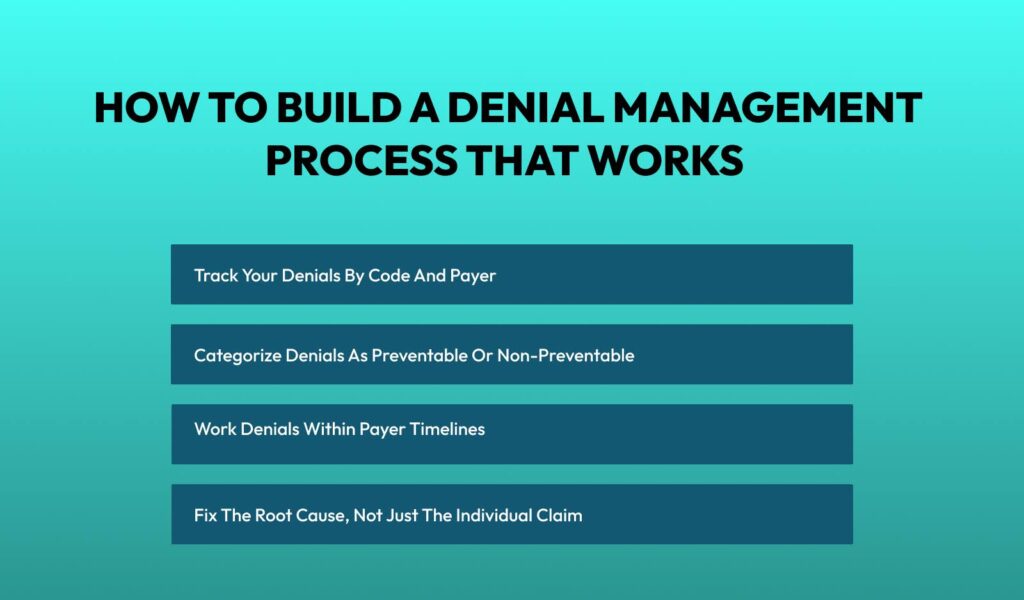
Knowing what denial codes mean is just the starting point. What separates practices with low denial rates from those constantly fighting claims is having a denial management process that is consistent, tracked, and actually fixes the root causes.
Step One: Track Your Denials by Code and Payer
You cannot manage what you are not measuring. Start by pulling denial reports from your practice management system broken down by denial code and by payer. You want to see your top denial reasons and which payers are generating the most denials. This is where most practices are surprised to discover that two or three denial codes account for 60 to 70 percent of their total denials. Fixing those two or three root causes will move the needle faster than working individual claims one at a time.
Step Two: Categorize Denials as Preventable or Non-Preventable
Not every denial is a front-end failure. Some denials are clinical disputes about medical necessity that require appeal regardless of how well your billing was done. But the majority of high-volume denial codes are preventable. Timely filing denials, duplicate claim denials, missing modifier denials, and eligibility denials are almost always preventable with better front-end processes. Separating preventable from non-preventable denials helps you prioritize where to invest your process improvement time.
Step Three: Work Denials Within Payer Timelines
Every payer has an appeals filing deadline, and it is different from the timely filing deadline for original claims. Most Medicare redetermination requests must be filed within 120 days of the initial determination date. Commercial payer appeal deadlines vary, but many are 60 to 180 days from the denial date. If your billing team lets denials sit in a queue longer than those windows, you lose the right to appeal. Build a workflow that ensures every denial is reviewed, categorized, and either corrected or appealed before the deadline.
Step Four: Fix the Root Cause, Not Just the Individual Claim
This is the step most practices skip. Your biller works the denied claim, resubmits it, and moves on. But nobody asks why that same CO-11 denial has come in 47 times this month for the same procedure code with the same diagnosis. If you only work individual claims without tracing the pattern back to its root cause, you will keep getting the same denials month after month. When a denial pattern shows up, trace it back to where in the process it originates and fix that step. That is how denial rates actually go down over time.
Denial Codes Specific to Medicare
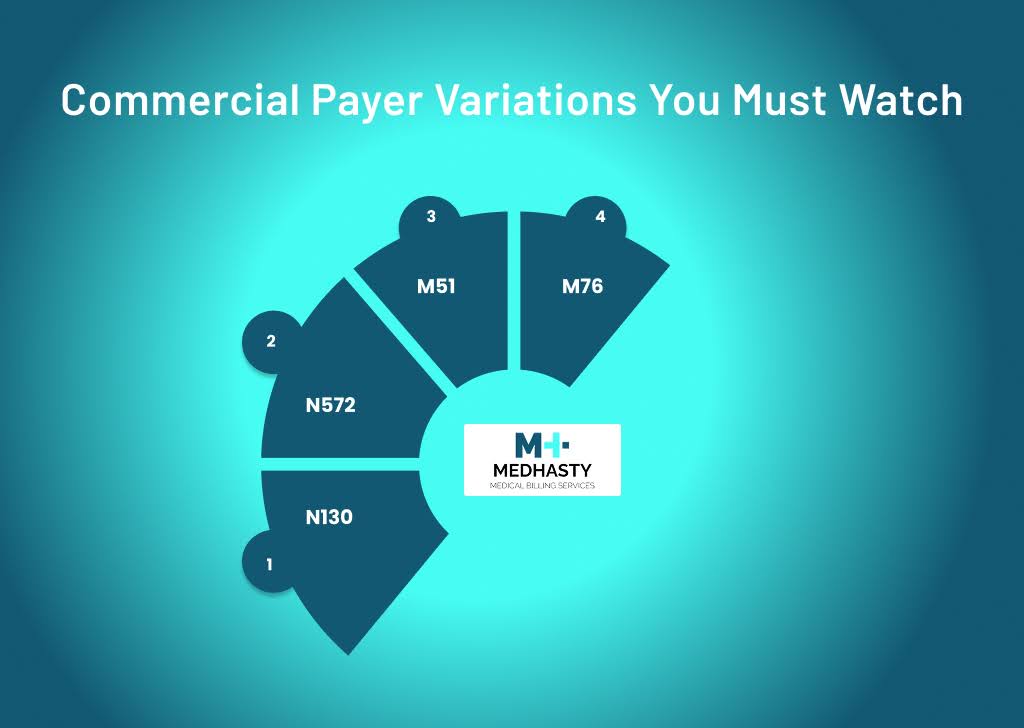
Medicare has its own layer of denial codes and remark codes that go beyond the standard CARC and RARC sets. Medicare Administrative Contractors, the regional contractors that process Medicare fee-for-service claims, use RARC codes beginning with M to provide Medicare-specific denial explanations.
Some of the most commonly seen Medicare-specific denial indicators include the following.
- N130: Consult your provider’s manual for additional information about this service. This is a general remark code that prompts you to look up the specific coverage article or local coverage determination that applies.
- N572: This service is not covered when performed by this type of provider. This shows up when a service is billed by a provider type that Medicare does not recognize as authorized to perform that service.
- M51: Missing or incomplete, invalid procedure code. This means the CPT or HCPCS code on the claim is either missing, invalid, or not recognized in the applicable code set for the service date.
- M76: Missing or incomplete, invalid diagnosis or condition. This accompanies medical necessity denials where the diagnosis code does not satisfy the coverage criteria for the billed procedure.
For Medicare denials, the most important resource is the Local Coverage Determination, or LCD, issued by your Medicare Administrative Contractor for the applicable procedure. LCDs specify exactly which diagnosis codes support medical necessity for covered procedures. Coding against the LCD before submitting the claim prevents the majority of Medicare medical necessity denials.
Key Entities in Denial Management
Denial management involves multiple systems, entities, and workflows within the healthcare billing ecosystem.
- Clearinghouses – Validate claims before submission and generate rejections
- EDI Transactions (837/835) – Standard formats for claims and remittance data
- CPT & ICD Codes – Determine procedure and diagnosis alignment
- Prior Authorization Systems – Required approvals before services
- Payer Policies & LCDs – Define coverage rules and medical necessity
Understanding these entities helps billing teams navigate denials more effectively and reduce errors at each stage of the claim lifecycle.
How Denial Codes Impact Medical Billing & Revenue Cycle
Denial codes are directly tied to the financial performance of a healthcare practice.
- High denial rates delay cash flow and increase accounts receivable days
- Reworking denied claims increases administrative costs
- Poor denial management leads to write-offs and lost revenue
- Efficient denial resolution improves reimbursement timelines
Denial management plays a critical role in optimizing overall medical billing services and improving reimbursement efficiency.
When to Consider Professional Denial Management Services
Managing denial codes internally can be resource-intensive and requires specialized expertise. Many practices choose to outsource denial management to improve efficiency and reduce revenue leakage.
Professional denial management services can:
- Analyze denial trends and identify root causes
- Handle claim corrections and appeals efficiently
- Improve first-pass claim acceptance rates
- Reduce administrative burden on in-house staff
For practices struggling with high denial rates, outsourcing can significantly improve revenue cycle performance.
Frequently Asked Questions About Denial Codes
What is a denial code in medical billing?
A denial code is a standardized code used by insurance payers to explain why a claim was not paid or adjusted.
What is the difference between CARC and RARC codes?
CARC codes explain the primary reason for denial, while RARC codes provide additional details.
How can denial rates be reduced?
Denial rates can be reduced by improving documentation, verifying eligibility, ensuring coding accuracy, and tracking denial patterns.
What is the most common denial code?
Codes like CO-16 (missing information) and CO-11 (diagnosis mismatch) are among the most common.
Can all denial codes be appealed?
No, some denials such as timely filing limits cannot be appealed unless there is a payer error.
Final Thoughts
Denial codes are not just a billing nuisance. They are a feedback system. Every denial code on a remittance is telling you something specific about what went wrong in your revenue cycle, whether it was a front-end eligibility issue, a coding error, a missing authorization, or a documentation gap. The practices that learn to read that feedback and act on it are the ones that get paid faster, write off less, and spend less time reworking claims.
Build the reporting to see your denial patterns. Train your billing team to understand what each denial code means and what action it requires. Fix root causes instead of just resubmitting individual claims. And make denial management a standing agenda item in your revenue cycle meetings, not something that only gets attention when things get bad. That consistency is what actually moves the numbers in the right direction over time.
Struggling with claim denials? Let Medhasty optimize your medical billing and reduce revenue loss with expert denial management solutions.
-> Get a Free Billing Audit Today