
If you have ever had a claim denied because of a simple data entry error pulled straight from an insurance card, you know exactly how frustrating that moment is. The patient handed over their card. Your staff copied the information. The claim went out. And then the denial came back because one number was transposed, or the wrong plan ID was used.
Reading a health insurance card sounds like the simplest task in your entire billing workflow. And in some ways it is. But in practice, insurance cards vary wildly from payer to payer. Some are packed with information. Others are minimalist and leave out details you desperately need. Some have changed their format so many times that even longtime staff members are not reading them correctly.
This guide walks through everything your front desk and billing team needs to know about reading, interpreting, and using health insurance card information accurately. Getting this right at the very first step of the revenue cycle prevents a chain reaction of errors downstream.
Why Reading Insurance Cards Correctly Is a Billing Priority
According to the Medical Group Management Association, front-end registration errors are responsible for more than 40 percent of all claim denials across physician practices in the United States. A significant chunk of those errors traces back to incorrectly captured insurance information, most of which comes directly off the insurance card.
The Advisory Board’s revenue cycle research consistently identifies patient access and registration as the highest-leverage area for denial prevention. When your team reads an insurance card incorrectly and enters bad data into your practice management system, that error travels through every subsequent step. It affects insurance eligibility verification. It affects claim submission. It affects remittance posting. One small mistake at the front desk creates a problem that can take three times as long to fix on the back end.
How Card Errors Affect the Patient Experience
Beyond the financial impact, there is also a patient experience component. When a patient receives a denial letter or an unexpected bill because their insurance information was entered incorrectly, they do not blame the front desk staff. They blame the practice. They call your office frustrated. They leave reviews. They lose confidence in your team. Getting the card right the first time is a patient satisfaction issue just as much as it is a billing issue.
The Standard Information Found on Most Insurance Cards
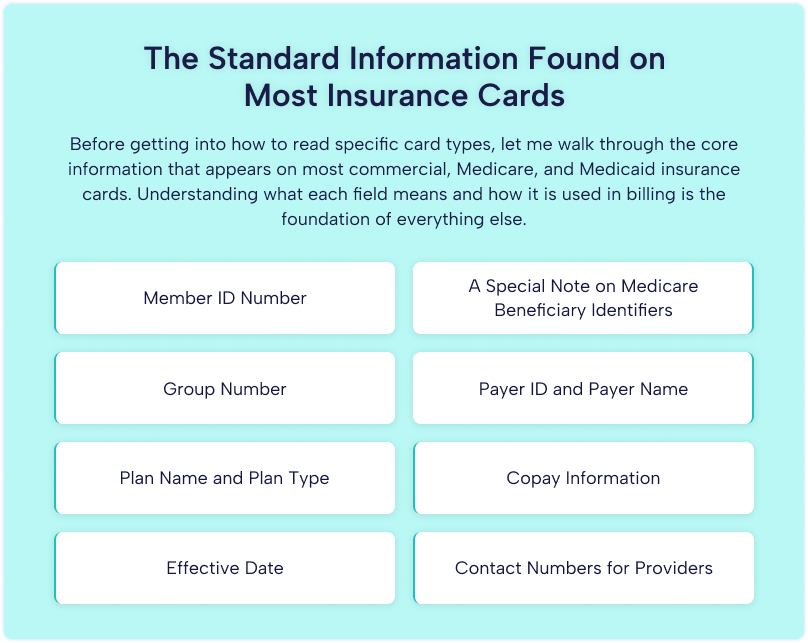
Before getting into how to read specific card types, let me walk through the core information that appears on most commercial, Medicare, and Medicaid insurance cards. Understanding what each field means and how it is used in medical billing is the foundation of everything else.
Member ID Number
The member ID is the single most important piece of information on any insurance card. This is the unique identifier that the payer uses to locate the patient’s record in their system. Every eligibility check, every prior authorization request, and every claim submission relies on this number.
Member IDs can be alphanumeric or purely numeric. They range from 8 to 15 or more characters, depending on the payer. Some payers prefix the member ID with letters that indicate the plan type or the employer group. Others use a purely random numeric string.
The most common error with member IDs is transposition. Staff members copy numbers quickly and swap digits without realizing it. A 1 and a 7 look similar in some fonts. An 8 and a 3 can be easy to confuse on a worn or laminated card. Train your staff to read the member ID out loud or enter it twice to catch these errors.
A Special Note on Medicare Beneficiary Identifiers
One important note on Social Security Numbers as member IDs. Medicare traditionally used the patient’s Social Security Number as their identifier. Centers for Medicare & Medicaid Services (CMS) transitioned Medicare beneficiaries to the Medicare Beneficiary Identifier format starting in 2018 and completed the transition by 2019. The MBI is an 11-character alphanumeric code. It does not contain any letters that look like numbers, specifically no S, L, O, I, B, or Z, to reduce transcription errors. If someone brings in an old Medicare card with a Social Security Number on it, that card is outdated and cannot be used for billing.
Group Number
The group number identifies the employer or group plan under which the member is covered. This is different from the member ID, which identifies the individual patient. The group number connects the patient’s coverage to a specific employer contract or benefits package with the insurer.
Group numbers are critically important for commercial insurance billing. They help the payer apply the correct fee schedule, coverage rules, and benefit structure to the claim. Two patients covered by the same insurance company but under different employer groups may have completely different benefits, copays, and deductibles.
Some insurance cards clearly label the group number as “Group” or “Group No.” Others use abbreviations like “Grp.” Still others bury it in a block of information with minimal labeling. Your staff needs to be able to identify the group number even when the labeling is not obvious.
Payer ID and Payer Name
The payer name is self-explanatory. But what many front desk teams overlook is the payer ID, which is the electronic ID your billing system uses to route claims to the correct payer through your clearinghouse.
The payer ID is often not printed on the insurance card. It is a separate lookup that your billing team performs when setting up a new payer in your system. However, the insurance card gives you the payer name, which is your starting point for that lookup.
Be careful with similar payer names. Anthem, Blue Cross Blue Shield, and various Blue plan subsidiaries all operate under related but distinct brands in different states. The Anthem plan in California is different from the Blue Cross plan in Texas, and they have different payer IDs and different coverage rules. Using the wrong payer ID routes your claim to the wrong destination and guarantees a rejection.
Plan Name and Plan Type
Many insurance cards display the specific plan name or product line in addition to the payer name. This might say PPO, HMO, EPO, POS, or it might reference a specific network name like Select or Choice Plus.
This information matters enormously for network verification. A provider who is in-network for one plan product may be out-of-network for another product from the same insurance company. The plan name on the card tells you which specific product the patient is enrolled in, which allows you to verify your network status accurately.
HMO plans typically require a primary care physician and referrals for specialist visits. If you are a specialist and the patient hands you an HMO card, check immediately whether your practice received a referral before proceeding. Seeing an HMO patient without a required referral means you may not get paid, and the patient may owe the full cost out of pocket.
PPO plans generally allow patients to see any in-network provider without a referral, but they may also have out-of-network benefits at a higher cost-sharing level. EPO plans are like PPOs in that they do not require referrals, but they have no out-of-network benefits at all. Understanding the plan type from the card shapes your entire workflow for that patient.
Copay Information
Many commercial insurance cards print copay amounts directly on the card for quick reference. You will often see separate copay amounts listed for primary care visits, specialist visits, urgent care visits, and emergency room visits.
Use this information as a starting point for patient collections at the time of service. However, do not rely on the copay printed on the card as your final word on patient responsibility. Copay amounts can change at annual renewal without the patient receiving a new card. The patient may also have a deductible that applies before the copay kicks in, depending on their plan structure.
Always verify the current copay amount through your eligibility check rather than relying solely on what is printed on the card. Use the card amount as a cross-reference, not as your primary source of truth.
Effective Date
Some insurance cards include the coverage effective date. This tells you when the current coverage period began. If a patient presents a card with an effective date that has not yet arrived, their coverage may not be active yet. If the card is missing an effective date or if it looks like it has not been updated in years, that is a cue to verify coverage through your eligibility system before assuming anything.
Contact Numbers for Providers
Most insurance cards include phone numbers specifically designated for provider use. These are separate from the member services number and connect you directly to the payer’s provider services team. Use these numbers for eligibility questions, authorization requests, and billing inquiries.
The back of the card almost always has more information than the front. Many staff members flip the card over only to get to the provider phone number and miss other important details printed there.
Reading Medicare Cards
Understanding the MBI Format and What It Tells You
The Medicare card is red, white, and blue and displays the patient’s name, Medicare Beneficiary Identifier, and the parts of Medicare the patient is enrolled in.
The MBI is printed prominently on the card. It is always 11 characters in a specific alphanumeric format. Every Medicare claim requires the MBI in the correct format.
The card also shows Part A and Part B enrollment with the effective dates for each. Part A covers inpatient hospital services. Part B covers outpatient physician and clinical services. Most Medicare patients have both. However, some patients may have Part A only, which can happen with certain low-income patients who qualify based on disability but have not yet enrolled in Part B.
Original Medicare vs. Medicare Advantage: A Critical Distinction
Note that the Medicare card itself tells you nothing about Medicare Advantage coverage. If a patient has a Medicare Advantage plan, they will have a separate card from their Medicare Advantage insurer such as Humana, UnitedHealthcare, or Aetna. The original red, white, and blue Medicare card is not the active coverage card for Medicare Advantage patients. You bill the Medicare Advantage payer, not original Medicare, for these patients. Getting this wrong is one of the most common and most costly errors in Medicare billing.
Reading Medicaid Cards
Why Medicaid Cards Vary More Than Any Other Insurance
Medicaid cards vary significantly by state because each state runs its own Medicaid program. Some states issue a plastic card similar to a commercial insurance card. Others use paper documentation. Many states have moved to electronic verification only, meaning the patient may not carry a physical card at all.
Medicaid Managed Care Cards vs. Fee-for-Service Cards
In states with Medicaid managed care, beneficiaries are enrolled in a specific Medicaid managed care organization, such as Centene, Molina, or a state-specific plan. The card will show the MCO name and plan-specific information rather than just the state Medicaid program name. Billing the state Medicaid fee-for-service program instead of the MCO is a common error that results in rejected claims.
Because Medicaid eligibility changes frequently, do not rely on the physical card alone. Always run a real-time eligibility check using the patient’s Medicaid ID number from the card.
Identifying Primary Versus Secondary Coverage From the Card
When a patient presents multiple insurance cards, your team needs to determine which coverage is primary and which is secondary before doing anything else.
Ask the patient directly whether they have more than one insurance plan. Many patients do not volunteer this information. Some do not realize that both plans need to be billed. Some assume you already know from their last visit.
Using the Card to Identify Coordination of Benefits
Look at the cards for clues. If one card is from an employer and another is from a spouse’s employer, coordination of benefits rules apply. If one card is Medicare and another is from a retirement supplement plan or employer retiree coverage, Medicare status as primary or secondary depends on the patient’s employment status and employer size.
The back of the card sometimes includes coordination of benefits instructions or a phone number specifically for COB inquiries. Use it when you are not certain which plan pays first.
Digital Insurance Cards and What Has Changed
What to Know When a Patient Pulls Up Their Phone
More and more patients now carry digital insurance cards on their smartphones through their payer’s mobile app. The information on a digital card is the same as a physical card, but there are a few practical points worth noting.
Always photograph or scan the digital card just as you would a physical one. Do not rely on the patient holding up their phone for your staff to read and type from manually. Transcription errors from small screens are very common.
Verify that the digital card is from the official payer app and not a screenshot from an old plan year. Patients sometimes save screenshots of their card and forget to update them when coverage changes.
QR Codes and Real-Time Eligibility Access
Some payers now offer QR codes on digital cards that link directly to the patient’s current eligibility information. If your practice management system supports QR code scanning, this can dramatically speed up the intake process and reduce data entry errors.
Building a Card Capture Process That Reduces Errors
The best way to reduce insurance card errors is to standardize how your team captures card information. Relying on manual transcription alone is the highest-risk approach.
Most modern practice management systems support scanning or photographing insurance cards and storing the image in the patient’s electronic chart. Implement this as a standard step at every new patient registration and at any visit where the patient presents a new card.
Creating a Verification Checklist That Works in Real Practice
Require staff to verify the information they entered against the image of the card before moving on. This one cross-check step catches most transposition errors before they become claim denials.
Create a checklist of the fields your billing team needs to capture from every card: member ID, group number, payer name, plan name, plan type, effective date, and provider services phone number. When staff follow a checklist rather than relying on memory, completeness improves significantly.
Annual Card Updates: A Policy Every Practice Needs
At the start of each calendar year, ask all established patients to bring in their current insurance card even if they believe their coverage has not changed. Employer plans renew annually, and group numbers, copay amounts, and plan names change more often than patients realize.
Conclusion
Reading a health insurance card is the very first step in a long billing journey, and when it goes wrong, everything that follows is built on a shaky foundation. The goal is simple: capture the right information accurately, completely, and consistently for every single patient at every single visit.
Standardize your card capture process. Train your staff to look beyond just the member ID and actually understand what each field on the card means for your billing workflow. Build in verification steps that catch errors before they reach your billing system. And never treat an insurance card as a static document. Coverage changes, plans change, and cards become outdated faster than most patients realize.
When your team reads insurance cards correctly, your eligibility checks are more accurate, your claims go out cleaner, and your denials go down. That is a straightforward return on a very simple process improvement.