

If you have spent any time in medical billing, you already know that CPT codes are everywhere. They show up on every claim you file, every EOB you reconcile, and every audit you face. But knowing that CPT codes exist and truly understanding how they work are two different things. And that gap in knowledge is where billing errors, claim denials, and compliance problems quietly pile up.
In this guide, I want to give you a thorough, practical breakdown of CPT codes. Not just what they are, but how they are organized, how to use them correctly, where practices commonly go wrong, and what the real-world impact of coding mistakes looks like on your bottom line. Whether you are a physician trying to understand your own billing, a coder looking to sharpen your skills, or an office manager trying to get your revenue cycle in shape, this is the foundation you need.
CPT Codes Quick Summary
- CPT codes describe medical services for billing
- Maintained by the AMA and updated annually
- Used with ICD-10 and HCPCS codes
- Directly impact reimbursement and claim approval
Who Should Learn CPT Codes?
- Physicians who want to understand billing accuracy
- Medical coders are responsible for claim submission
- Billing specialists managing the revenue cycle
- Practice managers improving financial performance
What Are CPT Codes and Where Do They Come From?
CPT stands for Current Procedural Terminology. These are standardized numeric codes that describe the medical, surgical, and diagnostic services provided to patients. When your practice submits a claim to an insurance company or to Medicare, you use CPT codes to communicate exactly what services were rendered. The insurer then uses those codes to determine how much to pay you based on your contract or on established fee schedules.
The American Medical Association (AMA) owns and publishes the CPT code set. They update it every year, typically releasing the new edition in September for use starting January 1 of the following year. As of 2024, the CPT code set contains over 10,000 codes, and the AMA adds, revises, or deletes hundreds of codes with each annual update. This is one reason why staying current on CPT changes is not optional. It is a core part of running a compliant billing operation.
CPT codes are the primary coding system used across virtually all payers in the United States. Medicare, Medicaid, and commercial insurers all require CPT codes on professional claims. They are distinct from ICD-10 diagnosis codes, which describe what is wrong with the patient, and from HCPCS Level II codes, which cover supplies, equipment, and services not described by CPT. On a properly filed claim, you need all three systems working together correctly.
How CPT Codes Fit into the Medical Billing Process
CPT codes are used throughout the entire revenue cycle:
- Patient visit is documented by the provider
- Medical coder assigns CPT codes based on documentation
- Claim is created using CMS-1500 or UB-04 form
- Claim is submitted through a clearinghouse
- Insurance company adjudicates the claim
- Payment is issued based on CPT codes and fee schedules
Any error in CPT coding at any step can result in claim denials, underpayments, or compliance issues.
Real-World Example of CPT Coding
For example, a patient visits a clinic for a sore throat:
- Diagnosis: ICD-10 code for acute pharyngitis
- Service: CPT code for office visit (99213)
- Additional test: CPT code for rapid strep test
If these codes are mismatched or unsupported by documentation, the claim may be denied or underpaid.
CPT Codes vs ICD-10 vs HCPCS Codes
To fully understand CPT codes, you need to see how they fit into the broader medical coding system:
- CPT Codes describe what service was performed
- ICD-10 Codes describe why the service was needed (diagnosis)
- HCPCS Level II Codes cover supplies, equipment, and non-physician services
All three code sets must align correctly on a claim to avoid denials and ensure proper reimbursement.
To understand diagnosis coding, see our guide on ICD-10 codes.
When CPT Codes Should Not Be Used
CPT codes should not be used when:
- A service is better represented by HCPCS Level II codes (e.g., medical equipment)
- The procedure is experimental and only has a Category III code not covered by payers
- Documentation does not support medical necessity
Using incorrect code sets can lead to claim rejections and compliance risks.
How CPT Codes Are Organized: The Three Categories
The CPT code set is divided into three main categories. Understanding how these categories work helps you know which codes apply to the services your practice provides and when you might need to look beyond the standard code range.
Category I CPT Codes
Category I codes are the ones you use every single day. They represent established, widely performed procedures and services that have been reviewed and approved by the AMA. Category I codes are five-digit numeric codes, and they are divided into six main sections based on the type of service.
- The Evaluation and Management section covers office visits, hospital care, consultations, and similar services. These codes range from 99202 to 99499 and are arguably the most important codes for primary care and many specialty practices. Getting E/M coding right is critical because these codes are tied to medical decision-making and time documentation requirements that changed significantly with the 2021 AMA E/M revisions.
- The Anesthesia section covers anesthesia services and uses codes from 00100 to 01999. These codes work differently from other CPT codes because anesthesia billing uses base units plus time units rather than a flat code value.
- The Surgery section is the largest section in Category I and covers every type of surgical procedure from minor skin procedures to complex cardiovascular surgeries. Surgery codes run from 10004 to 69990. When billing surgical procedures, understanding the global surgical package concept is essential because it affects what you can bill separately and what is included in the surgical fee.
- The Radiology section covers diagnostic imaging, radiation oncology, and nuclear medicine services with codes from 70010 to 79999. These codes are often split into a professional component and a technical component, which matters a great deal depending on whether your practice owns imaging equipment or refers patients elsewhere.
- The Pathology and Laboratory section covers lab tests, anatomic pathology, and other diagnostic procedures from 80047 to 89398. If your practice does any in-office lab work or sends specimens to an outside lab that bills under your name, these codes apply to you.
- Finally, the Medicine section covers a broad range of services from immunizations and allergy testing to cardiac catheterizations and psychiatric services, with codes from 90281 to 99199 and 99500 to 99607. This is also where you find codes for telehealth services, chronic care management, and transitional care management, which have become increasingly important post-pandemic.
Category II CPT Codes
Category II codes are supplemental tracking codes used for performance measurement. They are alphanumeric codes that end in the letter F, such as 0001F or 1000F. These codes are optional, meaning you do not have to use them to get paid. But some payers and value-based care contracts encourage or require them because they track quality measures like patient counseling, preventive screenings, and chronic disease management documentation.
If your practice participates in Medicare’s Merit-based Incentive Payment System, also known as MIPS, Category II codes can be relevant because they demonstrate quality care that ties back to your performance score. They do not generate a separate payment, but they can affect your overall reimbursement adjustment under value-based programs.
Category III CPT Codes
Category III codes are temporary codes for emerging technologies, services, and procedures that are new enough that they do not yet have enough evidence or utilization data to qualify for a permanent Category I code. These are also alphanumeric codes, but they end in the letter T. Examples include codes for certain telehealth-delivered services and novel surgical techniques.
One important thing to know about Category III codes is that some payers will reimburse for them and others will not. Before you start billing a Category III code, verify coverage with your primary payers. If you provide a service that only has a Category III code and your payer does not cover it, you need to communicate the potential cost to the patient in advance and get an appropriate financial consent.
The AMA adds approximately 200 to 300 new or revised CPT codes every year. In 2023 alone, there were 393 code changes, including 225 new codes, 75 deletions, and 93 revisions. Keeping up with these changes is a full-time effort for any serious billing operation.
Key Attributes of CPT Codes You Must Understand
To use CPT codes correctly, you must understand their key attributes:
- Code Structure: 5-digit numeric format for Category I codes
- Code Descriptors: Define the exact service performed
- Documentation Requirements: Must support medical necessity
- Code Updates: Revised annually by AMA
- Bundling Rules: Governed by NCCI edits
- Reimbursement Value: Determined by RVUs and fee schedules
Each of these attributes directly affects claim approval and payment accuracy.
Documentation Requirements for CPT Coding
Accurate CPT coding depends on proper clinical documentation, including:
- Chief complaint and patient history
- Physical examination findings
- Medical decision-making (MDM)
- Procedure details and time (if applicable)
Incomplete documentation can result in downcoding, denials, or audit risk.
How CPT Codes Determine Reimbursement
CPT codes are linked to Relative Value Units (RVUs), which determine how much a provider is paid. Each CPT code includes:
- Work RVU (provider effort)
- Practice Expense RVU
- Malpractice RVU
These are multiplied by a conversion factor set by CMS to calculate the final reimbursement.
Understanding Modifiers: The Key to Accurate CPT Billing
CPT codes tell the payer what service you provided. Modifiers tell the payer more about the circumstances under which you provided it. Modifiers are two-digit codes appended to a CPT code to indicate that a service was altered in some way without changing its basic definition. Using modifiers correctly can be the difference between getting paid and getting denied.
Modifier 25: Significant, Separately Identifiable E/M Service
This is one of the most commonly used and most commonly misused modifiers in all of medical billing. Modifier 25 is used when a provider performs a significant, separately identifiable evaluation and management service on the same day as a procedure. For example, if a patient comes in for a scheduled injection but during that visit the physician also evaluates a new complaint that requires a separate medical decision-making process, you can bill both the procedure and an E/M code, with Modifier 25 on the E/M.
The E/M has to be a real, documented, medically necessary evaluation, not just a routine check-in before the procedure. If the documentation does not support a separate E/M, you should not be adding Modifier 25. Auditors look for Modifier 25 abuse specifically, and improper use is a well-known billing red flag that invites further scrutiny.
Modifier 59: Distinct Procedural Service
Modifier 59 indicates that a procedure or service was distinct or independent from other services performed on the same day. It tells the payer that two codes that would normally be bundled together should actually be paid separately because they were performed on different anatomic sites, at different sessions, or under different circumstances.
CMS has actually introduced more specific X modifiers to replace Modifier 59 in many situations. These X modifiers include XE for a separate encounter, XS for a separate structure, XP for a separate practitioner, and XU for unusual non-overlapping service. CMS now requires the more specific X modifier when applicable, so knowing the difference matters if you bill Medicare.
Modifier 50: Bilateral Procedure
When a procedure is performed on both sides of the body during the same session, Modifier 50 tells the payer it was a bilateral procedure. Most payers pay 150 percent of the standard fee for bilateral procedures. However, some CPT codes already have the bilateral nature built into the code description, and applying Modifier 50 to those codes would result in double-counting. Always verify whether a code’s descriptor already implies bilateral before adding this modifier.
Modifier 51 and the Multiple Procedure Rule
When multiple procedures are performed during the same operative session, Modifier 51 signals a secondary procedure. Medicare and most commercial payers apply a multiple procedure reduction to secondary and subsequent procedures, typically paying 100 percent for the highest-valued procedure and 50 percent for subsequent ones. Some practices miss revenue here by not billing all performed procedures. Others create compliance problems by billing procedures separately when they should be bundled.
The Global Surgical Package: What Is and Is Not Included
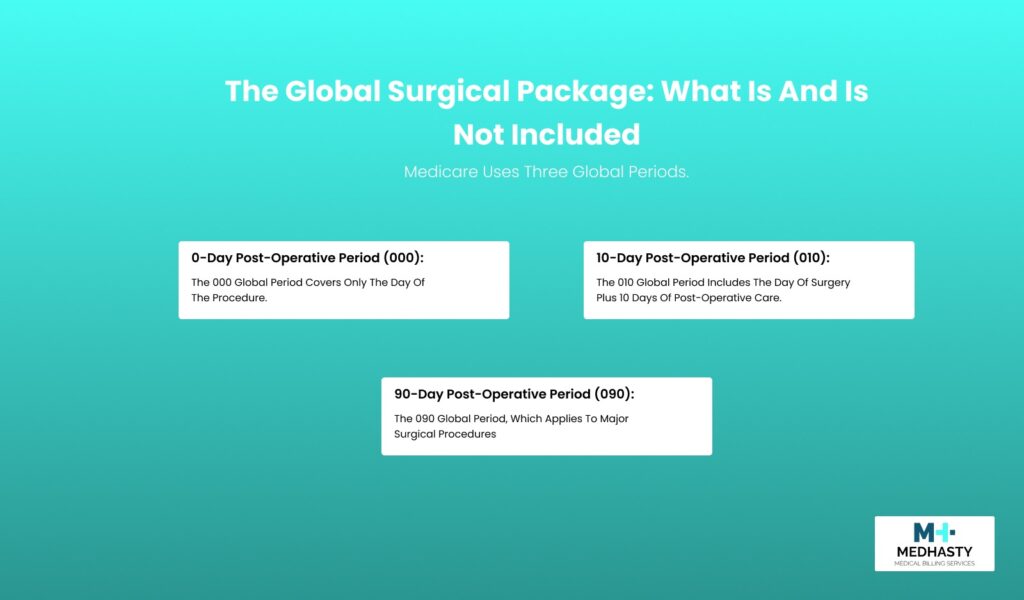
If your practice performs surgical procedures, you absolutely need to understand the global surgical package concept. When Medicare and most commercial payers reimburse for a surgical procedure, the payment includes not just the surgery itself but also the pre-operative care in the period leading up to surgery and the post-operative care for a defined number of days afterward.
Medicare uses three global periods.
- 0-Day Post-Operative Period (000): The 000 global period covers only the day of the procedure.
- 10-Day Post-Operative Period (010): The 010 global period includes the day of surgery plus 10 days of post-operative care.
- 90-Day Post-Operative Period (090): The 090 global period, which applies to major surgical procedures, includes one day pre-operative care plus the day of surgery plus 90 days of post-operative follow-up.
During the global period, you cannot separately bill for routine post-operative visits that are directly related to the surgery.
Those visits are already included in the global surgical payment. However, if a patient develops an unrelated new problem during the global period, you can bill a separate E/M with the appropriate modifier to indicate the visit is unrelated to the surgery.
Where practices run into trouble is when they bill post-operative visits during the global period without understanding whether those visits fall inside or outside the global package. Upcoding post-operative care that is included in the global fee is a compliance issue that comes up in OIG audits regularly.
The National Correct Coding Initiative and Code Bundling
The National Correct Coding Initiative (NCCI) is CMS’s primary tool for preventing improper code combinations on Medicare claims. NCCI edits define pairs of codes that cannot be billed together because one is considered a component of the other. When you submit two codes that NCCI considers bundled, the secondary code will be denied.
There are two types of NCCI edits. Column 1 or Column 2 edits identify codes that are components of more comprehensive codes. Mutually exclusive edits identify code pairs that cannot reasonably be performed at the same time on the same patient by the same provider. Understanding NCCI is not optional if you want to avoid denials. Your billing software should flag NCCI conflicts before claims go out the door, but your coding team should understand the logic behind the edits, not just accept the flags blindly.
NCCI also applies to Medicaid programs in most states, and commercial payers use similar bundling logic even if they have their own proprietary edits. Staying up to date on NCCI updates, which CMS releases quarterly, is part of any solid coding compliance program.
Types of NCCI Edits You Should Know
- Procedure-to-Procedure (PTP) Edits: Prevent billing of bundled services
- Medically Unlikely Edits (MUE): Limit units of service per day
Understanding both helps reduce denials and ensures compliant billing.
Common CPT Coding Mistakes That Lead to Denials and Audits
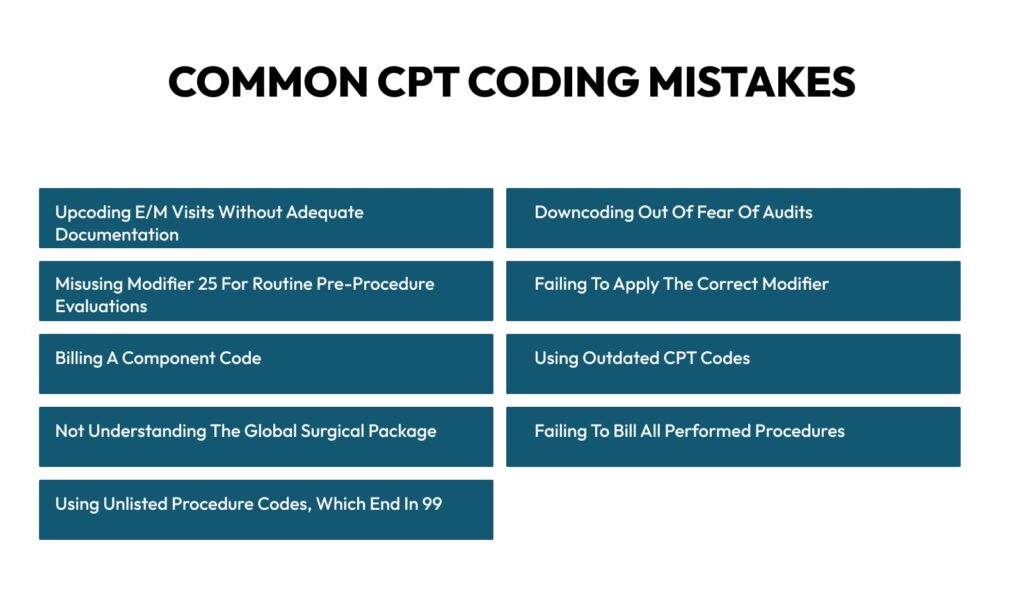
Let me give you a straightforward list of the most common CPT coding errors I see across practices. These are the ones that trigger denials, result in underpayments, or put practices at compliance risk.
- Upcoding E/M visits without adequate documentation to support the level of service. This is one of the top audit triggers for both Medicare and commercial payers.
- Downcoding out of fear of audits, which leaves significant legitimate revenue on the table. If the documentation supports a higher level of service, bill it correctly.
- Misusing Modifier 25 for routine pre-procedure evaluations that are not truly separate and distinct from the procedure.
- Failing to apply the correct modifier for bilateral procedures, laterality, or multiple surgical procedures results in either underpayment or improper bundling.
- Billing a component code when a more comprehensive code covers the entire service, which NCCI will catch and deny.
- Using outdated CPT codes. Each January 1, deleted codes become non-billable. Submitting a deleted code results in an automatic denial that wastes time and delays payment.
- Not understanding the global surgical package and billing post-operative visits that are included in the surgical fee triggers recoupment demands during audits.
- Failing to bill all performed procedures because of unfamiliarity with available codes, leaving legitimate revenue uncollected.
- Using unlisted procedure codes, which end in 99, when a specific code exists but was not looked up properly. Unlisted codes require special handling and often result in delays.
How to Prevent CPT Coding Denials
To reduce denials related to CPT coding:
- Verify documentation supports the selected code
- Check NCCI edits before claim submission
- Use correct modifiers based on payer rules
- Stay updated with annual CPT changes
- Perform internal coding audits regularly
CPT Coding Compliance and Audit Risks
Incorrect CPT coding can trigger audits from organizations such as the Office of Inspector General (OIG) and CMS. Common compliance risks include:
- Upcoding without proper documentation
- Misuse of modifiers
- Billing services not rendered
- Ignoring global surgical package rules
These issues can lead to penalties, recoupments, and legal consequences if not corrected.
How to Stay Current on CPT Code Changes
The AMA releases CPT changes every year, and those changes go into effect January 1. This means your billing team needs to be prepared and updated before the new year starts, not scrambling to catch up in February when your January claims start getting denied for invalid codes.
Subscribe to the AMA’s CPT code updates directly, or use a medical billing software platform that automatically updates its code tables annually. Attend coding webinars and training sessions from reputable organizations like the American Academy of Professional Coders, or AAPC, and the American Health Information Management Association, or AHIMA. These organizations publish coding guidance, offer certifications, and stay on top of changes so your team does not have to do it alone.
Most importantly, build a culture of coding accuracy in your practice. Encourage your coders and physicians to communicate. Physicians need to understand how their documentation drives coding decisions. Coders need to understand the clinical context of what they are coding. That collaboration is what separates practices with strong, compliant billing from those that are constantly dealing with denials and audit exposure.
Role of Medical Billing Software in CPT Coding
Most practices use billing software to:
- Automatically update CPT code sets
- Check NCCI edits before submission
- Flag missing modifiers or documentation issues
- Track denials and payment trends
Using software improves coding accuracy and reduces administrative workload.
Step-by-Step CPT Coding Process
Here is a simplified workflow for accurate CPT coding:
- Review provider documentation
- Identify procedures performed
- Select the most accurate CPT code
- Apply necessary modifiers
- Check NCCI edits and bundling rules
- Verify payer-specific guidelines
- Submit claim and monitor reimbursement
Following this structured process helps reduce errors and improve payment timelines.
Frequently Asked Questions About CPT Codes
What are CPT codes used for?
CPT codes are used to report medical procedures and services for insurance billing and reimbursement.
Who maintains CPT codes?
The American Medical Association (AMA) updates CPT codes annually.
What happens if CPT codes are incorrect?
Incorrect CPT codes can lead to claim denials, payment delays, or audits.
Final Thoughts
CPT codes are the language of medical billing in the United States. Mastering them is not something that happens overnight, but building a strong foundation in how they are organized, how modifiers work, how bundling rules apply, and how to stay current on annual changes will make your practice’s billing cleaner, more accurate, and significantly more compliant. The investment you make in coding education and process improvement pays off directly in fewer denials, faster payments, and a revenue cycle that actually works the way it should.