
If you have been in medical billing for any length of time, you know that using the wrong code on a claim is like showing up to the wrong address. You might be doing everything else right, but if the code is off, the payer will not process your claim the way you expect. HCPCS codes fall into that exact category. They confuse a lot of providers and billing teams, and that confusion costs money every single day.
So let’s break this down in a way that actually makes sense. No fluff, no complexity for the sake of it. Just practical knowledge that helps you bill correctly, get paid faster, and stay out of trouble with payers and auditors.
What Are HCPCS Codes and Where Do They Come From
HCPCS stands for Healthcare Common Procedure Coding System. The Centers for Medicare and Medicaid Services developed and maintains this system to create a standardized way of billing for services, supplies, equipment, and drugs across all payers in the United States.
Here is the key thing to understand right away. HCPCS is not a separate system that competes with CPT codes. It is actually the umbrella that contains CPT codes within it.
The system has two levels.
- Level I consist of CPT codes, which the American Medical Association maintains. These cover physician and clinical services, surgeries, and diagnostic procedures.
- Level II is what most people refer to when they say “HCPCS codes.” CMS maintains Level II, and these codes cover medical supplies, durable medical equipment, injectable drugs, ambulance services, and a wide range of other items and services that CPT does not address.
When a physician performs an office visit, you use a CPT code. When that same physician administers an injectable medication during that visit, you add a HCPCS Level II J code for the drug. When a patient goes home with a walker after a hospital stay, the DME supplier bills a HCPCS E code. These two levels work together on most claims, not in competition with each other.
According to CMS, there are currently over 7,000 active HCPCS Level II codes covering everything from wheelchairs to biologic drugs to ambulance transport. This code set is updated annually with additional quarterly updates for certain drug categories. Staying current with these updates is not optional. Billing a code that CMS deleted six months ago will get your claim rejected before it even reaches the adjudication stage.
How HCPCS Level II Codes Are Structured
Every HCPCS Level II code follows the same format. One letter followed by four numbers. That is it. But that letter at the beginning tells you a lot about what category the code falls into.
The letter groups organize codes by the type of item or service. A codes cover medical and surgical supplies as well as transportation services. E codes cover durable medical equipment, which is one of the largest and most frequently used categories in this system.
J codes cover drugs administered by routes other than oral, which makes them essential for physician offices, infusion centers, and hospitals that bill for injectable medications. L codes cover orthotic and prosthetic devices. G codes are temporary codes that CMS creates for procedures and professional services that do not yet have a permanent CPT code. Q codes cover temporary drugs and biologics as well as miscellaneous services.
Understanding these categories helps your billing team quickly narrow down the right code family when they are working a claim. If a claim involves a rental wheelchair, they know immediately they are looking at E codes. If it involves a chemotherapy drug, they go straight to J codes.
Why HCPCS Codes Directly Affect Your Revenue
HCPCS codes are not just administrative identifiers. They are the mechanism by which your payer determines what to pay you and whether your claim is even eligible for reimbursement.
According to the American Academy of Professional Coders, coding errors are responsible for approximately 30 percent of all claim denials in outpatient and ancillary service settings. A significant portion of those errors involve HCPCS Level II codes, particularly in DME, drug billing, and supplies.
When you bill an injectable drug without the correct J code, the payer cannot accurately adjudicate the claim. When you bill the wrong E code for a piece of equipment, you may receive a lower reimbursement rate than you are entitled to, or the claim may deny outright. When you omit a required modifier on a DME code, the claim goes to a rejection queue.
On the revenue side, HCPCS accuracy matters in both directions. Undercoding means you collect less than you are owed. Overcoding triggers audits, recoupment demands, and potentially False Claims Act exposure. Neither outcome is acceptable. Accurate coding is the only path that protects your practice financially and legally.
The Most Important HCPCS Code Categories You Need to Know
Durable Medical Equipment E Codes
DME is one of the most heavily regulated billing categories in U.S. healthcare. CMS has strict coverage criteria for every item billed under E codes. The patient must have a documented medical need, a physician order, and in most cases a face-to-face encounter with the ordering physician that confirms the necessity of the equipment.
Common E codes that practices and DME suppliers bill regularly include E0110 for crutches, E0114 for crutches with underarm pads, E0130 for a standard walker, and E0601 for a CPAP device. Each of these codes has a specific definition, and you must match the exact equipment being provided to the correct code.
One area that generates frequent errors is power wheelchairs and mobility scooters. These fall under a range of K codes and E codes depending on the specific equipment and the patient’s functional limitation level. CMS has very detailed local coverage determinations for these items. Billing the wrong mobility code or failing to document the required functional assessment is one of the fastest ways to attract a DME audit.
Drug Codes: The J Code Universe
J codes are used to bill for injectable, infusible, and in some cases inhaled medications when they are administered in a clinical setting. These codes are critically important for oncology practices, rheumatology offices, infusion centers, and any specialty that regularly administers biologics or specialty medications.
The key thing to understand about J codes is that units matter enormously. Each J code specifies the billing unit, which may be per milligram, per 10 milligrams, per vial, or per dose. If a physician administers 40mg of a drug but the J code specifies billing per 10mg, you need to bill four units. Getting the units wrong means you either underpay yourself or trigger a billing accuracy issue.
For drugs that do not have a specific J code, CMS provides J3490 for unclassified drugs and J3590 for unclassified biologics. These codes require a drug name and dosage in the claim narrative field. Payers process these claims manually, which means they take longer and require more documentation.
G Codes for Professional Services
G codes deserve more attention than they typically get in billing education. CMS creates these temporary codes when new services or clinical programs do not yet have CPT codes assigned to them. Over time, some G codes get replaced by permanent CPT codes. Others remain as G codes permanently because the service is specific to Medicare.
Annual wellness visits are a prime example. G0438 is the code for the initial annual wellness visit under Medicare, and G0439 covers subsequent years. These are entirely separate from the standard evaluation and management services that most providers are familiar with. Many primary care practices leave significant Medicare revenue on the table because their billing teams do not know these G codes well enough to capture them consistently.
Other important G codes include those for diabetes prevention programs, chronic care management add-on services, and various quality reporting measures under Medicare’s value-based care programs.
Common HCPCS Coding Mistakes That Are Costing Your Practice Money
Mistake 1: Using CPT When a HCPCS Level II Code Is Required
The most frequent mistake is using a CPT code when a HCPCS Level II code is actually required. This happens most often with drugs and supplies. A physician office might bill a generic procedure code for a drug administration service without attaching the correct J code for the medication itself. The administration code may process, but the drug cost goes unrecovered.
Mistake 2: Billing Incorrect Units for Injectable Drugs
The providers may bill incorrect units for drugs. This happens when billers are not familiar with the specific unit definition in a J code. Some practices systematically underbill drug units, which over the course of a year can represent tens of thousands of dollars in lost revenue. Others overbill units unknowingly, which creates a recoupment liability.
Mistake 3: Missing or Incorrect Modifiers on Claims
Missing modifiers can also be a big issue. Many HCPCS codes require modifiers to process correctly. DME codes require modifiers like NU for new equipment and RR for rental. Bilateral procedures require LT and RT modifiers. Replacement equipment requires specific modifiers to distinguish it from a first-time provision. Without the right modifier, the claim either denies or pays incorrectly.
Mistake 4: Billing Deleted or Inactive HCPCS Codes
Billing deleted or inactive HCPCS codes may also cause denials. CMS issues code updates every January, and some codes are deleted, others are revised, and new ones are added. A practice that does not update its charge master and billing system annually will continue billing deleted codes and collecting denials that could have been avoided entirely.
Mistake 5: Ignoring Payer-Specific HCPCS Coverage Policies
Medicare follows CMS rules, but Medicaid programs vary by state, and commercial payers have their own coverage determinations. A HCPCS code that Medicare covers may not be covered by a particular commercial plan, or the coverage criteria may differ. Checking payer policies before submitting is essential, especially for high-cost items like DME and specialty drugs.
HCPCS Modifiers: What They Are and When You Need Them
Modifiers in the HCPCS system add necessary context to a code without changing its fundamental definition. They communicate information to the payer that affects how the claim is processed and reimbursed.
NU and RR Modifiers: New Equipment vs. Rental
The NU modifier indicates that equipment being billed is new, not refurbished or rented. The RR modifier indicates that equipment is being rented rather than purchased outright. This distinction matters because Medicare has different payment rules for rented versus purchased equipment, including capped rental rules for certain categories.
LT and RT Modifiers: Billing for Bilateral Services
LT and RT indicate left side and right side respectively. For bilateral procedures or bilateral equipment provision, these modifiers ensure the payer processes the claim correctly instead of applying a duplicate claim edit.
The KX Modifier and What It Certifies in DME Billing
The KX modifier is particularly important in DME billing. It indicates that the documentation in the patient’s file meets the specific coverage criteria defined in the applicable local coverage determination. When you add KX to a claim, you are certifying that the required documentation exists. Billing KX without having that documentation is a compliance violation.
How CMS Uses HCPCS Codes to Enforce Coverage Policy
Medicare depends on HCPCS Level II codes more heavily than any other payer. CMS uses these codes to enforce coverage policies, apply frequency limitations, and trigger medical review.
Local Coverage Determinations as Your Compliance Roadmap
CMS publishes local coverage determinations through Medicare Administrative Contractors. Each LCD specifies which HCPCS codes are covered for a given item or condition, what diagnosis codes support medical necessity, and what documentation the provider must maintain. These LCDs are your roadmap for compliant billing.
OIG Audit Targets and What They Mean for Your Practice
The OIG’s Work Plan consistently includes HCPCS-related areas as audit targets. DME billing, drug administration coding accuracy, and ambulance transport billing appear regularly. Practices that do not have an internal HCPCS audit process are exposed to post-payment review risks they may not even be aware of.
A 2023 OIG report found that improper payments for DME claims alone totaled over $1.5 billion in a single year, with a significant portion attributable to coding errors and inadequate documentation. These are real numbers with real consequences for real practices.
Best Practices for HCPCS Accuracy in Your Practice
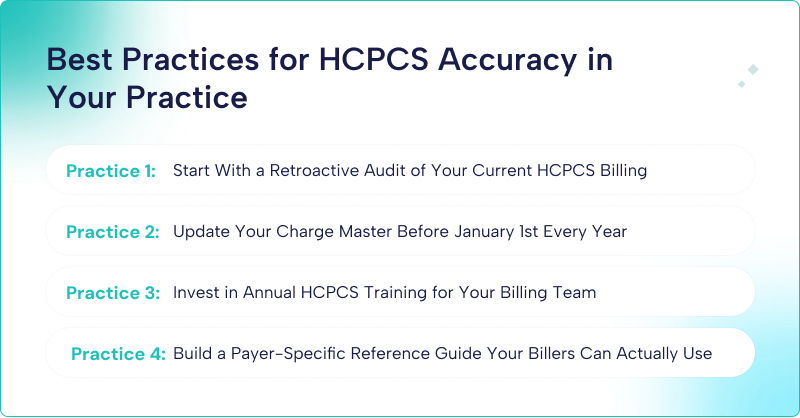
Start With a Retroactive Audit of Your Current HCPCS Billing
Start by conducting HCPCS code audit of your current billing. Pull claims from the last 12 months and review your most frequently billed Level II codes. Check whether units are calculated correctly, whether modifiers are applied consistently, and whether the codes match the documentation in the patient record.
Update Your Charge Master Before January 1st Every Year
Update your charge master and billing system every January when the new HCPCS codes take effect. Do not wait until you start seeing rejections. Get ahead of the updates by downloading the new code file from CMS as soon as it is published and loading it into your system before the effective date.
Invest in Annual HCPCS Training for Your Billing Team
Train your billing and coding staff specifically on HCPCS updates each year. An annual HCPCS training session that covers changes, deletions, and new additions keeps your team sharp and reduces the lag time between a code change and your practice’s adoption of it.
Build a Payer-Specific Reference Guide Your Billers Can Actually Use
Build payer-specific HCPCS policies into your billing workflow. Create a quick reference guide that documents which codes require prior authorization, which payers have different coverage rules, and which codes are historically high-denial items. Put that guide in front of your billers where they can use it daily.
Conclusion
HCPCS coding sits at the center of accurate billing for supplies, equipment, and drugs. When you understand how Level II codes work and how they connect with CPT and diagnosis codes, your claims become cleaner and more reliable.
Strong documentation, correct units, and proper modifier use make the difference between fast payment and repeated denials. Practices that invest time in HCPCS accuracy see better reimbursement, fewer audits, and smoother revenue cycles.