
Prior authorization remains one of the most challenging administrative processes in healthcare. While insurers use prior authorization to ensure medical necessity and control healthcare costs, the process often creates delays that affect providers, staff, and patients alike.
In 2026, healthcare organizations face increasing prior authorization requirements across various specialties, procedures, medications, and diagnostic services. Delays in obtaining approvals can result in postponed treatments, claim denials, increased administrative costs, and reduced patient satisfaction.
Implementing effective prior authorization strategies can help healthcare providers accelerate approvals, reduce revenue cycle disruptions, and improve overall operational efficiency.
For organizations focused on optimizing reimbursement and patient care, establishing best practices for prior authorization management has become more important than ever.
Prior authorization is the process of obtaining approval from a health insurance payer before certain healthcare services, treatments, procedures, medications, or diagnostic tests are performed.
Insurance companies typically require prior authorization to confirm:
Without proper authorization, healthcare providers risk claim denials, payment delays, and increased administrative burdens.
A proactive authorization process helps ensure services are approved before care is delivered.
Healthcare providers continue to face growing complexity in payer requirements.
Factors contributing to increased authorization challenges include:
Failure to manage authorizations effectively can lead to:
Organizations that streamline authorization workflows often experience improved reimbursement outcomes and stronger revenue cycle performance.
The prior authorization process should begin with accurate insurance verification.
Before requesting authorization, staff should confirm:
Early eligibility verification helps prevent wasted effort on authorization requests that may ultimately be denied due to coverage issues.
Addressing eligibility concerns upfront improves approval efficiency and reduces claim rejections.
Every insurance payer has unique authorization guidelines.
Healthcare organizations should maintain updated information regarding:
Understanding payer-specific requirements helps staff submit complete and accurate requests the first time.
This reduces delays caused by missing information or incorrect submissions.
Incomplete documentation is one of the leading causes of authorization delays.
Authorization requests should include all required clinical information, such as:
Providing comprehensive documentation helps payers make timely decisions and reduces the need for additional information requests.
Well-documented submissions significantly improve approval rates.
Standardized processes create consistency and reduce errors.
Healthcare organizations should develop clear workflows that define:
A structured approach ensures requests are handled efficiently and consistently across all departments.
Standardization also improves staff productivity and accountability.
Electronic Prior Authorization (ePA) solutions have transformed authorization management.
Compared to manual processes, ePA systems offer:
Electronic workflows help providers accelerate approval timelines while reducing administrative burdens.
Many healthcare organizations report significant efficiency gains after implementing ePA solutions.
Submitting an authorization request is only part of the process.
Organizations should actively monitor pending requests to identify delays before they affect patient care.
Regular follow-up helps staff:
Proactive monitoring minimizes treatment delays and improves scheduling efficiency.
Timely follow-up often results in faster authorization decisions.
Prior authorization requirements change frequently.
Ongoing staff education ensures team members remain current on:
Well-trained staff are more likely to submit accurate requests and avoid preventable delays.
Regular training strengthens overall authorization performance.
Understanding common obstacles can help healthcare organizations improve approval rates.
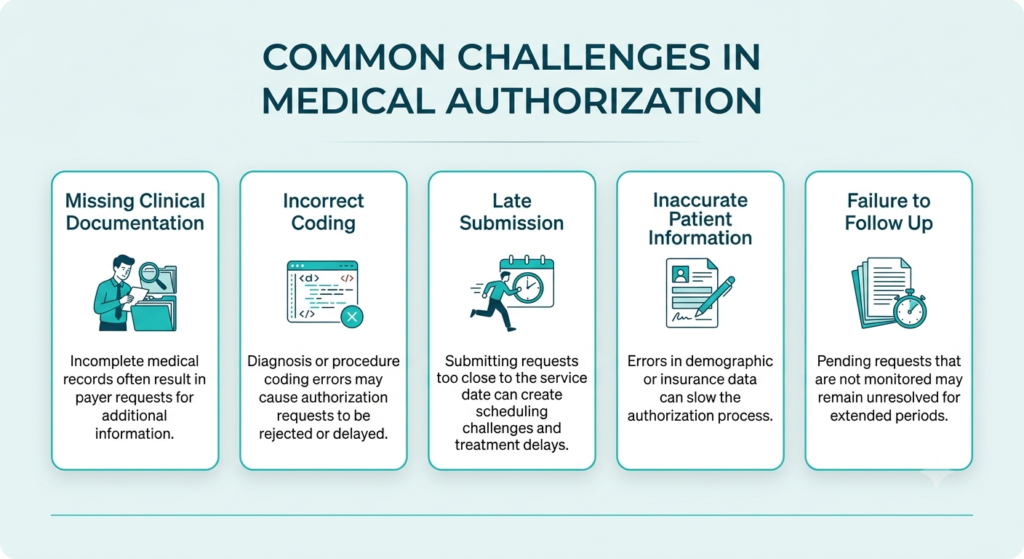
Identifying and addressing these issues helps organizations improve authorization efficiency.
Healthcare organizations increasingly rely on automation and technology to streamline authorization workflows.
Advanced solutions can:
Automation reduces manual workloads while improving consistency and accuracy.
Organizations leveraging technology often achieve faster approvals and lower administrative costs.
Efficient authorization management directly influences revenue cycle performance.
Benefits include:
Proper authorization minimizes reimbursement issues related to coverage requirements.
Approved services are more likely to move smoothly through the claims process.
Efficient workflows reduce time spent on resubmissions and appeals.
Providers can confidently schedule approved services without unnecessary delays.
Organizations are more likely to receive full reimbursement for authorized services.
These financial benefits contribute to improved operational stability and long-term growth.
Healthcare organizations can improve authorization performance by consistently following these strategies:
Consistent execution of these practices can significantly reduce approval delays.
The authorization landscape continues to evolve as healthcare technology advances.
Emerging innovations include:
These advancements will help providers reduce administrative burdens while improving approval speed and accuracy.
Organizations that embrace modern authorization technologies will be better positioned to navigate future payer requirements.
Prior authorization plays a critical role in healthcare reimbursement, but inefficient processes can create significant operational and financial challenges. By implementing standardized workflows, improving documentation practices, utilizing automation tools, and maintaining proactive communication with payers, healthcare organizations can achieve faster prior authorization approvals.
In 2026, as payer requirements continue to evolve, efficient authorization management has become an essential component of successful revenue cycle operations.
Healthcare providers that invest in strong prior authorization strategies can reduce claim denials, accelerate reimbursements, improve patient satisfaction, and strengthen overall financial performance.
Electronic Health Records (EHR) have become a cornerstone of modern healthcare operations. While EHR systems are often associated with improving patient care and clinical documentation, their impact on revenue cycle management is equally significant.
As healthcare organizations continue to face increasing administrative demands, reimbursement challenges, and evolving payer requirements, EHR integration has emerged as a powerful tool for improving revenue cycle performance. By connecting clinical workflows with billing and financial processes, integrated EHR systems help healthcare providers reduce errors, streamline operations, and accelerate reimbursements.
In 2026, healthcare organizations that leverage fully integrated EHR solutions are better positioned to improve financial outcomes while delivering high-quality patient care.
EHR integration refers to the seamless connection between electronic health records and other healthcare systems involved in patient care, billing, scheduling, insurance verification, claims management, and revenue cycle operations.
An integrated EHR system allows information to flow automatically between departments, reducing manual data entry and improving data accuracy.
Integrated systems typically connect:
By creating a unified workflow, healthcare organizations can improve both operational efficiency and financial performance.
Healthcare providers are dealing with increasingly complex reimbursement requirements, stricter payer scrutiny, and growing patient financial responsibility.
Disconnected systems often create challenges such as:
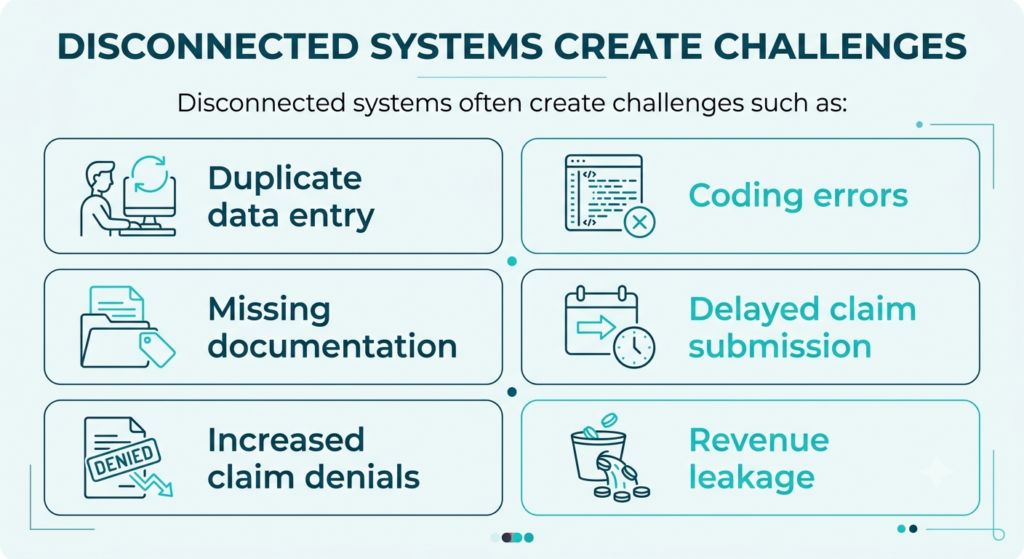
EHR integration helps eliminate these inefficiencies by ensuring accurate information is available across the entire revenue cycle.
Organizations with integrated systems often experience faster reimbursements, fewer denials, and improved cash flow.
Accurate clinical documentation is essential for successful reimbursement.
When EHR systems are integrated with billing and coding platforms, providers can ensure that documentation supports the services billed.
Benefits include:
Comprehensive documentation helps minimize claim errors and supports compliance with payer requirements.
Missed charges can significantly impact healthcare revenue.
Integrated EHR systems automatically capture clinical services and transfer relevant information to billing workflows.
This helps organizations:
Automated charge capture ensures providers are properly compensated for the services they deliver.
Timely claim submission is critical for maintaining healthy cash flow.
Without integration, staff may spend significant time manually transferring information between systems.
EHR integration enables:
Faster claim submission often results in quicker reimbursement and reduced accounts receivable days.
Medical coding directly affects reimbursement outcomes.
Integrated EHR systems provide coders with access to complete clinical documentation, helping them assign accurate diagnosis and procedure codes.
Advantages include:
Accurate coding supports clean claim submission and minimizes revenue cycle disruptions.
Clean claims are essential for efficient reimbursement.
Integrated EHR platforms help ensure claims contain accurate information before submission.
This includes:
By reducing errors at multiple stages of the revenue cycle, EHR integration increases first-pass claim acceptance rates.
Healthcare organizations benefit from fewer rejections and reduced administrative rework.
Insurance verification is one of the most important front-end revenue cycle activities.
Integrated EHR systems can connect directly with eligibility verification tools, allowing staff to confirm coverage in real time.
This helps providers:
Accurate insurance information reduces claim rejections and improves reimbursement outcomes.
Claim denials remain a major challenge for healthcare organizations.
Many denials occur due to:
Integrated EHR systems help address these issues before claims are submitted.
By improving data accuracy throughout the revenue cycle, organizations can significantly reduce denial rates and improve collection performance.
Healthcare organizations that rely on disconnected systems often face several operational challenges.
Staff may need to enter the same information into multiple systems, increasing labor costs and error risks.
Departments may struggle to access consistent information, leading to workflow inefficiencies.
Manual workflows often slow down claim preparation and submission.
Missing or inconsistent information can result in rejected or denied claims.
Incomplete charge capture and billing errors may cause providers to lose revenue.
These challenges can negatively impact both financial performance and patient satisfaction.
Modern EHR platforms increasingly incorporate automation capabilities that improve revenue cycle management.
Advanced integrations can:
Automation reduces manual workloads while improving overall accuracy and efficiency.
Healthcare organizations can process more claims with fewer resources while maintaining compliance.
The impact of EHR integration extends throughout the revenue cycle.
Key benefits include:
Accurate and timely claim submission improves payment turnaround times.
Automation reduces manual tasks and staff workload.
Fewer delays and denials lead to more predictable revenue streams.
Better documentation and charge capture reduce missed billing opportunities.
Integrated systems help maintain documentation and coding standards required by payers.
Together, these benefits contribute to a healthier financial foundation for healthcare organizations.
Healthcare organizations can maximize the value of EHR integration by following several best practices.
These include:
Organizations that prioritize these practices often achieve stronger financial and operational results.
Healthcare technology continues to evolve rapidly, making EHR systems even more valuable to revenue cycle operations.
Emerging innovations include:
These technologies will further improve revenue cycle efficiency while helping providers adapt to changing payer requirements.
Healthcare organizations that invest in modern EHR integration strategies will be better equipped to achieve long-term financial success.
EHR integration plays a vital role in improving revenue cycle performance by connecting clinical and financial workflows into a single, efficient system. By improving documentation accuracy, reducing billing errors, supporting clean claims, and streamlining reimbursement processes, integrated EHR platforms help healthcare organizations strengthen their financial health.
In 2026, as healthcare reimbursement becomes increasingly complex, EHR integration is no longer just a technology upgrade—it is a strategic investment in revenue cycle success.
Providers that embrace integrated EHR solutions can reduce denials, accelerate payments, improve operational efficiency, and create a stronger financial future while continuing to deliver exceptional patient care.
Insurance verification is one of the most important steps in the healthcare revenue cycle. Despite advances in billing technology and claims management processes, claim rejections continue to affect healthcare organizations due to inaccurate or incomplete insurance information. Many of these rejections can be prevented through a thorough and proactive insurance verification process.
In 2026, healthcare providers face increasing challenges related to payer requirements, changing coverage policies, and growing patient responsibility. Verifying insurance eligibility before services are provided has become essential for reducing claim rejections, improving reimbursement rates, and enhancing the patient experience.
For healthcare organizations seeking to strengthen their revenue cycle performance, insurance verification serves as the foundation for clean claims and successful reimbursement outcomes.
Insurance verification is the process of confirming a patient’s insurance coverage, benefits, eligibility, and financial responsibilities before healthcare services are rendered.
The verification process typically includes:
By verifying this information before a patient visit, providers can reduce billing errors and prevent avoidable claim rejections.
Healthcare insurance plans continue to evolve, with frequent changes to:
Failure to verify insurance information can result in:
As payer requirements become more complex, insurance verification has become a critical component of revenue cycle management.
Organizations that prioritize verification often experience higher first-pass claim acceptance rates and stronger financial performance.
One of the most common reasons claims are rejected is inactive or invalid insurance coverage.
Patients may experience changes in coverage due to:
Without verification, providers may submit claims to inactive plans, resulting in immediate claim rejections.
Verifying eligibility before appointments helps identify coverage issues early and allows staff to address them before services are provided.
Accurate patient registration is essential for successful claim processing.
Insurance verification helps identify errors such as:
Correcting these issues before claim submission significantly reduces rejection rates and administrative rework.
Strong front-end verification processes create a solid foundation for clean claims management.
Many insurance plans require prior authorization for specific procedures, treatments, or diagnostic services.
Failure to obtain authorization can lead to claim denials or payment delays.
Insurance verification helps billing teams determine:
By addressing authorization needs before treatment, healthcare organizations can reduce avoidable reimbursement challenges.
Patients are increasingly responsible for larger portions of their healthcare costs.
Insurance verification helps providers determine:
This information allows healthcare organizations to communicate financial expectations clearly before treatment.
Improved transparency reduces billing disputes and enhances patient satisfaction.
Insurance verification plays a major role in producing clean claims.
When eligibility, benefits, and coverage details are confirmed in advance, claims are more likely to be submitted accurately the first time.
Clean claims help providers:
Insurance verification serves as one of the most effective tools for improving first-pass claim acceptance rates.
Despite its importance, insurance verification can be challenging for healthcare organizations.
Common obstacles include:
Insurance policies and benefits can change throughout the year, requiring continuous verification efforts.
Manual verification consumes valuable staff time and increases the risk of human error.
Different insurance companies often have unique verification and authorization requirements.
Busy healthcare practices may struggle to complete thorough verification for every patient encounter.
These challenges highlight the need for efficient verification workflows and technology solutions.
Modern healthcare organizations increasingly rely on technology to streamline insurance verification.
Advanced verification tools can:
Automation helps healthcare organizations improve accuracy while reducing administrative burdens.
Real-time verification technology enables staff to address insurance issues before they affect claim outcomes.
Organizations utilizing automated verification systems often experience fewer claim rejections and faster reimbursements.
Insurance verification directly influences revenue cycle performance.
Benefits include:
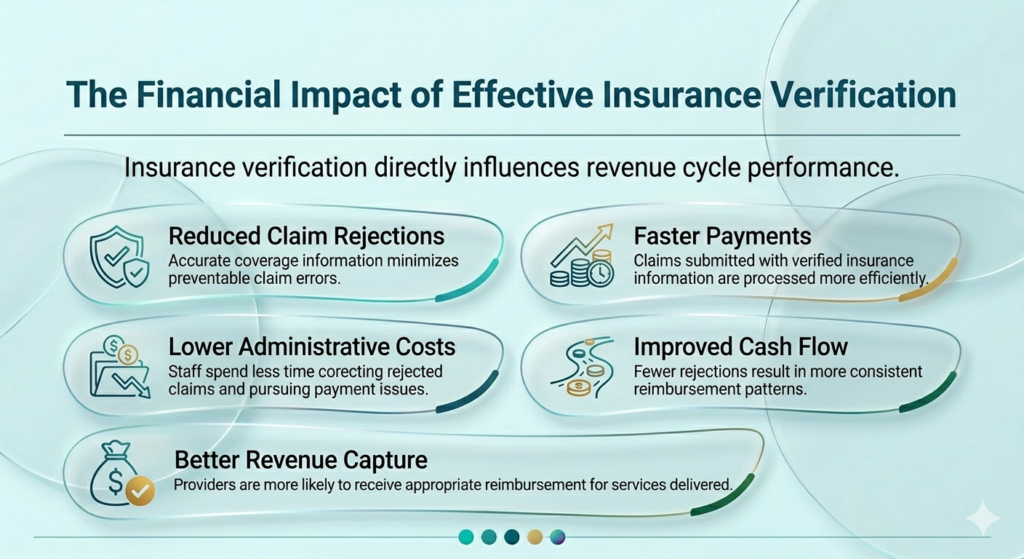
These financial benefits make insurance verification a high-value investment for healthcare organizations.
Healthcare organizations can strengthen verification processes by implementing several proven strategies.
These include:
Organizations that consistently follow these practices can significantly reduce claim rejections and improve reimbursement outcomes.
As healthcare technology continues to advance, insurance verification is becoming increasingly automated and data-driven.
Emerging innovations include:
These technologies will help healthcare organizations improve accuracy, efficiency, and patient communication while reducing revenue cycle risks.
Providers that embrace modern verification solutions will be better positioned to navigate evolving payer requirements and reimbursement challenges.
Insurance verification plays a critical role in reducing claim rejections and improving overall revenue cycle performance. By confirming eligibility, benefits, coverage details, and authorization requirements before services are provided, healthcare organizations can prevent many of the issues that lead to rejected claims.
In 2026, as insurance plans and payer requirements become increasingly complex, effective verification processes are more important than ever.
Healthcare providers that invest in strong insurance verification workflows, staff training, and automation technologies can improve reimbursement accuracy, strengthen cash flow, reduce administrative burdens, and create a better financial experience for both patients and providers.
Claim denials continue to be one of the biggest challenges facing healthcare providers today. Every denied claim represents delayed revenue, additional administrative work, and increased operational costs. As payer requirements become more complex and reimbursement regulations continue to evolve, medical practices must adopt proactive denial prevention strategies to protect their financial health.
In 2026, healthcare organizations are under growing pressure to improve revenue cycle performance while maintaining compliance and delivering high-quality patient care. Preventing denials before they occur has become far more effective than managing them after the fact.
For medical practices looking to reduce revenue leakage, improve cash flow, and streamline billing operations, implementing a strong denial prevention strategy is essential.
Denial prevention refers to the proactive processes and strategies used to identify and eliminate claim issues before claims are submitted to insurance payers.
Rather than focusing solely on denial management after a claim is rejected, denial prevention aims to reduce the likelihood of denials occurring in the first place.
Effective denial prevention involves:
By addressing potential issues early in the revenue cycle, healthcare organizations can significantly improve reimbursement outcomes.
Healthcare payers continue to tighten claim review processes, making accurate claim submission more important than ever.
Common consequences of claim denials include:
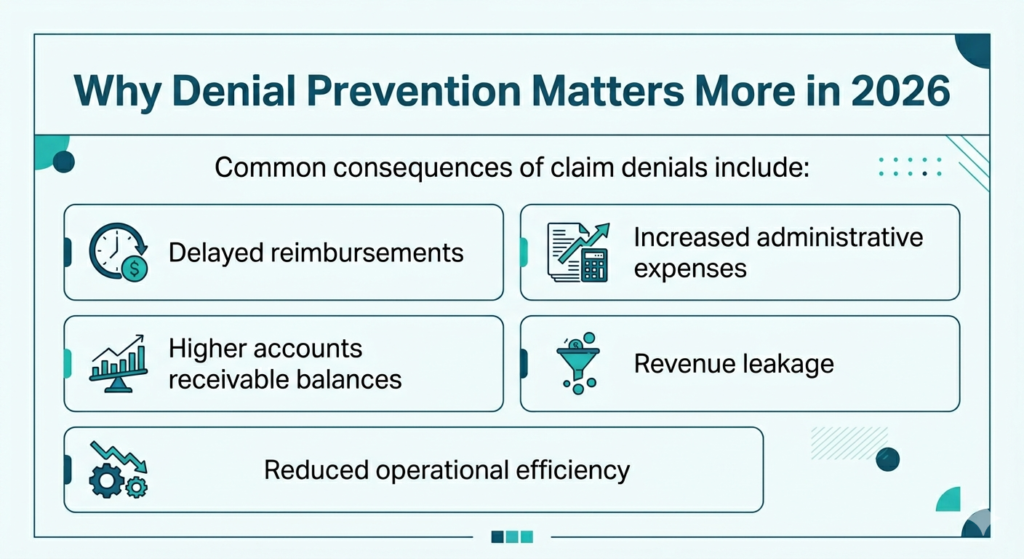
A proactive denial prevention program helps organizations improve first-pass claim acceptance rates while reducing costly rework.
Medical practices that prioritize denial prevention often experience stronger financial performance and healthier cash flow.
One of the most preventable causes of claim denials is eligibility-related errors.
Coverage information can change frequently due to:
Verifying eligibility before every appointment helps ensure that services are covered and reduces the risk of denied claims.
Eligibility verification should include:
Real-time verification tools can help practices streamline this process and improve claim accuracy.
Incorrect patient information remains a leading cause of claim rejections and denials.
Even minor registration errors can prevent claims from being processed successfully.
Common registration mistakes include:
Front-desk staff should be trained to carefully verify patient information during every visit.
Accurate registration creates a strong foundation for a clean claims process.
Coding errors continue to be one of the most common reasons claims are denied.
Mistakes involving CPT, ICD-10, or HCPCS codes can result in:
Medical practices should invest in:
Accurate coding helps ensure claims are processed correctly the first time.
Strong documentation supports accurate coding and demonstrates medical necessity.
Incomplete or unclear documentation often leads to payer requests for additional information or outright denials.
Documentation should include:
Providers and billing teams should work together to ensure documentation fully supports services billed.
Proper documentation not only reduces denials but also strengthens compliance efforts.
Claims scrubbing technology helps identify potential errors before claims are submitted to payers.
Modern claims scrubbing systems can detect:
By correcting these issues before submission, practices can improve first-pass acceptance rates and reduce denial volume.
Claims scrubbing has become a critical component of modern revenue cycle management.
Many denials occur because required authorizations were not obtained before services were provided.
Prior authorization requirements vary among payers and frequently change.
Practices should establish clear workflows to:
A structured authorization process helps prevent avoidable denials and treatment delays.
Successful denial prevention requires continuous monitoring and improvement.
Medical practices should regularly analyze denial data to identify:
Tracking denial patterns allows organizations to address root causes before they impact additional claims.
Data-driven decision-making helps create a more efficient and proactive revenue cycle strategy.
Technology plays an increasingly important role in preventing denials across healthcare organizations.
Modern revenue cycle management solutions can:
Artificial intelligence and automation tools help billing teams detect issues earlier and improve overall claim quality.
Organizations leveraging advanced technology often experience lower denial rates and faster reimbursements.
Medical practices that prioritize denial prevention can achieve significant operational and financial improvements.
Proactive processes help eliminate common claim errors before submission.
Cleaner claims move through payer systems more efficiently.
Reduced denials lead to more predictable and timely revenue.
Staff spend less time appealing and correcting denied claims.
Accurate billing processes create a smoother financial experience for patients.
A strong denial prevention strategy benefits every stage of the revenue cycle.
As payer requirements continue to evolve, denial prevention will become increasingly technology-driven.
Emerging innovations include:
These tools enable healthcare organizations to identify potential claim issues before they occur and continuously improve reimbursement performance.
Practices that embrace proactive denial prevention strategies will be better positioned to succeed in the increasingly competitive healthcare landscape.
Claim denials remain a major source of revenue loss for healthcare providers, but many denials are preventable. By focusing on eligibility verification, patient registration accuracy, proper coding, complete documentation, claims scrubbing, and denial trend analysis, medical practices can significantly reduce denial rates and improve financial outcomes.
In 2026, denial prevention is no longer simply a billing function—it is a critical component of effective revenue cycle management.
Healthcare organizations that invest in proactive denial prevention strategies today will benefit from stronger cash flow, improved operational efficiency, reduced administrative burdens, and long-term financial stability.
Medicare continues to be one of the largest healthcare payers in the United States, making Medicare billing accuracy a critical component of revenue cycle management. As regulations evolve and reimbursement models become increasingly complex, healthcare providers must stay informed about Medicare billing changes to avoid claim denials, compliance issues, and revenue disruptions.
In 2026, Medicare updates are affecting reimbursement methodologies, documentation requirements, telehealth services, value-based care initiatives, and compliance standards. Providers who proactively adapt to these changes can improve billing accuracy, accelerate reimbursements, and strengthen their overall financial performance.
For healthcare organizations looking to optimize their revenue cycle, understanding Medicare billing updates is essential for maintaining compliance and maximizing reimbursement opportunities.
Medicare regulations are updated regularly to address changing healthcare needs, improve patient outcomes, and control healthcare spending.
Failure to stay current with billing changes can result in:
Healthcare providers that monitor Medicare updates closely can reduce administrative challenges while ensuring claims are submitted accurately and efficiently.
Several Medicare billing updates are expected to impact healthcare providers across multiple specialties and care settings.
Understanding these changes allows organizations to prepare billing teams, update workflows, and minimize reimbursement disruptions.
Medicare continues shifting from traditional fee-for-service reimbursement toward value-based care programs that focus on quality outcomes and cost efficiency.
Providers participating in these programs may experience:
Organizations that effectively align billing and clinical documentation with value-based care initiatives can improve reimbursement opportunities while enhancing patient outcomes.
Internal Link Opportunity: Link to your Revenue Cycle Management Services page.
Accurate documentation remains one of the most important factors in Medicare billing compliance.
In 2026, providers are expected to maintain detailed documentation supporting:
Incomplete documentation can result in denied claims, payment recoupments, and audit findings.
Healthcare organizations should continue strengthening clinical documentation improvement (CDI) programs to support compliant billing practices.
Telehealth services have become a permanent component of healthcare delivery, and Medicare continues refining billing requirements for virtual care.
Providers should closely monitor updates related to:
Accurate telehealth billing is essential for ensuring claims are processed correctly and reimbursed appropriately.
Healthcare organizations should regularly review Medicare guidance to remain compliant with evolving telehealth regulations.
Medicare contractors continue expanding audit activities to identify billing errors, improper payments, and compliance concerns.
Areas receiving increased scrutiny often include:
Healthcare providers must maintain robust compliance programs to reduce audit risks and ensure billing accuracy.
Regular internal audits can help identify issues before they become larger compliance concerns.
Medicare reimbursement methodologies continue evolving as healthcare transitions toward outcome-focused payment models.
Providers may experience changes related to:
Monitoring reimbursement updates allows healthcare organizations to adjust financial planning and revenue cycle strategies accordingly.
Understanding how reimbursement changes affect specific specialties is critical for long-term financial stability.
Medicare billing updates affect multiple aspects of the revenue cycle.
Healthcare organizations that fail to adapt may experience operational challenges and financial losses.
Outdated billing processes can result in denied or rejected Medicare claims.
Incorrect coding or documentation often leads to payment delays and additional administrative work.
Billing teams may spend more time correcting preventable errors when Medicare changes are not implemented effectively.
Failure to follow Medicare requirements can increase exposure to audits, penalties, and repayment demands.
By proactively managing Medicare updates, providers can strengthen financial performance and operational efficiency.
Modern revenue cycle technology is helping healthcare organizations navigate increasingly complex Medicare requirements.
Advanced billing solutions can:
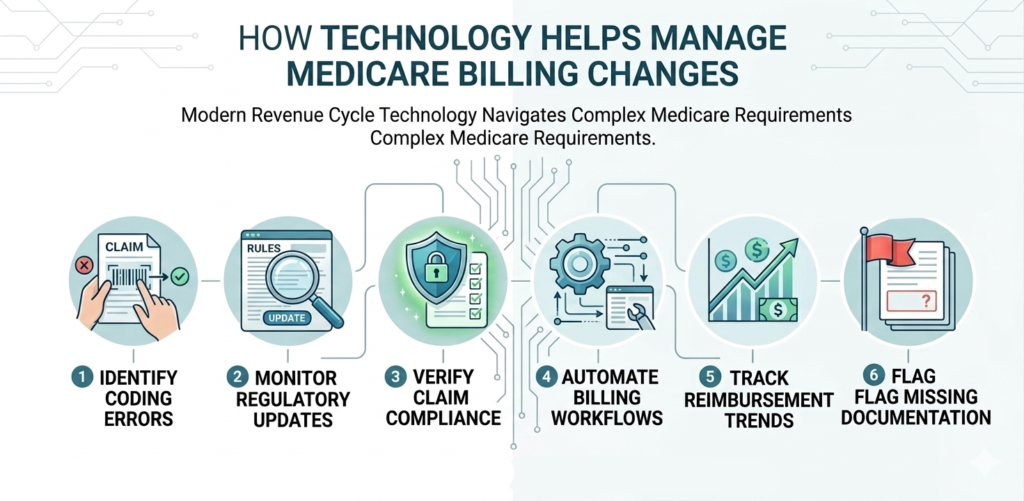
Automation helps providers adapt more quickly to Medicare changes while reducing administrative burdens.
Organizations leveraging technology often achieve higher claim acceptance rates and improved reimbursement outcomes.
Internal Link Opportunity: Link to your Claims Management Services page.
Healthcare providers can reduce disruption and improve compliance by adopting several best practices.
These include:
Organizations that invest in continuous improvement are better positioned to navigate regulatory changes successfully.
As healthcare continues evolving, Medicare billing will become increasingly data-driven, technology-enabled, and outcome-focused.
Future trends may include:
Healthcare providers that embrace innovation and maintain compliance-focused billing strategies will be better equipped to succeed in a changing reimbursement environment.
Waiting until Medicare changes take effect can create unnecessary operational challenges and revenue disruptions.
Proactive preparation allows providers to:
Organizations that stay ahead of Medicare updates often experience smoother transitions and stronger financial outcomes.
Internal Link Opportunity: Link to your Eligibility Verification Services page.
Medicare billing changes continue to shape the healthcare reimbursement landscape in 2026. From evolving documentation requirements and telehealth policies to value-based care initiatives and reimbursement updates, providers must remain informed to maintain billing accuracy and compliance.
Healthcare organizations that proactively adapt to Medicare changes can reduce denials, improve reimbursement speed, strengthen compliance, and enhance overall revenue cycle performance.
By investing in education, technology, and effective billing processes, providers can successfully navigate Medicare’s evolving requirements while positioning themselves for long-term financial success.
Artificial Intelligence (AI) is rapidly reshaping the healthcare industry, and medical billing is one of the areas experiencing the most significant transformation. As healthcare organizations face increasing administrative burdens, rising claim denial rates, and growing compliance requirements, AI-driven solutions are helping providers streamline operations and improve financial performance.
In 2026, healthcare providers are leveraging AI to automate repetitive tasks, improve billing accuracy, reduce claim denials, and accelerate reimbursement cycles. These innovations are enabling revenue cycle teams to work more efficiently while minimizing costly human errors.
For healthcare organizations seeking to optimize revenue cycle management, AI has become a powerful tool for improving medical billing workflows and enhancing overall operational efficiency.
AI in medical billing refers to the use of machine learning, automation, predictive analytics, and intelligent algorithms to perform billing-related tasks that traditionally required significant manual effort.
AI-powered billing systems can:
By automating complex billing activities, AI helps healthcare organizations improve efficiency while reducing administrative costs.
Healthcare billing has become increasingly complex due to evolving payer requirements, regulatory changes, and growing patient expectations.
Traditional billing processes often struggle with:
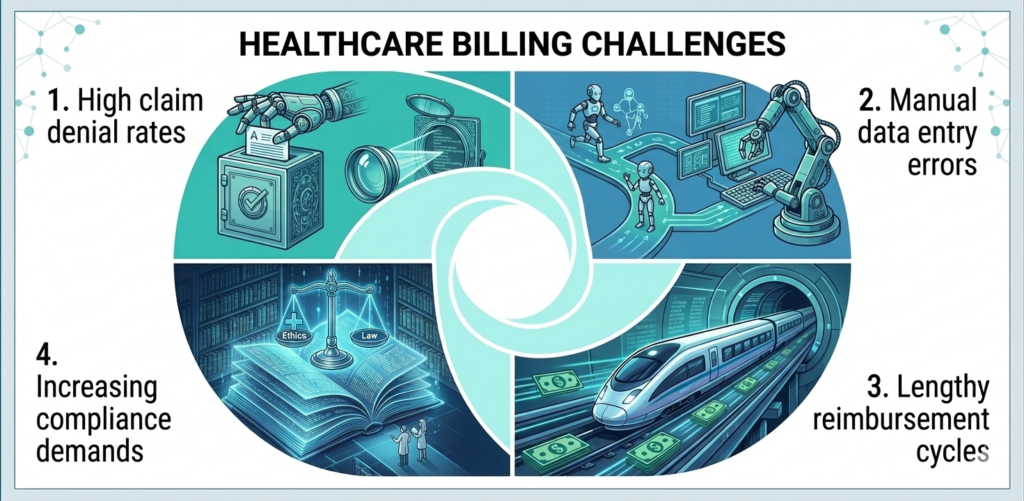
AI provides healthcare organizations with the ability to manage these challenges more effectively while improving revenue cycle outcomes.
Organizations adopting AI-powered billing solutions are often seeing measurable improvements in productivity, reimbursement speed, and claim accuracy.
One of the most valuable applications of AI in medical billing is automated claims scrubbing.
Before claims are submitted to payers, AI systems can review them for:
By identifying errors before submission, AI helps reduce claim rejections and improve first-pass claim acceptance rates.
This proactive approach minimizes rework and accelerates reimbursement timelines.
Internal Link Opportunity: Link to your Claims Management Services page.
Medical coding errors remain one of the leading causes of claim denials and revenue loss.
AI-assisted coding tools can analyze clinical documentation and recommend appropriate:
These systems help coders work more efficiently while reducing the risk of coding mistakes.
AI does not replace medical coders but serves as a powerful support tool that improves accuracy and consistency.
Healthcare organizations using AI-assisted coding often experience lower denial rates and improved reimbursement outcomes.
Internal Link Opportunity: Link to your Medical Billing & Coding Services page.
AI-powered predictive analytics can identify patterns that may lead to claim denials before claims are submitted.
These systems analyze historical data to predict:
Revenue cycle teams can then address these issues proactively, reducing denial rates and improving cash flow.
Predictive denial management is becoming a critical strategy for healthcare organizations seeking to maximize reimbursement.
Insurance eligibility verification is an essential part of the billing process.
Manual verification can be time-consuming and prone to errors, often leading to denied claims when coverage issues are discovered after services are provided.
AI-powered eligibility verification systems can:
Real-time verification improves claim accuracy and enhances the patient registration experience.
Internal Link Opportunity: Link to your Eligibility Verification Services page.
Prior authorization requirements continue to create administrative challenges for healthcare providers.
AI is helping automate many aspects of the authorization process by:
By streamlining authorization workflows, providers can improve operational efficiency while reducing treatment delays for patients.
Payment posting and reconciliation can consume significant staff time when performed manually.
AI-powered systems can automatically:
Automation helps billing teams process payments more efficiently while improving financial visibility across the revenue cycle.
AI impacts multiple areas of the revenue cycle simultaneously, creating measurable financial benefits.
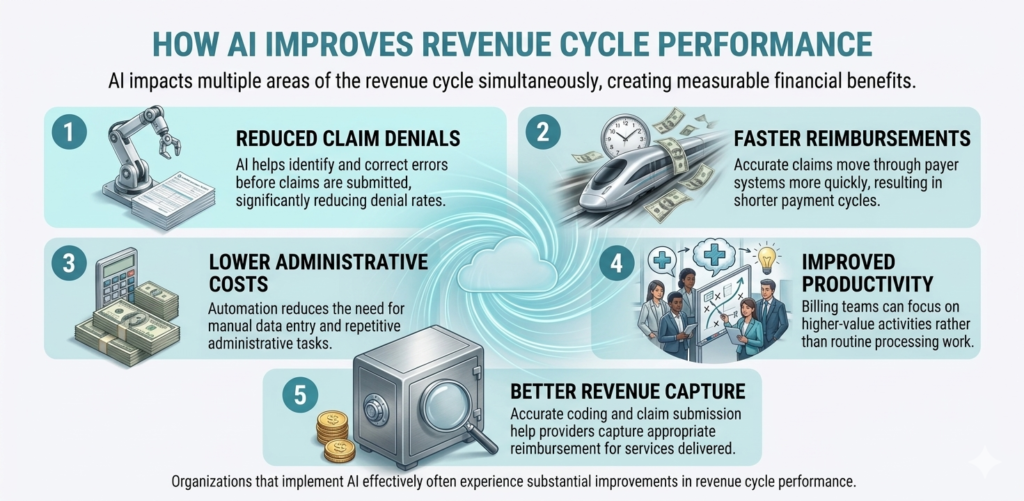
Healthcare compliance remains a major concern for providers and billing organizations.
AI can support compliance efforts by:
These capabilities help healthcare organizations reduce compliance exposure while maintaining billing accuracy.
As regulations continue to evolve, AI-driven compliance monitoring is becoming increasingly valuable.
While AI offers significant benefits, successful implementation requires careful planning.
Common challenges include:
Healthcare organizations should approach AI adoption strategically to maximize long-term value and return on investment.
When implemented correctly, AI can deliver substantial operational and financial benefits.
AI technology continues to evolve rapidly, creating new opportunities for healthcare organizations.
Future advancements are expected to include:
As AI capabilities expand, healthcare organizations will gain even greater control over billing efficiency, revenue optimization, and compliance management.
Providers who embrace AI-driven solutions today will be better positioned to compete in an increasingly complex healthcare environment.
AI is transforming medical billing workflows by improving accuracy, reducing administrative burdens, accelerating reimbursements, and strengthening revenue cycle performance. From automated claims scrubbing and coding assistance to predictive denial prevention and real-time eligibility verification, AI is helping healthcare organizations navigate growing billing complexities more effectively.
As healthcare continues to evolve in 2026, AI-driven billing solutions are becoming essential for organizations seeking to improve efficiency, reduce costs, and maximize revenue.
Healthcare providers that invest in AI-powered medical billing technologies today will be better equipped to achieve long-term financial success and operational excellence in the future.
Medical coding plays a crucial role in the healthcare revenue cycle. Accurate coding ensures healthcare providers receive proper reimbursement for the services they deliver while maintaining compliance with payer and regulatory requirements. However, even small coding mistakes can lead to claim denials, payment delays, underpayments, and significant revenue loss.
In 2026, healthcare organizations face increasing pressure from evolving coding guidelines, stricter payer audits, and growing compliance requirements. As a result, minimizing coding errors has become essential for maintaining financial stability and operational efficiency.
For healthcare providers looking to improve revenue cycle performance, understanding and preventing common medical coding mistakes is one of the most effective strategies for reducing revenue leakage and maximizing reimbursements.
Medical coding translates healthcare services, diagnoses, procedures, and treatments into standardized codes used for billing and reimbursement purposes.
Accurate coding helps providers:
When coding errors occur, healthcare organizations often face delayed payments, increased administrative costs, and lost revenue opportunities.
One of the most common medical coding mistakes is assigning incorrect CPT or ICD-10 codes to services provided.
Coding inaccuracies may occur due to:
Incorrect codes can cause claims to be denied, delayed, or reimbursed at lower rates than expected.
To prevent this issue, healthcare organizations should regularly update coding resources and provide ongoing education for coding staff.
Internal Link Opportunity: Link to your Medical Billing & Coding Services page.
Upcoding occurs when a provider reports a more expensive service than what was actually performed. Downcoding happens when services are reported at a lower level than warranted.
Both situations can create serious financial consequences.
Proper documentation and coding audits help ensure services are coded accurately and appropriately.
Modifiers provide additional information about procedures and services performed. When modifiers are missing, incorrect, or improperly applied, claims may be denied or reimbursed incorrectly.
Common modifier-related issues include:
Accurate modifier application helps ensure claims reflect the full scope of services provided.
Internal Link Opportunity: Link to your Claims Management Services page.
Medical coders rely heavily on provider documentation to assign accurate codes. If documentation is incomplete, unclear, or inconsistent, coders may be unable to support the services billed.
Common documentation problems include:
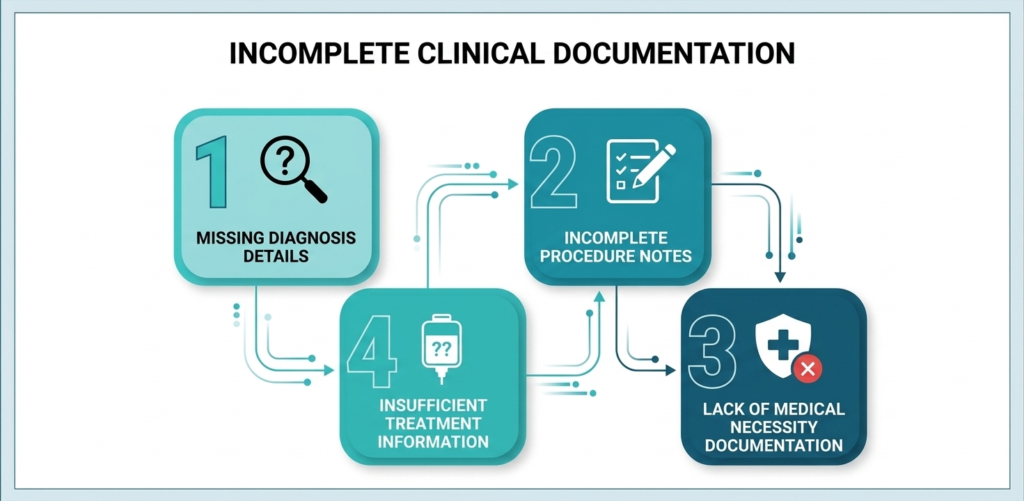
Strong clinical documentation supports accurate coding, improves reimbursement accuracy, and reduces audit risks.
Payers often require services to meet specific medical necessity criteria before reimbursement is approved.
If coding does not adequately demonstrate medical necessity, claims may be denied even when services were appropriately provided.
Healthcare organizations can reduce these denials by:
Medical necessity verification is an important component of successful revenue cycle management.
Internal Link Opportunity: Link to your Eligibility Verification Services page.
Unbundling occurs when services that should be billed together are reported separately to increase reimbursement.
While some coding combinations are appropriate, improper unbundling can trigger claim denials, audits, and compliance concerns.
Healthcare organizations should regularly review payer guidelines and coding updates to ensure bundled services are reported correctly.
Proper coding practices help protect both revenue and compliance.
Medical coding guidelines change frequently. Every year, updates are made to:
Using outdated codes can result in claim rejections and lost revenue.
In 2026, healthcare organizations must stay current with coding changes to maintain reimbursement accuracy and compliance.
Regular training programs and coding updates help billing teams stay informed.
Medical coding mistakes affect far more than individual claims.
Common consequences include:
Coding errors remain one of the leading causes of denied claims across healthcare organizations.
Incorrect coding often requires claim corrections and resubmissions, slowing payment cycles.
Billing teams spend valuable time correcting preventable coding mistakes rather than focusing on revenue-generating activities.
Repeated coding inaccuracies can increase exposure to audits, penalties, and regulatory scrutiny.
Underpayments and denied claims directly reduce organizational revenue and profitability.
By addressing coding issues proactively, providers can strengthen overall financial performance.
Modern healthcare organizations increasingly rely on technology to improve coding accuracy.
Advanced coding solutions can:
Artificial intelligence and automation tools are helping providers reduce manual errors while improving claim accuracy and reimbursement outcomes.
Organizations that invest in coding technology often experience lower denial rates and stronger revenue cycle performance.
Internal Link Opportunity: Link to your Revenue Cycle Management Services page.
Healthcare organizations can significantly reduce coding-related revenue loss by implementing proven best practices.
These include:
Organizations that continuously monitor coding performance are better positioned to improve reimbursement accuracy and reduce financial risk.
As healthcare becomes increasingly complex, medical coding will continue evolving alongside payer requirements and regulatory standards.
Emerging technologies such as AI-assisted coding, predictive analytics, and automated compliance monitoring are helping healthcare organizations improve coding accuracy while reducing administrative burdens.
Providers who prioritize coding excellence will gain significant advantages through:
Accurate medical coding is no longer simply a billing function—it is a strategic component of successful revenue cycle management.
Medical coding mistakes remain one of the leading causes of claim denials, delayed payments, compliance issues, and revenue loss in healthcare organizations. From incorrect CPT and ICD-10 codes to documentation deficiencies and modifier errors, even small mistakes can have a significant financial impact.
By investing in coder education, documentation improvement, technology solutions, and proactive auditing processes, healthcare providers can minimize coding errors and maximize reimbursement opportunities.
Healthcare organizations that focus on coding accuracy in 2026 will be better equipped to reduce revenue leakage, improve cash flow, maintain compliance, and achieve long-term financial success.
In the rapidly evolving healthcare industry, clean claims have become one of the most critical factors in maintaining financial stability for healthcare providers. As payer requirements become stricter and reimbursement timelines grow more complex, submitting accurate and error-free claims is no longer optional it is essential.
In 2026, healthcare organizations are facing increased pressure to reduce denials, improve cash flow, and maintain compliance with changing regulations. A clean claim ensures providers get reimbursed faster while minimizing administrative burdens and costly rework.
For practices, hospitals, and healthcare organizations looking to optimize their revenue cycle, focusing on clean claims is one of the most effective ways to improve operational efficiency and financial performance.
A clean claim is a medical claim submitted to an insurance payer that is complete, accurate, and free from errors or missing information. These claims can be processed without requiring additional clarification, corrections, or manual intervention.
A clean claim typically includes:
When claims are submitted correctly the first time, providers can significantly reduce payment delays and denials.
Insurance companies are becoming increasingly strict about claim submissions. Even small mistakes can result in denials, delayed reimbursements, or requests for additional documentation.
In 2026, payer policies continue to evolve rapidly, making it more important than ever for healthcare organizations to implement proactive claims management strategies.
A strong clean claims process helps:
Internal Link Opportunity: Link to your Denial Management Services page.
Delayed claims often lead to delayed payments, directly affecting a provider’s cash flow. Healthcare organizations rely on timely reimbursements to manage daily operations, payroll, staffing, and patient care investments.
Submitting clean claims helps practices:
Practices that prioritize clean claims often experience faster payment cycles and stronger overall revenue cycle performance.
Internal Link Opportunity: Link to your Revenue Cycle Management Services page.
Modern healthcare billing systems and automation tools are transforming the way claims are processed. In 2026, advanced claims scrubbing tools and AI-driven billing solutions help identify errors before submission.
Technology can help providers:
Automated workflows not only improve efficiency but also increase clean claim rates significantly.
Organizations using advanced claims management technology are better positioned to handle increasing payer complexity while improving reimbursement outcomes.Internal Link Opportunity: Link to your Eligibility Verification Services page.
Many claim denials happen because of preventable issues. Understanding these common errors can help healthcare organizations improve their clean claim rate.
Misspelled names, incorrect dates of birth, or outdated insurance details can immediately trigger claim rejections.
Incorrect CPT, HCPCS, or ICD-10 codes remain one of the leading causes of denials.
Incomplete clinical documentation or missing authorization details can delay claim processing.
Failure to verify active coverage before patient visits often results in denied claims.
Submitting duplicate claims can create unnecessary payment delays and payer confusion.
By implementing strong front-end verification and claims review processes, providers can prevent many of these issues before submission.
Clean claims do not only benefit providers — they also improve the patient experience.
When claims are processed accurately:
Patients today expect transparency and accuracy in healthcare billing. Efficient claims management helps build trust and improves overall patient satisfaction.
Healthcare regulations continue to evolve, making compliance a major priority for providers and billing teams.
Submitting inaccurate claims can increase the risk of:
Maintaining clean claims helps healthcare organizations stay aligned with payer requirements and industry regulations while reducing operational risk.
Practices that invest in compliance-focused billing workflows are more likely to achieve long-term financial stability.Internal Link Opportunity: Link to your Medical Billing & Coding Services page.
Healthcare providers can improve clean claim performance by adopting several proven strategies.
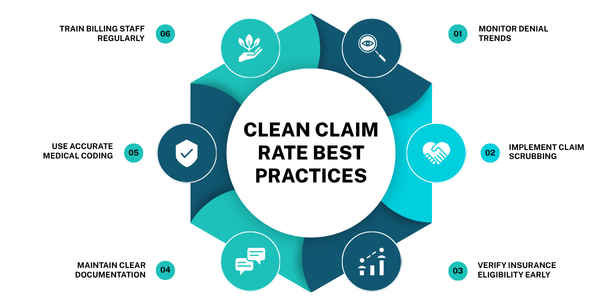
Organizations that consistently monitor and optimize their claims management process can achieve higher first-pass acceptance rates and improved revenue performance.
As healthcare continues to evolve, claims management will become increasingly data-driven and automated. AI-powered analytics, predictive denial prevention, and real-time eligibility verification are shaping the future of revenue cycle management.
In 2026, providers who prioritize clean claims will gain a competitive advantage by:
Clean claims are no longer just a billing goal — they are a critical component of sustainable healthcare operations.
Clean claims matter more than ever in 2026 because they directly impact reimbursement speed, operational efficiency, compliance, and patient satisfaction. As payer requirements become more complex, healthcare organizations must focus on accuracy, automation, and proactive claims management strategies.
By improving clean claim rates, providers can reduce denials, optimize cash flow, and create a more efficient revenue cycle process.
Healthcare organizations that invest in advanced claims management solutions today will be better prepared to succeed in the increasingly competitive healthcare landscape of tomorrow.
If you have been in medical billing for any length of time, you know that using the wrong code on a claim is like showing up to the wrong address. You might be doing everything else right, but if the code is off, the payer will not process your claim the way you expect. HCPCS codes fall into that exact category. They confuse a lot of providers and billing teams, and that confusion costs money every single day.
So let’s break this down in a way that actually makes sense. No fluff, no complexity for the sake of it. Just practical knowledge that helps you bill correctly, get paid faster, and stay out of trouble with payers and auditors.
HCPCS stands for Healthcare Common Procedure Coding System. The Centers for Medicare and Medicaid Services developed and maintains this system to create a standardized way of billing for services, supplies, equipment, and drugs across all payers in the United States.
Here is the key thing to understand right away. HCPCS is not a separate system that competes with CPT codes. It is actually the umbrella that contains CPT codes within it.
The system has two levels.
When a physician performs an office visit, you use a CPT code. When that same physician administers an injectable medication during that visit, you add a HCPCS Level II J code for the drug. When a patient goes home with a walker after a hospital stay, the DME supplier bills a HCPCS E code. These two levels work together on most claims, not in competition with each other.
According to CMS, there are currently over 7,000 active HCPCS Level II codes covering everything from wheelchairs to biologic drugs to ambulance transport. This code set is updated annually with additional quarterly updates for certain drug categories. Staying current with these updates is not optional. Billing a code that CMS deleted six months ago will get your claim rejected before it even reaches the adjudication stage.
Every HCPCS Level II code follows the same format. One letter followed by four numbers. That is it. But that letter at the beginning tells you a lot about what category the code falls into.
The letter groups organize codes by the type of item or service. A codes cover medical and surgical supplies as well as transportation services. E codes cover durable medical equipment, which is one of the largest and most frequently used categories in this system.
J codes cover drugs administered by routes other than oral, which makes them essential for physician offices, infusion centers, and hospitals that bill for injectable medications. L codes cover orthotic and prosthetic devices. G codes are temporary codes that CMS creates for procedures and professional services that do not yet have a permanent CPT code. Q codes cover temporary drugs and biologics as well as miscellaneous services.
Understanding these categories helps your billing team quickly narrow down the right code family when they are working a claim. If a claim involves a rental wheelchair, they know immediately they are looking at E codes. If it involves a chemotherapy drug, they go straight to J codes.
HCPCS codes are not just administrative identifiers. They are the mechanism by which your payer determines what to pay you and whether your claim is even eligible for reimbursement.
According to the American Academy of Professional Coders, coding errors are responsible for approximately 30 percent of all claim denials in outpatient and ancillary service settings. A significant portion of those errors involve HCPCS Level II codes, particularly in DME, drug billing, and supplies.
When you bill an injectable drug without the correct J code, the payer cannot accurately adjudicate the claim. When you bill the wrong E code for a piece of equipment, you may receive a lower reimbursement rate than you are entitled to, or the claim may deny outright. When you omit a required modifier on a DME code, the claim goes to a rejection queue.
On the revenue side, HCPCS accuracy matters in both directions. Undercoding means you collect less than you are owed. Overcoding triggers audits, recoupment demands, and potentially False Claims Act exposure. Neither outcome is acceptable. Accurate coding is the only path that protects your practice financially and legally.
DME is one of the most heavily regulated billing categories in U.S. healthcare. CMS has strict coverage criteria for every item billed under E codes. The patient must have a documented medical need, a physician order, and in most cases a face-to-face encounter with the ordering physician that confirms the necessity of the equipment.
Common E codes that practices and DME suppliers bill regularly include E0110 for crutches, E0114 for crutches with underarm pads, E0130 for a standard walker, and E0601 for a CPAP device. Each of these codes has a specific definition, and you must match the exact equipment being provided to the correct code.
One area that generates frequent errors is power wheelchairs and mobility scooters. These fall under a range of K codes and E codes depending on the specific equipment and the patient’s functional limitation level. CMS has very detailed local coverage determinations for these items. Billing the wrong mobility code or failing to document the required functional assessment is one of the fastest ways to attract a DME audit.
J codes are used to bill for injectable, infusible, and in some cases inhaled medications when they are administered in a clinical setting. These codes are critically important for oncology practices, rheumatology offices, infusion centers, and any specialty that regularly administers biologics or specialty medications.
The key thing to understand about J codes is that units matter enormously. Each J code specifies the billing unit, which may be per milligram, per 10 milligrams, per vial, or per dose. If a physician administers 40mg of a drug but the J code specifies billing per 10mg, you need to bill four units. Getting the units wrong means you either underpay yourself or trigger a billing accuracy issue.
For drugs that do not have a specific J code, CMS provides J3490 for unclassified drugs and J3590 for unclassified biologics. These codes require a drug name and dosage in the claim narrative field. Payers process these claims manually, which means they take longer and require more documentation.
G codes deserve more attention than they typically get in billing education. CMS creates these temporary codes when new services or clinical programs do not yet have CPT codes assigned to them. Over time, some G codes get replaced by permanent CPT codes. Others remain as G codes permanently because the service is specific to Medicare.
Annual wellness visits are a prime example. G0438 is the code for the initial annual wellness visit under Medicare, and G0439 covers subsequent years. These are entirely separate from the standard evaluation and management services that most providers are familiar with. Many primary care practices leave significant Medicare revenue on the table because their billing teams do not know these G codes well enough to capture them consistently.
Other important G codes include those for diabetes prevention programs, chronic care management add-on services, and various quality reporting measures under Medicare’s value-based care programs.
The most frequent mistake is using a CPT code when a HCPCS Level II code is actually required. This happens most often with drugs and supplies. A physician office might bill a generic procedure code for a drug administration service without attaching the correct J code for the medication itself. The administration code may process, but the drug cost goes unrecovered.
The providers may bill incorrect units for drugs. This happens when billers are not familiar with the specific unit definition in a J code. Some practices systematically underbill drug units, which over the course of a year can represent tens of thousands of dollars in lost revenue. Others overbill units unknowingly, which creates a recoupment liability.
Missing modifiers can also be a big issue. Many HCPCS codes require modifiers to process correctly. DME codes require modifiers like NU for new equipment and RR for rental. Bilateral procedures require LT and RT modifiers. Replacement equipment requires specific modifiers to distinguish it from a first-time provision. Without the right modifier, the claim either denies or pays incorrectly.
Billing deleted or inactive HCPCS codes may also cause denials. CMS issues code updates every January, and some codes are deleted, others are revised, and new ones are added. A practice that does not update its charge master and billing system annually will continue billing deleted codes and collecting denials that could have been avoided entirely.
Medicare follows CMS rules, but Medicaid programs vary by state, and commercial payers have their own coverage determinations. A HCPCS code that Medicare covers may not be covered by a particular commercial plan, or the coverage criteria may differ. Checking payer policies before submitting is essential, especially for high-cost items like DME and specialty drugs.
Modifiers in the HCPCS system add necessary context to a code without changing its fundamental definition. They communicate information to the payer that affects how the claim is processed and reimbursed.
The NU modifier indicates that equipment being billed is new, not refurbished or rented. The RR modifier indicates that equipment is being rented rather than purchased outright. This distinction matters because Medicare has different payment rules for rented versus purchased equipment, including capped rental rules for certain categories.
LT and RT indicate left side and right side respectively. For bilateral procedures or bilateral equipment provision, these modifiers ensure the payer processes the claim correctly instead of applying a duplicate claim edit.
The KX modifier is particularly important in DME billing. It indicates that the documentation in the patient’s file meets the specific coverage criteria defined in the applicable local coverage determination. When you add KX to a claim, you are certifying that the required documentation exists. Billing KX without having that documentation is a compliance violation.
Medicare depends on HCPCS Level II codes more heavily than any other payer. CMS uses these codes to enforce coverage policies, apply frequency limitations, and trigger medical review.
CMS publishes local coverage determinations through Medicare Administrative Contractors. Each LCD specifies which HCPCS codes are covered for a given item or condition, what diagnosis codes support medical necessity, and what documentation the provider must maintain. These LCDs are your roadmap for compliant billing.
The OIG’s Work Plan consistently includes HCPCS-related areas as audit targets. DME billing, drug administration coding accuracy, and ambulance transport billing appear regularly. Practices that do not have an internal HCPCS audit process are exposed to post-payment review risks they may not even be aware of.
A 2023 OIG report found that improper payments for DME claims alone totaled over $1.5 billion in a single year, with a significant portion attributable to coding errors and inadequate documentation. These are real numbers with real consequences for real practices.
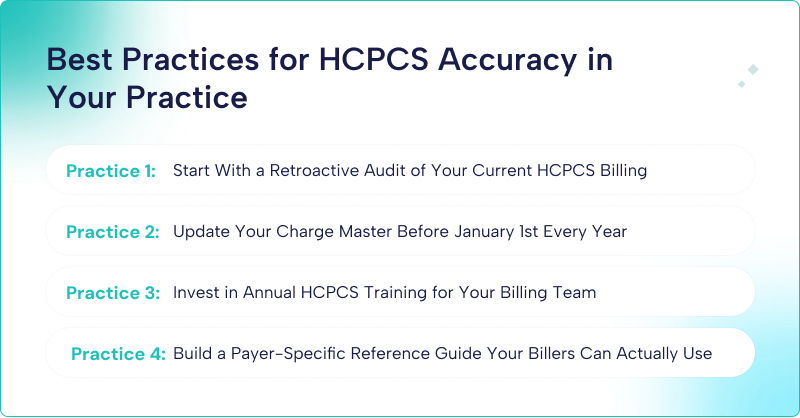
Start by conducting HCPCS code audit of your current billing. Pull claims from the last 12 months and review your most frequently billed Level II codes. Check whether units are calculated correctly, whether modifiers are applied consistently, and whether the codes match the documentation in the patient record.
Update your charge master and billing system every January when the new HCPCS codes take effect. Do not wait until you start seeing rejections. Get ahead of the updates by downloading the new code file from CMS as soon as it is published and loading it into your system before the effective date.
Train your billing and coding staff specifically on HCPCS updates each year. An annual HCPCS training session that covers changes, deletions, and new additions keeps your team sharp and reduces the lag time between a code change and your practice’s adoption of it.
Build payer-specific HCPCS policies into your billing workflow. Create a quick reference guide that documents which codes require prior authorization, which payers have different coverage rules, and which codes are historically high-denial items. Put that guide in front of your billers where they can use it daily.
HCPCS coding sits at the center of accurate billing for supplies, equipment, and drugs. When you understand how Level II codes work and how they connect with CPT and diagnosis codes, your claims become cleaner and more reliable.
Strong documentation, correct units, and proper modifier use make the difference between fast payment and repeated denials. Practices that invest time in HCPCS accuracy see better reimbursement, fewer audits, and smoother revenue cycles.