
If you have ever had a claim denied because of a simple data entry error pulled straight from an insurance card, you know exactly how frustrating that moment is. The patient handed over their card. Your staff copied the information. The claim went out. And then the denial came back because one number was transposed, or the wrong plan ID was used.
Reading a health insurance card sounds like the simplest task in your entire billing workflow. And in some ways it is. But in practice, insurance cards vary wildly from payer to payer. Some are packed with information. Others are minimalist and leave out details you desperately need. Some have changed their format so many times that even longtime staff members are not reading them correctly.
This guide walks through everything your front desk and billing team needs to know about reading, interpreting, and using health insurance card information accurately. Getting this right at the very first step of the revenue cycle prevents a chain reaction of errors downstream.
According to the Medical Group Management Association, front-end registration errors are responsible for more than 40 percent of all claim denials across physician practices in the United States. A significant chunk of those errors traces back to incorrectly captured insurance information, most of which comes directly off the insurance card.
The Advisory Board’s revenue cycle research consistently identifies patient access and registration as the highest-leverage area for denial prevention. When your team reads an insurance card incorrectly and enters bad data into your practice management system, that error travels through every subsequent step. It affects insurance eligibility verification. It affects claim submission. It affects remittance posting. One small mistake at the front desk creates a problem that can take three times as long to fix on the back end.
Beyond the financial impact, there is also a patient experience component. When a patient receives a denial letter or an unexpected bill because their insurance information was entered incorrectly, they do not blame the front desk staff. They blame the practice. They call your office frustrated. They leave reviews. They lose confidence in your team. Getting the card right the first time is a patient satisfaction issue just as much as it is a billing issue.
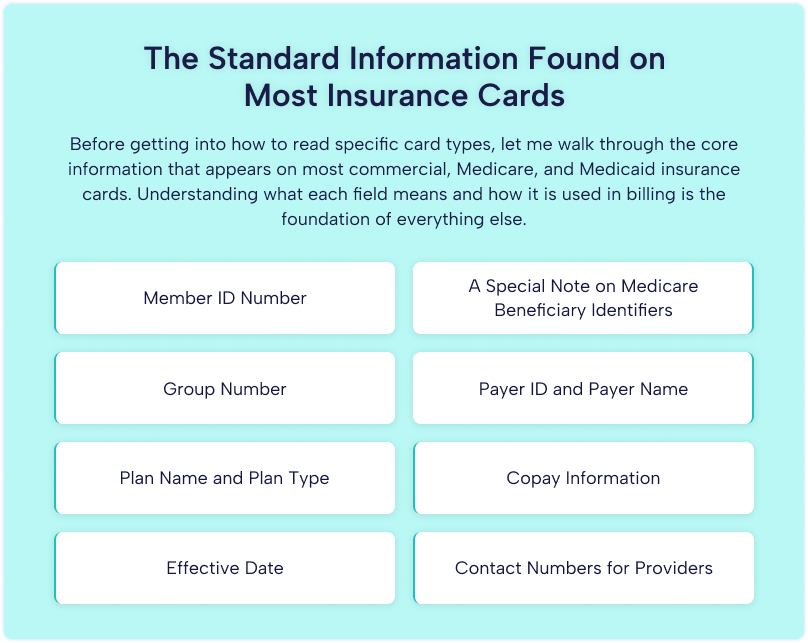
Before getting into how to read specific card types, let me walk through the core information that appears on most commercial, Medicare, and Medicaid insurance cards. Understanding what each field means and how it is used in medical billing is the foundation of everything else.
The member ID is the single most important piece of information on any insurance card. This is the unique identifier that the payer uses to locate the patient’s record in their system. Every eligibility check, every prior authorization request, and every claim submission relies on this number.
Member IDs can be alphanumeric or purely numeric. They range from 8 to 15 or more characters, depending on the payer. Some payers prefix the member ID with letters that indicate the plan type or the employer group. Others use a purely random numeric string.
The most common error with member IDs is transposition. Staff members copy numbers quickly and swap digits without realizing it. A 1 and a 7 look similar in some fonts. An 8 and a 3 can be easy to confuse on a worn or laminated card. Train your staff to read the member ID out loud or enter it twice to catch these errors.
One important note on Social Security Numbers as member IDs. Medicare traditionally used the patient’s Social Security Number as their identifier. Centers for Medicare & Medicaid Services (CMS) transitioned Medicare beneficiaries to the Medicare Beneficiary Identifier format starting in 2018 and completed the transition by 2019. The MBI is an 11-character alphanumeric code. It does not contain any letters that look like numbers, specifically no S, L, O, I, B, or Z, to reduce transcription errors. If someone brings in an old Medicare card with a Social Security Number on it, that card is outdated and cannot be used for billing.
The group number identifies the employer or group plan under which the member is covered. This is different from the member ID, which identifies the individual patient. The group number connects the patient’s coverage to a specific employer contract or benefits package with the insurer.
Group numbers are critically important for commercial insurance billing. They help the payer apply the correct fee schedule, coverage rules, and benefit structure to the claim. Two patients covered by the same insurance company but under different employer groups may have completely different benefits, copays, and deductibles.
Some insurance cards clearly label the group number as “Group” or “Group No.” Others use abbreviations like “Grp.” Still others bury it in a block of information with minimal labeling. Your staff needs to be able to identify the group number even when the labeling is not obvious.
The payer name is self-explanatory. But what many front desk teams overlook is the payer ID, which is the electronic ID your billing system uses to route claims to the correct payer through your clearinghouse.
The payer ID is often not printed on the insurance card. It is a separate lookup that your billing team performs when setting up a new payer in your system. However, the insurance card gives you the payer name, which is your starting point for that lookup.
Be careful with similar payer names. Anthem, Blue Cross Blue Shield, and various Blue plan subsidiaries all operate under related but distinct brands in different states. The Anthem plan in California is different from the Blue Cross plan in Texas, and they have different payer IDs and different coverage rules. Using the wrong payer ID routes your claim to the wrong destination and guarantees a rejection.
Many insurance cards display the specific plan name or product line in addition to the payer name. This might say PPO, HMO, EPO, POS, or it might reference a specific network name like Select or Choice Plus.
This information matters enormously for network verification. A provider who is in-network for one plan product may be out-of-network for another product from the same insurance company. The plan name on the card tells you which specific product the patient is enrolled in, which allows you to verify your network status accurately.
HMO plans typically require a primary care physician and referrals for specialist visits. If you are a specialist and the patient hands you an HMO card, check immediately whether your practice received a referral before proceeding. Seeing an HMO patient without a required referral means you may not get paid, and the patient may owe the full cost out of pocket.
PPO plans generally allow patients to see any in-network provider without a referral, but they may also have out-of-network benefits at a higher cost-sharing level. EPO plans are like PPOs in that they do not require referrals, but they have no out-of-network benefits at all. Understanding the plan type from the card shapes your entire workflow for that patient.
Many commercial insurance cards print copay amounts directly on the card for quick reference. You will often see separate copay amounts listed for primary care visits, specialist visits, urgent care visits, and emergency room visits.
Use this information as a starting point for patient collections at the time of service. However, do not rely on the copay printed on the card as your final word on patient responsibility. Copay amounts can change at annual renewal without the patient receiving a new card. The patient may also have a deductible that applies before the copay kicks in, depending on their plan structure.
Always verify the current copay amount through your eligibility check rather than relying solely on what is printed on the card. Use the card amount as a cross-reference, not as your primary source of truth.
Some insurance cards include the coverage effective date. This tells you when the current coverage period began. If a patient presents a card with an effective date that has not yet arrived, their coverage may not be active yet. If the card is missing an effective date or if it looks like it has not been updated in years, that is a cue to verify coverage through your eligibility system before assuming anything.
Most insurance cards include phone numbers specifically designated for provider use. These are separate from the member services number and connect you directly to the payer’s provider services team. Use these numbers for eligibility questions, authorization requests, and billing inquiries.
The back of the card almost always has more information than the front. Many staff members flip the card over only to get to the provider phone number and miss other important details printed there.
The Medicare card is red, white, and blue and displays the patient’s name, Medicare Beneficiary Identifier, and the parts of Medicare the patient is enrolled in.
The MBI is printed prominently on the card. It is always 11 characters in a specific alphanumeric format. Every Medicare claim requires the MBI in the correct format.
The card also shows Part A and Part B enrollment with the effective dates for each. Part A covers inpatient hospital services. Part B covers outpatient physician and clinical services. Most Medicare patients have both. However, some patients may have Part A only, which can happen with certain low-income patients who qualify based on disability but have not yet enrolled in Part B.
Note that the Medicare card itself tells you nothing about Medicare Advantage coverage. If a patient has a Medicare Advantage plan, they will have a separate card from their Medicare Advantage insurer such as Humana, UnitedHealthcare, or Aetna. The original red, white, and blue Medicare card is not the active coverage card for Medicare Advantage patients. You bill the Medicare Advantage payer, not original Medicare, for these patients. Getting this wrong is one of the most common and most costly errors in Medicare billing.
Medicaid cards vary significantly by state because each state runs its own Medicaid program. Some states issue a plastic card similar to a commercial insurance card. Others use paper documentation. Many states have moved to electronic verification only, meaning the patient may not carry a physical card at all.
In states with Medicaid managed care, beneficiaries are enrolled in a specific Medicaid managed care organization, such as Centene, Molina, or a state-specific plan. The card will show the MCO name and plan-specific information rather than just the state Medicaid program name. Billing the state Medicaid fee-for-service program instead of the MCO is a common error that results in rejected claims.
Because Medicaid eligibility changes frequently, do not rely on the physical card alone. Always run a real-time eligibility check using the patient’s Medicaid ID number from the card.
When a patient presents multiple insurance cards, your team needs to determine which coverage is primary and which is secondary before doing anything else.
Ask the patient directly whether they have more than one insurance plan. Many patients do not volunteer this information. Some do not realize that both plans need to be billed. Some assume you already know from their last visit.
Look at the cards for clues. If one card is from an employer and another is from a spouse’s employer, coordination of benefits rules apply. If one card is Medicare and another is from a retirement supplement plan or employer retiree coverage, Medicare status as primary or secondary depends on the patient’s employment status and employer size.
The back of the card sometimes includes coordination of benefits instructions or a phone number specifically for COB inquiries. Use it when you are not certain which plan pays first.
More and more patients now carry digital insurance cards on their smartphones through their payer’s mobile app. The information on a digital card is the same as a physical card, but there are a few practical points worth noting.
Always photograph or scan the digital card just as you would a physical one. Do not rely on the patient holding up their phone for your staff to read and type from manually. Transcription errors from small screens are very common.
Verify that the digital card is from the official payer app and not a screenshot from an old plan year. Patients sometimes save screenshots of their card and forget to update them when coverage changes.
Some payers now offer QR codes on digital cards that link directly to the patient’s current eligibility information. If your practice management system supports QR code scanning, this can dramatically speed up the intake process and reduce data entry errors.
The best way to reduce insurance card errors is to standardize how your team captures card information. Relying on manual transcription alone is the highest-risk approach.
Most modern practice management systems support scanning or photographing insurance cards and storing the image in the patient’s electronic chart. Implement this as a standard step at every new patient registration and at any visit where the patient presents a new card.
Require staff to verify the information they entered against the image of the card before moving on. This one cross-check step catches most transposition errors before they become claim denials.
Create a checklist of the fields your billing team needs to capture from every card: member ID, group number, payer name, plan name, plan type, effective date, and provider services phone number. When staff follow a checklist rather than relying on memory, completeness improves significantly.
At the start of each calendar year, ask all established patients to bring in their current insurance card even if they believe their coverage has not changed. Employer plans renew annually, and group numbers, copay amounts, and plan names change more often than patients realize.
Reading a health insurance card is the very first step in a long billing journey, and when it goes wrong, everything that follows is built on a shaky foundation. The goal is simple: capture the right information accurately, completely, and consistently for every single patient at every single visit.
Standardize your card capture process. Train your staff to look beyond just the member ID and actually understand what each field on the card means for your billing workflow. Build in verification steps that catch errors before they reach your billing system. And never treat an insurance card as a static document. Coverage changes, plans change, and cards become outdated faster than most patients realize.
When your team reads insurance cards correctly, your eligibility checks are more accurate, your claims go out cleaner, and your denials go down. That is a straightforward return on a very simple process improvement.
A superbill is a detailed document provided by a healthcare provider that includes patient information, diagnosis codes (ICD 10), procedure codes (CPT), and charges, allowing patients to submit claims to their insurance for out-of-network reimbursement.
A superbill is a detailed summary of a patient visit that you give to the patient so they can submit it to their insurance for possible reimbursement. You do not file the claim. The patient does.
Superbills are not for every practice. They are not for every patient. But in the right situation, they save you from having to credential with dozens of insurance plans while still giving your patients a path to reimbursement.
This guide walks through what a superbill is, who uses it, what goes on it, and how to create one that actually gets paid. Superbills also play a critical role in overall revenue cycle management, particularly for out-of-network and cash-pay practices.
A superbill is a document that contains all the information an insurance company needs to process a claim. It is called a superbill because it is a “super” bill – more detailed than a standard receipt, less formal than a full claim submission.
The superbill serves as the source document for the patient’s claim. The patient takes the superbill, attaches it to a claim form (usually the CMS-1500), and sends it to their insurance company. The insurance company uses the information on the superbill to determine what they will reimburse.
Here is the difference between standard billing and superbill billing.
Standard in-network billing:
Superbill billing (out-of-network):
You never file the claim yourself. The patient does. That is what makes a superbill different from standard billing.
Use when:
– Out of network provider
– PPO plans
– Cash pay practices
Avoid when:
– In network provider
– Medicare or Medicaid patients
– No out of network benefits
Submitting a superbill correctly is essential for reimbursement. Since providers do not submit the claim, the responsibility lies with the patient.
Missing or incorrect information can result in claim denial or delayed reimbursement.
Insurance reimbursement for superbills depends on several key factors defined by the patient’s plan.
If a provider charges $150 and the insurer’s allowed amount is $100:
A superbill does not guarantee full reimbursement, as the insurance policy determines payment.
A patient visits an out-of-network therapist and pays $150 at the time of service.
This process shows how superbills help patients recover part of their out-of-pocket costs.
A superbill is not a receipt. A receipt just says “paid X amount on Y date.” A superbill includes clinical information such as diagnosis and procedure codes.
A superbill is not a claim form. A claim form is a standardized document (CMS-1500 or UB-04) that you submit to an insurance company. A superbill is the source document that the patient uses to fill out the claim form.
A superbill is not a substitute for a contract. Giving a patient a superbill does not mean you are in network with their insurance. It does not guarantee they will get reimbursed. It only gives them the information they need to try.
| Feature | Superbill | CMS-1500 |
| Purpose | Provides billing details | Submits claim to insurance |
| Submitted by | Patient | Provider (or patient manually) |
| Format | Flexible document | Standardized form |
| Contains codes | Yes (CPT, ICD-10) | Yes (required fields) |
| Role | Source document | Official claim |
The superbill provides the information, while the CMS-1500 is the actual claim submission form.
Superbills are not for every practice. They are most useful for providers who do not contract with insurance companies directly.
Not every patient who sees an out-of-network provider needs a superbill. The superbill is only useful for patients who plan to seek reimbursement from their insurance.

A superbill contains all the information an insurance company needs to evaluate a claim. If you leave something out, the patient’s claim gets rejected. Here is exactly what you need to include.
The insurance company needs to know who provided the service.
The insurance company needs to identify the patient and match them to their policy.
If the service required a referral, include the referring provider’s information.
The specific date the service was provided. Use MM/DD/YYYY format.
If the service spanned multiple days (like a hospital stay), include the start date and end date.
A two-digit code that tells the insurance company where the service happened.
Use the wrong code, and the claim gets denied. A service provided in your office is coded 11. The same service provided in a hospital outpatient department is coded 22. Reimbursement rates differ significantly.
ICD-10-CM codes that describe the patient’s condition. Include the full code, not just the first three characters.
Each diagnosis code must be valid for the date of service. Codes change every October. Using a code that was deleted last year gets the claim rejected.
CPT or HCPCS Level II codes that describe what you did.
Include modifiers where required. Modifiers tell the insurance company about special circumstances. For example, modifier 25 means a significant, separately identifiable evaluation and management service was provided on the same day as a procedure.
Each procedure code must be linked to the diagnosis code that supports it. This is called a diagnosis pointer. The superbill should show which diagnosis goes with which procedure.
The amount you charged for each service. List each service separately. Do not lump multiple services into one line.
The charge is what you billed, not what you expect to be paid. Out-of-network reimbursement is based on the insurance company’s allowed amount, which is usually lower than your charge. That is fine. The patient needs to see your charge on the superbill.
The amount the patient paid at the time of service.
Insurance companies want to know that the patient paid you. They will not reimburse the patient for amounts they did not pay.
Creating a superbill is not complicated, but it must be accurate. Errors get claims denied. Denied claims mean angry patients.
You can also follow a structured medical billing audit checklist to ensure accuracy, compliance, and complete documentation before issuing superbills.
Do not write descriptions in plain English. Insurance companies do not read plain English. They read codes.
Wrong: “Extended office visit with patient with diabetes.”
Right: “99214” with diagnosis code “E11.9”
Wrong: “Therapy session for anxiety.”
Right: “90837” with diagnosis code “F41.1”
If you do not use standard codes, the insurance company cannot process the claim. They will send it back to the patient and ask for corrected codes. Most patients do not know how to fix this. They give up. You lose a referral source.
Every procedure code needs a diagnosis code that supports it. This is called medical necessity. The insurance company will not pay for a procedure if the diagnosis does not justify it.
Example:
The diagnosis supports the procedure. The patient came in for knee pain. You evaluated them. That is a valid visit.
Now imagine this:
The diagnosis does not support a level 4 visit. The patient came in for a routine check-up. A level 4 visit is for patients with moderate to high complexity. The claim will deny.
Your superbill needs to show which diagnosis goes with which procedure. Most superbills use a grid or a numbering system. List each diagnosis with a number (1, 2, 3). Next to each procedure, list the numbers of the diagnoses that support it.
Insurance companies expect to see two NPIs on a claim.
If you are a solo practitioner, these may be the same. If you work in a group, they are different. Use the wrong one and the claim gets rejected.
The date of service must be exactly right. If you saw the patient on March 15, put March 15. Do not put March 16. Do not put March 14.
If the service spanned multiple days, put the start date and end date. For a hospital stay, put the admission date and discharge date.
If the patient had multiple services on different dates, list each date separately. Do not lump them together.
Before you hand a patient a superbill, verify that the patient’s information is correct. Ask them to confirm:
Do not assume the information in your system is current. Patients change jobs. They get divorced. They turn 65 and switch to Medicare. Verify at every visit.
Paper superbills are exactly what they sound like. You print a document and give it to the patient.
Advantages:
Disadvantages:
An electronic superbill is a digital file, usually a PDF, that you email to the patient or make available through a patient portal.
Advantages:
Disadvantages:
Most practices today use electronic superbills. The technology is standard in most billing software. If your software does not generate superbills, consider upgrading.
Here are the most common errors I see on superbills. Each one leads to a denied claim and an angry patient. Many of these errors also contribute to claim rejections in medical billing, especially when incomplete or incorrect data is submitted.
The rendering provider NPI is missing. Or you used the group NPI when the payer expects the individual NPI. Or you used an NPI that is not enrolled with the payer.
Fix – Always include both NPIs. Verify that each NPI is active and correct for the payer.
You used an ICD-10 code that does not exist. Or you used a code that was deleted in the last annual update. Or you used a code that is not valid for the patient’s age or gender.
Fix – Use a current ICD-10 code book or software. Update your codes every October.
You billed separately for services that should be bundled together. For example, billing for a routine office visit on the same day as a preventive medicine visit without using the correct modifier.
Fix – Learn the bundling rules for the codes you use most often. Use modifiers when appropriate.
The procedure code requires a modifier, but you left it off. For example, billing for a bilateral procedure without modifier 50.
Fix – Check payer requirements for each procedure code. Some require modifiers. Some do not. Know the difference.
You listed procedure codes, but did not show which diagnosis supports each procedure. The insurance company has no way to assess medical necessity.
Fix – Use a superbill format that includes diagnosis pointers. Number each diagnosis. Next to each procedure, list the numbers of the diagnoses that support it.
You coded an office visit as place of service 11 when it should be 22. Or you coded a telehealth visit as 11 instead of 02.
Fix – Know the correct POS code for every service location. Update your codes when telehealth rules change.
These issues often result in specific denial codes from payers, which indicate why a claim was rejected or not reimbursed.
A superbill does not change your obligation under balance billing laws. If you are in network with a patient’s insurance, you cannot give them a superbill and bill them your full fee. You must bill the insurance directly and accept the contracted rate.
If you are out of network, you can bill the patient your full fee. The superbill is just documentation. But some states have balance billing protections for out-of-network emergency care and certain other services. Know your state’s rules.
Do not put false information on a superbill. Do not upcode (bill for a higher level of service than you provided). Do not unbundle (bill separately for services that should be bundled). Do not bill for services you did not provide.
Insurance companies audit out-of-network claims just like in-network claims. If they find fraud on a superbill, they can pursue you for damages. They can also report you to state licensing boards and the OIG.
Starting in 2022, the No Surprises Act requires providers to give uninsured and self-pay patients a good faith estimate of charges before providing services. A superbill is not a substitute for a good-faith estimate. You must provide the estimate separately.
If you treat self-pay patients, learn the good faith estimate requirements. The penalties for non-compliance are steep.
A superbill is a detailed billing document that allows patients to submit out-of-network claims using standardized codes such as CPT and ICD-10. It includes provider information, patient details, and service charges, helping insurers determine reimbursement based on policy terms.
A superbill is a tool. It lets you serve patients even when you are not in network with their insurance. The patient pays you up front. You give them a superbill. They file for reimbursement themselves.
Superbills work best for out-of-network providers, direct primary care practices, cash-pay practices, and patients with PPO plans that include out-of-network benefits.
To create a superbill that actually gets paid, include accurate provider and patient information, valid diagnosis codes, correct procedure codes with modifiers, proper diagnosis links, and complete charge information. Use electronic superbills when possible. Train your staff on common mistakes.
And remember. A superbill does not guarantee reimbursement. The patient still needs to file the claim correctly. Their plan still needs to have out-of-network benefits. Their deductible still applies. Set realistic expectations up front. Tell patients what to expect. Give them instructions. Answer their questions.
A superbill is used to help patients submit out of network claims for reimbursement. It contains all the coding and provider details required by insurance companies to process the claim.
No, reimbursement depends on the patient’s insurance benefits, deductible, and out of network coverage. The superbill only provides the required information.
The patient submits the superbill to their insurance company. The provider does not file the claim in this process.
In most cases, Medicare patients cannot use superbills for reimbursement due to strict billing rules. Providers must follow Medicare billing requirements directly.
Managing superbills, coding, and reimbursement can get complicated fast. Small errors lead to denied claims, frustrated patients, and lost revenue.
Medhasty helps you handle billing the right way. From accurate coding to clean documentation and fewer rejections, you get a smoother workflow and better financial outcomes.
If you want fewer billing headaches and more predictable revenue, it’s time to bring in the right support.
Talk to Our Medical Billing Expert
A Medicare billing audit is a systematic review of medical claims, coding accuracy, clinical documentation, and reimbursement data to ensure compliance with CMS regulations, identify underpayments, and reduce billing errors.
It evaluates whether the services billed are:
Regular Medicare audits help practices prevent denials, recover lost revenue, and reduce compliance risk.
There is a number sitting inside most Medicare billing operations that nobody has calculated. It is the amount being lost each month to underpayments that were never caught, denials that were never worked, and coding patterns that trigger audits nobody saw coming. Some practices have a rough sense of their denial rate. Far fewer know how much Medicare is paying them below the contracted rate on correctly coded claims. Almost none have a documented audit process that they run on a scheduled basis.
That gap is expensive. The American Medical Association puts physician practice revenue loss from billing inefficiencies at tens of thousands of dollars per physician per year. A significant chunk of that is Medicare-specific, because Medicare billing has its own rules, its own documentation requirements, its own modifier logic, and its own audit contractors who spend their entire working day looking for patterns that indicate improper payments.
Running your own Medicare billing audit before someone else runs one for you is not defensive accounting. It is how practices find money they are already earning but not collecting, fix patterns that would have eventually drawn external scrutiny, and keep their revenue cycle running the way it should. This guide covers why internal Medicare audits matter, what they should examine, and how to run one that actually produces actionable results.
Medicare is not just another commercial payer with a slightly different fee schedule. The rules governing Medicare billing are federal regulations. Violations are not contract disputes. They are potentially False Claims Act. That distinction matters because the stakes attached to billing errors are higher with Medicare than with any commercial payer, and the audit infrastructure CMS has built reflects that.
Recovery Audit Contractors, MAC pre-payment reviews, OIG audits, CERT audits, and Unified Program Integrity Contractors all exist specifically to identify Medicare billing errors. They work from data. They look for statistical outliers, billing patterns that differ significantly from peer benchmarks, high volumes of certain modifiers, unusual procedure-to-diagnosis combinations, and claims where documentation does not support the service billed.
Most practices find out they are on one of these entities’ radar when a request for medical records arrives in the mail. By then, the review is already in motion. Running an internal audit first, on your own timeline, gives the practice the chance to identify and voluntarily correct issues before that letter arrives, which is a very different legal and financial position than responding to an external audit after the fact.
Medicare audits are conducted by multiple entities, each focusing on different aspects of billing accuracy and compliance.
RAC audits identify improper payments, including both overpayments and underpayments, using data-driven analysis.
MACs perform pre-payment and post-payment reviews to ensure claims meet coverage and documentation requirements.
CERT audits measure the accuracy of Medicare payments and identify national error rates.
OIG audits focus on detecting fraud, abuse, and systemic billing issues across providers.
Each audit type uses data patterns, making internal audits critical for early detection.
Understanding Medicare audits requires familiarity with the organizations and systems involved in claim processing and compliance.
The federal agency that establishes billing rules, reimbursement policies, and compliance standards.
Regional contractors responsible for processing claims and conducting audits.
Entities that identify improper payments using data analysis.
Government body responsible for detecting fraud and enforcing compliance.
Measures the accuracy of Medicare payments and identifies error trends.
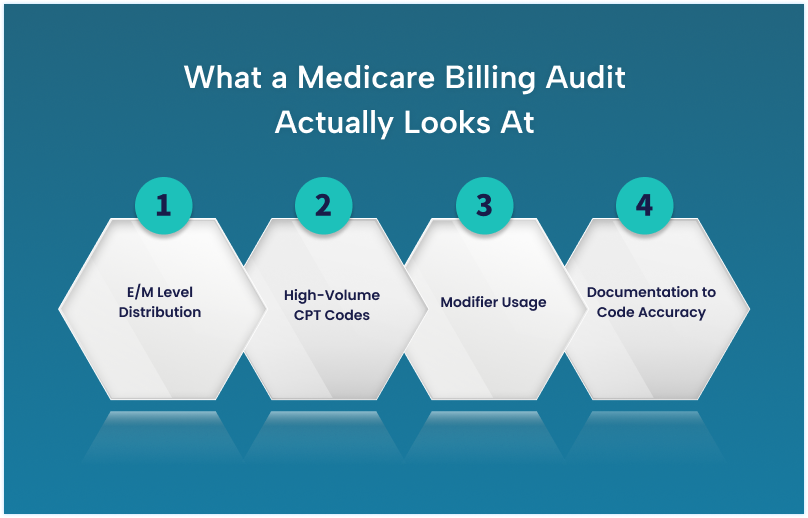
An internal Medicare billing audit is not a random check of a few claims. A well-structured audit examines specific areas that are known to generate errors, and it does so with enough sample size to identify patterns rather than isolated mistakes. Here is what the audit should cover.
You can also follow a structured medical billing audit checklist to ensure every step of the audit process is completed accurately and consistently.
Pull your evaluation and management code distribution for the last 12 months. Look at what percentage of your established patient office visits were billed at each level from 99211 through 99215. Compare that distribution against the national benchmark for your specialty, which CMS publishes in the Physician Fee Schedule data and which specialty societies often publish for their members.
If your practice is billing 99214 or 99215 at rates significantly above the national benchmark for your specialty, that is a flag. It does not necessarily mean the billing is wrong. High-complexity practices see higher-acuity patients. But it means the documentation supporting those higher-level visits needs to be airtight, because statistically anomalous billing patterns are exactly what automated screening systems are designed to detect.
Equally important: if your E/M distribution is heavily weighted toward lower-level codes when your patient population is genuinely complex, you may be leaving legitimate revenue behind through systematic undercoding. Both problems are worth finding.
Identify the 15 to 20 CPT codes that account for the largest share of your Medicare claims volume. For each one, pull a sample of 10 to 15 claims and compare the code billed against the documentation in the corresponding medical record.
You are checking three things. First, does the documentation support the code billed? Not in a general way. Specifically: does the note contain the elements that the code’s descriptor requires? Second, is the ICD-10 diagnosis code on the claim clinically consistent with the procedure performed? Third, are the modifiers applied correctly? A high-volume procedure with a consistently misapplied modifier is a systematic billing problem that affects every claim in that group.
Modifier 25 is the most frequently misused modifier in physician billing. When your audit pulls claims where Modifier 25 was appended to an E/M code on the same day as a procedure, check whether the documentation clearly shows a separately identifiable E/M service. A physician who bills a 99213 with Modifier 25 alongside every minor procedure, regardless of whether a genuinely distinct E/M occurred, is creating a billing pattern that looks like systematic Modifier 25 abuse.
Modifier 59 and the X modifiers deserve similar scrutiny. When two codes that NCCI would normally bundle are being billed together, the modifier justifying separate payment needs to be backed by documentation showing the services were genuinely distinct. A sample review of your top 10 modifier 59 code pairings will tell you whether those modifiers are being applied with appropriate clinical support or as a workaround to pass bundling edits.
This is the core of any billing audit. Pull a sample of claims, find the corresponding medical records, and read them. Does the note support the code? Neither does the code seem reasonable given the patient’s condition. Does the actual documentation support the specific code billed?
For E/M codes under the 2021 guidelines, the note needs to either document the total time spent or reflect a level of medical decision-making that corresponds to the billed code. For procedure codes, the operative or procedure note needs to describe what was done in enough detail to confirm the specific CPT code was the right one. For diagnostic codes, the physician needs to have documented the diagnosis, not just a lab value or an imaging finding.
Medicare billing is governed by strict federal regulations that directly impact claim approval and reimbursement.
Services must be medically necessary and supported by documentation aligned with CMS coverage policies.
Every billed service must be supported by complete and accurate clinical documentation.
CPT and ICD-10 codes must accurately reflect the services performed and diagnoses treated.
National Correct Coding Initiative (NCCI) edits prevent improper code combinations, and modifiers must be used correctly to justify exceptions.
Violating these rules increases the risk of denials, audits, and financial penalties.
Most conversations about billing audits focus on finding overcoding and compliance risk. But internal audits are just as valuable for finding underpayments, and there are more of them than most practices realize.
Medicare pays based on its fee schedule, and the fee schedule is locality-adjusted. If your practice management system has the wrong locality code, or if it is applying outdated payment rates, claims may be processed correctly, but paying at incorrect amounts. This is a setup and maintenance issue, not a coding issue, but it affects every claim submitted.
More commonly, underpayments occur when Medicare applies a payment reduction that the practice does not notice. A multiple procedure reduction was applied incorrectly. A bilateral modifier was appended, but the bilateral rate was not applied. A global surgery payment where Medicare incorrectly bundled a separately billable service. These discrepancies sit in the payment posting data and are only visible if someone is comparing what was paid against what should have been paid.
The check involves pulling the allowed amounts from your EOBs or ERA data and comparing them against the Medicare Physician Fee Schedule for your locality. The CMS Medicare Physician Fee Schedule lookup tool at cms.gov allows providers to search by CPT code and geographic area to confirm the correct allowed amount. When the allowed amount on your remittance is lower than the published fee schedule rate for your locality, that is an underpayment.
Track these discrepancies by payer and by code. A single underpayment on one claim is likely a processing error worth appealing. Twenty underpayments on the same CPT code from the same Medicare contractor over three months is a systematic problem worth escalating formally to your MAC’s provider relations department with documented evidence.
Many of these issues originate earlier in the process, such as claim rejections in medical billing.
There is no single right answer to audit frequency, but there are wrong answers. Running an audit once at implementation and never again is one of them. Annual audits catch some things but miss the systematic errors that build up over months.
A practical cadence for most practices is a focused quarterly review covering high-volume codes and modifiers, combined with a broader annual audit that examines E/M distribution, documentation accuracy across all service types, and underpayment reconciliation. Practices with higher Medicare volume or higher audit risk profiles, specialty practices in oncology, cardiology, surgery, and pain management, for example, should run more frequent focused reviews.
When Medicare publishes its annual Physician Fee Schedule final rule, that is also a trigger for an audit review. Fee schedule changes, new covered services, updated NCCI edits, and revised coverage criteria all affect whether existing billing patterns remain compliant. What was correct billing in October may generate denials in January if nobody reviewed the changes.
When an internal audit identifies a pattern of overcoding, the response depends on the scope and nature of the finding. Isolated errors corrected going forward require updated coder and physician education and a process fix. Systematic overcoding that has been occurring over months or years at significant dollar volume may require voluntary self-disclosure to CMS through the OIG’s Self-Disclosure Protocol or through the MAC’s voluntary refund process.
The decision about voluntary refund versus internal correction is not one to make without legal counsel familiar with Medicare compliance. The OIG’s guidance on voluntary disclosure is clear that self-reporting and refunding overpayments before a government investigation begins is treated very differently from being found in an audit. The 60-day rule under the False Claims Act requires that identified overpayments be reported and returned within 60 days of identification. Ignoring a known overpayment after identifying it in an internal audit is not an option.
When the audit finds legitimate undercoding, meaning the documentation supports a higher level of service than was billed, the fix is education. Physicians who consistently underbill either do not understand the documentation requirements for the higher codes, or they are deliberately selecting lower codes out of fear of audits. Both situations cost the practice money and neither protects from audits in any real way.
Correcting undercoding going forward is straightforward. Going back and amending claims that were undercoded is more complicated and generally not worth the administrative cost for individual claim adjustments. The priority is getting the coding right on future encounters.
Documentation gaps found in the audit require physician-specific feedback. Not a general staff email about documentation. A review of the specific note types that are falling short, what elements are missing, and what the physician needs to add to bring the documentation in line with what the code requires. Many physicians underestimate how specifically their notes need to address medical decision-making complexity, time, or procedure detail. Targeted physician education with concrete examples from their own notes is what actually changes documentation behavior.
A Medicare billing audit is not about finding things to be afraid of. It is about knowing what is happening inside your revenue cycle before someone else finds out first. The practices that run regular internal audits collect more of what they earn, fix problems when they are small, and face external reviews from a position of documented compliance rather than scrambling to surprise. The time investment is real. So is the return.
Medicare billing errors, underpayments, and unnoticed compliance risks don’t just delay revenue—they quietly reduce it over time.
At Medhasty Medical Billing Services, our billing experts analyze your claims, identify hidden revenue gaps, and implement proven processes to improve accuracy, reduce denials, and maximize reimbursements.
Our team processes thousands of claims monthly, giving us direct insight into billing errors and underpayment trends across multiple medical billing specialties.
Request a customized Medicare billing audit and uncover revenue you may already be losing.
A Medicare audit is a review of claims and documentation to ensure compliance with CMS guidelines and identify billing errors or improper payments.
A Medicare audit can take anywhere from a few weeks to several months, depending on the audit type and the number of claims being reviewed.
Common triggers include abnormal billing patterns, excessive use of modifiers, high-level coding distributions, and inconsistencies in documentation.
After an audit, providers may receive payment adjustments, requests for refunds, or recommendations for corrective action.
Medicare audits include RAC, MAC, CERT, and OIG audits, each focusing on identifying improper payments, compliance issues, and billing accuracy.
Common errors include incorrect coding, insufficient documentation, misuse of modifiers, and failure to meet medical necessity requirements.
A medical billing audit checklist is a structured process used to review patient registration, coding accuracy, claim submission, payment posting, and denial management to identify errors, prevent revenue loss, and improve overall revenue cycle performance.
Most billing problems that show up on the aging report at the end of the month did not start at the month’s end. They started weeks earlier when a claim went out with the wrong code, when a modifier was missing, when a denial sat unworked in a queue, or when an underpayment was posted and nobody compared it against the contracted rate. By the time the aging report reflects the damage, the window to fix some of those claims has already closed.
A billing audit checklist is not a panacea. But when it is used consistently, it catches errors before they become aged denials, finds the revenue leaks that do not show up in aggregate reports, and gives the billing manager something concrete to act on rather than a vague sense that collections could be better.
What follows is a working checklist organized by billing workflow area. It is built for practices that want to run their own internal audits without waiting for an external consultant to tell them what they could have already found. Use it monthly for focused reviews and quarterly for a broader pass through the revenue cycle.
A medical billing audit evaluates multiple components of the revenue cycle to identify errors, ensure compliance, and improve reimbursement accuracy. Each component plays a critical role in how claims are processed, paid, or denied.
Revenue Cycle Management (RCM) is the end-to-end financial process that tracks a patient’s journey from appointment scheduling to final payment collection. In a billing audit, RCM is evaluated to identify breakdowns in workflows such as eligibility verification, charge capture, claims submission, and payment posting.
A well-audited RCM process helps reduce claim denials, improve cash flow, and shorten accounts receivable cycles.
Medical billing processes and reimbursement policies are governed by organizations such as the Centers for Medicare & Medicaid Services (CMS).
CPT (Current Procedural Terminology) and ICD-10 (International Classification of Diseases) codes are used to report medical procedures and diagnoses on claims. A billing audit reviews whether these codes accurately reflect the services provided and are supported by clinical documentation.
Incorrect or mismatched coding can lead to claim rejections, denials, or underpayments, making coding accuracy a critical audit focus.
A clearinghouse is an intermediary system that reviews claims for errors before transmitting them to insurance payers. It performs validation checks such as missing data, invalid codes, and formatting issues.
During an audit, clearinghouse reports are analyzed to identify recurring rejection patterns and upstream data entry or coding errors.
EOBs and ERAs are payer-issued documents that explain how a claim was processed, including payment amounts, adjustments, and patient responsibility.
Audits compare EOB/ERA details against posted payments to ensure:
Accounts Receivable (AR) represents the outstanding payments owed to a healthcare provider for services rendered. A billing audit evaluates AR aging reports to identify delayed payments, unresolved claims, and revenue leakage.
High AR days or large balances in 90+ day buckets indicate inefficiencies in billing, insurance claim denial management, or follow-up processes.
Billing problems that trace back to registration are the most preventable and the most frustrating. By the time a claim is denied for an invalid member ID or missing prior authorization, the patient has already been seen, and the practice is chasing a fix for a problem that could have been caught two weeks earlier.
The gap between what was clinically done and what was billed is where some of the most significant revenue leakage lives. Undercaptured charges and incorrect codes both reduce what the practice collects, in different ways.
Claims that do not make it to the payer cannot generate payment. A clean claim rate below 95 percent on first submission is a signal that something in the pre-submission workflow is breaking down consistently.
Payment posting errors are invisible in most billing reports unless someone specifically looks for them. An incorrectly posted contractual adjustment, a misapplied patient payment, or an overpayment that was not flagged all affect the accuracy of the accounts receivable without generating a denial or a rejection that would attract attention.
Denials are where most practices have the most visible revenue cycle problem and the most room for improvement. A denial rate above 5 percent is a signal that upstream processes need attention. An unworked denial rate above 2 percent is a signal that the denial management workflow itself is broken.
The aging report is the financial health report of your revenue cycle. Every dollar sitting in 90-plus-day aging is a dollar that may never be collected. The goal is not to have no aging. The goal is to understand what is aging and why, and to make sure nothing is aging for a preventable reason.
Even well-structured audits can fail if critical gaps are overlooked. These common mistakes often lead to repeated denials, revenue leakage, and inaccurate financial reporting.
Failing to verify patient eligibility before services are rendered is one of the most preventable causes of billing errors.
Always confirm:
CPT codes are updated annually, and using outdated or invalid codes results in immediate claim rejection or denial.
Best practice:
Many practices focus only on denials and overlook underpayments, which silently reduce revenue.
Always:
Most billing issues are not caused by complex problems—but by missed fundamentals in verification, coding, and payment review.
Addressing these early prevents downstream issues in:
A billing audit checklist works when it is used on a schedule, not when it is pulled out during a crisis. The practices with the cleanest revenue cycles are not the ones that investigate problems after they pile up. They are the ones that check the same things every month, fix what they find immediately, and watch their aging shrink and their collection rate climb as a result of consistent attention to the details that compound into real money over time.
A consistent audit process can improve accuracy—but expert insight can transform your entire revenue cycle.
Talk to Medhasty’s Medical Billing team and see how we help practices reduce errors, recover lost revenue, and improve financial performance.
A medical billing audit checklist includes a structured review of key revenue cycle components such as patient registration accuracy, insurance verification, CPT and ICD coding, claim submission processes, clearinghouse rejections, payment posting, denial management, and accounts receivable (AR) follow-up.
The purpose of this checklist is to identify errors, ensure compliance with payer guidelines, and detect revenue leakage caused by undercoding, missed charges, or incorrect reimbursements.
A comprehensive audit covers both front-end processes (eligibility, authorization) and back-end processes (denials, AR, payments) to ensure end-to-end billing accuracy.
A medical billing audit should be performed monthly for targeted reviews and quarterly for a comprehensive evaluation of the entire revenue cycle.
High-volume practices or those experiencing frequent denials may benefit from more frequent audits or continuous monitoring systems.
A good denial rate in medical billing is typically below 5% of total claims submitted, with best-performing practices maintaining rates closer to 2–3%.
Denial rates above 5% usually indicate issues in:
Monitoring denial rates by payer, denial reason, and claim type is essential for identifying root causes and improving revenue cycle performance.
A medical billing audit improves revenue cycle performance by identifying errors, correcting inefficiencies, and optimizing workflows across the billing process.
Key benefits include:
By addressing both front-end and back-end issues, audits help practices maximize reimbursements and maintain consistent cash flow.
The most common errors identified during a medical billing audit include:
These errors often originate in early stages of the billing process but impact the entire revenue cycle if not corrected promptly.
Clearinghouse reports help in billing audits by identifying claim errors before they reach the payer, including missing data, invalid codes, and formatting issues.
By analyzing clearinghouse rejection reports, billing teams can:
A high rejection rate at the clearinghouse level indicates upstream issues in data entry or coding processes.
Accounts receivable (AR) analysis in a billing audit focuses on outstanding claims and unpaid balances to identify delays, inefficiencies, and potential revenue loss.
Audits evaluate:
High AR days or large 90+ balances indicate problems in follow-up processes, denial management, or payer delays.
Yes, small practices benefit significantly from billing audits because even minor errors can lead to substantial revenue loss over time.
For smaller practices, audits help:
Regular audits allow small practices to maintain financial stability and operational efficiency without increasing overhead.
A claim rejection in medical billing occurs when a submitted claim fails validation checks and is returned before being processed by the insurance payer. This usually happens due to errors such as missing patient information, invalid codes, incorrect payer details, or formatting issues.
Unlike claim denials, rejected claims never enter the payer’s adjudication system and must be corrected and resubmitted before payment can be considered.
Claim rejections are a pain. They slow down your cash flow, waste your staff’s time, and mess with your numbers.
But here is the thing most people get wrong. They lump rejections and denials together like they are the same problem. They are not. And if you treat them the same way, you are going to keep losing money.
This guide walks through what rejections are, why they happen, and how to stop them before they ever hit your workflow.
This is where most billing staff get tripped up. A rejection and a denial sound similar, but they happen at completely different stages of the process.
A claim is rejected before the payer even looks at it. The claim never enters the payer’s system as a legitimate billable claim.
Why?
Your claim failed basic formatting or data requirements. This is like trying to board a flight without a valid ID. You do not even get to the gate. The airline turns you away immediately.
Rejections come from things like:
The good news?
You can fix a rejection and resubmit it.
The bad news?
Every rejection adds days or weeks to your payment timeline.
A denial is different. The payer accepted your claim, processed it, reviewed it, and then said “no”. The claim made it through the front door, got looked at, and was refused.
Denials occur when the payer determines that the service is not covered, is not medically necessary, or does not meet their policy requirements.
Here is the critical difference. You cannot just fix a denial and resubmit it. You have to file an appeal. And appeals require documentation, clinical justification, and often multiple rounds of back-and-forth.
| Rejection | Denial | |
| When discovered | Before processing | After processing |
| Claim status | Never entered payer system | Entered and reviewed |
| Typical causes | Missing data, invalid codes, formatting errors | Not covered, no auth, medical necessity |
| Payer response | Claim returned; no payment considered | EOB/ERA with denial code |
| Fixing it | Correct and resubmit | Appeal with documentation |
| Time pressure | Must be fixed and resubmitted before timely filing deadline | Appeal deadlines vary by payer (60-180 days) |
| Success rate | High, if error is fixed correctly | Variable, depends on denial reason and documentation |
To better understand denial-related issues, read our complete guide on medical billing denial codes. Medical billing guidelines and claim validation rules are defined by organizations like the Centers for Medicare & Medicaid Services (CMS).
Understanding claim rejections requires familiarity with the core systems and entities involved in the medical billing workflow.
A clearinghouse acts as an intermediary that checks claims for errors before sending them to the payer. It performs validation edits to ensure claims meet formatting and data requirements.
Electronic Data Interchange (EDI) enables claim transmission:
These transaction standards are regulated under HIPAA electronic data exchange guidelines.
These documents provide details about claim processing outcomes, including payments or denials.
Incorrect pairing can trigger rejections.
Diagnosis coding follows ICD-10 guidelines established by healthcare authorities.
RCM is the financial process that manages claims from submission to payment. Rejections disrupt this cycle and delay revenue.
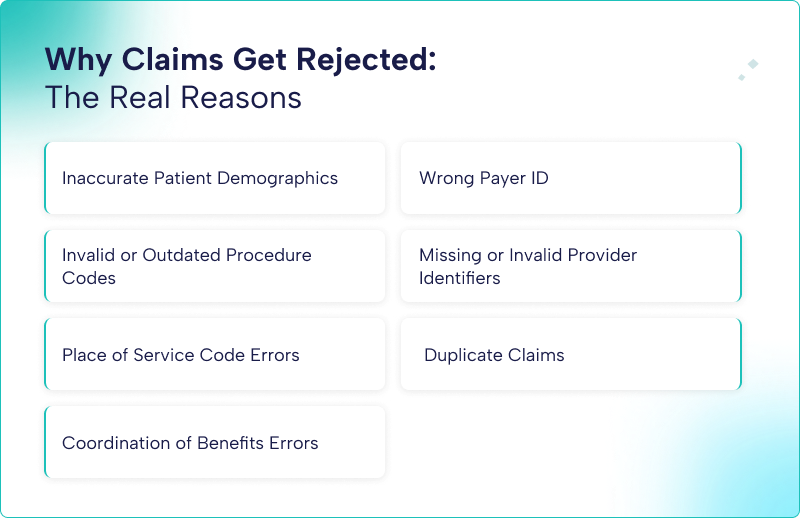
Let us look at what actually causes rejections. Not the theory. The actual, day-to-day screw-ups that stop your claims cold.
This is the number one killer of clean claims. A transposed digit in a birth date. A missing apartment number. A maiden name that does not match what the insurance company has on file.
Here is why this happens. Payer eligibility and EDI edits depend on exact field matches. Your system says the patient’s birthday is 04/15/1975. The payer’s system says 04/05/1975. That is a mismatch. The claim gets rejected instantly.
Fix this at the front desk. Verify patient information at every single visit. Not just the first one. People change jobs. They get divorced. They turn 65 and switch to Medicare. You need to catch those changes before your bill.
Each insurance company has a unique Payer ID. Usually a five-digit alphanumeric code. This tells the clearinghouse where to send the claim.
Use the wrong Payer ID, and your claim goes to the wrong place. Or it goes nowhere at all. The system rejects it because it does not recognize the destination.
Keep a current list of Payer IDs for every insurance company you bill. Update it every time you get a new contract or a payer changes their processing system.
CPT and HCPCS codes change every year. New codes get added. Old codes get deleted. Some codes get revised.
If you bill a code that was deleted last year, your claim will be rejected. The payer’s system looks for that code in its valid code table. It is not there. Rejection.
Here is a concrete example. Medicare has specific frequency codes. If you submit a corrected claim without using the frequency code “7”, it gets rejected. That is a simple thing. But thousands of claims get rejected for exactly that reason every day.
CPT codes are maintained and updated annually by the American Medical Association (AMA).
Your NPI needs to be on every claim. The rendering provider’s NPI needs to be there too. And they need to match what the payer has on file for your practice.
When a new provider joins your practice, their NPI needs to be enrolled with each payer before you bill under their name. Send a claim before that enrollment is active? Rejection.
Same thing with taxonomy codes. A taxonomy code tells the payer what kind of provider you are. If you bill a cardiology procedure but your taxonomy code says family practice, that claim is getting rejected.
Place of Service codes are two-digit codes that tell the payer where the service happened. The office is 11. The inpatient hospital is 21. Telehealth has its own codes.
Use the wrong one, and your claim gets rejected. For example, submitting a telehealth visit under an office POS code triggers an automatic rejection because the payer’s system expects a different code for virtual visits.
Submit the same claim twice, and the second one gets rejected as a duplicate. The payer’s system sees the same patient, same date of service, same procedure code, and says, “We already have this one.”
Here is where people mess up. They get a rejection for some other reason, fix it, and resubmit. But they forget to mark it as a corrected claim. The system sees what looks like a duplicate and rejects it again.
If you are resubmitting a corrected claim, you need to indicate that. For electronic claims, use frequency code “7”. For paper claims, check the “resubmission” box or indicate it in the appropriate field.
When a patient has two insurance policies, you need to bill the primary payer first. Bill the secondary payer before the primary? Rejection. Bill is primary, but do not indicate that there is a secondary? Also, a problem.
This gets even messier when patients switch jobs or get divorced. The order of payers can change. You need to verify the correct primary payer at every visit.
Our medical billing experts can identify root causes and fix systemic issues to improve your clean claim rate.

Here is how rejections actually move through your system and what you need to do at each stage.
You send the claim. Either directly to the payer or through a clearinghouse. Most providers use a clearinghouse because it adds an extra layer of validation before the claim hits the payer.
Before the clearinghouse forwards your claim, it runs a series of edits. It checks for missing fields. Invalid codes.
If the clearinghouse finds an error, it rejects the claim right there. You get a rejection report. You fix the error. You resubmit. The claim never goes to the payer.
This is actually a good thing. A clearinghouse rejection is easier to fix than a payer rejection because you catch it immediately.
If the clearinghouse passes the claim, it goes to the payer. The payer runs their own validation. They check:
If any of this fails, the payer sends back a rejection. This usually comes in the form of a 277CA transaction or a rejection report.
Your billing team receives the rejection. This needs to go into a tracking system immediately. Record:
Do not skip this step. Without tracking, you have no idea which claims need rework and which are still pending.
Before you fix anything, figure out why the rejection happened. Was it a data entry error? A system mapping issue? A missing step in your front desk process?
If you just fix the one claim without understanding the root cause, the same error will happen again on the next claim. And the one after that.
Fix the error. Update the patient’s demographic. Correct the procedure code. Add the missing modifier.
Then resubmit. Make sure you mark it as a corrected claim using frequency code “7”. Otherwise, it might get rejected as a duplicate.
After resubmission, track the claim to make sure it gets accepted. Do not assume that fixing one error means there are no other errors. The claim could have had multiple problems. You might have fixed one but missed another.
A clinic submitted a claim for an outpatient procedure, but the claim was rejected due to incorrect patient demographics.
✔ Claim accepted on resubmission
✔ Payment received within standard cycle
This highlights how small front-end errors can disrupt the entire billing process.
Here are some rejection codes you will see frequently and what they actually mean.
| Rejection Code | What It Means | How to Fix |
| 0053 | Duplicate claim | Verify the procedure code is valid and appropriate for the diagnosis |
| 14 | Incorrect coding | Obtain authorization and resubmit with the auth number |
| 263 | Claim timeliness | Check timely filing limits. May be too late to resubmit |
| 0026 | Prior authorization required | Check that the date of service is valid and within allowable range |
| 7 | Invalid family or insuree | Verify patient insurance information is current and active |
| 9 | Invalid target date | Check that the date of service is valid and within the allowable range |
| 1 | Invalid item or service code | Verify procedure code exists and is current for the date of service |
Rejections cost you in three ways.
Industry data shows that average initial denial rates run between 11.8 percent and 20 percent. That means one out of every five to ten claims you submit gets denied or rejected. And about 65 percent of denied claims never get reworked.
If you submit 1,000 claims a month and 15 percent get rejected, that is 150 claims that need rework. If each one takes 15 minutes to fix, that is 37.5 hours of staff time. Every month. Just on rework.
Claim rejections do more than delay payments—they create compounding financial challenges across your practice.
Practices with high rejection rates often experience reduced profitability and inefficiencies in their revenue cycle management.
Prevention is cheaper than rework. Much cheaper. Here is how to stop rejections at the front end.
Do not assume coverage is active just because the patient has an insurance card. Coverage changes. Policies terminate. People lose jobs.
Verify eligibility at least 48 to 72 hours before the appointment. Do it again at check-in. Things change fast. Use your practice management system’s eligibility tool or check directly on the payer portal.
Do not send a claim without scrubbing it first. Your clearinghouse probably offers scrubbing. Your practice management system might have it built in. Use it.
Scrubbing catches things like:
A good scrubber can catch 80 to 90 percent of common errors before the claim ever leaves your office.
CPT and HCPCS codes change every January. ICD-10 codes change every October. Your billing staff needs to know what changed and how it affects the codes you use.
Set up a training session every quarter. Go over new codes, deleted codes, and revised codes. Review payer-specific requirements for the codes you bill most often.
Most rejections trace back to front desk errors. Wrong birth dates. Misspelled names. Incorrect insurance IDs.
Create a standardized check-in process. Verify two forms of ID. Scan the insurance card front and back. Have the patient confirm their demographic information at every visit.
Use dropdown menus instead of free text fields where possible. Limit the opportunity for typos.
Track every rejection and denial you receive. Include the reason code, the payer, the provider, and the date. Review this log monthly.
Look for patterns. Is one payer rejecting claims more often than others? Is one provider generating more rejections? Is a specific code getting rejected repeatedly?
Those patterns tell you where to focus your prevention efforts.
Most practice management systems let you build custom edits. Use them. Set up rules that flag claims before submission if certain conditions are not met.
For example, if a claim has a procedure code that requires prior authorization, set an edit that blocks submission until an authorization number is entered. If a claim is missing the referring provider NPI for a specialty visit, flag it.
These edits stop errors at the source instead of catching them after submission.
Use this checklist to minimize rejection rates:
Following these steps can significantly improve your clean claim rate.
Claim rejections are preventable. Not all of them. But most of them. The practices that have low rejection rates are not smarter than you. They just have better systems.
Verify eligibility before every visit. Scrub every claim before submission. Train your staff on code updates. Track your rejections and look for patterns. Fix the root cause, not just the one claim.
Do those things consistently, and your rejection rate will drop. Your staff will spend less time on rework. Your cash will flow faster. And you will stop losing money to claims that never should have been rejected in the first place.
A rejection occurs before claim processing due to errors, while a denial happens after the payer reviews and refuses payment.
Yes, rejected claims can be corrected and resubmitted, unlike denied claims, which require an appeal.
Rejected claims should be corrected and resubmitted immediately to avoid missing timely filing deadlines.
The most common cause is inaccurate patient demographic information.
An entity code in medical billing is a two-character identifier used in EDI transactions (such as the 837 claim) to define the role of each party involved in a healthcare claim. These codes identify whether a party is the billing provider, rendering provider, patient, subscriber, or referring provider.
Entity codes ensure that payer systems correctly interpret claim data and match each provider, patient, and organization to the appropriate role during claim processing.
Let say an insurance payer denies a claim because of an entity qualifier or entity code mismatch. The biller stares at it for a moment, runs a quick search, gets a vague answer about EDI loops and segments, and eventually calls the clearinghouse for help. Twenty minutes later, the fix is made, and the claim goes out again.
That scenario repeats itself in billing offices more often than it should. Entity codes are not a complicated concept once they are explained properly. But because they live mostly inside the technical structure of electronic claim transactions rather than on the face of a paper claim, many billers who work with claims every day have never had the concept laid out clearly.
Entity codes tell an electronic claim transaction which party each party is. Not by name. By role. They identify whether a given name and NPI on the claim belongs to the billing provider, the rendering provider, the referring provider, the patient, the subscriber, or a handful of other parties that might be involved in a healthcare transaction. Without entity codes, the receiving system cannot sort out which NPI belongs to whom or which address corresponds to which party.
This guide covers what entity codes are, where they appear, which ones show up most frequently in medical billing, and why getting them wrong causes claims to be rejected.
To understand entity codes, it helps to understand where they actually live. In medical billing, claims are submitted electronically using the HIPAA-mandated EDI 837 transaction set. The 837P is the professional claim format used by physician practices. The 837I is the institutional claim format used by hospitals. Both are structured documents made up of loops and segments that organize every piece of information on the claim into a predictable format that receiving systems can parse.
Within those EDI transactions, each party involved in the claim is introduced with an entity identifier code, sometimes called an entity qualifier or entity type code. This is a short code that tells the receiving system the role of the name, address, and identification information that follows it.
The American National Standards Institute, which maintains the X12 EDI standards used in healthcare, defines dozens of entity qualifier codes. In practice, a much smaller set appears on medical claims regularly. Knowing those codes and what they mean is what turns entity code errors from mysterious rejections into straightforward fixes.
One source of terminology confusion is the difference between entity qualifier codes and entity type codes. Both appear in the EDI 837, and both describe parties to the transaction, but they do different things.
Entity qualifier codes, the two-character codes like 82, 85, DN, PR, and IL, identify the role of a party. Entity type codes describe whether that party is a person or an organization. A rendering provider who is an individual physician has an entity type code 1. A billing provider that is a group practice has an entity type code 2. When entity type code 1 is used for a group NPI, or entity type code 2 is used for an individual NPI, payers that validate this field will reject the claim.
Most practice management systems handle entity type codes automatically based on how provider records are set up. But in practices where provider records were manually configured or migrated from an older system, the entity type code may be set incorrectly. It is worth checking in the provider setup if entity code rejections are occurring and the entity qualifier looks correct.
Entity codes are a small part of the claim structure that has a disproportionate impact when they are wrong. They are not difficult to understand once the concept is clear, and most entity code errors follow predictable patterns that are entirely fixable with the right provider setup and data entry practices. Billing teams that understand what each code represents and where it belongs spend less time chasing rejections and more time working claims that actually need clinical or coverage investigation.
Entity codes are defined by several key attributes that determine how claims are processed:
These attributes ensure that every claim is structured correctly and interpreted accurately by clearinghouses and payers.
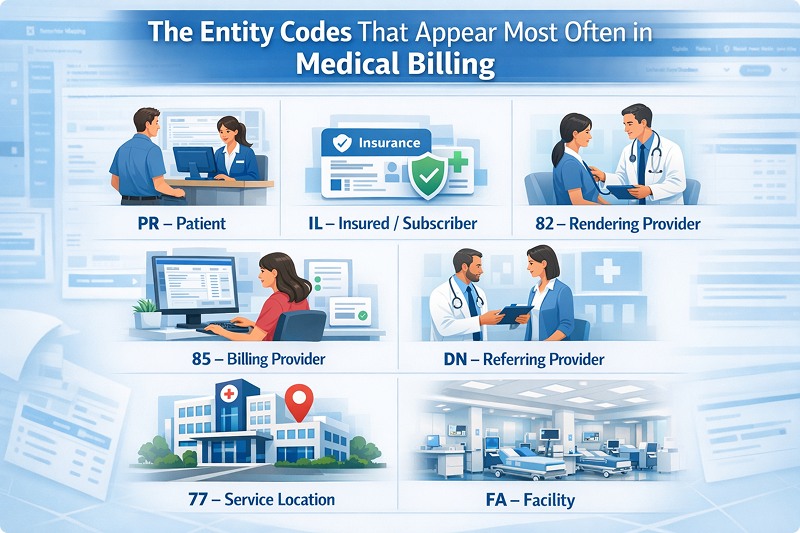
Rather than a theoretical walkthrough of every possible entity code, what follows covers the specific codes that billing teams actually encounter and that cause claim rejections when they are wrong.
The PR entity code identifies the patient receiving the services. In the EDI 837, the PR loop carries the patient’s name, date of birth, gender, and address. The patient information loop is separate from the subscriber loop because the patient and the subscriber are not always the same person.
When a parent brings a child in for care, and the parent holds the insurance, the subscriber is the parent, and the patient is the child. The claim needs both a subscriber loop and a separate patient loop. Each is tagged with its correct entity code. When a claim has only a subscriber loop and no separate patient loop, and the patient is a different person from the subscriber, the claim will often fail eligibility matching because the insurance company cannot identify whose care is being billed.
The IL entity code identifies the subscriber, the person who holds the insurance policy. This is the party whose member ID, group number, and plan information appear on the insurance card. When the patient is the policyholder, IL and PR may refer to the same person. When a child is being treated under a parent’s policy, IL identifies the parent and PR identifies the child.
Getting the IL and PR relationship right is the most common fix in entity code troubleshooting. Billing teams who enter the child’s name and date of birth in the subscriber fields, rather than the parent’s information, generate claims that do not match the payer’s enrollment records for the subscriber. The eligibility check fails, or the claim is rejected because the subscriber information does not correspond to any active policy in the payer’s system.
Entity code 82 identifies the rendering provider, the clinician who actually performed the service. This is the individual whose NPI goes in the rendering provider loop. In group practices, the rendering NPI is the individual physician’s NPI, not the group’s NPI.
A claim that has only a group NPI and no rendering provider NPI will process incorrectly at many payers. Some payers pay at lower rates or deny claims that cannot attribute the service to a specific credentialed rendering provider. Medicare specifically requires the rendering provider’s individual NPI on professional claims. Leaving it off is a compliance gap that also causes payment delays.
Entity code 85 identifies the billing provider, the entity submitting the claim and receiving payment. For group practices, this is typically the group practice with its group NPI and tax ID. For solo practitioners, the billing provider and the rendering provider are the same person. For employed physicians in a hospital-based setting, the billing entity may be the hospital system rather than the individual physician.
The billing provider NPI is used for credentialing and contract purposes. The rendering provider NPI is used to attribute the service. Both need to be present and correctly assigned on most claims. When a claim has the rendering provider’s individual NPI in the billing provider loop, payments can go to the wrong NPI, create contract matching issues, or generate credentialing mismatch errors.
Entity code DN identifies the referring physician. Not every claim requires a referring provider. But for managed care plans with referral requirements, for certain diagnostic services, and for Medicare claims where a referral was made, the referring provider loop must be present and must identify the correct physician by name and NPI.
A claim submitted without a referring provider NPI to a payer that requires one will be rejected. A claim submitted with a referring provider NPI that does not match an active, enrolled provider in the payer’s system will often be rejected as well. When a referring physician is not enrolled with a specific commercial payer, some payers accept claims without the referring NPI, while others require it regardless of the referring physician’s enrollment status. Know each payer’s requirement before defaulting to leaving the field empty.
Entity code 77 identifies the service facility location where the service was performed. This is distinct from the billing provider address. A physician practice that owns multiple clinic locations, or a physician who performs procedures at a hospital outpatient department, needs the service facility address correctly populated so the claim places the service at the right physical location.
Place of service codes on the claim tell payers the setting type. The service facility address in the 77 loop tells them the specific physical address. Some payers verify that the place of service code matches the type of facility at the address in the 77 loop. A mismatch between the two, such as a place of service code for an office with a hospital address in the service facility loop, can trigger an edit or denial.
Entity code FA identifies the facility, typically the hospital or ambulatory surgery center, where a procedure was performed. This code appears on institutional claims and on professional claims for facility-based procedures. The FA loop carries the facility’s NPI and address.
| Entity Code | Role | Description |
| PR | Patient | Identifies the patient receiving services |
| IL | Subscriber | Identifies the insurance policyholder |
| 82 | Rendering Provider | The provider who performed the service |
| 85 | Billing Provider | The entity submitting the claim |
| DN | Referring Provider | The physician who referred the patient |
| 77 | Service Location | Physical location where services were performed |
| FA | Facility | Facility where procedures occurred |
When an entity code is wrong, missing, or applied to the wrong NPI, the receiving system cannot correctly interpret who is who on the claim. The system may try to match the wrong NPI against its provider enrollment database and fail. It may route payment to the wrong entity. It may reject the claim outright with a rejection reason that references the entity code directly or that describes a downstream consequence like an invalid NPI or a provider not found.
The most common root causes of entity code errors in practice management systems are:
Entity code errors may seem technical, but their impact on the revenue cycle is significant.
In practice, these errors can lead to:
At Medhasty, we often find that recurring entity code errors stem from system-level setup issues rather than individual claim mistakes. Once corrected at the source, rejection rates drop significantly, and claim processing becomes more predictable.
Entity code errors are a frequent cause of claim rejections in EDI 837 transactions. These errors typically occur when entity roles, NPIs, or relationships between parties are incorrect.
Common entity code errors include:
👉 These errors prevent payer systems from validating the claim correctly, resulting in rejections or delayed payments.
When a claim is rejected for an entity code issue, the rejection message from the clearinghouse will usually identify the specific loop and segment where the error occurred. That information looks technical, but it is actually precise. A rejection that says NM1 loop 2310B entity qualifier mismatch is pointing to the rendering provider loop, which is where the 82 entity code and the rendering NPI should appear.
The fix process involves opening the rejected claim in the practice management system, locating the affected loop or field, correcting the entity code or the NPI assignment, and resubmitting. Most clearinghouses show the raw EDI transaction alongside a readable claim view, which makes it easier to identify which field was wrong without needing to parse raw X12 code.
Practices that see repeated entity code rejections for the same type of error are dealing with a setup problem, not a one-off data entry mistake. If every claim for a particular rendering provider is rejected because the entity code is wrong, the provider record in the practice management system was configured incorrectly. The fix is at the provider setup level, not at the individual claim level.
Fixing entity code errors requires identifying the issue at both the claim and system levels:
Most entity code issues are not one-time errors — they originate from incorrect system setup.
Entity codes are part of the broader EDI 837 claim structure, which organizes all claim data into loops and segments for electronic processing.
Within this structure:
Together, these components ensure that healthcare claims are transmitted, validated, and processed accurately across clearinghouses and payer systems.
Medhasty Medical Billing Services works with healthcare practices to identify and resolve entity code issues at both the claim and system level.
Our approach includes:
By addressing the root cause, not just individual claim errors, we help practices reduce rejections and improve overall billing efficiency.
Entity codes sit in the background, but they control how every claim gets interpreted. When they’re right, claims move cleanly through clearinghouses and payer systems. When they’re wrong, even a perfectly coded visit can stall or reject.
The takeaway is simple. Entity codes are not guesswork. Each one maps to a specific role, and each role must align with the correct NPI, name, and address. Once a billing team understands that structure, most “mysterious” rejections stop being mysterious.
In day-to-day operations, the real win comes from prevention. Clean provider setup, accurate patient and subscriber entry, and routine audits eliminate most entity code issues before a claim ever leaves the system. That means fewer rejections, faster payments, and less time spent fixing avoidable errors.
At the end of the day, entity codes are not just technical details. They are part of the foundation of clean claims. Get them right once, systemwide, and the entire revenue cycle runs smoother.
An entity code in an 837 claim identifies the role of each party, such as billing provider, rendering provider, patient, or subscriber.
Entity code rejections occur when roles, NPIs, or entity relationships are incorrectly assigned in the claim.
PR represents the patient, while IL represents the subscriber or policyholder.
An entity qualifier is a code used in EDI transactions to define the role of a party, such as a billing provider, rendering provider, or subscriber.
An entity code mismatch occurs when the assigned role does not align with the correct NPI or claim structure, causing claim rejection.
An Electronic Remittance Advice (ERA) is an electronic file (EDI 835) sent by insurance payers to healthcare providers that explains how claims were processed, including payments, denials, adjustments, and patient responsibility amounts.
ERA enables automated payment posting, reduces manual errors, and improves revenue cycle efficiency.
Healthcare providers submit claims to insurance payers for reimbursement. After processing, the payer sends a detailed breakdown of how the claim was handled.
This breakdown is called an Electronic Remittance Advice (ERA).
ERA provides clear information about:
– Payment amounts
– Claim approvals or denials
– Adjustment reasons
– Patient financial responsibility
Understanding ERA is essential for accurate payment posting, denial management, and revenue cycle optimization.
An ERA is an electronic file from a health plan that explains how it processed your claim payments. Think of it as the digital version of an Explanation of Benefits (EOB) or paper remittance advice.
One ERA file usually covers multiple claims, not just one. The file tells you:
The ERA uses standard codes for everything—no more deciphering payer-specific nonsense. Under HIPAA, every payer has to use the same code sets.
Electronic Remittance Advice (ERA) and Explanation of Benefits (EOB) both describe how claims are processed, but they serve different purposes.
While both contain similar payment and adjustment information, ERA enables faster processing, improved accuracy, and seamless integration with practice management systems.
An ERA follows a standardized structure defined by ANSI X12 (835 transaction). It includes three main sections:
Contains payer and provider information, payment method, and trace number.
Includes claim-level data such as:
– Paid amounts
– Denials
– Adjustments
– Patient responsibility
Summarizes total payments, adjustments, and balancing information.
Each section is divided into segments that ensure consistency across all payers.
When you open an ERA file, you will see three types of codes. They work together to tell the complete story of why you got paid what you got paid.
These assign financial responsibility for unpaid amounts.
| Group Code | What It Means | Who Pays |
| CO | Contractual Obligation | Provider writes it off |
| PR | Patient Responsibility | Patient owes this amount |
| OA | Other Adjustment | Varies by situation |
| PI | Payer-Initiated Reduction | Payer takes it back |
Here is a hard rule from CMS. You can only bill the patient when the Group Code PR is used. If you see CO and bill the patient anyway, you are violating your payer contract.
These provide the specific reason for an adjustment. For example, CARC 45 is “Charge exceeds fee schedule/maximum allowable or contracted/legislated fee arrangement.” CARC 97 is “The benefit for this service is included in the payment for another service.”
These add more detail when a CARC is not specific enough. RARCs are like footnotes. They give context. “This service was not covered because the patient was out of network” would be a RARC clarifying a denial.
If you want to request new codes or changes to existing ones, you can. The CARC Committee reviews requests three times per year. The RARC Committee meets every month.
Reading an ERA correctly ensures accurate payment posting and reconciliation.
Follow these steps:
1. Identify the total payment amount and trace number (TRN)
2. Review each claim’s status (paid, denied, or adjusted)
3. Analyze adjustment codes (CARC and RARC)
4. Check Group Codes to determine financial responsibility
5. Match ERA data with the corresponding EFT deposit
Proper ERA interpretation helps reduce errors, prevent revenue leakage, and improve billing accuracy.
ERA is part of a structured revenue cycle workflow that connects claim processing, payment, and reconciliation.
This workflow ensures accurate reconciliation between payments and claim processing.
CMS lists several advantages of ERA over paper, and they are not small advantages.
Using ERA improves both operational efficiency and financial performance in medical billing.
ERA allows billing teams to focus on resolving complex issues rather than manual processing tasks.
Fast. Molina Healthcare reports that providers using ERA can get payment in as little as five days from claim submission. That is not a typo. Five days.
Paper remittances? You are waiting for the check to be printed, mailed, delivered, opened, and manually processed. That is two to four weeks minimum.
ERA is used across the healthcare ecosystem by multiple entities involved in revenue cycle management.
Each entity relies on ERA to ensure accurate payment processing and financial reconciliation.
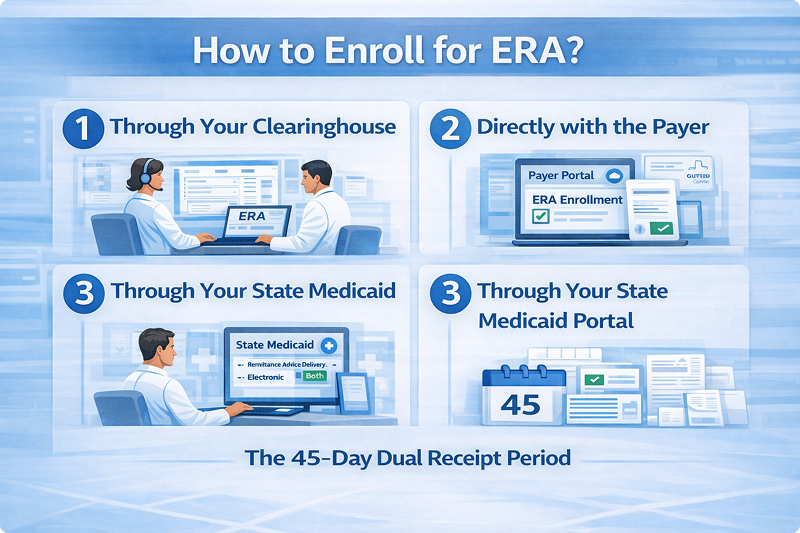
The enrollment process varies by payer, but the pattern is consistent.
If you already use a clearinghouse to submit claims, contact them first. They can usually handle ERA enrollment for you. This is the easiest path because your clearinghouse already has your provider information on file.
Most payers have an online enrollment portal. For example, Sanford Health Plan uses the E-Payment Center for ERA enrollment. You fill out a form, agree to their trading partner agreement, and they set you up.
For Medicaid, you can often enroll during provider enrollment or later from your provider home page. Select “Electronic” or “Both” when asked about remittance advice delivery.
Here is something most people do not know. When you first enroll in ERA, payers typically send you both the electronic file AND the paper remittance for about 45 days. This gives you a safety net while you test your electronic posting process. After that window closes, the paper stops. You are all electronic.
The ERA file comes to your clearinghouse or directly to your practice management system. Then the posting process begins.
First, the system matches the ERA with the corresponding EFT (electronic funds transfer) deposit. This matching uses a TRN segment that is supposed to be identical in both the payment file and the remittance file. Same number. Same format. That is how the system knows which remittance goes with which deposit.
Then, the system attempts to automatically post each payment to the correct claim.
When it works smoothly, you never touch anything. The payment posts. The adjustments apply. The patient balance updates. Done.
When it does not work smoothly, you have problems.
ERA posting errors often originate from mismatches between claim data, payer processing rules, and EDI formatting. Common issues include 835 file balancing errors, incorrect adjustment codes, and missing claim identifiers.
These issues can disrupt reconciliation and delay revenue cycle processes if not resolved systematically.
Sometimes the total payment amount in the file does not match the sum of the individual claim adjustments. This is called an “out-of-balance” remittance. When this happens, your system cannot post the payments because the math does not work.
NC Tracks, North Carolina’s Medicaid system, had exactly this issue in early 2026. The actual deposits were correct, but the 835 files explaining those deposits were wrong. They had to regenerate every affected file.
What do you do? Do not force the posting. Flag the file. Contact the payer. Get a corrected file.
Sometimes the ERA arrives, but your system cannot find the original claim to post the payment against. This becomes a “no matching charge” record. Someone has to manually search for the claim and match it up.
Recoupments, voids, reversals, takebacks. These are all negative adjustments where the payer takes money back. These transactions are common but tricky. If the ERA miscalculates them, your entire file goes out of balance.
Not every practice has a high-end practice management system that can automatically post ERAs. If yours cannot, CMS has you covered.
CMS offers free software to read and print ERAs.
These tools let you view and print an ERA in a readable format. MREP also lets you export reports to Excel.
If you use Medicare’s free billing software PC-ACE, you already have ERA viewing built in.
Electronic Remittance Advice (ERA) and Electronic Funds Transfer (EFT) are complementary components of the payment process.
These transactions are linked using the TRN (Trace Number) segment, ensuring accurate matching between payment and remittance.
Without ERA, providers receive payments without clear claim-level details. Without EFT, providers receive remittance data but must wait for paper checks.
ERA posting follows a structured workflow:
1. Receive ERA file from clearinghouse or payer
2. Match ERA with EFT deposit using trace number
3. Import ERA into billing system
4. Automatically post payments and adjustments
5. Review exceptions or unmatched claims
6. Reconcile accounts and finalize posting
Automated ERA posting reduces manual workload and increases accuracy in revenue cycle management.
You would think every payer would offer ERA by now. They do not. Or if they do, the adoption rate is terrible in some sectors.
Take workers’ compensation insurance. Fewer than 20% of workers’ comp claims use 835 ERA files. That is not a typo. Eighty percent are still paper.
The Council for Affordable Quality Healthcare estimates that broader ERA adoption could save the healthcare industry $20 billion in administrative waste. Twenty. Billion. Dollars.
Some of that is payer inertia. Some is state regulatory complexity. But the bottom line is the same. If your payer does not offer ERA, ask them why. If enough providers ask, they eventually change.
Once the file arrives, you have to actually import it. The process varies by software, but the pattern is the same.
Your system will generate an import report showing what succeeded and what failed. A new batch gets created for each check number.
If your computer crashes during the import, do not panic. The batch does not get created until all transactions have been processed. Just start over.
Payers make mistakes. ERAs can be wrong even when the deposit amount is correct.
Step one: Compare the ERA to the actual deposit in your bank account. If the numbers do not match, do not post.
Step two: Contact the payer. Ask for a corrected ERA. Most payers can regenerate and resend.
Step three: If you already posted from a bad ERA, reverse the posting. Then post from the corrected file.
Do not ignore discrepancies. They do not fix themselves. And they will mess up your end-of-month reconciliation.
A provider submits a claim for $500.
The ERA shows:
– Paid amount: $350
– Adjustment: $100 (Contractual Obligation – CO)
– Patient responsibility: $50 (PR)
This breakdown helps providers understand how payments are calculated and what amount can be billed to the patient.
ERA processing errors, reconciliation issues, and posting delays can significantly impact your revenue cycle performance.
Medhasty Medical Billing Services helps healthcare providers streamline ERA workflows, resolve posting discrepancies, and improve payment accuracy.
Request a free billing audit and identify hidden inefficiencies in your payment process.
ERA is not optional anymore. It is the standard. CMS mandates it. HIPAA requires it. And your competitors are already using it to post payments faster and with fewer staff hours.
If you are still on paper remittances, you are losing money on administrative costs alone. Not to mention the delay in getting paid.
Get enrolled. Set up your posting process. Use the free CMS tools if you need them. And if your payer does not offer ERA, ask them when they will.
The money is out there. ERA just helps you find it faster.
Electronic Remittance Advice (ERA) is an electronic file (EDI 835) that explains how insurance claims were processed, including payments, denials, and adjustments.
An ERA 835 file is a standardized electronic transaction used by payers to send payment and claim adjustment details to healthcare providers.
ERA is an electronic, machine-readable file used for automated payment posting, while EOB (Explanation of Benefits) is a paper or PDF document for manual review.
ERA works by providing detailed claim payment data from payers, which is automatically imported into billing systems for payment posting and reconciliation.
To read an ERA file, review payment amounts, claim status, adjustment codes (CARC, RARC), group codes, and match the data with EFT deposits.
CARC (Claim Adjustment Reason Codes) explain why a claim was adjusted, while RARC (Remittance Advice Remark Codes) provide additional details about the adjustment.
ERA payment posting is the automated process of applying payments, adjustments, and patient balances to claims using ERA data.
Common ERA errors include out-of-balance files, missing claims, incorrect adjustment codes, and negative adjustments like recoupments.
Providers can enroll for ERA through a clearinghouse, directly with payers, or via state Medicaid portals.
ERA improves efficiency by automating payment posting, reducing manual errors, speeding up reimbursements, and enhancing revenue cycle management.
Medicaid billing is not like commercial insurance billing. It’s not even like Medicare billing. It has its own structure, its own rules, and its own frustrations.
If you treat Medicaid patients, you already know this. Payments are lower. Documentation standards are strict. Each state runs its program differently.
And small mistakes can delay reimbursement for weeks.
But here’s the truth. Medicaid can still be financially viable if you bill it correctly, document thoroughly, and understand how your state program works.
This guide walks you through Medicaid billing from enrollment to reimbursement, with real-world clarity. No fluff. Just what providers and billing teams need to know.
Medicaid is a joint federal-state program that provides health coverage to low-income individuals, children, pregnant women, seniors, and people with disabilities.
While the federal government sets broad rules through the Centers for Medicare & Medicaid Services (CMS), each state administers its own Medicaid program.
That means Medicaid billing rules in Texas are not identical to those in Florida or California.
Fee schedules vary. Prior authorization rules differ.
Some states use heavily managed care models. Others rely more on fee-for-service structures.
If you bill Medicaid, your first responsibility is understanding your state’s program.
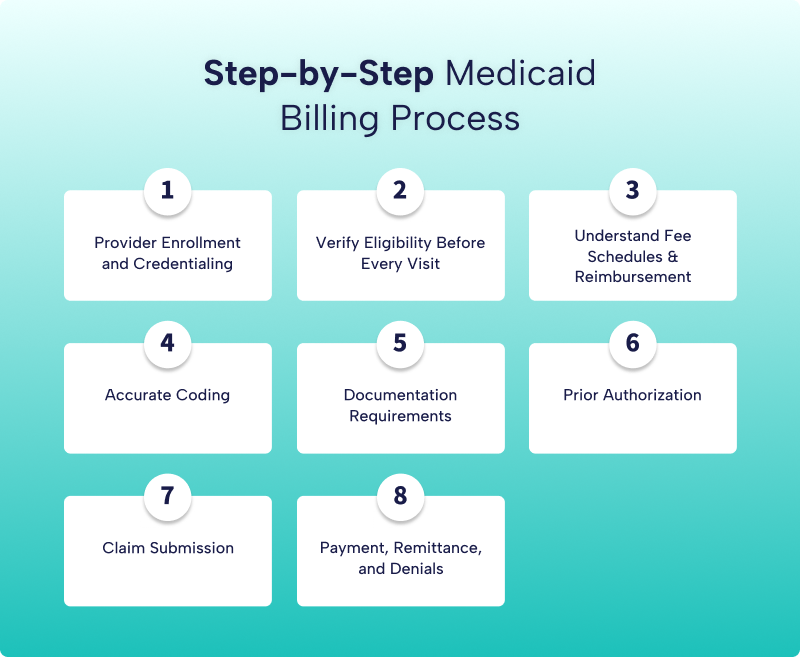
Many practices focus heavily on coding, but the billing process actually starts much earlier. It begins with patient scheduling and eligibility verification. It moves through documentation, coding accuracy, claim submission, and finally payment reconciliation. Every phase connects to the next.
That’s why understanding the full workflow matters. When your team sees Medicaid billing as a coordinated system rather than isolated tasks, denial rates drop, and cash flow stabilizes.
Now, let’s walk through the Medicaid billing process, so you can see exactly where risk lives and where revenue is protected.
Before you submit a single claim, you must be properly enrolled in Medicaid in your state. This process includes:
Here’s where many practices make mistakes.
They enroll in fee-for-service Medicaid but forget to credential with the state’s managed care organizations.
They claim, then deny, because that specific plan does not recognize the provider.
If your state uses managed care, you must contract with each Medicaid MCO separately.
Medicaid eligibility changes frequently. A patient covered last month may not be covered today.
Always verify eligibility before the visit. Not once a year. Every single time.
Check:
If you skip this step, you risk providing care that won’t be reimbursed.
Medicaid reimbursement rates are generally lower than those of Medicare or commercial payers. Many states base rates loosely on Medicare’s physician fee schedule but apply percentage reductions.
For example, if Medicare pays $100 for a service, your state Medicaid may reimburse $60 to $80, depending on the state.
Before accepting large Medicaid volumes, review:
Knowing your actual reimbursement helps you make staffing and scheduling decisions.
Medicaid requires proper coding using:
Common Medicaid billing issues include:
Many states enforce strict bundling edits. For example, certain minor procedures may be bundled into evaluation and management visits unless documentation clearly supports separate billing.
Always review your state Medicaid provider manual for coding specifics.
Documentation must fully support medical necessity. Medicaid programs are aggressive in denying services that do not meet medical necessity criteria.
Your documentation should clearly include:
For procedures, document:
If it isn’t documented, it didn’t happen. Medicaid audits follow that rule strictly.
Many Medicaid services require prior authorization. This is especially common for:
Submitting claims without prior authorization when required will almost always result in denial.
Build internal workflows so your staff checks authorization requirements before scheduling certain services.
Claims are submitted electronically through clearinghouses or directly to the state Medicaid portal or managed care organization.
Key claim elements include:
Small errors, such as missing taxonomy codes or incorrect rendering provider data, frequently trigger denials.
Medicaid claims are typically submitted electronically through clearinghouses or directly through state Medicaid portals and managed care organization systems.
Clearinghouses act as intermediaries that:
Many practices rely on clearinghouse integrations with their practice management systems to streamline submissions and improve clean claim rates.
However, Medicaid managed care plans may require direct portal submissions for certain claim types, authorizations, or corrected claims.
Understanding where and how to submit each claim is essential. Submitting to the wrong channel can delay processing or result in automatic rejection.
Once processed, Medicaid sends an electronic remittance advice. Review this carefully.
Common denial reasons include:
Denial management is not optional. Practices that ignore denials lose revenue.
Build a process to:
If the same denial appears repeatedly, it’s a workflow issue.
Medicaid billing is not just an administrative process. It directly affects your practice’s cash flow, staffing efficiency, and long-term sustainability.
Because Medicaid reimbursement rates are lower, even small inefficiencies can have a significant financial impact. Delayed claims, repeated denials, or incorrect coding can reduce already tight margins.
For example:
Practices that implement structured workflows, accurate coding, and proactive denial management consistently see:
Medicaid becomes financially sustainable only when billing is handled with precision.
If you bill Medicaid, you need to know which model you’re dealing with. This is not a small detail. It changes how you submit claims, how you get paid, and how you handle denials.
Most states originally operated under a traditional fee-for-service structure. In that model, the state Medicaid agency pays providers directly for each covered service. You submit a claim. The state processes it. You get paid based on the state’s published fee schedule.
Over time, many states shifted to Medicaid managed care. Under this structure, the state contracts with private insurance companies to manage benefits for Medicaid members. These companies are called managed care organizations (MCOs).
In a fee-for-service, you deal with one payer, the state Medicaid agency. In managed care, you may deal with three, five, sometimes even ten different MCOs in the same state.
That changes everything.
Each Medicaid MCO may pay different rates for the same CPT code. One plan might reimburse 85 dollars for a level 3 office visit. Another might pay 72. If your contract is not loaded correctly into your system, you won’t catch underpayments.
Always load each MCO’s fee schedule separately. Do not assume parity across plans.
In a fee-for-service model, you usually submit prior authorizations through the state’s Medicaid portal. In managed care, every MCO has its own authorization system. Some use proprietary portals. Others use third-party vendors.
If your staff submits an authorization to the wrong portal, the service may be automatically denied. And most plans will not excuse that mistake.
Timely filing limits vary. Fee-for-service Medicaid might allow 180 days from the date of service. An MCO could allow 90 days. Another might allow 120.
Miss that window, and you lose the claim. No exceptions in most cases.
Track timely filing limits per payer inside your practice management system. Do not rely on memory.
Appeals in fee-for-service usually follow a standardized state process. Managed care plans set their own appeal timelines, forms, and documentation requirements.
One plan may require appeals within 30 days. Another may allow 60. Some require paper submission. Others require portal uploads.
You must treat each Medicaid MCO like a separate commercial payer with its own policies, workflows, and contract terms. If you treat them as “just Medicaid,” you’ll see preventable denials stack up fast.
Even experienced practices make avoidable mistakes when billing Medicaid. These errors often lead to delays, denials, and lost revenue.
The most common issues include:
Submitting claims to the wrong Medicaid MCO results in automatic denials.
Many services require prior authorization. Claims without it are rarely paid.
Medicaid coverage can change monthly. Failure to verify eligibility leads to denied claims.
Incorrect CPT, ICD-10, or modifier usage can trigger payer edits.
Errors in NPI, taxonomy, or rendering provider details often result in claim rejection.
Medicaid billing looks simple on the surface. Lower reimbursement, state program, standardized rules. That assumption causes problems fast.
In reality, Medicaid is one of the most complex payers to administer. Rules change often. Managed care adds layers. Audit exposure is real.
Below are the most common challenges medical practices face, along with realistic solutions you can implement.
Medicaid typically reimburses less than commercial insurance and sometimes less than Medicare. For example, an office visit that costs 120 dollars under a commercial plan might cost 70 to 85 dollars under Medicaid, depending on the state.
When your payer mix is high in Medicaid patients, margins get tight. Practices feel pressure quickly.
The Solution
Medicaid Managed Care Organizations operate like separate insurance companies. Each has:
Staff confusion leads to denials. Denials lead to delayed cash flow.
The Solution
Medicaid eligibility can change monthly. Patients may lose coverage, switch MCOs, or move into different benefit categories.
If you do not verify eligibility at each visit, claims will be denied for inactive coverage.
The Solution
Many Medicaid services require prior authorization, especially imaging, therapies, specialty visits, and durable medical equipment.
Submitting incomplete or incorrect authorizations leads to denials that are difficult to overturn.
The Solution
Medicaid programs conduct regular audits. These may involve:
Common triggers include high-level E and M coding, excessive modifier use, or billing patterns outside peer norms.
Recoupments can reach back several years.
The Solution
Medicaid denial rates can be higher than commercial plans, especially in managed care.
Common reasons include:
Each denial adds labor cost and delays revenue.
The Solution
Medicaid programs conduct routine audits to ensure compliance with billing, coding, and documentation requirements. These audits are designed to identify overpayments, improper billing patterns, and services that do not meet medical necessity criteria.
Audits may include:
Even small documentation gaps can lead to recoupments, penalties, or extended audits.
Practices can reduce audit exposure by:
A proactive compliance approach protects revenue and ensures long-term stability in Medicaid billing.
Medicaid billing requires constant attention to eligibility changes, payer-specific rules, documentation standards, and managed care variations.
At Medhasty Medical Billing Services, we help healthcare providers:
We support practices across multiple specialties and state Medicaid programs, ensuring compliance with evolving billing requirements. Our team stays aligned with Centers for Medicare & Medicaid Services (CMS) guidelines and state-specific Medicaid requirements to ensure compliance and accurate reimbursement.
👉 Explore our medical billing services
👉 Improve collections with revenue cycle management solutions
👉 Reduce denials with denial management services
Medicaid claim processing times vary by state and payer type. Fee-for-service claims may take 2–4 weeks, while managed care claims can be processed faster depending on the MCO.
Timely filing limits vary by state and managed care organization. Most Medicaid programs allow 90 to 180 days from the date of service, but missing this deadline can result in claim denial.
Common reasons include eligibility issues, missing prior authorization, coding errors, incorrect payer submission, and incomplete documentation.
No, but many services, such as imaging, therapies, and durable medical equipment, require prior authorization depending on the state and MCO.
Practices can reduce errors by verifying eligibility for every visit, ensuring accurate coding, maintaining proper documentation, and implementing structured billing workflows.
A clean claim is a claim submitted without errors, complete with all required documentation, coding, and authorization details. Clean claims are processed faster and reduce the risk of denial.
Coordination of benefits determines which payer is primary when a patient has multiple insurance coverages. Medicaid is usually the payer of last resort.
Medicaid billing is complex because it blends federal oversight with state-level administration and managed care layers. It requires attention to detail, consistent documentation, and proactive denial management.
When handled correctly, Medicaid can be a stable revenue source and expand access to care in your community.
When handled carelessly, it becomes a denial factory.
If you’d like, I can next create a state-specific Medicaid billing guide template that you can customize for your market.
Every fall, Medicare releases the new numbers. Premiums change. Deductibles move. Headlines pop up saying costs are rising. Most articles throw out a few figures and call it a day.
That doesn’t help you plan.
Let’s walk you through the exact 2026 Medicare Part A and Part B premiums and deductibles, explain what they mean in real life, and show you how they affect your monthly and annual budget. No jargon. No filler. Just what you need to know.
The official numbers come from the Centers for Medicare & Medicaid Services, the federal agency that runs Medicare.
These figures are based on official 2026 Medicare premium and deductible updates released by the Centers for Medicare & Medicaid Services (CMS).
The 2026 Medicare Part B standard premium is $202.90 per month, and the annual deductible is $283. The 2026 Medicare Part A hospital deductible is $1,736 per benefit period. Most beneficiaries qualify for premium-free Part A, but those who must buy in pay between $311 and $565 per month.
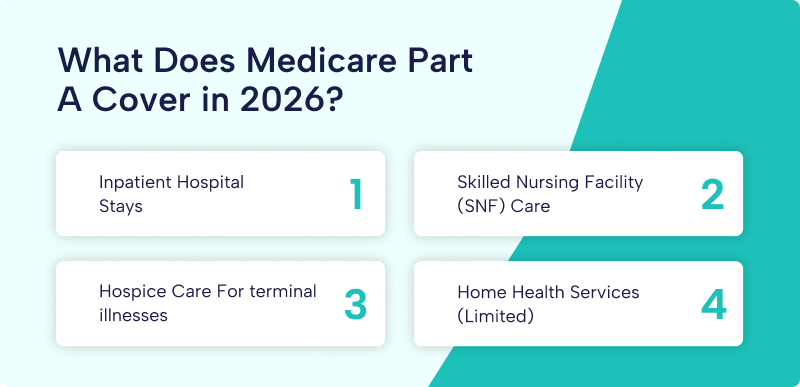
Part A is all about inpatient and facility-based care. It helps cover major health events that require a hospital or similar setting.
Covered Services are:
• Semi-private room, meals, nursing, and hospital services
• Surgery and procedures performed in the hospital
• Medications administered during your stay
• Only after a qualifying hospital stay of 3+ days
• Covers skilled nursing and rehab (like physical therapy)
• Note: Only the first 20 days are fully covered; days 21–100 involve coinsurance
• For terminal illnesses
• Covers pain management, counseling, and support for family
• Patient must choose hospice instead of standard hospital care
• Short-term skilled nursing, physical therapy, or occupational therapy at home
• Patient must be homebound
• Long-term custodial care (assistance with daily living, like bathing or dressing)
• Most outpatient care
• Routine dental, vision, or hearing
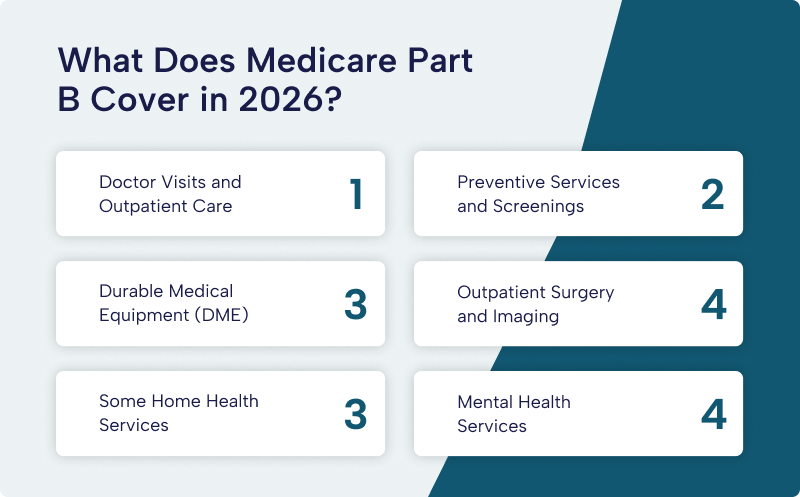
Part B picks up where Part A leaves off. It’s outpatient-focused and preventative, covering the services you see a doctor for or get outside of a hospital stay.
Covered Services:
• Primary care and specialists
• Office visits, consultations, minor procedures
• Annual wellness visit, vaccinations (flu, COVID, shingles)
• Screenings like mammograms, colonoscopies, and blood tests
• Wheelchairs, walkers, oxygen equipment
• Prosthetics and some orthotics
• Minor surgeries not requiring an overnight hospital stay
• Imaging (X-rays, MRIs, CT scans)
• Only medically necessary skilled care
• Part B may pay if the patient doesn’t qualify under Part A
• Outpatient therapy and counseling
• Psychiatric consultations
• Most dental, hearing aids, and vision exams
• Cosmetic procedures
• Long-term care.
Here’s a comparison table for Medicare Part A vs Part B coverage:
| Feature / Coverage | Part A (Hospital Insurance) | Part B (Medical Insurance) |
| Primary Focus | Inpatient & facility-based care | Outpatient & physician-based care |
| Monthly Premium | Usually $0 (based on work history); $311–$565 if buying in | $202.90 standard (2026) |
| Deductible (2026) | $1,736 per benefit period | $283 per year |
| Coinsurance | Days 61–90: $434/day; Lifetime reserve days: $868/day; SNF days 21–100: $217/day | Typically, 20% of approved services are after the deductible |
| Hospital Stays | Covered | Not covered |
| Skilled Nursing Facility (SNF) Care | Covered after a 3+ day hospital stay | Not covered |
| Home Health Services | Limited, post-hospital | Limited, medically necessary (if Part A not applicable) |
| Hospice Care | Covered | Not covered |
| Doctor Visits | Not covered | Covered |
| Outpatient Procedures | Not covered | Covered |
| Preventive Services (screenings, vaccines) | Not covered | Covered |
| Durable Medical Equipment (DME) | Not covered | Covered |
| Mental Health (outpatient) | Not covered | Covered |
| Long-Term Care | Not covered | Not covered |
| Dental, Vision, Hearing | Not covered | Not covered |
Patients can also review their benefits and coverage details directly through Medicare’s official portal.
Do You Pay a Monthly Premium for Part A?
Most people don’t.
If you or your spouse worked and paid Medicare taxes for at least 40 quarters (about 10 years), you get premium-free Part A.
If you didn’t work long enough, you can still buy into Part A. In 2026, here’s what that costs:
That’s a serious bill. At $565 per month, you’re paying $6,780 per year just for Part A.
Most retirees don’t face this, but if you do, you need to factor it into your retirement income plan immediately.
In 2026, the Part A hospital deductible is $1,736 per benefit period.
A benefit period starts the day you’re admitted as an inpatient and ends after you’ve been out of the hospital or skilled nursing facility for 60 days in a row.
So yes, you could pay that deductible more than once in a year.
Let’s say you’re admitted in March for surgery. You pay the $1,736 deductible.
You recover and go home.
Then, in September, you’re admitted again for a different issue, and it’s been more than 60 days since your last hospital stay ended.
You pay another $1,736. That’s how benefit periods work.
The Medicare Part A hospital deductible in 2026 is $1,736 per benefit period. A benefit period begins the day you are admitted as an inpatient and ends after you have been out of the hospital or skilled nursing facility for 60 consecutive days.
After you pay the deductible, here’s what happens:
Days 1 through 60 in the hospital. You pay $0 after the deductible.
Days 61 through 90
You pay $434 per day.
After day 90, you move into “lifetime reserve days.” You get 60 of these for your entire life.
You pay $868 per day during those days.
After you use up those 60 lifetime reserve days, you’re responsible for all costs.
That’s why long hospital stays can get expensive quickly without supplemental coverage.
If you qualify for skilled nursing facility care after a hospital stay:
Days 1 through 20
$0 coinsurance.
Days 21 through 100
You pay $217 per day.
After day 100
Medicare stops paying.
A 30-day stay could cost roughly $2,170 out of pocket just for the coinsurance portion.
Accurate skilled nursing facility billing services are essential to properly manage Medicare benefit periods and coinsurance tracking.
Part B is the one most people notice because it comes out of their Social Security check every month.
In 2026, the standard monthly Part B premium is:
$202.90 per month
That’s what most beneficiaries will pay.
Over 12 months, that’s about $2,435 in premiums alone.
This amount usually gets deducted automatically from your Social Security benefits.
The standard Medicare Part B premium in 2026 is $202.90 per month. Higher-income beneficiaries pay more due to Income-Related Monthly Adjustment Amount (IRMAA) surcharges determined by the Social Security Administration based on Modified Adjusted Gross Income (MAGI).
The annual Part B deductible in 2026 is:
$283
You pay this first before Medicare starts paying its share for most covered services.
After you meet that deductible, Medicare typically pays 80 percent of approved charges. You pay 20 percent.
That 20 percent sounds small. Sometimes it is. Sometimes it isn’t.
Here’s a simple example.
If you have an outpatient procedure that Medicare approves at $5,000:
You pay 20 percent.
That’s $1,000.
There is no out-of-pocket maximum with Original Medicare.
If you have frequent doctor visits, imaging, or chemotherapy, that 20 percent adds up fast.Strong revenue cycle management services help practices reduce patient balance write-offs and improve collections.
Now let’s talk about something many people don’t expect.
If your income is higher, you’ll pay more than $202.90 for Part B.
This extra charge is called IRMAA.
The Social Security Administration (SSA) determines IRMAA using your federal income tax return from two years prior.
For 2026 premiums, they generally look at your 2024 income.
If your Modified Adjusted Gross Income (MAGI) exceeds certain thresholds, you’ll pay a higher Part B premium. The higher your income, the higher the surcharge.
At the top end, high earners can pay well over $600 per month for Part B.
That’s a huge difference from the standard premium. Understanding how these adjustments affect billing and patient balances is a key part of accurate Medicare billing services, especially for practices managing high-income patient populations.
Original Medicare does not cap your annual out-of-pocket costs.
That’s why many people:
Buy a Medigap policy. Or enroll in a Medicare Advantage plan.
Medigap policies can cover deductibles and coinsurance. Medicare Advantage plans often include an annual out-of-pocket maximum.
But those plans come with their own rules, networks, and costs. You need to compare carefully.
Here’s the clean summary for 2026:
All figures released by the Centers for Medicare and Medicaid Services for 2026. These annual updates are formally published in the Federal Register following CMS announcements.
Understanding Medicare premiums and deductibles is only the first step. The real question is how these costs translate into your yearly healthcare spending.
For most beneficiaries, the $202.90 monthly Part B premium totals over $2,400 annually. But that’s just the baseline. Once deductibles and coinsurance are added, total out-of-pocket costs can increase significantly depending on healthcare usage.
For example:
Because Original Medicare does not include an out-of-pocket maximum, costs can continue to grow with increased care.
This is why many beneficiaries explore supplemental options like Medigap or Medicare Advantage plans to stabilize their healthcare expenses.
Many beneficiaries misunderstand how Medicare costs work, which can lead to unexpected financial stress.
Here are the most common mistakes:
Medicare does not cover long-term care, dental, vision, or hearing services. Many essential services require additional coverage.
After meeting the Part B deductible, patients still pay 20% of approved services. This can add up quickly for imaging, procedures, or chronic care.
The Part A deductible applies per benefit period, not per year. Multiple hospital stays can result in multiple deductibles.
Without Medigap or Medicare Advantage, there is no cap on out-of-pocket spending.
Higher-income individuals may face significantly higher premiums due to IRMAA adjustments.
Medicare billing requires precise understanding of benefit periods, deductibles, coinsurance structures, and payer-specific rules. Even small errors can lead to denied claims, delayed payments, and lost revenue.
At Medhasty Medical Billing Services, we help healthcare providers:
👉 Explore our medical billing services
👉 Strengthen collections with revenue cycle management solutions
👉 Reduce claim rejections with denial management services
The standard Medicare Part B premium in 2026 is $202.90 per month. This amount applies to most beneficiaries. However, higher-income individuals may pay more due to the Income-Related Monthly Adjustment Amount (IRMAA), which is calculated by the Social Security Administration using Modified Adjusted Gross Income (MAGI) from tax returns filed two years prior.
The Medicare Part A hospital deductible in 2026 is $1,736 per benefit period. A benefit period begins the day you are admitted as an inpatient in a hospital and ends after you have been out of the hospital or a skilled nursing facility for 60 consecutive days. Because deductibles apply per benefit period, it is possible to pay this amount more than once in a single calendar year.
Most beneficiaries qualify for premium-free Medicare Part A if they or their spouse worked and paid Medicare payroll taxes for at least 40 quarters (approximately 10 years). Individuals who do not meet this requirement may purchase Part A coverage. In 2026, buy-in premiums range from $311 to $565 per month, depending on work history.
Original Medicare (Part A and Part B) does not include an annual out-of-pocket maximum. Beneficiaries are responsible for deductibles and coinsurance without a spending cap. To limit financial exposure, many individuals enroll in a Medigap (Medicare Supplement Insurance) policy or a Medicare Advantage (Part C) plan, which typically includes an annual out-of-pocket maximum.
IRMAA stands for Income-Related Monthly Adjustment Amount. It is an additional surcharge added to Medicare Part B (and Part D) premiums for higher-income beneficiaries. The Social Security Administration determines IRMAA using Modified Adjusted Gross Income (MAGI) reported on federal tax returns from two years earlier. As income increases, the Part B premium increases in tiered brackets.
Medicare premiums and deductibles are typically updated once per year, with new figures announced in the fall by the Centers for Medicare & Medicaid Services (CMS). Changes reflect projected healthcare spending, inflation, and Medicare program funding needs. Updated rates usually take effect on January 1 of the following year.
The Medicare Part B annual deductible in 2026 is $283. After this deductible is met, Medicare generally pays 80 percent of approved outpatient services, and the beneficiary pays the remaining 20 percent coinsurance. There is no cap on annual coinsurance under Original Medicare.
For a beneficiary paying the standard Part B premium, annual premiums total approximately $2,435 ($202.90 × 12 months), not including deductibles or coinsurance. Depending on healthcare usage, total out-of-pocket costs can be significantly higher, especially since Original Medicare does not include an annual spending limit.
Healthcare in retirement isn’t cheap. Medicare helps a lot, but it doesn’t cover everything.
The biggest mistake I see people make is assuming Medicare equals free healthcare. It doesn’t.
Between premiums, deductibles, and 20 percent coinsurance, you need a realistic annual healthcare budget. For many retirees, that means setting aside several thousand dollars per year, even in relatively healthy years.
If you’re turning 65 in 2026 or helping a parent who is, now is the time to run the numbers. Look at your income. Estimate your likely usage. Decide whether you need supplemental coverage.
Medicare works well. But only if you understand what you’re signing up for.
A primary care physician orders a 25-hydroxyvitamin D level on a 54-year-old woman during her annual wellness visit. The result comes back at 14 ng/mL. She has started on high-dose vitamin D supplementation and is scheduled for a follow-up. The billing team codes the visit. Someone picks E55.9. Done.
Except the coder never asked whether that result was low enough to constitute a true deficiency versus an insufficiency. Nobody checked whether the ICD-10 coding system has a code specifically for vitamin D insufficiency that would be more accurate. And the physician’s note says vitamin D is low without specifying the clinical severity or the treatment intent. The claim goes out on a code that might be right or might be a rough approximation of what actually happened.
This plays out in primary care, endocrinology, nephrology, and geriatrics practices constantly. Vitamin D testing is among the most ordered lab panels in outpatient medicine. The deficiency diagnosis is common. But the coding around it is frequently imprecise because most providers and billers treat E55.9 as the only vitamin D code that exists. It is not.
This guide covers what E55.9 actually means, how it differs from related codes in the same family, what documentation is needed, how payers handle vitamin D deficiency claims, and where billing errors cluster in practices that order a lot of vitamin D testing.
ICD-10 E55.9 sits inside category E55, which covers vitamin D deficiency. The full category breaks down like this:
Notice what is absent from that list. There is no specific ICD-10 code for vitamin D insufficiency as a distinct category within E55. That is a gap that creates coding confusion because clinicians distinguish between deficiency, typically a 25-OH vitamin D level below 20 ng/mL, and insufficiency, typically 20 to 29 ng/mL, but the ICD-10 code set lumps both presentations under the same unspecified deficiency code or routes insufficiency to a different code entirely.
When a patient has vitamin D insufficiency rather than outright deficiency, the more technically accurate code is E50.9 or, in many practices, E64.3, which covers sequelae of rickets when there are long-term effects, or more commonly, the clinician documents it as a finding, and the coder uses E55.9 anyway. The right approach depends on what the physician documented and what clinical severity the note reflects.
E55.9 is appropriate when a physician has documented vitamin D deficiency, not merely a low lab value. The distinction between those two things matters more than it sounds.
A lab result that says vitamin D level 14 ng/mL is a finding. It becomes a diagnosis when the physician interprets that finding and documents it as a clinical condition warranting treatment. When the physician documents vitamin D deficiency in the assessment, vitamin D deficiency, or deficient vitamin D levels requiring supplementation, E55.9 is the correct code for that encounter.
E55.9 is also appropriate for follow-up encounters where the vitamin D deficiency is still being actively managed. A patient on prescribed high-dose vitamin D supplementation who comes in for a recheck level and whose deficiency has not yet resolved is still carrying an active vitamin D deficiency diagnosis. E55.9 on that follow-up visit is accurate.
The physician’s language in the note determines which code is used. When a physician writes vitamin D insufficient or suboptimal vitamin D levels, the coder is in a gray zone because insufficiency does not map directly to E55.9 the way deficiency does.
In practice, most coders assign E55.9 for both deficiency and insufficiency because there is no clean ICD-10 distinction between them in the E55 category. That approach is defensible when the physician’s documentation reflects a clinical concern significant enough to prompt treatment. When the note says mild vitamin D insufficiency, the patient is advised to take OTC vitamin D supplements, the clinical picture is minor, and some payers will question E55.9 as a diagnosis, driving higher-complexity visits.
The cleanest documentation approach is for physicians to specify whether the clinical finding rises to the level of deficiency, and if so, note the severity and the treatment intent. That specificity gives the coder something concrete to work with rather than a vague reference to a lab value.
Vitamin D deficiency rarely stands alone in the chart of an older adult patient. It appears alongside osteoporosis, chronic kidney disease, malabsorption syndromes, hyperparathyroidism, and a range of other conditions that either cause it or are worsened by it. Coding the comorbid conditions correctly alongside E55.9 changes the clinical picture on the claim and affects both medical necessity and reimbursement.
When vitamin D deficiency is documented in a patient who also has osteoporosis, both conditions should be coded when both are addressed or relevant to the encounter. Osteoporosis codes from the M80 and M81 families sequence alongside E55.9. The clinical connection between the two conditions is well established, and treating one affects the management of the other.
When vitamin D deficiency is being treated specifically in the context of osteoporosis management, the documentation should reflect that clinical relationship. A note that says vitamin D deficiency, contributing to osteoporosis risk, on supplementation tells the billing story far more clearly than a note listing the two diagnoses separately without connecting them.
Chronic kidney disease impairs the conversion of vitamin D to its active form. Patients with CKD stage 3 and above commonly have functional vitamin D deficiency even when dietary intake is adequate. When a nephrologist or primary care provider manages vitamin D deficiency in the context of CKD, both E55.9 and the appropriate N18 CKD stage code belong on the claim.
There is also a separate consideration for activated vitamin D analogs prescribed to CKD patients for secondary hyperparathyroidism management. Those prescriptions relate to a different clinical indication than simple vitamin D deficiency and may be better supported by coding secondary hyperparathyroidism, E21.1, rather than E55.9 alone. The distinction affects prior authorization for certain vitamin D receptor agonists.
Vitamin D deficiency secondary to a malabsorption condition like celiac disease, Crohn’s disease, or post-bariatric surgery should include the underlying malabsorption condition code alongside E55.9. When the deficiency is caused by poor absorption rather than inadequate intake or sun exposure, the causative condition is clinically important and belongs on the claim. The vitamin D deficiency code and the malabsorption code together tell the complete story.
This is where practices run into real billing problems. Vitamin D testing is expensive relative to most common lab panels, and payers have varying coverage policies for when it is reimbursable.
Medicare covers 25-hydroxyvitamin D testing, CPT 82306, when it is medically necessary. The challenge is that, medically necessary under Medicare’s interpretation, is stricter than many physicians expect. Medicare does not cover routine vitamin D screening in the absence of clinical symptoms or conditions that warrant it.
Conditions that typically support Medicare coverage for 82306 include documented osteoporosis or significant osteopenia, chronic kidney disease, malabsorption disorders, documented clinical signs of vitamin D deficiency such as muscle weakness or bone pain, and patients on medications known to deplete vitamin D. An annual wellness visit that includes routine vitamin D testing without a documented clinical indication is at risk for a non-covered finding under Medicare.
When Medicare coverage is uncertain, an Advance Beneficiary Notice should be issued to the patient before the test is drawn. Without an ABN, the practice cannot collect from the patient if Medicare denies on medical necessity grounds.
Commercial payers are all over the map on vitamin D testing coverage. Some cover it broadly for any adult with a risk factor for deficiency. Others follow more restrictive criteria similar to Medicare. A handful cover it as part of routine preventive panels. Practices ordering high volumes of vitamin D testing should know the specific policy of each major payer in their market before reflexively ordering on every wellness visit.
When 82306 is ordered, and the result comes back deficient, documenting E55.9 as the diagnosis on subsequent visits and prescriptions ties the clinical management back to the original tested finding. That documentation thread, test ordered for documented clinical concern, result confirms deficiency, ongoing management coded with E55.9, builds a record that holds up in a coverage review.
For an E55.9 claim to hold up under payer review, the medical record should reflect the following:
Vitamin D deficiency is one of the most common diagnoses in outpatient medicine and one of the most loosely coded. E55.9 is the right code when the physician has documented a deficiency and the clinical record supports active management. Getting there requires physicians who document specifically, coders who understand the E55 family, and billing teams that know which payers cover vitamin D testing and under what circumstances. That combination is rarer than it should be in practice, seeing this diagnosis every single day.
ICD-10 code E55.9 is used to report vitamin D deficiency when a physician documents a clinically significant deficiency that requires treatment or monitoring. It should not be used for a low lab value alone unless it is clearly interpreted and documented as a diagnosis.
No, ICD-10 does not provide a specific code for vitamin D insufficiency within the E55 category. In practice, many providers and coders use E55.9 when the clinical documentation supports treatment, even if the lab value falls into the insufficiency range. The correct code depends on physician documentation and clinical intent.
The most commonly used CPT code for vitamin D testing is 82306, which represents the 25-hydroxyvitamin D test. This is the standard test used to diagnose vitamin D deficiency in outpatient settings.
Medicare covers vitamin D testing (CPT 82306) when it is medically necessary. Coverage typically requires documented conditions such as osteoporosis, chronic kidney disease, malabsorption disorders, or symptoms consistent with vitamin D deficiency. Routine screening without clinical justification is generally not covered.
E55.9 should be used when the physician explicitly documents vitamin D deficiency and provides a treatment plan, such as supplementation or follow-up testing. If the documentation only reflects a lab finding without clinical interpretation, coding E55.9 may not be appropriate.
Yes, E55.9 is often reported alongside related conditions such as osteoporosis, chronic kidney disease, or malabsorption syndromes. Coding these comorbidities together provides a more accurate clinical picture and supports medical necessity for testing and treatment.
Common errors include:
These mistakes can lead to claim denials or payer audits and documentation level, ensuring that every diagnosis, including E55.9, is fully supported, compliant, and reimbursable.
Vitamin D deficiency is one of the most commonly coded conditions in outpatient medicine — and one of the most frequently misclassified. Small documentation gaps, incorrect diagnosis selection, or unsupported medical necessity can quietly lead to claim denials, underpayments, and delayed reimbursements across hundreds of encounters every month.
At Medhasty, we don’t just process claims — we protect your revenue at the coding and documentation level, ensuring that every diagnosis, including E55.9, is fully supported, compliant, and reimbursable.
We work closely with high-volume specialties where vitamin D testing and deficiency management are routine:
Our team ensures:
✔ Accurate ICD-10 coding aligned with clinical documentation
✔ Proper linkage between CPT 82306 and medical necessity
✔ Reduced denials from payer-specific coverage rules
✔ Faster reimbursements with fewer resubmissions