
A patient checks in at a medical office. The receptionist asks for the insurance card. The patient hands it over. The receptionist photocopies both sides and hands it back. Somewhere in that process, three or four different numbers get captured and entered into the practice management system. Member ID. Group number. Policy number. Possibly a plan number. And in many practices, at least one of those numbers ends up in the wrong field.
The confusion is understandable. Insurance cards are not standardized across payers. Different insurance companies label the same information differently. What one insurer calls a Member ID, another calls a Policy Number. What one card puts at the top, another buries on the back. Front desk staff who verify insurance from dozens of carriers every week work with cards that each have their own layout and terminology.
This guide explains what the policy number is, how it differs from a member ID and a group number, where to find it on different types of insurance cards, and why getting it right matters for claims processing and eligibility verification.
A policy number on an insurance card (often called a member ID or subscriber ID) is a unique identifier assigned by an insurance company to identify a patient’s coverage and process medical claims. This number is used by healthcare providers, billing teams, and insurance systems to verify eligibility and route claims correctly.
Understanding the difference between a policy number, member ID, and group number is essential for accurate insurance verification and medical billing. These terms are often used interchangeably by patients, but they serve different purposes in the insurance system.
In most cases, the policy number and member ID refer to the same identifier. This is the unique number assigned by the insurance company to identify the patient within their system.
Depending on the payer, this number may be labeled as:
Regardless of the label, this identifier is used to:
If this number is entered incorrectly, the insurance system will not recognize the patient, leading to claim rejections and eligibility verification failures.
The group number is different from the policy number. It identifies the employer or organization that provides the insurance plan.
For example:
The group number determines:
Claims submitted without the correct group number (when required) may be rejected or processed incorrectly.
Confusing the policy number with the group number is one of the most common data entry errors in medical billing.
When the wrong number is entered:
Accurately identifying and entering both the member ID (policy number) and group number ensures smoother claim processing and reduces administrative delays.
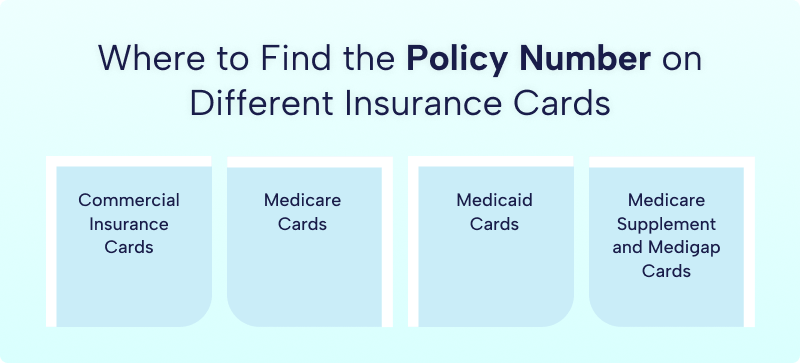
The location of the policy number on an insurance card depends on the type of insurance and the payer. While most insurance cards display this information clearly, the label and placement may vary between carriers.
Understanding where to find the correct identifier helps prevent eligibility errors and claim rejections during medical billing.
Most commercial insurance cards display the policy number (member ID) prominently on the front of the card.
It may be labeled as:
This number is typically an alphanumeric code and is often located near the top or center of the card.
In many cases, the group number appears close to the member ID and is labeled separately as “Group Number” or “Group ID.”
Some carriers, such as Blue Cross Blue Shield, include a prefix at the beginning of the member ID. This prefix is important for claims routing and should always be entered exactly as shown.
Medicare uses a unique identifier called the Medicare Beneficiary Identifier (MBI), which functions as the policy number for billing and eligibility purposes.
The MBI:
Traditional Medicare cards do not include a group number, since coverage is not tied to an employer plan.
Medicaid cards vary by state, and the policy number is typically referred to as the Member ID or Recipient ID.
Depending on the state:
In many cases, Medicaid managed care plans issue separate cards with their own member ID, which must be used for billing instead of the state-issued identifier.
Patients with Medicare supplement (Medigap) plans receive a separate insurance card issued by a private insurer.
These cards include:
When billing secondary insurance, the policy number on the Medigap card must be used instead of the Medicare identifier.
Insurance cards are not standardized, and each payer uses different formats and terminology. Misidentifying the policy number or entering the wrong field into a billing system can lead to:
Careful review of the insurance card ensures that the correct identifier is captured and used throughout the billing process.
The policy number or member ID on an insurance card may belong to the subscriber, the primary insured person, rather than the dependent receiving care. When a child is brought in for an appointment and the insurance is through a parent’s employer plan, the card may show the parent’s name as the subscriber. The child is a dependent on the policy.
How this affects billing depends on the payer. Some payers assign a unique member ID to each covered family member. The parent has one ID, each child has a different ID. Other payers use the subscriber’s ID for all dependents and distinguish between them by date of birth or relationship code on the claim.
When a dependent is being treated, the correct information to capture is the subscriber’s member ID and group number from the card, the subscriber’s date of birth and name, and the patient’s relationship to the subscriber. Entering the child’s date of birth as the subscriber’s date of birth, or using the child’s name as the subscriber name, are common data entry errors that cause eligibility verification mismatches and claim rejections.
Every claim submitted to an insurance company includes the member ID as a required field on the CMS-1500 claim form, specifically in Box 1a for the insured’s ID number.
If that number is wrong, mistyped, or pulled from the wrong field on the card, the payer’s adjudication system cannot locate the patient’s coverage record, and the claim is rejected.
Unlike many claim errors that can be corrected and resubmitted, an invalid member ID error requires going back to the source, checking the physical card or calling the payer’s eligibility line, confirming the correct number, correcting it in the system, and resubmitting.
Each step takes time, and when this happens across multiple patients because the front desk staff is misreading a particular carrier’s card format, the administrative time adds up quickly.
Practices that see certain payers frequently should invest a few minutes in training staff on how each carrier’s card is laid out. Where the member ID is, what it looks like, whether the group number is on the front or back, and what the card calls each field.
That familiarity prevents the repetitive errors that come from staff guessing which number is which on an unfamiliar card format.
Eligibility verification is one of the most critical steps in the medical billing process, and the policy number (member ID) plays a central role in retrieving accurate patient coverage information.
When entered correctly, it allows billing systems and clearinghouses to instantly confirm insurance status, benefits, and financial responsibility. When entered incorrectly, it leads to failed verification, claim delays, and denied reimbursements.
Begin by entering the exact details from the insurance card into your system, including:
Even a small error, such as a missing character, incorrect prefix, or confusion between letters and numbers (O vs 0), can prevent the system from locating the patient’s coverage.
Once the correct information is entered, the eligibility system or clearinghouse will return real-time results.
A complete eligibility check should confirm:
This information ensures that the provider understands what services are covered before the visit.
Eligibility verification is not just about confirming coverage. It also determines what the patient owes.
This includes:
Capturing this information helps front desk teams collect accurate payments and reduces billing disputes after the visit.
Many patients have more than one insurance plan. In these cases:
Both policies must be entered accurately using the correct policy numbers and group numbers.
Missing or incorrect policy details can disrupt the claim flow and delay payments.
Coordination of benefits determines which insurance plan pays first.
For example:
Incorrect coordination can result in claims being sent to the wrong payer, leading to denials and resubmissions.
If the system returns an error such as “invalid member ID” or “no coverage found,” the issue is often due to data entry errors.
To resolve this:
Do not assume the insurance is inactive until all fields are verified accurately.
Accurate eligibility verification using the correct policy number prevents:
Practices that follow structured verification workflows consistently achieve higher claim acceptance rates and smoother revenue cycle performance.
Errors in entering policy numbers are one of the most common causes of eligibility failures and claim rejections in medical billing. Even small inaccuracies can prevent the payer from identifying the patient’s coverage, leading to delays and additional administrative work.
Understanding these common mistakes helps reduce billing errors and improve claim acceptance rates.
One of the most frequent mistakes is entering the group number in place of the policy number (member ID).
The policy number identifies the patient, while the group number identifies the employer’s plan. Mixing these fields results in failed eligibility verification and rejected claims.
Policy numbers often contain a mix of letters and numbers. Small errors such as:
can cause the system to reject the entry. Insurance systems require exact matches, so even minor discrepancies can break the verification process.
Some insurance carriers include prefixes at the beginning of the policy number, especially for plans like Blue Cross Blue Shield.
These prefixes are not optional. They are used for:
Leaving out a prefix can result in misrouted or rejected claims.
When a patient is covered under a family plan, the insurance card may list the subscriber (policy holder) instead of the dependent receiving care.
Common errors include:
These mistakes lead to eligibility mismatches and claim processing issues.
When eligibility checks fail, some staff assume the insurance is inactive without verifying the entered data.
In many cases, the issue is not the insurance but incorrect data entry. Skipping re-verification leads to unnecessary delays, rescheduling, or claim denials.
Incorrect policy number entry directly impacts:
Practices that train staff to correctly identify and enter policy numbers reduce denials, improve billing efficiency, and maintain consistent revenue flow.
The policy number on an insurance card is not a formality. It is the key that unlocks the patient’s coverage record in the payer’s system and routes every claim correctly. Practices that capture it accurately, understand the difference between the member ID and the group number, know how to handle subscriber versus dependent situations, and train front desk staff on the card layouts of their most common payers will see fewer eligibility rejections and faster claims processing than those treating insurance card entry as a routine check-in task. The information is small. The downstream impact is not.
Accurate insurance verification is not just a front desk task. It directly impacts claim approval, reimbursement timelines, and overall revenue performance.
US-Based Medical billing companies like Medhasty help healthcare providers implement structured workflows for eligibility verification, coding validation, and claim submission. This reduces errors, improves claim acceptance rates, and ensures consistent revenue flow.
In most cases, yes. Many insurance companies use the terms “policy number,” “member ID,” and “subscriber ID” interchangeably. However, the label may vary depending on the payer, so it is important to verify the exact terminology on the insurance card.
The policy number is usually displayed on the front of the insurance card and labeled as Member ID, Policy Number, or Subscriber ID. Some insurers may place it on the back or include prefixes that must be entered exactly for claims processing.
Medicare uses the Medicare Beneficiary Identifier (MBI) as the primary identifier instead of a traditional policy number. This alphanumeric code is required for eligibility verification and claim submission.
If the policy number is incorrect, the insurance system cannot identify the patient’s coverage. This leads to failed eligibility checks, claim rejections, and delayed reimbursements. The claim must be corrected and resubmitted.
The policy number identifies the individual patient, while the group number identifies the employer or organization providing the insurance plan. Both are required for accurate billing, but they serve different purposes.
Incorrect policy numbers can cause claims to fail during initial processing, leading to denials, delays, and additional administrative work. Accurate data entry is essential for maintaining efficient revenue cycle performance.
Providers can reduce errors by training front desk staff, verifying insurance information before each visit, and using structured eligibility verification systems to confirm patient coverage.
Every hospital billing department has seen this scenario. A patient is admitted for sepsis. Three days into the stay, creatinine levels climb, urine output drops, and the nephrologist is consulted. Acute kidney injury is now clearly part of the clinical picture. The question that lands on the coder’s desk: Is N17.9 the right code? Is there a more specific one? Does the sequence in which these diagnoses are listed on the claim actually matter?
All three questions have answers that affect payment. AKI coding in 2026 carries the same ICD-10 structure it has had, but the documentation expectations from payers, the sequencing rules under UHDDS guidelines, and the clinical specificity that separates a defensible code from an audit risk have all gotten sharper. Payers are looking more closely at hospital-acquired AKI versus AKI that brought the patient in. Severity staging is being factored into medical necessity reviews for extended stays. And N17.9 on a claim without supporting documentation is increasingly flagging for review.
This guide covers what N17.9 means, when it is the right choice versus a more specific AKI code, what the documentation needs to reflect, how AKI coding affects DRG assignment and reimbursement, and where the coding errors tend to cluster in practices and hospitals billing this diagnosis.
The ICD-10-CM code for acute kidney injury (AKI) is N17.9 – Acute kidney failure, unspecified. This code is commonly used by providers and billing teams relying on ICD-10 coding services for providers to ensure accurate diagnosis reporting and reimbursement.
This code is used when a provider documents acute kidney injury or acute renal failure but does not specify the underlying pathological type such as acute tubular necrosis, cortical necrosis, or medullary necrosis.
N17.9 is the most commonly used code for AKI in inpatient and hospital-based settings, especially when the diagnosis is based on clinical findings such as elevated creatinine levels and reduced urine output without further classification.
N17.9 is the ICD-10-CM code for acute kidney failure, unspecified. It sits inside category N17, which covers acute kidney failure and acute tubular necrosis. The full N17 family looks like this:
N17.9 is the code assigned when the physician has documented acute kidney injury or acute kidney failure but has not specified the type of necrosis or the pathological mechanism involved. In most inpatient encounters, N17.9 ends up being the default code because acute kidney injury is the working clinical diagnosis before a specific nephrology workup confirms whether tubular necrosis is present.
That default pattern is exactly what payers and auditors are scrutinizing. A patient admitted with dehydration-related AKI that resolves with hydration is clinically different from a patient with ischemic acute tubular necrosis requiring dialysis. Both might get coded N17.9 under a loose coding practice, but the clinical picture, the resource use, the length of stay, and the DRG implications are entirely different.
According to the National Kidney Foundation, AKI affects roughly 13.3 million people worldwide annually and contributes to over 1.7 million deaths. In the US hospital setting, AKI is identified in approximately 1 in 5 ICU admissions and significantly increases both length of stay and hospital resource use. CMS and commercial payers have made AKI documentation accuracy a coding quality priority given its impact on DRG assignment and risk adjustment.
| ICD-10 Code | Description |
| N17.0 | Acute kidney failure with tubular necrosis |
| N17.1 | Acute kidney failure with acute cortical necrosis |
| N17.2 | Acute kidney failure with medullary necrosis |
| N17.8 | Other acute kidney failure |
| N17.9 | Acute kidney failure, unspecified |
This classification allows coders to assign the highest level of specificity based on physician documentation and clinical findings.
N17.9 is appropriate when a physician has diagnosed acute kidney injury or acute kidney failure and the clinical documentation does not specify tubular necrosis, cortical necrosis, or medullary necrosis as the mechanism. For most community-acquired AKI in general hospital medicine, the acute kidney injury is documented as a clinical syndrome based on creatinine rise and clinical context, not a histologically confirmed necrosis type. In those cases, N17.9 is the right code and attempting to assign a more specific code without physician documentation to support it is incorrect.
N17.9 is also used when a physician documents AKI without further classification and there is no query response from the physician clarifying the mechanism. Coders cannot assign N17.0 for tubular necrosis based on clinical inference. The physician has to document it.
When nephrology documentation specifically identifies acute tubular necrosis as the mechanism of injury, N17.0 is the appropriate code. This happens most commonly in ischemic AKI following prolonged hypotension, septic shock, or nephrotoxic drug exposure where the consulting nephrologist characterizes the injury as ATN in their consultation note or progress notes.
When the clinical picture has been fully characterized by nephrology and a specific mechanism is documented, coders should assign the specific N17 code rather than the unspecified N17.9. The documentation drives the code. If a nephrologist writes acute tubular necrosis secondary to gentamicin toxicity in their note, N17.0 plus an adverse drug effect code is correct, not N17.9.
N17.9 should be assigned when:
Avoid using N17.9 when:
Accurate code selection must always be driven by provider documentation—not clinical assumption.
Clinically, acute kidney injury is staged using the KDIGO criteria: Stage 1, Stage 2, and Stage 3. Stage 1 is a creatinine rise of 1.5 to 1.9 times baseline or a rise of 0.3 mg/dL or more within 48 hours. Stage 2 is a 2.0 to 2.9 times baseline creatinine rise. Stage 3 is a 3.0 times or greater rise, or a creatinine of 4.0 mg/dL or more, or initiation of renal replacement therapy.
ICD-10 does not have specific codes for KDIGO stages. N17.9 is assigned regardless of severity stage unless the documentation specifies a necrosis type that maps to N17.0, N17.1, or N17.2. However, AKI severity staging documented in the physician’s notes has a direct impact on medical necessity reviews, particularly for extended hospital stays. Payers reviewing claims for patients with a long length of stay will look at whether AKI severity justified the resource use.
When a patient has Stage 3 AKI requiring dialysis, the dialysis procedure codes get added to the claim alongside N17.9. The combination of N17.9 plus dialysis procedure codes tells the full clinical story in the claim data. When a patient has Stage 1 AKI that resolves with IV fluids in 48 hours and the claim has N17.9 as a principal diagnosis driving a high-weight DRG, payers will look at whether the AKI severity justified that DRG assignment.
This is where many AKI coding errors live. The sequencing of N17.9 on the claim changes the DRG assignment and the reimbursement, sometimes significantly.
AKI is coded as the principal diagnosis when it was the condition established after study to be chiefly responsible for the admission. A patient who comes to the emergency department with decreased urine output, elevated creatinine, and confusion from uremic encephalopathy, where the AKI is the clinical reason the admission happened, would have N17.9 as the principal diagnosis. The conditions that caused the AKI, dehydration, nephrotoxic drug exposure, or hypotension, are coded as secondary diagnoses.
More commonly in hospital medicine, AKI develops during an admission that was initiated for a different primary reason. A patient admitted for community-acquired pneumonia develops AKI on day three. The pneumonia is the principal diagnosis. N17.9 is a secondary diagnosis coded as a complication or comorbidity that affected patient care.
This secondary diagnosis sequencing triggers the complication and comorbidity impact on the DRG. AKI, when coded as a secondary diagnosis, typically qualifies as a MCC, major complication and comorbidity, in the MS-DRG system. That MCC designation moves the case to a higher-weighted DRG tier. A hospital billing a pneumonia admission with AKI as a secondary diagnosis should be assigning the DRG that accounts for the MCC. Failing to code the AKI because it was not the primary reason for the visit leaves the MCC impact on the table.
Under the Medicare MS-DRG system, the presence of an MCC like AKI can shift a base medical DRG to the highest-weight MCC tier, sometimes increasing reimbursement by $3,000 to $8,000 per admission depending on the DRG family. Coders who skip AKI as a secondary diagnosis because it resolved during the stay are forfeiting legitimate reimbursement that the clinical complexity of the case justifies.
Present on admission status is relevant for AKI coding. When AKI was present at the time of admission, it is flagged as POA = Yes. When AKI developed after admission, it is POA = No, meaning it was potentially a hospital-acquired condition.
Hospital-acquired AKI draws scrutiny for quality and payment purposes. CMS and accreditation bodies view hospital-acquired AKI as a potentially preventable complication in certain circumstances. When AKI is coded as POA = No, the clinical documentation should reflect the timeline clearly enough to establish when the creatinine rise occurred relative to admission. Was baseline renal function documented on admission? When was the first elevated creatinine level recorded? What was the clinical context: new nephrotoxic drug exposure, procedure-related hypotension, or progressive systemic illness?
These clinical details are not billing technicalities. They are legitimate medical record elements that describe what happened to the patient. But from a coding and billing perspective, they directly affect whether the AKI is coded as a POA condition or a hospital-acquired complication and how that affects quality reporting and payment.
Acute kidney injury rarely arrives without company. The claim for an AKI encounter typically includes several additional codes that together tell the full clinical story. Coders need to know how AKI interacts with these common comorbidities and the sequencing rules that apply.
When sepsis causes AKI, the sepsis code sequences first. Sepsis, severe sepsis, or septic shock codes are principal, and N17.9 follows as a manifestation or complication. The code for the underlying organism or infection source also gets assigned. A sepsis claim with AKI is a complex multi-code encounter that requires careful sequencing to reflect the clinical relationship accurately.
When a patient with underlying chronic kidney disease develops an acute kidney injury on top of their CKD baseline, both conditions are coded. The acute-on-chronic presentation uses N17.9 for the acute injury plus the appropriate N18 code for the stage of CKD. The combination code for acute and chronic kidney disease, N18.9, should not be used in place of coding both N17.9 and the specific CKD stage separately. Code them together. The stage of the underlying CKD matters for clinical documentation, risk adjustment, and DRG assignment.
Diabetic nephropathy and AKI occurring in the same patient require both the diabetic kidney disease code and the AKI code. The AKI may be an acute exacerbation in the context of underlying diabetic kidney disease, but if the AKI represents a clinically distinct acute process, N17.9 belongs on the claim alongside E11.65 or the applicable diabetic kidney complication code. The physician documentation needs to distinguish between the chronic underlying nephropathy and the acute kidney injury for this coding to be defensible.
AKI carries a significant HCC weight in the CMS-HCC risk adjustment model used for Medicare Advantage and ACO shared savings programs. When N17.9 is coded on inpatient claims and carries over into outpatient documentation, it contributes to the patient’s risk score. Higher risk scores translate to higher capitation payments for Medicare Advantage plans and influence the performance benchmarks for ACO providers.
Coders who consistently under-document or skip coding AKI when it was clinically present are inadvertently suppressing the risk scores of complex patients, which affects how those patients’ plans and providers are reimbursed for the true complexity of their care. Accurate coding of N17.9 when it is clinically documented is not aggressive billing. It is accurate representation of what happened to the patient.
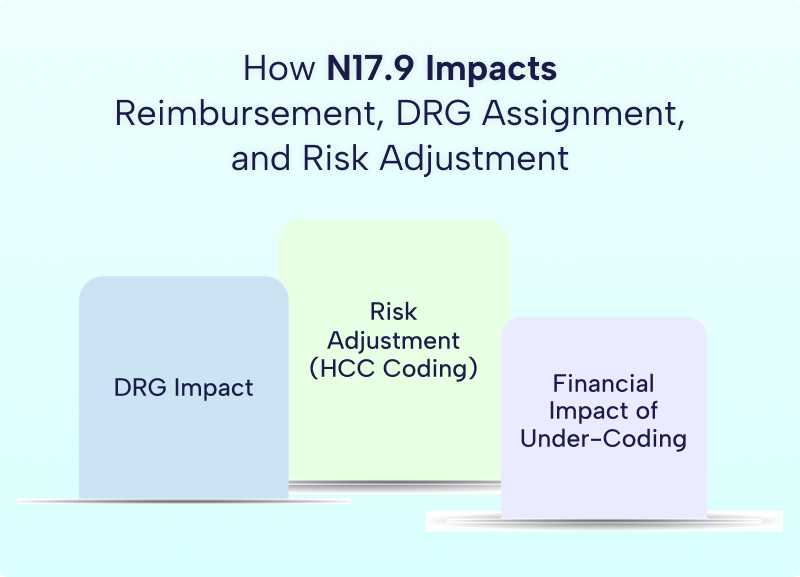
Acute kidney injury is not just a clinical condition—it is a high-impact reimbursement driver.
In inpatient billing, AKI (N17.9) is typically classified as a Major Complication or Comorbidity (MCC) under the Medicare MS-DRG system.
The presence of an MCC can:
N17.9 also plays a role in CMS-HCC risk adjustment models, particularly in Medicare Advantage plans.
Accurate AKI documentation contributes to:
Failure to code AKI when clinically present can result in:
Accurate AKI coding ensures both compliance and appropriate financial outcomes.
The AKI code is only as good as the documentation behind it. Payers reviewing N17.9 claims in 2026 are looking for specific clinical elements in the medical record.
AKI coding errors don’t just affect compliance—they directly impact your revenue. Missed MCC capture, incorrect sequencing, or weak documentation can cost thousands per admission.
Medhasty Medical Billing Services helps healthcare providers across the USA:
👉 Get Your Free Revenue Cycle Audit Today
👉 Talk to a Medical Billing Specialist
N17.9 may appear to be a simple ICD-10 code, but its impact on reimbursement, risk adjustment, and compliance is significant. From DRG assignment to MCC capture and audit scrutiny, accurate AKI coding depends on strong documentation, correct sequencing, and coding precision.
Healthcare providers and billing teams that prioritize accurate AKI documentation and coding not only protect themselves from audits but also ensure they are fully reimbursed for the complexity of care delivered.
If your organization is facing challenges with AKI coding accuracy, denials, or missed revenue opportunities, partnering with an experienced medical billing company can make a measurable difference.
The ICD-10 code for acute kidney injury is N17.9, which represents acute kidney failure, unspecified.
In most MS-DRG systems, AKI (N17.9) is classified as a Major Complication or Comorbidity (MCC), but classification may vary depending on payer guidelines and documentation.
Yes, AKI can be the principal diagnosis if it is the primary reason for hospital admission.
AKI is a general clinical diagnosis, while acute tubular necrosis (ATN) is a specific pathological cause of AKI coded as N17.0.
Yes, both acute kidney injury (N17.9) and chronic kidney disease (N18.x) should be coded together when documented.
No. A physician must document AKI. Lab values alone are not sufficient for coding.
ICD-10 code R06.02 is used to report shortness of breath, one of the most common presenting complaints across emergency medicine, primary care, and pulmonology. However, correctly using this code is critical, as improper coding can lead to claim denials, audit risks, and inaccurate reimbursement.
Patients present with shortness of breath for a wide range of clinical conditions, including anxiety, heart failure, pulmonary embolism, and chronic respiratory diseases such as COPD. From a coding perspective, these underlying causes determine whether ICD-10 code R06.02 should be used or replaced with a more specific diagnosis code.
Also Read: Denial Codes in Medical Billing: A Practical Guide for Practices
The shortness of breath ICD-10 code R06.02, also referred to as the R06.02 code, is classified as a symptom code. This means its correct use depends on whether a definitive diagnosis has been established at the time of the encounter.
This distinction between symptom coding and confirmed diagnosis coding is where most errors occur. Providers may continue using R06.02 even after a diagnosis is confirmed, while coders may default to it due to familiarity. In both cases, the result is reduced coding accuracy and increased payer scrutiny.
Understanding when to use ICD-10 code R06.02, and when not to is essential for maintaining compliance, supporting medical necessity, and ensuring proper reimbursement.
This guide explains what ICD-10 code R06.02 means, when it should be used, when it should be avoided, and how it impacts documentation, coding accuracy, and billing outcomes across different clinical settings.
ICD-10 code R06.02 is a billable diagnosis code used to report shortness of breath (dyspnea) when no confirmed underlying condition has been established. It belongs to the “Symptoms, Signs, and Abnormal Clinical Findings” category and is commonly used in outpatient and emergency settings during initial evaluation.
Shortness of breath is a symptom—not a disease—which means this code should only be used when the underlying cause has not yet been identified or confirmed.
Yes, R06.02 is a billable and specific ICD-10-CM code that can be used for reimbursement purposes. However, its use depends heavily on clinical documentation and whether a definitive diagnosis has been established.
Using R06.02 incorrectly—especially when a confirmed diagnosis exists—can lead to claim denials or reduced reimbursement.
R06.02 sits inside category R06, which covers abnormalities of breathing. The full R06 family is worth knowing because multiple related codes get confused with R06.02 in practice:
R06.02 specifically covers shortness of breath as a symptom. R06.00 covers dyspnea when documented more broadly. The clinical overlap between R06.00 and R06.02 is substantial, and either may be appropriate depending on exactly how the physician documents the complaint. Dyspnea and shortness of breath are often used interchangeably in clinical notes. The code assignment follows the specific language in the documentation.
R06.01, orthopnea, applies when the patient specifically experiences breathing difficulty in the recumbent position. This is a more specific symptom with a narrower clinical implication, often pointing toward heart failure or significant pulmonary pathology. When orthopnea is documented, R06.01 is more accurate than R06.02.
In the outpatient and emergency setting, when a patient presents with shortness of breath and no definitive diagnosis has been established by the end of the encounter, R06.02 is the appropriate code. This is the most common clinical scenario where ICD-10 code R06.02 is appropriately assigned. A patient comes in short of breath. Labs and imaging are ordered. The workup is pending or inconclusive. The physician documents the presenting complaint as shortness of breath without confirming a specific underlying cause. R06.02 gets assigned.
This applies in the emergency department when a patient is evaluated for shortness of breath and discharged without a confirmed diagnosis. It applies in a same-day urgent care visit where chest X-ray was ordered but the result was pending at the time of coding. It applies in a primary care office visit where the symptom is new and being evaluated. In all of those settings, the symptom code is appropriate because no confirmed diagnosis exists.
There is a nuance here that trips people up. When shortness of breath is a symptom of a confirmed diagnosed condition and the confirmed condition is already being coded, R06.02 should not also be coded as a separate secondary diagnosis. The shortness of breath is a manifestation of the primary condition and is captured within that primary code.
A patient with a confirmed diagnosis of acute exacerbation of COPD, coded J44.1, does not also need R06.02 on the claim. Shortness of breath is expected in COPD exacerbations. Coding it separately adds nothing to the clinical picture and creates the appearance of redundant coding.
However, if a patient has COPD and also has a separate clinical complaint of shortness of breath that is out of proportion to their COPD baseline, is being separately evaluated, and is potentially unrelated to the COPD, coding both J44.1 and R06.02 may be appropriate. The physician documentation needs to reflect the clinical distinction.
Dyspnea on exertion is a specific complaint that often warrants its own code assignment. R06.09 covers other forms of dyspnea including exertional dyspnea. When a patient’s shortness of breath is specifically noted to occur with exertion, R06.09 may be more accurate than R06.02. The clinical relevance is that exertional dyspnea has specific workup pathways, including cardiac stress testing, and accurately coding the specific symptom type supports the medical necessity of those downstream services.
R06.02 should not be assigned when a definitive diagnosis explains the patient’s shortness of breath.
Examples include:
– Acute exacerbation of COPD (J44.1)
– Congestive heart failure (I50.x)
– Pneumonia (J18.9)
– Pulmonary embolism (J26.x)
In these cases, shortness of breath is considered an integral symptom of the condition and should not be coded separately unless it is clinically distinct and independently evaluated.
For R06.02 coding to hold up under payer review, the medical record needs to reflect specific elements regardless of the care setting.
In the emergency department, R06.02 is among the most commonly used initial presenting complaint codes. The ED workflow is built around evaluating undifferentiated symptoms and either confirming a diagnosis or ruling out life-threatening causes. When a patient is evaluated for shortness of breath and discharged without a confirmed diagnosis, R06.02 is appropriate for the encounter.
When the workup confirms a specific condition, the coding updates. A patient who came in with shortness of breath and is found to have a pulmonary embolism gets coded with J26.09 or J26.99 for PE, not R06.02. The confirmed diagnosis replaces the presenting symptom code for the same encounter once the diagnosis is established. ED coders often work from the final assessment in the physician’s note, not from the triage complaint. If the final assessment says pulmonary embolism confirmed, the PE code is the correct code regardless of the triage presenting complaint.
In primary care, R06.02 is often used for the first visit where a new shortness of breath complaint is being evaluated. If the same patient returns two weeks later and has now been diagnosed with heart failure, the return visit should be coded with the confirmed heart failure diagnosis, not R06.02. The symptom code should not continue to appear on subsequent visits once the diagnosis is established.
Where primary care coding tends to go wrong is in practices that assign R06.02 at the first visit for a new shortness of breath complaint and then never update the diagnosis code on subsequent visits, even after a workup confirms a specific condition. The medical record may have the confirmed diagnosis documented, but the billing system keeps pulling the same symptom code from the problem list. Someone has to update the billing diagnosis after the workup is complete.
In the inpatient setting, ICD-10 coding guidelines prohibit coding a symptom as a principal diagnosis when a definitive diagnosis that explains the symptom has been established by the time of discharge. A patient admitted for shortness of breath who is found to have community-acquired pneumonia and is discharged with that confirmed diagnosis should have the pneumonia code as the principal diagnosis, not R06.02.
The exception is when the shortness of breath is not adequately explained by the confirmed diagnoses. A patient discharged with a confirmed COPD exacerbation who also had a separate, unexplained episode of dyspnea that was evaluated independently during the admission may have R06.02 coded as a secondary diagnosis if the physician documentation supports that it was a distinct clinical finding.
R06.02 rarely appears alone on a claim. Understanding which codes commonly pair with it, and in what sequence, is part of billing it correctly.
Shortness of breath is a symptom that spans multiple clinical domains. Common underlying causes include:
– Chronic obstructive pulmonary disease (COPD)
– Heart failure
– Asthma
– Pulmonary embolism
– Pneumonia
– Anxiety and panic disorders
Understanding these associations helps guide both clinical evaluation and accurate coding practices.
The medical necessity question that comes up with R06.02 is whether the services billed alongside the symptom code are supported by the clinical presentation. A patient presenting with shortness of breath may receive an ECG, a chest X-ray, blood gases, a D-dimer, a BNP level, and a pulmonary function test. Each of those diagnostic services needs medical necessity support from the clinical documentation.
R06.02 as the presenting complaint is generally considered a sufficient medical necessity indicator for the initial diagnostic workup. An acute onset of shortness of breath justifies ECG, chest X-ray, and basic labs on the first visit. More intensive testing like CT pulmonary angiography requires additional clinical context: risk factors for PE, abnormal initial workup findings, or clinical deterioration.
The issue arises when providers order a broad diagnostic panel for every patient with shortness of breath regardless of clinical severity or risk stratification. R06.02 alone does not justify every possible pulmonary and cardiac diagnostic test. The level of workup should be proportionate to the clinical picture, and the documentation should reflect the clinical reasoning behind each test ordered.
R06.02 is frequently flagged in payer audits due to overuse or improper sequencing. Common issues include:
– Using R06.02 when a confirmed diagnosis is already documented
– Lack of supporting documentation (no vitals, exam findings, or workup)
– Ordering high-cost diagnostic tests without sufficient clinical justification
– Repeating R06.02 across multiple visits after diagnosis is established
Proper documentation and timely code updates are essential to avoid denials.
Yes, but only when shortness of breath is the main reason for the encounter and no confirmed diagnosis has been established.
No, unless the shortness of breath is unrelated or separately evaluated beyond the COPD diagnosis.
It can be used as a secondary diagnosis if clinically relevant, but not as a principal diagnosis when a confirmed condition exists.
Documentation should include onset, severity, associated symptoms, vital signs, exam findings, and clinical reasoning.
While R06.02 is a valid billable code, it typically does not carry high reimbursement value compared to definitive diagnoses.
Using symptom codes alone may:
– Reduce claim value
– Trigger payer scrutiny
– Limit risk adjustment scoring
Whenever possible, coding should reflect the most specific confirmed diagnosis supported by documentation.
R06.02 is the right code in the right setting. It belongs on encounters where shortness of breath is genuinely the presenting complaint and no definitive diagnosis has been established. It belongs as a symptom code, not as a stand-in for a confirmed diagnosis that the provider did not feel like looking up. The practices that use it correctly build documentation habits that specify the onset, severity, associated findings, and the clinical reasoning behind the workup. That documentation is what separates a defensible claim from one that comes back with a medical necessity question attached.
If you have spent any time in medical billing, you already know that CPT codes are everywhere. They show up on every claim you file, every EOB you reconcile, and every audit you face. But knowing that CPT codes exist and truly understanding how they work are two different things. And that gap in knowledge is where billing errors, claim denials, and compliance problems quietly pile up.
In this guide, I want to give you a thorough, practical breakdown of CPT codes. Not just what they are, but how they are organized, how to use them correctly, where practices commonly go wrong, and what the real-world impact of coding mistakes looks like on your bottom line. Whether you are a physician trying to understand your own billing, a coder looking to sharpen your skills, or an office manager trying to get your revenue cycle in shape, this is the foundation you need.
CPT stands for Current Procedural Terminology. These are standardized numeric codes that describe the medical, surgical, and diagnostic services provided to patients. When your practice submits a claim to an insurance company or to Medicare, you use CPT codes to communicate exactly what services were rendered. The insurer then uses those codes to determine how much to pay you based on your contract or on established fee schedules.
The American Medical Association (AMA) owns and publishes the CPT code set. They update it every year, typically releasing the new edition in September for use starting January 1 of the following year. As of 2024, the CPT code set contains over 10,000 codes, and the AMA adds, revises, or deletes hundreds of codes with each annual update. This is one reason why staying current on CPT changes is not optional. It is a core part of running a compliant billing operation.
CPT codes are the primary coding system used across virtually all payers in the United States. Medicare, Medicaid, and commercial insurers all require CPT codes on professional claims. They are distinct from ICD-10 diagnosis codes, which describe what is wrong with the patient, and from HCPCS Level II codes, which cover supplies, equipment, and services not described by CPT. On a properly filed claim, you need all three systems working together correctly.
CPT codes are used throughout the entire revenue cycle:
Any error in CPT coding at any step can result in claim denials, underpayments, or compliance issues.
For example, a patient visits a clinic for a sore throat:
If these codes are mismatched or unsupported by documentation, the claim may be denied or underpaid.
To fully understand CPT codes, you need to see how they fit into the broader medical coding system:
All three code sets must align correctly on a claim to avoid denials and ensure proper reimbursement.
To understand diagnosis coding, see our guide on ICD-10 codes.
CPT codes should not be used when:
Using incorrect code sets can lead to claim rejections and compliance risks.
The CPT code set is divided into three main categories. Understanding how these categories work helps you know which codes apply to the services your practice provides and when you might need to look beyond the standard code range.
Category I codes are the ones you use every single day. They represent established, widely performed procedures and services that have been reviewed and approved by the AMA. Category I codes are five-digit numeric codes, and they are divided into six main sections based on the type of service.
Category II codes are supplemental tracking codes used for performance measurement. They are alphanumeric codes that end in the letter F, such as 0001F or 1000F. These codes are optional, meaning you do not have to use them to get paid. But some payers and value-based care contracts encourage or require them because they track quality measures like patient counseling, preventive screenings, and chronic disease management documentation.
If your practice participates in Medicare’s Merit-based Incentive Payment System, also known as MIPS, Category II codes can be relevant because they demonstrate quality care that ties back to your performance score. They do not generate a separate payment, but they can affect your overall reimbursement adjustment under value-based programs.
Category III codes are temporary codes for emerging technologies, services, and procedures that are new enough that they do not yet have enough evidence or utilization data to qualify for a permanent Category I code. These are also alphanumeric codes, but they end in the letter T. Examples include codes for certain telehealth-delivered services and novel surgical techniques.
One important thing to know about Category III codes is that some payers will reimburse for them and others will not. Before you start billing a Category III code, verify coverage with your primary payers. If you provide a service that only has a Category III code and your payer does not cover it, you need to communicate the potential cost to the patient in advance and get an appropriate financial consent.
The AMA adds approximately 200 to 300 new or revised CPT codes every year. In 2023 alone, there were 393 code changes, including 225 new codes, 75 deletions, and 93 revisions. Keeping up with these changes is a full-time effort for any serious billing operation.
To use CPT codes correctly, you must understand their key attributes:
Each of these attributes directly affects claim approval and payment accuracy.
Accurate CPT coding depends on proper clinical documentation, including:
Incomplete documentation can result in downcoding, denials, or audit risk.
CPT codes are linked to Relative Value Units (RVUs), which determine how much a provider is paid. Each CPT code includes:
These are multiplied by a conversion factor set by CMS to calculate the final reimbursement.
CPT codes tell the payer what service you provided. Modifiers tell the payer more about the circumstances under which you provided it. Modifiers are two-digit codes appended to a CPT code to indicate that a service was altered in some way without changing its basic definition. Using modifiers correctly can be the difference between getting paid and getting denied.
This is one of the most commonly used and most commonly misused modifiers in all of medical billing. Modifier 25 is used when a provider performs a significant, separately identifiable evaluation and management service on the same day as a procedure. For example, if a patient comes in for a scheduled injection but during that visit the physician also evaluates a new complaint that requires a separate medical decision-making process, you can bill both the procedure and an E/M code, with Modifier 25 on the E/M.
The E/M has to be a real, documented, medically necessary evaluation, not just a routine check-in before the procedure. If the documentation does not support a separate E/M, you should not be adding Modifier 25. Auditors look for Modifier 25 abuse specifically, and improper use is a well-known billing red flag that invites further scrutiny.
Modifier 59 indicates that a procedure or service was distinct or independent from other services performed on the same day. It tells the payer that two codes that would normally be bundled together should actually be paid separately because they were performed on different anatomic sites, at different sessions, or under different circumstances.
CMS has actually introduced more specific X modifiers to replace Modifier 59 in many situations. These X modifiers include XE for a separate encounter, XS for a separate structure, XP for a separate practitioner, and XU for unusual non-overlapping service. CMS now requires the more specific X modifier when applicable, so knowing the difference matters if you bill Medicare.
When a procedure is performed on both sides of the body during the same session, Modifier 50 tells the payer it was a bilateral procedure. Most payers pay 150 percent of the standard fee for bilateral procedures. However, some CPT codes already have the bilateral nature built into the code description, and applying Modifier 50 to those codes would result in double-counting. Always verify whether a code’s descriptor already implies bilateral before adding this modifier.
When multiple procedures are performed during the same operative session, Modifier 51 signals a secondary procedure. Medicare and most commercial payers apply a multiple procedure reduction to secondary and subsequent procedures, typically paying 100 percent for the highest-valued procedure and 50 percent for subsequent ones. Some practices miss revenue here by not billing all performed procedures. Others create compliance problems by billing procedures separately when they should be bundled.
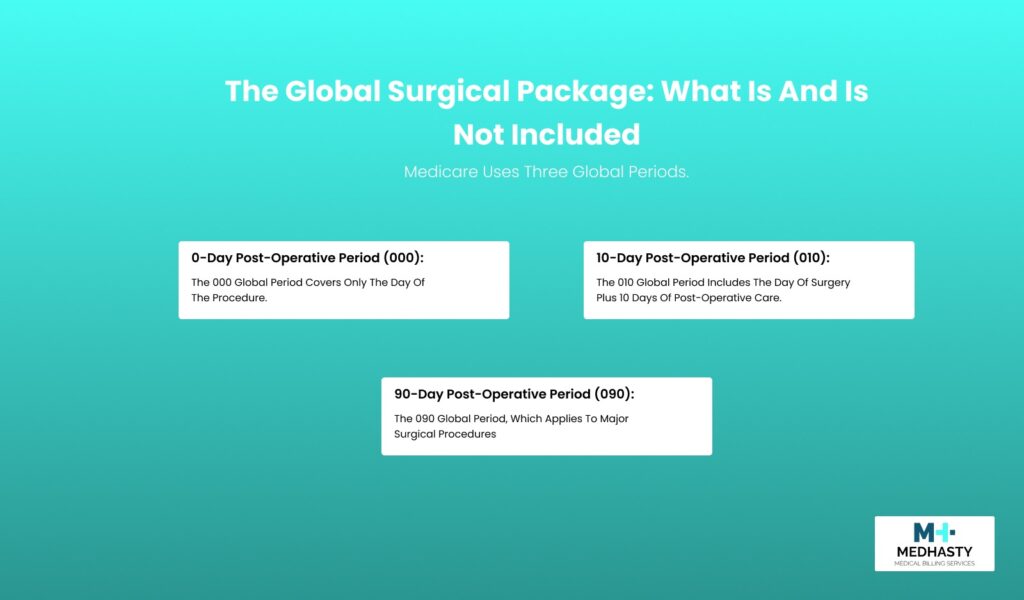
If your practice performs surgical procedures, you absolutely need to understand the global surgical package concept. When Medicare and most commercial payers reimburse for a surgical procedure, the payment includes not just the surgery itself but also the pre-operative care in the period leading up to surgery and the post-operative care for a defined number of days afterward.
Medicare uses three global periods.
During the global period, you cannot separately bill for routine post-operative visits that are directly related to the surgery.
Those visits are already included in the global surgical payment. However, if a patient develops an unrelated new problem during the global period, you can bill a separate E/M with the appropriate modifier to indicate the visit is unrelated to the surgery.
Where practices run into trouble is when they bill post-operative visits during the global period without understanding whether those visits fall inside or outside the global package. Upcoding post-operative care that is included in the global fee is a compliance issue that comes up in OIG audits regularly.
The National Correct Coding Initiative (NCCI) is CMS’s primary tool for preventing improper code combinations on Medicare claims. NCCI edits define pairs of codes that cannot be billed together because one is considered a component of the other. When you submit two codes that NCCI considers bundled, the secondary code will be denied.
There are two types of NCCI edits. Column 1 or Column 2 edits identify codes that are components of more comprehensive codes. Mutually exclusive edits identify code pairs that cannot reasonably be performed at the same time on the same patient by the same provider. Understanding NCCI is not optional if you want to avoid denials. Your billing software should flag NCCI conflicts before claims go out the door, but your coding team should understand the logic behind the edits, not just accept the flags blindly.
NCCI also applies to Medicaid programs in most states, and commercial payers use similar bundling logic even if they have their own proprietary edits. Staying up to date on NCCI updates, which CMS releases quarterly, is part of any solid coding compliance program.
Understanding both helps reduce denials and ensures compliant billing.
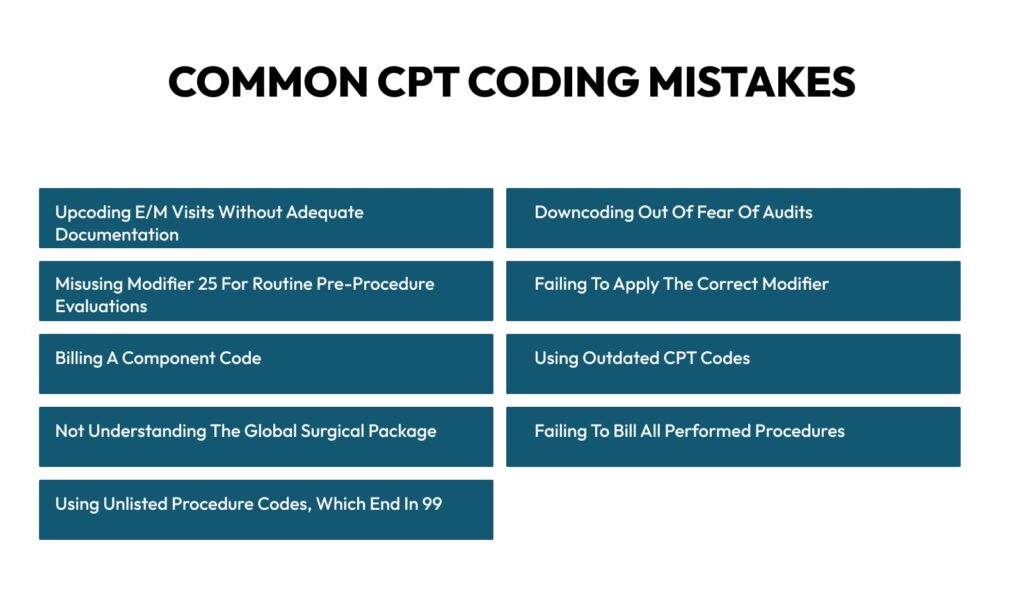
Let me give you a straightforward list of the most common CPT coding errors I see across practices. These are the ones that trigger denials, result in underpayments, or put practices at compliance risk.
To reduce denials related to CPT coding:
Incorrect CPT coding can trigger audits from organizations such as the Office of Inspector General (OIG) and CMS. Common compliance risks include:
These issues can lead to penalties, recoupments, and legal consequences if not corrected.
The AMA releases CPT changes every year, and those changes go into effect January 1. This means your billing team needs to be prepared and updated before the new year starts, not scrambling to catch up in February when your January claims start getting denied for invalid codes.
Subscribe to the AMA’s CPT code updates directly, or use a medical billing software platform that automatically updates its code tables annually. Attend coding webinars and training sessions from reputable organizations like the American Academy of Professional Coders, or AAPC, and the American Health Information Management Association, or AHIMA. These organizations publish coding guidance, offer certifications, and stay on top of changes so your team does not have to do it alone.
Most importantly, build a culture of coding accuracy in your practice. Encourage your coders and physicians to communicate. Physicians need to understand how their documentation drives coding decisions. Coders need to understand the clinical context of what they are coding. That collaboration is what separates practices with strong, compliant billing from those that are constantly dealing with denials and audit exposure.
Most practices use billing software to:
Using software improves coding accuracy and reduces administrative workload.
Here is a simplified workflow for accurate CPT coding:
Following this structured process helps reduce errors and improve payment timelines.
CPT codes are used to report medical procedures and services for insurance billing and reimbursement.
The American Medical Association (AMA) updates CPT codes annually.
Incorrect CPT codes can lead to claim denials, payment delays, or audits.
CPT codes are the language of medical billing in the United States. Mastering them is not something that happens overnight, but building a strong foundation in how they are organized, how modifiers work, how bundling rules apply, and how to stay current on annual changes will make your practice’s billing cleaner, more accurate, and significantly more compliant. The investment you make in coding education and process improvement pays off directly in fewer denials, faster payments, and a revenue cycle that actually works the way it should.
Denial codes are one of those things in medical billing that most people learn on the job, piece by piece, over years of working through rejected and denied claims. Nobody sits you down on day one and walks you through the entire system. You just start seeing codes on remittances and slowly figure out what they mean and what to do about each one.
But that trial-and-error approach costs practices money. Every day a denied claim sits unworked is a day that payment is not coming in. And if your team does not understand why claims are denying, they cannot fix the root cause.
This guide lays out how the denial code system works, what the most common codes mean in practice, how to respond to them, and how to build a denial management process that actually reduces your denial rate over time.
Denial codes are standardized codes used by insurance payers to explain why a medical claim was not paid as billed. These codes appear on the Electronic Remittance Advice (ERA) or Explanation of Benefits (EOB) and provide specific reasons for claim adjustments, partial payments, or full denials.
Each denial code corresponds to a particular issue in the claim, such as missing information, incorrect coding, lack of medical necessity, or coverage limitations. Understanding these codes allows billing teams to identify the root cause of denials and take the correct action, whether that involves correcting the claim, resubmitting it, or filing an appeal.
Denial codes are not just error messages—they are structured feedback from payers that help improve billing accuracy and reduce future denials.
In medical billing, claim denials and claim rejections are often confused, but they represent two different stages in the claim processing workflow.
A claim rejection occurs before a claim reaches the payer’s adjudication system. Rejections typically happen when the clearinghouse detects formatting issues, missing fields, or incorrect claim structure. Because rejected claims never enter the payer’s processing system, they can usually be corrected and resubmitted quickly.
A claim denial, however, occurs after the insurance payer receives and processes the claim. In this case, the payer reviews the submitted information and determines that the service cannot be paid as billed. Denials often require additional documentation, coding corrections, or formal appeals before payment can be obtained.
Understanding the difference is important for revenue cycle management. Rejections are usually simple data errors that can be corrected immediately, while denials require deeper investigation into coverage rules, medical necessity, or payer policy.
When a payer denies or adjusts a claim, they communicate the reason through standardized codes on the Explanation of Benefits for patients or the Electronic Remittance Advice, which is the 835 transaction, for providers. These codes tell you why the claim was not paid as billed. There are two main code sets you will encounter, and it helps to understand the difference between them.
Healthcare providers encounter dozens of denial codes, but a small group of codes typically accounts for the majority of claim denials in most practices.
The table below summarizes several frequently encountered denial codes and the actions required to resolve them.
| Denial Code | Meaning | Typical Cause | Recommended Action |
| CO-4 | Modifier inconsistent with procedure | Incorrect or unnecessary modifier | Correct modifier and resubmit |
| CO-11 | Diagnosis inconsistent with procedure | Diagnosis does not support medical necessity | Review documentation and update diagnosis |
| CO-16 | Missing or incomplete information | Missing NPI, authorization, or demographic data | Review remark code and correct claim |
| CO-18 | Duplicate claim | Claim submitted more than once | Verify claim history before resubmitting |
| CO-22 | Coordination of benefits | Wrong payer billed as primary | Verify insurance order |
| CO-29 | Timely filing | Claim submitted after filing deadline | Appeal only if payer error |
| CO-50 | Non-covered service | Service excluded under patient plan | Bill patient if allowed |
| PR-1 | Deductible | Patient deductible not met | Bill patient |
| PR-2 | Coinsurance | Patient share of covered services | Bill patient |
This quick reference helps billing teams quickly identify denial causes and determine the appropriate corrective action.
Claim Adjustment Reason Codes, known as CARC codes, are the primary denial and adjustment codes used in the 835 remittance. These codes are maintained by the Washington Publishing Company and are standardized across all payers. When a payer adjusts or denies a line item on your claim, they assign at least one CARC code to explain the adjustment. There are over 200 active CARC codes in use today, and each one has a specific meaning.
Some CARC codes indicate a full denial, meaning the service was not covered at all. Others indicate a partial payment, where the payer paid less than billed and the CARC code tells you why. CARC codes can appear at the claim level or at the individual service line level, and a single claim can have multiple CARC codes applying to different lines.
Remittance Advice Remark Codes, called RARC codes, provide additional explanation beyond what the CARC code alone conveys. While CARC codes are required on every adjustment, RARC codes are supplemental. They give more context. For example, a CARC code might tell you the claim was denied for lack of prior authorization, and the accompanying RARC code might specify that the authorization number is missing from the claim. That extra detail matters because it tells you exactly what to fix.
RARC codes that start with the letter M are called Medicare Remittance Advice Remark Codes and are specific to Medicare processing. RARC codes starting with N are standard codes used across payers.
Group Codes
Group codes are a third component of the remittance adjustment. They tell you who is financially responsible for the adjusted amount. The most common group codes you will see are CO, which stands for Contractual Obligation and means the adjustment is between the provider and the payer per the contracted rate. PR stands for Patient Responsibility and means the patient owes the adjusted amount. OA means Other Adjustment and covers miscellaneous situations. PI means Payer Initiated Reduction and indicates the payer reduced the amount without a specific contractual basis. Group codes matter because they determine whether you can bill the patient for the difference.
To manage denials effectively, it is important to understand the key attributes that define how denial codes function within the revenue cycle.
Denial codes indicate the underlying issue, such as missing data, incorrect coding, eligibility problems, or lack of authorization.
Each denial affects revenue differently. Some denials result in full non-payment, while others lead to partial adjustments or patient responsibility.
Some denials can be corrected and resubmitted quickly, while others require appeals, additional documentation, or payer follow-up.
High-volume denial codes are often preventable. Identifying patterns helps reduce future denials through process improvements.
Understanding these attributes helps practices move from reactive claim fixing to proactive denial prevention.
Knowing the denial code categories that show up most frequently helps your billing team respond faster and more accurately. Here are the ones that account for the majority of denials in most practice settings.
This denial means the modifier billed on the claim is not consistent with the procedure code. A common example is billing a bilateral surgery modifier on a procedure that is inherently bilateral, or using an assistant surgeon modifier on a procedure that does not allow assistant surgeon billing under the payer’s policy. To fix a CO-4 denial, review the modifier you billed, check whether it is appropriate for that specific CPT code under that payer’s policies, and
resubmit with the corrected modifier or without the modifier if it does not apply.
This code means the diagnosis code on the claim does not support the procedure billed. The payer’s coverage policy for that procedure requires a specific diagnosis or range of diagnoses, and the code you submitted does not match.
This is a very common denial in specialties where medical necessity is diagnosis-driven, such as radiology, laboratory, and physical therapy. The fix is to review the medical record, confirm the correct diagnosis, update coding if the documentation supports a different code, and resubmit. If the diagnosis is correct and you believe the procedure is medically necessary, you may need to add additional diagnosis codes or write a medical necessity
appeal letter.
This is a generic denial that tells you the claim is missing required information. On its own, CO-16 does not tell you what is missing. That is where the accompanying RARC code becomes important. The RARC code attached to a
CO-16 will specify what the payer needs. It might be a missing National Provider Identifier, a missing authorization number, an incomplete patient address, or any number of other required data elements. Always read the RARC code alongside CO-16 before deciding how to respond.
This means the payer believes you already submitted this claim and it was processed. Duplicate denials happen for a few different reasons. Sometimes a claim was actually submitted twice in error. Sometimes the payer incorrectly flags a legitimate resubmission as a duplicate. And sometimes a claim was submitted correctly the first time but payment was never received, so the billing team resubmits and the payer treats it as a duplicate of the original. To resolve a CO-18, pull the remittance history for the original claim date. If the original was paid, you are done. If it was denied or there is no record of payment, submit the claim again with the appropriate resubmission code in box 22 of the CMS-1500, or in the 837 claim loop, to signal that this is a corrected or resubmission rather than a duplicate.
This denial means the payer believes another insurance plan is primary and should process the claim first. COB denials show up when a patient has multiple insurance plans and the claim was sent to the wrong primary payer, or when the payer does not have current COB information on file for the patient. To resolve this, verify the correct order of benefits for the patient, bill the correct primary payer first, and then submit a secondary claim with the primary EOB attached.
Timely filing denials mean the claim was submitted after the payer’s filing deadline for that date of service. Every payer sets its own timely filing limit, and those limits vary considerably. Medicare allows 12 months from the date of service. Many commercial payers allow 90 to 180 days. Some managed care plans allow as little as 60 days. Timely filing denials are among the hardest to overturn because the appeals process is limited. Most payers will only reverse a timely filing denial if you can demonstrate that the late filing was due to a payer error or a retroactive eligibility change. The best way to handle CO-29 is to prevent it entirely by tracking filing deadlines by payer and monitoring your claims pipeline for anything approaching those limits.
This denial means the service is simply not covered under the patient’s plan. This could mean the service is excluded from the patient’s specific benefit plan, the patient’s plan does not include coverage for that category of service, or the service is a statutory exclusion that Medicare never covers. CO-50 denials with a group code of PR mean the patient is financially responsible, and you can bill the patient directly. CO-50 denials with a group code of CO mean the contracted adjustment is the provider’s responsibility and you generally cannot bill the patient. Read the group code carefully before billing a patient for a CO-50 adjusted amount.
These codes indicate the adjusted amount is the patient’s financial responsibility. PR-1 means the patient has not met their deductible. PR-2 means the adjusted amount is the patient’s coinsurance. PR-3 means the adjusted amount is the patient’s copay. These are not denials in the true sense. The claim was processed correctly. The payer paid their portion and the balance belongs to the patient. You can and should collect these from the patient.
Resolving denial codes requires a structured approach that goes beyond simply resubmitting claims.
Review the CARC and RARC codes together to understand the exact issue.
Determine whether the issue is related to coding, documentation, eligibility, or payer rules.
Update missing or incorrect information such as modifiers, diagnosis codes, or patient data.
Monitor recurring denial codes and fix upstream issues to prevent repeat denials.
Effective denial resolution is not just about fixing claims—it is about eliminating recurring errors.
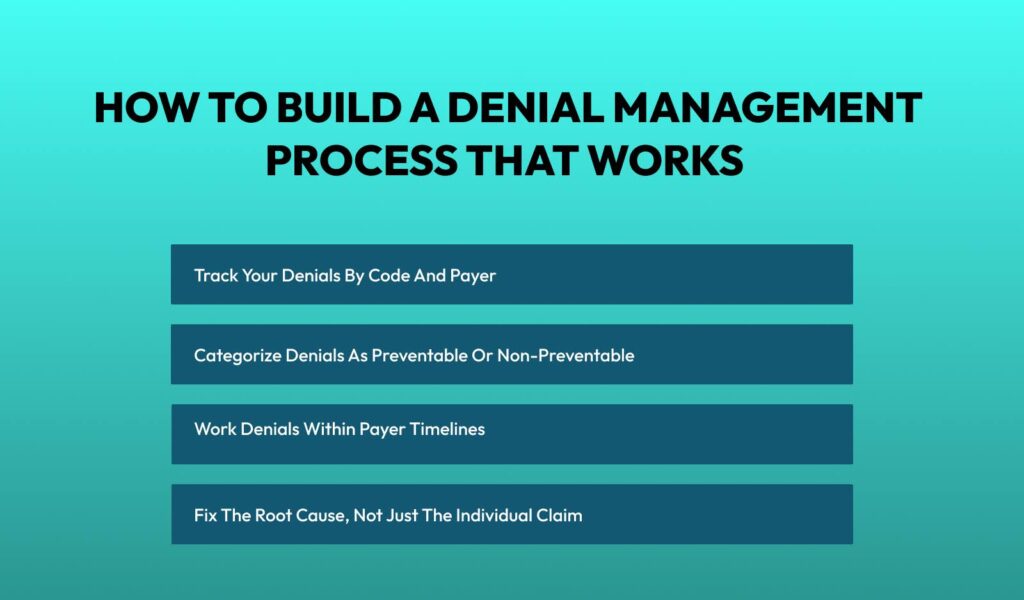
Knowing what denial codes mean is just the starting point. What separates practices with low denial rates from those constantly fighting claims is having a denial management process that is consistent, tracked, and actually fixes the root causes.
You cannot manage what you are not measuring. Start by pulling denial reports from your practice management system broken down by denial code and by payer. You want to see your top denial reasons and which payers are generating the most denials. This is where most practices are surprised to discover that two or three denial codes account for 60 to 70 percent of their total denials. Fixing those two or three root causes will move the needle faster than working individual claims one at a time.
Not every denial is a front-end failure. Some denials are clinical disputes about medical necessity that require appeal regardless of how well your billing was done. But the majority of high-volume denial codes are preventable. Timely filing denials, duplicate claim denials, missing modifier denials, and eligibility denials are almost always preventable with better front-end processes. Separating preventable from non-preventable denials helps you prioritize where to invest your process improvement time.
Every payer has an appeals filing deadline, and it is different from the timely filing deadline for original claims. Most Medicare redetermination requests must be filed within 120 days of the initial determination date. Commercial payer appeal deadlines vary, but many are 60 to 180 days from the denial date. If your billing team lets denials sit in a queue longer than those windows, you lose the right to appeal. Build a workflow that ensures every denial is reviewed, categorized, and either corrected or appealed before the deadline.
This is the step most practices skip. Your biller works the denied claim, resubmits it, and moves on. But nobody asks why that same CO-11 denial has come in 47 times this month for the same procedure code with the same diagnosis. If you only work individual claims without tracing the pattern back to its root cause, you will keep getting the same denials month after month. When a denial pattern shows up, trace it back to where in the process it originates and fix that step. That is how denial rates actually go down over time.
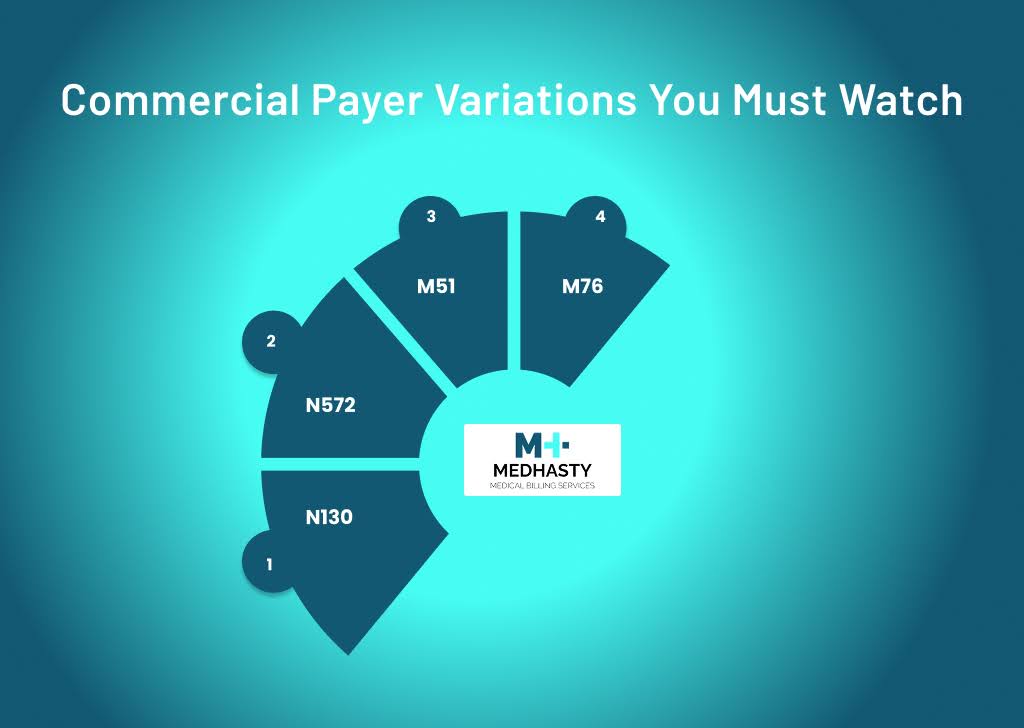
Medicare has its own layer of denial codes and remark codes that go beyond the standard CARC and RARC sets. Medicare Administrative Contractors, the regional contractors that process Medicare fee-for-service claims, use RARC codes beginning with M to provide Medicare-specific denial explanations.
Some of the most commonly seen Medicare-specific denial indicators include the following.
For Medicare denials, the most important resource is the Local Coverage Determination, or LCD, issued by your Medicare Administrative Contractor for the applicable procedure. LCDs specify exactly which diagnosis codes support medical necessity for covered procedures. Coding against the LCD before submitting the claim prevents the majority of Medicare medical necessity denials.
Denial management involves multiple systems, entities, and workflows within the healthcare billing ecosystem.
Understanding these entities helps billing teams navigate denials more effectively and reduce errors at each stage of the claim lifecycle.
Denial codes are directly tied to the financial performance of a healthcare practice.
Denial management plays a critical role in optimizing overall medical billing services and improving reimbursement efficiency.
Managing denial codes internally can be resource-intensive and requires specialized expertise. Many practices choose to outsource denial management to improve efficiency and reduce revenue leakage.
Professional denial management services can:
For practices struggling with high denial rates, outsourcing can significantly improve revenue cycle performance.
A denial code is a standardized code used by insurance payers to explain why a claim was not paid or adjusted.
CARC codes explain the primary reason for denial, while RARC codes provide additional details.
Denial rates can be reduced by improving documentation, verifying eligibility, ensuring coding accuracy, and tracking denial patterns.
Codes like CO-16 (missing information) and CO-11 (diagnosis mismatch) are among the most common.
No, some denials such as timely filing limits cannot be appealed unless there is a payer error.
Denial codes are not just a billing nuisance. They are a feedback system. Every denial code on a remittance is telling you something specific about what went wrong in your revenue cycle, whether it was a front-end eligibility issue, a coding error, a missing authorization, or a documentation gap. The practices that learn to read that feedback and act on it are the ones that get paid faster, write off less, and spend less time reworking claims.
Build the reporting to see your denial patterns. Train your billing team to understand what each denial code means and what action it requires. Fix root causes instead of just resubmitting individual claims. And make denial management a standing agenda item in your revenue cycle meetings, not something that only gets attention when things get bad. That consistency is what actually moves the numbers in the right direction over time.
Struggling with claim denials? Let Medhasty optimize your medical billing and reduce revenue loss with expert denial management solutions.
-> Get a Free Billing Audit Today
If you work in a medical practice, you have signed or handed a patient a form that says something like ‘I authorize my insurance benefits to be paid directly to my provider.’ That right there is the Assignment of Benefits, or AOB. It touches every part of your billing process, from patient intake to final payment. And if your team does not handle it correctly, it can create some serious headaches with denied claims, delayed payments, and even compliance issues.
In this guide, I want to walk you through exactly what AOB means in medical billing, why it matters so much for your revenue cycle, how it works in real-world practice, and for what you need to watch out. Whether you are a physician, office manager, or billing specialist, this is something you need to have a solid handle on.
Assignment of Benefits (AOB) is a legal authorization that allows a healthcare provider to receive insurance reimbursement directly from a patient’s insurance company instead of the payment being sent to the patient. In medical billing, AOB ensures that providers can bill insurers, receive direct payment for services rendered, and reduce the need for patient collections.
In plain terms, Assignment of Benefits is a legal authorization that a patient signs allowing their insurance company to pay their healthcare provider directly instead of sending the payment to the patient. Without this signed authorization on file, the insurance company technically sends the reimbursement check to the patient. The patient would then be responsible for paying you out of pocket. In theory. In practice, that leads to all kinds of problems.
When a patient signs an AOB form, they are essentially saying: ‘I want my insurance company to pay my doctor or hospital directly for the services they provided.’ From the provider’s perspective, this is how you get paid without chasing patients down for money that an insurer already sent to them.
This is not a new concept. AOB has been a foundational piece of medical billing for decades. But it has gotten more complicated over the years as insurance contracts, government programs, and state regulations have all evolved. Today, understanding the nuances of AOB is genuinely important for anyone managing a medical practice’s revenue cycle.
According to the American Medical Association, payment delays and billing disputes cost physician practices an estimated $68,000 to $85,000 per physician annually. A properly executed AOB process helps minimize a significant portion of that loss.

Let me walk you through the typical flow so you can see exactly where AOB fits in your revenue cycle.
Before a patient ever sees the doctor, they fill out intake paperwork. Buried in that paperwork is the AOB form. Most practices include it right alongside the HIPAA authorization and financial responsibility forms. The patient signs it, and that signed document gives you the legal right to bill their insurer and receive payment directly.
This step sounds routine. But here is where many practices make their first mistake. They let patients skip or rush through this form, or they use outdated forms that do not meet current CMS or payer requirements. A missing or incomplete AOB can actually result in the insurance company sending payment to the patient instead of your practice. That means you are now chasing down your own payment from a patient who may or may not have already spent that check.
Once the patient is seen and services are documented, your billing team submits the claim to the insurance company. On that claim form, specifically on the CMS-1500 form, Box 13 asks for the patient’s signature authorizing payment of medical benefits to the physician or supplier. That is where the AOB authorization is referenced. If this box is blank or unsigned, some payers will still process the claim but route payment to the patient. Others will reject the claim outright.
On the institutional UB-04 claim form used by hospitals and outpatient facilities, the same authorization is referenced in the Condition Codes and Value Codes section. Your billing team needs to make sure the form is completed correctly based on the claim type.
Once the payer reviews and adjudicates the claim, they issue payment based on the contracted rate. If an AOB is on file and everything is in order, they send that payment directly to your practice. This is the whole point of the AOB process. You get paid without the patient acting as a middleman.
The payer also sends an Explanation of Benefits, or EOB, to both the provider and the patient. Your billing team should reconcile every EOB against the original claim to confirm the payment matches what was expected and to identify any underpayments, denials, or adjustments that need to be addressed.
According to CMS data, over 90% of Medicare claims are processed electronically, and proper AOB documentation is one of the key compliance requirements for receiving those direct payments under Medicare Part B.
If a patient does not sign an Assignment of Benefits form, the insurance company may send reimbursement payments directly to the patient instead of the healthcare provider.
When this occurs, the provider must rely on the patient to forward the payment or settle the balance themselves. This can create delays in reimbursement and increase the administrative burden on the billing team.
In some cases, patients may not fully understand that the insurance payment they receive is intended to cover the provider’s services. This can lead to unpaid balances and additional collection efforts for the practice.
For this reason, most healthcare providers require a signed Assignment of Benefits as part of the patient registration process before services are delivered.
Patients generally have the right to revoke an Assignment of Benefits, although the specific rules may vary depending on the insurance payer and state regulations.
If a patient revokes an AOB, the insurance company will stop sending payments directly to the healthcare provider. Instead, reimbursement will be sent to the patient, who becomes responsible for paying the provider.
This situation can create challenges for a healthcare practice’s revenue cycle, as the provider must rely on the patient to transfer the insurance reimbursement.
For this reason, many practices maintain updated AOB documentation within their electronic health record (EHR) or practice management systems to ensure proper authorization is on file when claims are submitted.
Assignment of Benefits is not always legally required for every healthcare service, but it is widely used to ensure efficient insurance claim processing.
Many insurance programs depend on AOB authorization to send payment directly to healthcare providers.
For example, Medicare participating providers must accept assignment on all Medicare claims. This means the provider agrees to receive payment directly from Medicare based on the approved reimbursement amount.
Medicaid programs typically require enrolled providers to accept assignment as part of their participation agreement with the state Medicaid system.
Most commercial insurance companies also encourage the use of Assignment of Benefits because it simplifies reimbursement and reduces administrative complications.
I hear from practices all the time that they treat AOB as just another form. But it is actually the backbone of your entire claims payment process. Here is why it matters so much.
When you have a valid AOB on file, you control the payment. The insurance company sends the money to you, not to the patient. This keeps your revenue cycle predictable. Think about a practice seeing 150 patients a week. If even 10 percent of those patients have no AOB on file, you are potentially chasing down 15 individual payments every week. That is a massive drain on your staff’s time and a real threat to your cash flow.
For Medicare, AOB is not optional. CMS regulations require that a valid AOB be on file before a provider can receive direct payment from Medicare. Medicare’s rules under 42 CFR 424.80 make it very clear that non-participating providers who do not have a signed AOB cannot receive direct Medicare payment. Participating providers generally have this requirement met through their participation agreement, but it is still best practice to have a signed AOB from every Medicare patient.
Most commercial payers have similar requirements. Blue Cross Blue Shield, Aetna, Cigna, UnitedHealthcare, and others all have provisions in their payer contracts that reference the need for an AOB before direct payment is issued. Always review your individual payer contracts carefully because the requirements can differ.
One of the biggest headaches in medical billing is collecting balances after the fact. When a patient owes a copay or coinsurance, you can collect that at the point of service. But when an insurer sends a larger payment directly to a patient because no AOB is on file, suddenly your practice becomes a collections agency. That damages the patient relationship, takes up staff time, and often results in partial or no payment at all.
Assignment of Benefits (AOB) and Authorization of Benefits are often included in the same patient intake paperwork, but they serve different purposes in the healthcare billing process.
Assignment of Benefits allows a healthcare provider to receive insurance reimbursement directly from the patient’s insurance company. When a patient signs an AOB form, the insurer sends payment directly to the provider rather than the patient.
Authorization of Benefits, however, allows the provider to communicate with the insurance company regarding coverage verification, claims status, and billing information related to the patient’s care.
In simple terms, Assignment of Benefits determines where the payment is sent, while Authorization of Benefits determines who can discuss the claim with the insurer.
Most healthcare practices collect both forms during patient registration to ensure claims processing and payer communication run smoothly.

Over the years, I have seen the same AOB mistakes come up again and again across practices of all sizes. Here are the ones that hurt practices the most.
Some practices are still using AOB forms they created 10 or 15 years ago. Insurance regulations change. CMS updates its requirements. State laws evolve. If your AOB form is outdated, it may not hold up if a payer questions its validity. Work with your billing team or a healthcare attorney to review your forms at least once a year and make sure they comply with current payer and regulatory requirements.
A common shortcut is to collect an AOB at the patient’s first visit and assume it covers all future visits. That may work for some payers, but not all. Some insurers require a fresh authorization for each episode of care or each calendar year. Medicare specifically has guidelines about when a blanket authorization is acceptable versus when a new signature is needed. Failing to get a fresh AOB when one is required can lead to payment going to the patient without your knowledge.
Before you send a claim, someone on your team should verify that a signed AOB is on file for that patient and that it is current. This sounds basic, but in busy practices with high patient volume, this step often gets skipped. When it does, you can end up filing hundreds of claims with a missing AOB and not realizing it until payments start going to patients instead of to your practice.
If your practice is out of network with a particular payer, the AOB situation gets more complicated. Non-participating providers do not have a contract with the insurer, so the payer’s default is often to pay the patient based on out-of-network benefit levels. In this case, getting a signed AOB from the patient is even more critical, and some states have specific laws about how out-of-network AOB situations must be handled. The No Surprises Act, which went into effect in 2022, added another layer of requirements here that practices need to understand.
The No Surprises Act, enforced by CMS starting January 2022, significantly changed how surprise billing works for out-of-network services. Practices must understand how this law interacts with their AOB policies to avoid compliance violations that can carry penalties up to $10,000 per violation.
Assignment of Benefits becomes more complex when healthcare providers are out of network with a patient’s insurance plan.
When a provider is out of network, the insurance company does not have a contracted reimbursement agreement with that provider. In many cases, insurers send reimbursement payments directly to the patient instead of the provider.
If a valid Assignment of Benefits form is signed, the provider may still be able to receive payment directly from the insurer. However, reimbursement amounts are typically based on the patient’s out-of-network benefit level rather than a negotiated in-network rate.
This can lead to higher patient responsibility because the insurer may cover only a portion of the provider’s charges.
Federal regulations such as the No Surprises Act have also introduced new protections for patients receiving certain out-of-network services. These rules limit surprise medical bills in emergency situations and require providers to follow specific disclosure and billing procedures.
Healthcare practices should understand how Assignment of Benefits interacts with out-of-network billing rules to ensure compliance and avoid disputes with patients or insurers.
Assignment of Benefits can also become a fraud and abuse issue if it is not handled carefully. The Office of Inspector General has specifically called out AOB schemes in the healthcare fraud landscape. The most common AOB fraud scenario involves a provider who has a patient sign an AOB and then bills for services that were never rendered, or inflates charges based on the fact that the patient has no financial skin in the game.
On the flip side, some unscrupulous practices have used AOB arrangements to essentially waive patient cost-sharing obligations, telling patients they will never have to pay their deductible or copay. This is a serious violation. Under federal anti-kickback statutes and the False Claims Act, routine waiver of cost-sharing can be treated as an illegal inducement. If you waive a patient’s copay because you feel sorry for them financially, that is one thing. But if it is a practice-wide policy to never collect cost-sharing in exchange for patients assigning benefits to you, that is a compliance red flag that can lead to significant legal trouble.
Assignment of Benefits regulations may vary depending on the state where a healthcare provider operates.
Some states have implemented laws that address patient consent requirements, insurance reimbursement practices, and consumer protections related to billing agreements.
Healthcare providers should ensure that their AOB forms comply with both federal healthcare regulations and any applicable state laws governing insurance billing practices.
Regular review of authorization forms with legal or compliance professionals can help practices remain aligned with evolving regulatory requirements.
Medicare and Medicaid have their own specific AOB rules that deserve some extra attention because the stakes are higher with government programs.
For Medicare, participating providers, meaning those who have signed a Medicare Participation Agreement, are required to accept assignment on all Medicare claims. This means they agree to accept Medicare’s approved amount as payment in full and must bill Medicare directly. They are automatically entitled to direct payment without needing a separate AOB from every patient, although it is still good practice to have one on file.
Non-participating Medicare providers have a choice. They can accept assignment on a claim-by-claim basis, which means the patient still pays the provider and then gets reimbursed by Medicare. Or they can accept assignment and bill Medicare directly with a signed AOB. The rules around limiting charges for non-par providers are strict, and exceeding Medicare’s limiting charge without a valid reason can result in penalties.
For Medicaid, the rules vary by state, but virtually all state Medicaid programs require enrolled providers to accept assignment. If you are enrolled as a Medicaid provider, you are required to bill Medicaid directly and accept their reimbursement as payment in full. You cannot balance bill Medicaid patients beyond their applicable cost-sharing amounts.
Many healthcare organizations now collect Assignment of Benefits forms electronically as part of their digital patient intake process.
Electronic AOB authorizations are commonly completed through patient portals, online registration forms, or tablet-based intake systems used at the front desk.
Digital signatures used in these systems are generally considered legally valid as long as they comply with electronic signature regulations.
Using electronic AOB documentation helps healthcare practices maintain accurate records, reduces the risk of missing paperwork, and allows billing teams to quickly verify authorization before submitting claims.
Most modern electronic health record (EHR) and practice management systems automatically store AOB documentation within the patient’s file for easy access during the billing process.
Assignment of Benefits allows insurers to send payments directly to healthcare providers, but it does not eliminate the patient’s financial responsibility.
After an insurance claim is processed, patients may still owe out-of-pocket expenses such as copayments, deductibles, or coinsurance.
Balance billing occurs when a provider bills the patient for the remaining amount that is not covered by the insurance payment.
However, federal regulations such as the No Surprises Act place limits on balance billing in certain situations, particularly for emergency services and some out-of-network care.
Healthcare providers must understand these regulations to ensure compliance with current healthcare billing laws.
Now that you understand the risks and the importance of AOB, here is what a well-managed AOB process looks like in practice.
What is the Assignment of Benefits in medical billing?
Assignment of Benefits is a legal authorization that allows healthcare providers to receive insurance reimbursement directly from a patient’s insurance company rather than the payment being sent to the patient.
Can a patient refuse to sign an AOB form?
Yes. A patient can refuse to sign an AOB form, but in that case, the insurance company may send reimbursement payments directly to the patient instead of the healthcare provider.
Does Medicare require Assignment of Benefits?
Medicare participating providers must accept assignment on all Medicare claims, meaning payments are sent directly to the provider.
Is the Assignment of Benefits legally binding?
Yes. Once signed, an Assignment of Benefits form becomes a legal authorization allowing the insurance company to send payment directly to the provider.
Assignment of Benefits is one of those foundational elements of medical billing that does not get nearly enough attention until something goes wrong. Getting your AOB process right from the start protects your revenue, reduces patient collection issues, keeps you compliant with payer contracts and government regulations, and sets your practice up for a cleaner, faster revenue cycle. It is worth the time to audit your current process, update your forms, and train your staff to treat AOB as a priority, not an afterthought.
ICD codes in medical billing are not just a formality. They are the language payers use to decide whether a service was medically necessary, whether it fits the patient’s covered benefits, and how much to reimburse. A claim without a solid ICD code foundation is a claim waiting to have problems.
This guide covers everything a medical practice, billing team, or healthcare professional needs to know about ICD codes. What they are, how the system is organized, how to pick the right one, where practices go wrong, and what the compliance stakes look like when coding falls short.
Diagnosis coding does not operate in isolation. In medical billing, ICD-10 diagnosis codes work together with CPT and HCPCS codes to describe the full details of a healthcare encounter.
Each code system serves a specific role in the claims process.
| Code System | Purpose | Example |
| ICD-10-CM | Describes the patient’s diagnosis or medical condition | E11.9 – Type 2 diabetes |
| CPT | Identifies the medical procedure or service performed | 99213 – Office visit |
| HCPCS Level II | Covers supplies, equipment, and certain services | J1100 – Injection medication |
Think of these codes as a three-part language used by healthcare payers.
The ICD-10 code explains the medical reason for the service, while the CPT or HCPCS code explains what service or procedure was performed. Insurance companies review both codes together to determine whether the service meets medical necessity requirements.
For example, if a physician performs a chest X-ray (CPT 71046), the claim must include an appropriate diagnosis code such as R05 – cough or R07.9 – chest pain. Without a diagnosis that supports the procedure, the payer may deny the claim as not medically necessary.
Understanding the relationship between diagnosis codes and procedure codes is essential for preventing denials and ensuring proper reimbursement.
ICD stands for International Classification of Diseases. The codes themselves are a standardized system for documenting diagnoses, symptoms, conditions, injuries, and the reasons a patient sought care. The World Health Organization originally developed the classification system, and the United States adapted it for healthcare billing and clinical data purposes.
Every time a patient receives medical care in the United States, the conditions and reasons for that visit get assigned an ICD code. Those codes appear on insurance claims, on hospital discharge summaries, on public health records, and in research databases. They are the common language shared between clinical care and the entire administrative infrastructure that surrounds it.
In the US billing context, ICD codes pair with CPT procedure codes to tell the complete story of an encounter. The CPT code says what was done. The ICD code explains why it was done. Payers need both to make a payment decision. One without the other is like getting half a
For anyone who was working in healthcare billing before October 2015, the switch from ICD-9 to ICD-10 was one of the biggest operational changes in the history of medical coding in this country. Understanding what changed explains a lot about how the current system works and why specificity is such a central theme in modern diagnosis coding.
ICD-9 had around 13,000 codes. That sounds like a lot until you realize how much clinical detail those codes had to cover. The system ran out of room. There were conditions that had no specific code, so coders defaulted to unspecified or not elsewhere classified categories constantly. The codes were three to five characters long and structured in a way that made it hard to add new conditions without breaking the existing framework. By the early 2000s it was clear the system was outdated, and a decade-long transition process toward the replacement began.
ICD-10-CM, which is the Clinical Modification used for diagnosis coding in the US, expanded the code set to over 70,000 codes. That number has grown further with each annual update and now sits above 80,000. The codes are alphanumeric and up to seven characters long, which created room for a level of clinical detail ICD-9 could never accommodate.
The specificity built into ICD-10 is worth understanding because it directly affects billing. Under ICD-9, a fracture of the right arm and a fracture of the left arm might share the same code or use a vague side-unspecified version. Under ICD-10, the laterality, the specific bone, the type of fracture, whether it is an initial encounter or a follow-up, and whether it is healing normally or with complications all have distinct codes. That detail allows payers to make much more precise coverage and payment decisions.
For billing purposes, this specificity cuts both ways. On the good side, a specific ICD-10 code paired with the right CPT code makes an airtight medical necessity argument. On the challenging side, picking the right code out of 80,000 options takes real clinical knowledge and careful documentation review. The unspecified codes are still there, but using them when a specific code exists is a red flag that tends to invite scrutiny.
While most healthcare professionals are familiar with ICD-10 diagnosis codes, fewer realize that the ICD-10 system actually includes two separate code sets used in different healthcare settings.
ICD-10-CM stands for International Classification of Diseases, Tenth Revision, Clinical Modification. This is the diagnosis coding system used by physicians, outpatient clinics, and most healthcare providers in the United States.
ICD-10-CM codes describe:
These codes appear on professional claims submitted by physicians and outpatient facilities.
ICD-10-PCS stands for International Classification of Diseases, Procedure Coding System. Unlike ICD-10-CM, it is used only for inpatient hospital procedures.
Hospitals use ICD-10-PCS codes to describe surgical and procedural services performed during inpatient stays, such as:
Physician billing, however, does not use ICD-10-PCS codes. Instead, physician services are reported using CPT procedure codes.
Understanding this distinction helps billing teams avoid confusion when reviewing hospital documentation versus physician claims.
The ICD-10-CM code set is divided into chapters, each covering a broad category of conditions. Understanding the structure makes it easier to navigate the code set and find the right code faster.
The code set opens with certain infectious and parasitic diseases, then moves through neoplasms, blood disorders, endocrine and metabolic diseases, mental and behavioral disorders, diseases of the nervous system, eye and ear conditions, circulatory diseases, respiratory diseases, digestive diseases, skin conditions, musculoskeletal diseases, genitourinary diseases, pregnancy and childbirth, conditions in the perinatal period, congenital anomalies, symptoms and abnormal clinical findings, and finally injury, poisoning, and external causes.
Beyond those clinical chapters, ICD-10 includes a section of Z codes, which cover health status, contact with health services, and encounters that are not strictly due to illness or injury. Z codes are used for preventive visits, screenings, follow-up care, vaccination encounters, and a wide range of other reasons a patient might interact with the healthcare system. Z codes get underused in a lot of practices, and that sometimes results in claims that lack a clear documented reason for the visit.
Every ICD-10-CM code follows a predictable format. The first character is always a letter. The second and third characters are numbers. After the decimal point, characters four through seven provide increasing specificity. Not every code uses all seven characters. Some conditions are fully described in three or four characters. Others require the full seven to capture all the clinical detail.
Take a straightforward example. M54.5 used to be the code for low back pain. That code was updated in 2021 and replaced by more specific options like M54.50 for low back pain unspecified, M54.51 for vertebrogenic low back pain, and M54.59 for other low back pain. That kind of specificity upgrade happens in the annual code updates and is exactly why billing teams need to review code changes every October when the new fiscal year code set takes effect.
Many ICD-10 codes appear frequently in physician billing because they represent common chronic conditions or symptoms seen in outpatient practice.
Some widely used diagnosis codes include:
| ICD-10 Code | Description |
| E11.9 | Type 2 diabetes mellitus without complications |
| I10 | Essential (primary) hypertension |
| J06.9 | Acute upper respiratory infection, unspecified |
| M54.50 | Low back pain, unspecified |
| R51.9 | Headache, unspecified |
| F41.9 | Anxiety disorder, unspecified |
These codes often appear alongside evaluation and management (E/M) visit codes when physicians assess and manage chronic or acute conditions.
Accurate documentation is essential because many conditions have multiple ICD-10 code variations depending on factors such as severity, complications, or associated conditions. Selecting the correct code ensures that the patient’s clinical situation is accurately represented and that the claim meets payer requirements.
The seventh character is particularly important in certain code categories, especially injuries, fractures, and musculoskeletal conditions. For fractures, the seventh character tells the payer whether it is the initial encounter for active treatment (A), a subsequent encounter for a fracture in normal healing (D), a subsequent encounter for a fracture with delayed healing (G), or a sequela (S). Billing the wrong seventh character for a follow-up fracture visit is one of the most common coding errors in orthopedic and urgent care practices, and it leads to denials that are entirely preventable.

Selecting the right ICD-10 code is a process, not a lookup. The physician’s documentation drives every coding decision. The coder’s job is to translate clinical language into the most accurate and specific code the documentation supports. Here is how that process should work.
Before opening the code book or the encoder, read the clinical note. Understand what the physician found, what the diagnosis is, what the clinical context is, and what the reason for the encounter was. A lot of coding errors happen because someone looked up a keyword without fully understanding the clinical scenario. The term ‘mass’ in a note could lead to a completely different code depending on whether it is a confirmed malignant neoplasm, a benign growth, or simply an undiagnosed abnormal finding. Context matters.
The correct workflow for finding an ICD-10 code is to look in the Alphabetic Index first to identify candidate codes, then verify and confirm the code in the Tabular List. The Tabular List is where inclusion and exclusion notes, code first instructions, use additional code notes, and other critical guidance live. Jumping straight to the Tabular without using the Index leads to missed codes. Going only to the Index without confirming in the Tabular leads to coding errors because the Index does not show all the instructional notes that affect code selection.
Unspecified codes exist for situations where the documentation genuinely does not provide enough detail to code more specifically. They are not a default for when looking up the specific code feels like too much work. Payers, especially Medicare, see a high volume of unspecified codes as a documentation quality problem and a potential medical necessity concern. If the physician documented enough detail to support a specific code, use the specific code. If the documentation is genuinely vague, the right answer is to query the physician for clarification before submitting the claim, not to pick an unspecified code and hope for the best.
Many billing teams code only the primary reason for the visit and stop there. But ICD-10 guidelines allow and often require coding of all conditions that were addressed, affected care, or were relevant to clinical decision-making during the encounter. A patient seen for pneumonia who also has Type 2 diabetes and hypertension that affected management decisions should have all three conditions coded. This is not about inflating the claim. It is about accurately representing the clinical complexity of the encounter, which affects the justification for the level of service billed and the risk assessment in the E/M framework.
ICD-10 code selection is governed by the Official Coding Guidelines for ICD-10-CM, which are published annually by the Centers for Medicare & Medicaid Services (CMS) and the National Center for Health Statistics (NCHS).
These guidelines provide standardized instructions for assigning diagnosis codes and ensure that coding practices remain consistent across the healthcare industry.
The guidelines cover several important topics, including:
Medical coders must follow these official guidelines when assigning diagnosis codes. Failing to follow the guidelines can lead to claim denials, compliance risks, or inaccurate clinical reporting.
Healthcare organizations typically review these guidelines each year as part of their annual ICD-10 update process to ensure their billing staff and clinical teams remain compliant.
Medical necessity is the single most important concept connecting ICD coding to claims payment. A payer covers a service when it is medically necessary for the patient’s diagnosed condition. The ICD-10 code on the claim is how the payer evaluates that.
When the diagnosis does not logically support the procedure, the claim denies on medical necessity grounds. A patient with a routine annual physical getting an MRI of the brain coded against a wellness visit diagnosis will not pass medical necessity review. That MRI needs a diagnosis that explains why it was ordered, something like new-onset headaches, dizziness, or a neurological symptom the physician was investigating.
For Medicare specifically, National Coverage Determinations and Local Coverage Determinations spell out which diagnosis codes are covered indications for specific procedures and services. Before submitting a claim for a service that has an NCD or LCD, verify that the diagnosis code on the claim is on the covered indications list for that payer. When it is not, an Advance Beneficiary Notice may be required so the patient understands they might be financially responsible.
ICD-10 coding also plays a major role in risk adjustment programs, particularly within Medicare Advantage and other value-based payment models.
Risk adjustment systems use diagnosis codes to calculate a patient’s risk score, which represents the expected cost of providing care for that individual. Patients with more complex medical conditions typically receive higher risk scores because they require greater healthcare resources.
One of the most widely used risk adjustment models is the Hierarchical Condition Category (HCC) model, which relies heavily on accurate ICD-10 coding.
For example:
Because risk scores influence reimbursement levels for health plans and providers, accurate diagnosis coding becomes essential not only for claims payment but also for population health management and value-based reimbursement models.
Incomplete or inaccurate coding can lead to underreported patient complexity and reduced payments, while improper coding practices can create significant compliance risks.
ICD-10-CM updates take effect every October 1, at the start of the federal fiscal year. CMS and the National Center for Health Statistics release the updated code set in advance, typically by early summer, so practices have time to prepare.
Each annual update can include new codes for newly recognized conditions, revised code descriptions that change how a condition should be coded, code deletions that retire codes no longer considered accurate, and instructional note changes that affect sequencing and coding guidelines.
The COVID-19 pandemic years demonstrated exactly how quickly the code set can change when a new clinical situation demands it. Codes for COVID-19 diagnosis, post-COVID conditions, vaccine administration, and related encounters were added and revised multiple times in a short period. Practices that tracked those changes stayed compliant. Practices that did not found themselves using outdated or inaccurate codes during a period when claims volume was already challenging.
Every practice should have a formal process for reviewing and implementing the annual ICD-10 code updates. That process should include updating the code tables in the practice management system, reviewing the chargemaster for deleted or revised codes, and briefing clinical staff on any changes that affect the most commonly treated conditions in the practice. Relying on the EHR vendor to automatically push updates without internal verification is risky. Vendors do update their systems, but not always on the same timeline, and implementation errors do happen.
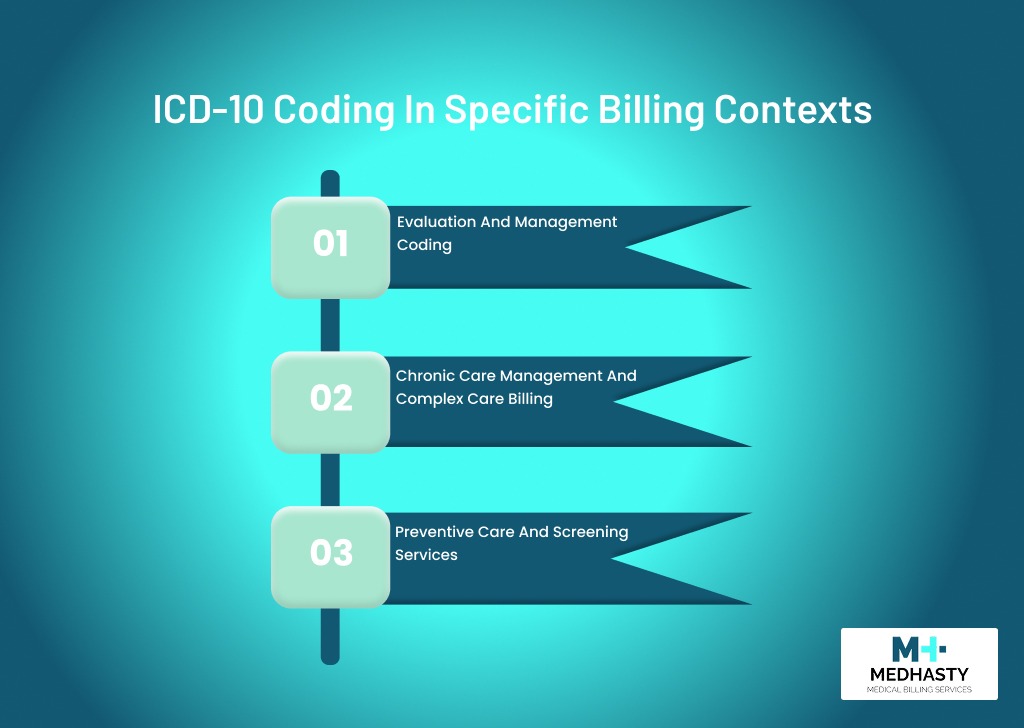
Under the 2021 revised E/M guidelines, medical decision-making is one of the two pathways for selecting the level of an office visit code. The number and complexity of problems addressed at the encounter feeds directly into the MDM calculation. Coding more conditions that were genuinely addressed during the visit is not padding. It is accurate documentation of clinical complexity that properly supports a higher-level E/M code when warranted. Conversely, undercoding the diagnoses, listing only one condition when three were managed, leads to downcoding the E/M and collecting less than the service justifies.
Chronic care management codes like 99490 and 99491 require patients to have two or more chronic conditions expected to last at least 12 months. Those conditions need to be coded accurately on the claim. If the coding on the account reflects only one chronic condition because the coder did not pull all relevant diagnoses from the documentation, the claim for the CCM service may deny as not meeting the criteria. Good ICD-10 coding is what makes CCM billing defensible.
Preventive visits and screenings have their own ICD-10 coding rules. A routine annual wellness exam uses Z codes. But when a physician identifies a new problem during a preventive visit and addresses it, that new problem gets its own diagnosis code and may support a separate E/M billed alongside the preventive visit. The ICD-10 code on each service line has to clearly distinguish between the preventive reason and the problem-oriented reason. Misapplying Z codes to services that were actually problem-focused, or failing to code the problem separately when it was addressed, both lead to either denied claims or missed billing opportunities.
The same errors show up over and over across practice types and specialties. Knowing them by name makes them easier to catch before a claim goes out.
An ICD-10 code is a diagnosis code used to identify a patient’s medical condition, symptom, or reason for receiving healthcare services. These codes appear on insurance claims and help payers determine whether a service is medically necessary.
Physicians document diagnoses in the medical record, and trained medical coders translate that documentation into ICD-10 codes that are used for billing and reporting.
The ICD-10-CM code set contains more than 80,000 diagnosis codes, allowing for a high level of clinical specificity when documenting medical conditions.
ICD-10 codes are updated annually. The updated code set becomes effective October 1 each year, which marks the beginning of the federal fiscal year for healthcare billing.
ICD-10 coding touches every part of the revenue cycle. It drives medical necessity decisions, affects E/M level selection, determines whether a claim clears prior auth, and shows up in every audit. Practices that treat diagnosis coding as a routine afterthought tend to pay for that attitude in denial rates, underpayments, and compliance exposure. Practices that invest in coder training, physician documentation education, and a disciplined annual update process build a revenue cycle on solid ground. The difference between the two shows up clearly in the aging report at the end of every month.
Accurate ICD-10 coding is critical for preventing claim denials, ensuring medical necessity compliance, and maintaining a healthy revenue cycle. However, keeping up with coding updates, payer requirements, and documentation standards can be challenging for busy healthcare providers.
Medhasty Medical Billing Services helps practices streamline their billing operations with expert medical coding, claims management, and revenue cycle optimization. Our experienced billing specialists ensure that diagnosis codes, procedure codes, and documentation align correctly to reduce denials and maximize reimbursements.
If your practice wants to improve billing accuracy and focus more on patient care, our team is here to help.
Contact Medhasty Medical Billing Services today for a free billing consultation.
Hypothyroidism looks simple on paper. One diagnosis code. A few labs. Routine follow-ups.
But in billing, it rarely stays that clean.
Claims for hypothyroidism often get delayed or denied because of vague documentation, incorrect code selection, or poor linkage between diagnosis and services. Medicare and commercial payers expect clarity. They want to see why the test was ordered, why the medication was adjusted, and why the visit level makes sense.
ICD-10 code E03.9 – Hypothyroidism, unspecified, is widely used across primary care, endocrinology, internal medicine, and even cardiology practices. However, “unspecified” does not mean “undocumented.” Payers still expect medical necessity to be clearly established.
This guide breaks down E03.9 billing, medical coding, documentation, reimbursement, and compliance in plain language. No fluff. No shortcuts. Just how it actually works in the U.S. healthcare system.
This code is used when a provider diagnoses hypothyroidism but does not document a specific underlying cause such as autoimmune thyroiditis, iodine deficiency, medication-induced hypothyroidism, or post-surgical thyroid dysfunction.
E03.9 falls under:
Category E03 – Other hypothyroidism
From a billing perspective, E03.9 supports:
However, “unspecified” does not mean vague documentation. The provider must still clearly document:
Payers expect medical necessity to be evident in the note. Using E03.9 without showing active management can result in denials, downcoding, or audit risk.
Before diving into billing complexity, here is the practical snapshot billing teams need.
| Item | Details |
|---|---|
| ICD-10 Code | E03.9 |
| Description | Hypothyroidism, unspecified |
| Category | E03 – Other hypothyroidism |
| Chronic Condition | Yes |
| Supports E/M Visits | Yes |
| Supports Lab Monitoring | Yes |
| Risk Adjustment Impact | Depends on payer |
E03.9 is appropriate when hypothyroidism is documented but the underlying cause is not specified in the assessment.
Hypothyroidism is a chronic endocrine condition in which the thyroid gland fails to produce sufficient thyroid hormones, primarily T3 and T4. These hormones control metabolism, energy levels, heart rate, and temperature regulation.
From a clinical standpoint, it often presents slowly. Patients complain of fatigue, weight gain, cold intolerance, constipation, depression, and hair thinning. From a billing standpoint, it is a long-term condition that supports ongoing E/M services, lab monitoring, and medication management.
According to the American Thyroid Association, hypothyroidism affects around 5% of the U.S. population, with up to 10% having subclinical disease. Women and older adults are affected at much higher rates. That prevalence alone makes E03.9 one of the most frequently reported endocrine diagnosis codes.
But frequency does not equal simplicity. Payers scrutinize chronic condition management closely, especially when visits occur multiple times per year.
Thyroid-stimulating hormone (TSH) is the primary laboratory marker used to diagnose and monitor hypothyroidism.
Most laboratories define the normal TSH range as approximately:
0.4 to 4.0 mIU/L
Hypothyroidism is typically indicated by:
Subclinical hypothyroidism presents with elevated TSH but normal Free T4.
From a billing standpoint, documenting actual lab values strengthens medical necessity for:
Simply stating “labs reviewed” is insufficient. Notes should reflect lab trends and clinical interpretation.
Untreated or poorly managed hypothyroidism can lead to:
Documenting complication risk strengthens medical necessity for close monitoring, especially in elderly or cardiac patients.
This also supports higher-level E/M services when risk factors are discussed.
E03.9 belongs to a broader ICD-10 category that includes multiple forms of hypothyroidism. Understanding the entire category strengthens coding accuracy and prevents unspecified overuse.
If documentation supports any of the above, E03.9 should not be used.
This section increases semantic authority and improves ranking for related search terms.
Understanding the type of hypothyroidism strengthens both clinical documentation and coding accuracy.
Primary hypothyroidism originates from dysfunction of the thyroid gland itself. It is the most common form and includes:
These conditions should be coded with greater specificity when documented (e.g., E06.3 for Hashimoto’s).
Secondary hypothyroidism occurs when the pituitary gland or hypothalamus fails to produce adequate TSH stimulation.
In these cases:
From a billing standpoint, identifying primary vs secondary disease reduces unspecified code usage and improves claim defensibility.
Subclinical hypothyroidism is defined by:
It is common in older adults and frequently discovered through routine lab testing.
From a coding perspective, if documented simply as “subclinical hypothyroidism” without a specified cause, E03.9 may still be appropriate.
However, subclinical cases often involve repeat TSH testing without medication adjustment. This creates audit risk.
To support medical necessity:
Repeated lab billing without documented clinical reasoning is one of the most common denial triggers.
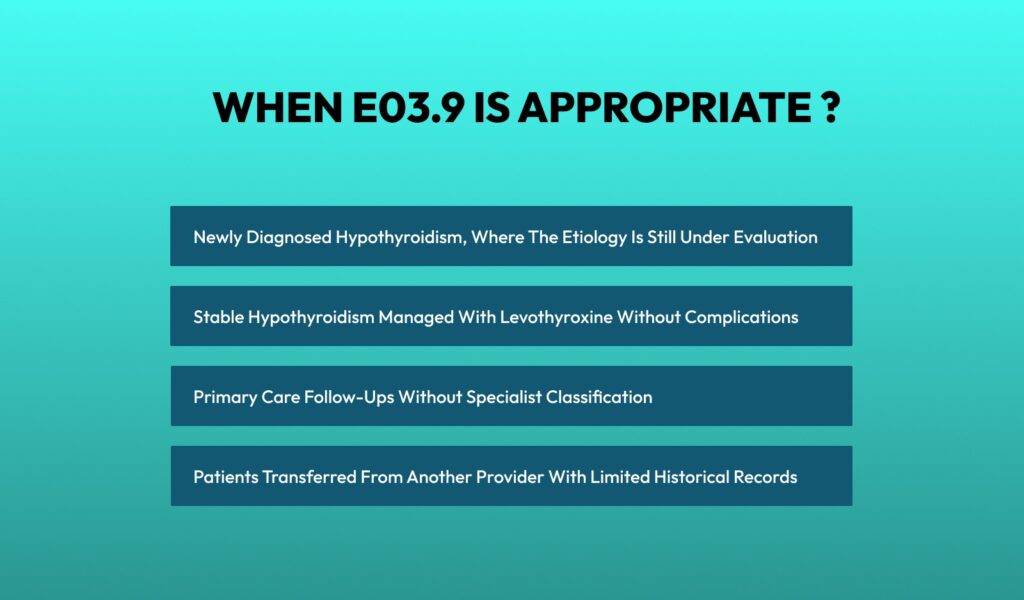
E03.9 is commonly used in these situations:
However, continued long-term use of E03.9 without supporting documentation can raise payer red flags.
Medicare and many commercial payers prefer specific coding when available. If Hashimoto’s thyroiditis or post-procedural hypothyroidism is documented, E03.9 should not be used.
Hypothyroidism is coded every single day in primary care and specialty practices. Because it’s common, payers watch it closely. This cheat sheet keeps coding accurate, compliant, and denial-proof.
E03.9 – Hypothyroidism, unspecified
Use this code when hypothyroidism is clearly diagnosed, but the provider has not documented the underlying cause.
Acceptable use cases
| Condition Documented | ICD-10 Code |
| Hashimoto’s thyroiditis | E06.3 |
| Other specified hypothyroidism | E03.8 |
| Congenital hypothyroidism | E03.0 / E03.1 |
| Post-thyroidectomy hypothyroidism | E89.0 |
| Drug-induced hypothyroidism | E03.2 |
Office / E&M Visits
E/M Level Support
| Test | CPT Code |
| Thyroid-stimulating hormone (TSH) | 84443 |
| Free T4 | 84439 |
| Total T3 | 84480 |
| Venipuncture | 36415 |
Link all thyroid labs to E03.9. Unlinked labs are often denied as routine screening.
Hypothyroidism follow-ups are commonly managed via telehealth, especially for medication titration and lab review.
Telehealth visits for stable hypothyroidism often support:
Documentation must include:
Telehealth errors often result in E/M downcoding when medical decision-making is not clearly documented.
Hypothyroidism crosses multiple specialties. Each bills it slightly differently based on the scope of care.
Primary care providers bill E03.9 for routine management, medication refills, and lab monitoring. Endocrinologists bill it for complex hormonal management, dose titration, and comorbidity evaluation. Cardiologists sometimes use E03.9 when thyroid dysfunction affects heart rate or rhythm. OB-GYNs may report it during pregnancy management.
Because multiple specialties touch this diagnosis, payer edits are often specialty-specific.
This is where most claims fail.
Even though E03.9 is an “unspecified” code, documentation still must support:
At a minimum, the medical record should include:
For example, writing “Hypothyroidism – stable” without lab correlation or medication detail often results in downcoded E/M levels.
Payers want to see why the visit occurred, not just that the condition exists.
Diagnosis codes do not get paid alone. They must justify services.
Common CPT Codes Billed with E03.9
E03.9 is frequently linked with:
Each CPT code must be medically necessary for hypothyroidism management. Ordering a full thyroid panel without symptoms or medication changes often triggers audits.
One of the most frequent audit triggers in hypothyroidism billing involves misclassification of lab testing.
TSH ordered as part of routine preventive screening — without symptoms or known thyroid disease — should be billed with appropriate screening diagnosis codes when applicable.
Screening labs are not always covered unless preventive benefits apply.
TSH or thyroid panels ordered to:
should be linked directly to E03.9 or a more specific thyroid diagnosis.
Payers frequently deny thyroid labs when documentation does not clearly explain why the test was medically necessary at that specific visit.
Every lab claim must answer:
Why was this test required today?
Hypothyroidism is a chronic condition that supports higher E/M levels when properly documented.
Under E/M guidelines, medical decision-making drives the visit level.
Hypothyroidism qualifies as:
For example, adjusting levothyroxine dosage based on lab trends and symptoms supports 99214, not 99213.
But documentation must clearly show:
Without this, payers downcode fast.
Medicare closely monitors endocrine diagnoses because of their chronic nature.
Medicare typically covers:
However, routine screening labs without symptoms or management changes may not be covered.
Medicare expects:
According to CMS data, TSH testing ranks among the top 10 most frequently billed lab tests in Medicare. That also makes it a high-audit item.
Levothyroxine is the standard treatment for hypothyroidism and plays a central role in visit complexity.
E/M levels increase when providers:
Medication management elevates risk category under E/M guidelines, often supporting 99214 when properly documented.
Clear documentation should include:
Without this detail, payers frequently downcode to 99213.
For Medicare Advantage plans, chronic conditions affect risk adjustment and RAF scoring.
While uncomplicated hypothyroidism does not always map to a high-value HCC category, it contributes to chronic disease burden profiling.
Key compliance rule:
Chronic conditions must be:
Simply listing “Hypothyroidism – stable” without active management does not support risk capture.
Annual documentation refresh is critical.
This section improves semantic authority around value-based care.
Hypothyroidism qualifies as a chronic condition under Medicare’s Chronic Care Management program when:
Practices managing multiple chronic conditions alongside hypothyroidism may qualify for CCM billing under CPT 99490 and related codes.
Proper documentation must show:
Integrating CCM into endocrine management can significantly improve revenue stability.
Commercial insurers often mirror Medicare but add their own edits.
Some plans limit thyroid panel frequency. Others require diagnosis specificity after initial visits. Many deny claims when E03.9 is used repeatedly without progression notes.
Prior authorization is rarely required for hypothyroidism labs, but medical necessity reviews are common.
Billing teams should always check payer LCDs and policies for lab frequency limits.
Reimbursement varies by region and payer, but trends are consistent.
Established patient visits for hypothyroidism management typically reimburse:
While individual services are not high-dollar, hypothyroidism generates steady, recurring revenue when billed correctly.
Denials, however, can quickly erode margins due to high volume.
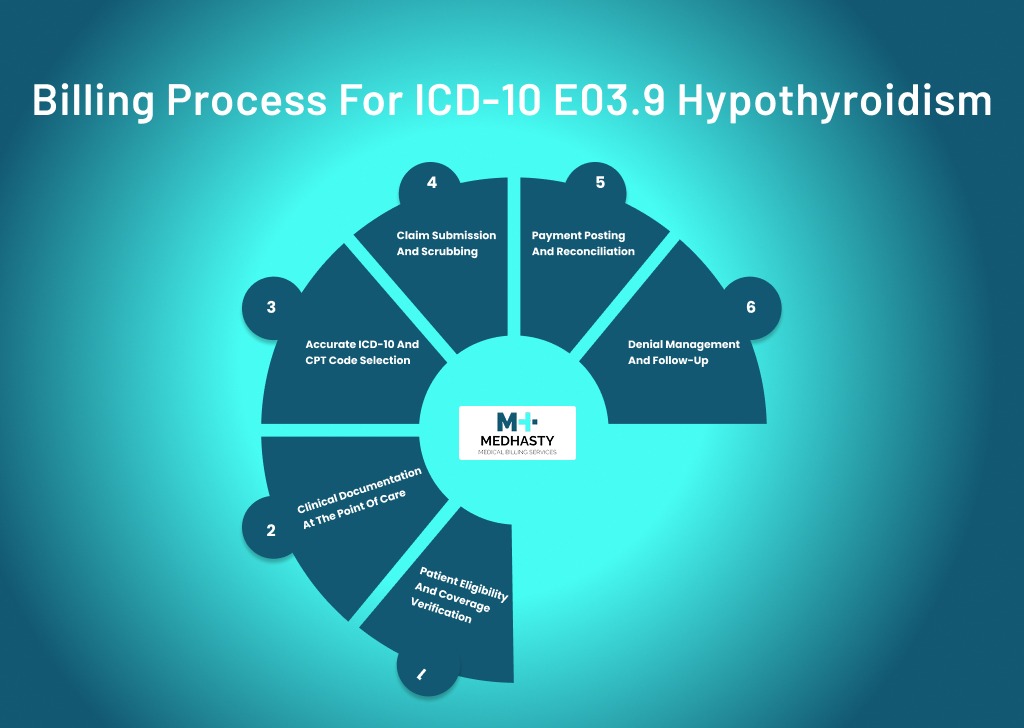
Billing hypothyroidism correctly is less about the code itself and more about how the entire workflow connects. When one step is weak, denials follow. A clean billing process keeps E03.9 claims predictable and compliant.
The process starts before the patient walks in.
Coverage must be verified for:
Many commercial plans allow thyroid labs but restrict how often they can be billed. Medicare covers labs when medically necessary, but flags excessive repeat testing.
If eligibility is skipped, practices often learn about coverage limits only after denial. At that point, appeals become time-consuming and rarely successful.
Documentation drives everything.
For E03.9, the provider must clearly document:
Even though E03.9 is unspecified, payers still expect proof that hypothyroidism is being actively managed. Notes should explain why the visit occurred, not just restate the diagnosis.
Chronic conditions like hypothyroidism support ongoing visits, but only when management is evident.
Coding must reflect exactly what the provider documented.
The coder assigns:
Coders should never default to E03.9 without reviewing the assessment. If Hashimoto’s, post-surgical hypothyroidism, or medication-induced causes are mentioned, E03.9 becomes incorrect.
Diagnosis-to-procedure linkage is critical. Every thyroid-related CPT must connect back to E03.9 to support medical necessity.
Before submission, claims should be scrubbed for:
Most E03.9 denials occur because labs were billed as routine screening or because the visit level was unsupported. A good scrubber catches these issues early.
Clean claims reduce payment delays and prevent unnecessary payer follow-ups.
Once payment is received, billing teams should verify:
Because hypothyroidism claims are frequent but lower dollar, underpayments often go unnoticed. Over time, this adds up to significant revenue leakage.
If a claim is denied, the reason must be carefully analyzed.
Common insurance claim denial reasons include:
Corrections should be applied at the root cause, not just used. Repeated appeals without fixing documentation or coding patterns only invite audits.
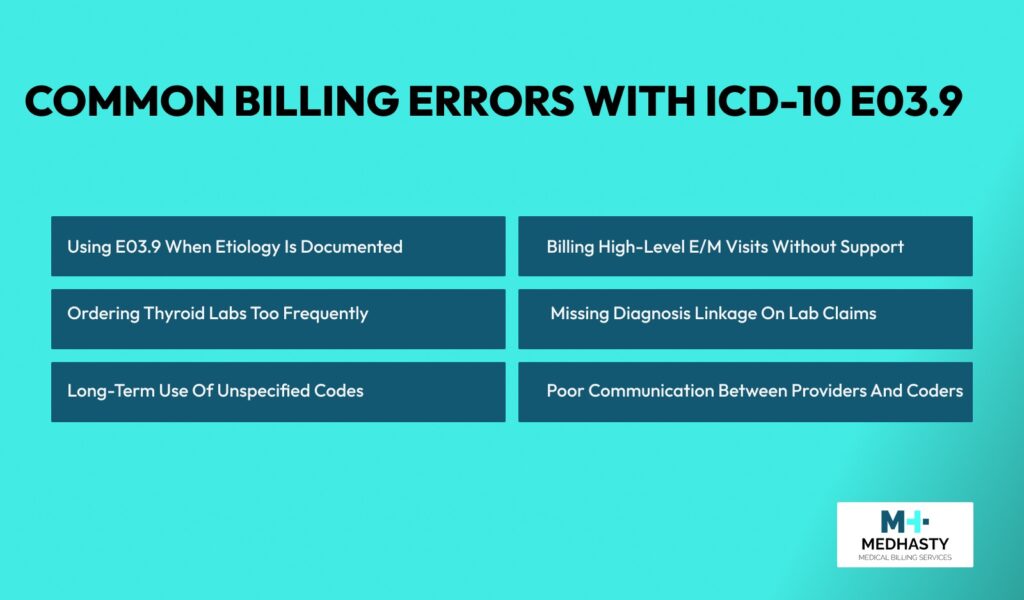
Hypothyroidism errors are rarely dramatic. They are quiet. They happen every day. And they slowly drain revenue.
Here are the most common ones and how to stop them.
This is the most frequent mistake.
Providers often document:
But coders still report E03.9 out of habit.
How to avoid it: Train coders to read the full assessment, not just the problem list. If etiology is mentioned, use the specific ICD-10 code. Query the provider when documentation is unclear.
Hypothyroidism can support moderate or even high-level E/M visits, but only when management is shown.
Billing 99214 without:
almost always leads to downcoding or denial.
How to avoid it: Ensure documentation shows medical decision-making. Notes should explain why labs were reviewed, why medication was continued or changed, and what risks were considered.
Excessive TSH or thyroid panel testing is a red flag for Medicare and commercial payers.
Many denials stem from:
How to avoid it: Link lab frequency to clinical changes. Document medication adjustments or abnormal results that justify repeat testing. Follow payer frequency guidelines closely.
Labs billed without E03.9 attached often are denied as preventive or screening services.
This happens when:
How to avoid it: Always link thyroid labs directly to E03.9. Double-check diagnosis pointers before claim submission.
Using E03.9 for years without updating the diagnosis invites audits.
Payers expect diagnosis specificity over time, especially from specialists.
How to avoid it: Update the ICD-10 code once the cause is confirmed. Periodically review chronic diagnosis lists and clean up outdated, unspecified codes.
Many E03.9 issues stem from silence.
Coders notice vague documentation but do not query about it. Providers assume coders will “figure it out.”
How to avoid it: Create a simple query process. Encourage coders to ask when etiology, management, or lab justification is unclear. This prevents repeat denials and compliance risk.
E03.9 represents hypothyroidism when no specific cause is documented.
When Hashimoto’s thyroiditis, post-surgical hypothyroidism, drug-induced causes, or congenital forms are documented.
Yes, if documentation shows medication adjustment, abnormal labs, or moderate medical decision-making.
Only as medically necessary. Excessive repeat testing may trigger denials.
Yes. It supports ongoing management and follow-up visits.
High-volume chronic diagnoses like E03.9 require precision. Small documentation gaps can lead to repeated denials and revenue leakage.
At Medhasty Medical Billing Services, we specialize in endocrine and chronic care billing optimization — from ICD-10 accuracy to Medicare compliance and risk-adjusted documentation.
Let our team review your current billing workflow and uncover opportunities to improve clean claim performance.
ICD-10 E03.9 may look simple, but billing it correctly takes discipline. Documentation, specificity, and payer awareness matter more than the code itself.
When hypothyroidism claims are clean, they pay consistently. When they are sloppy, denials pile up quietly.
Treat E03.9 like what it is: a chronic condition that deserves structured documentation and smart billing, and it becomes a reliable part of your revenue cycle instead of a compliance headache.
Anxiety disorders are among the most common mental health diagnoses in the United States, representing a significant portion of behavioral health billing. According to recent surveys, more than 20% of adults experience an anxiety disorder each year, and practices are increasingly relying on ICD-10 codes to capture these diagnoses accurately. For mental health providers, correct coding is not just about compliance; it directly impacts reimbursement, claim acceptance, and revenue stability.
In this guide, we’ll cover everything from ICD-10 code selection and documentation requirements to CPT coding, payer-specific strategies, and reimbursement optimization for anxiety treatment. By the end, your practice will have a roadmap for accurately coding, documenting, and billing for anxiety services while reducing denials.
Behavioral health billers and clinicians often need a fast reference. Below is a practical snapshot of the most commonly used anxiety ICD-10-CM codes and what payers expect in documentation.
| Disorder | ICD-10 Code | Core Criteria | Documentation Focus |
|---|---|---|---|
| Generalized Anxiety Disorder | F41.1 | ≥6 months excessive worry | 3+ physical symptoms + impairment |
| Panic Disorder | F41.0 | Recurrent unexpected attacks | 4+ panic symptoms + 1 month behavior change |
| Social Anxiety Disorder (Generalized) | F40.11 | Social fear across most settings | 6+ months + avoidance |
| Agoraphobia | F40.0 | Fear of escape difficulty | Avoidance + companion reliance |
| Adjustment Disorder w/ Anxiety | F43.22 | Stressor within 3 months | Named stressor + proportionality |
| Adjustment Disorder w/ Mixed Anxiety & Depression | F43.23 | Anxiety + depressive symptoms | Timeline + dual symptom documentation |
| PTSD | F43.10 | Trauma + 4 symptom clusters | Trauma exposure + functional impact |
This table improves claim accuracy and reduces overuse of unspecified codes like F41.9.
Anxiety disorders are coded primarily under ICD-10 categories F40–F48, which encompass:
Proper coding ensures that diagnoses are trackable, clinically justified, and reimbursable. Missteps, such as using unspecified codes (e.g., F41.9) or failing to document functional impairment, lead to denials and audit triggers. Studies show that 15–25% of mental health claim denials are linked directly to vague or incorrect ICD-10 documentation.
Effective October 1, 2025, the FY 2026 ICD-10 updates refine anxiety coding, expanding specificity for generalized anxiety disorder, panic disorder, and adjustment disorders. Practices must integrate these changes into electronic health records, superbills, and staff training to maintain compliance and reimbursement efficiency.
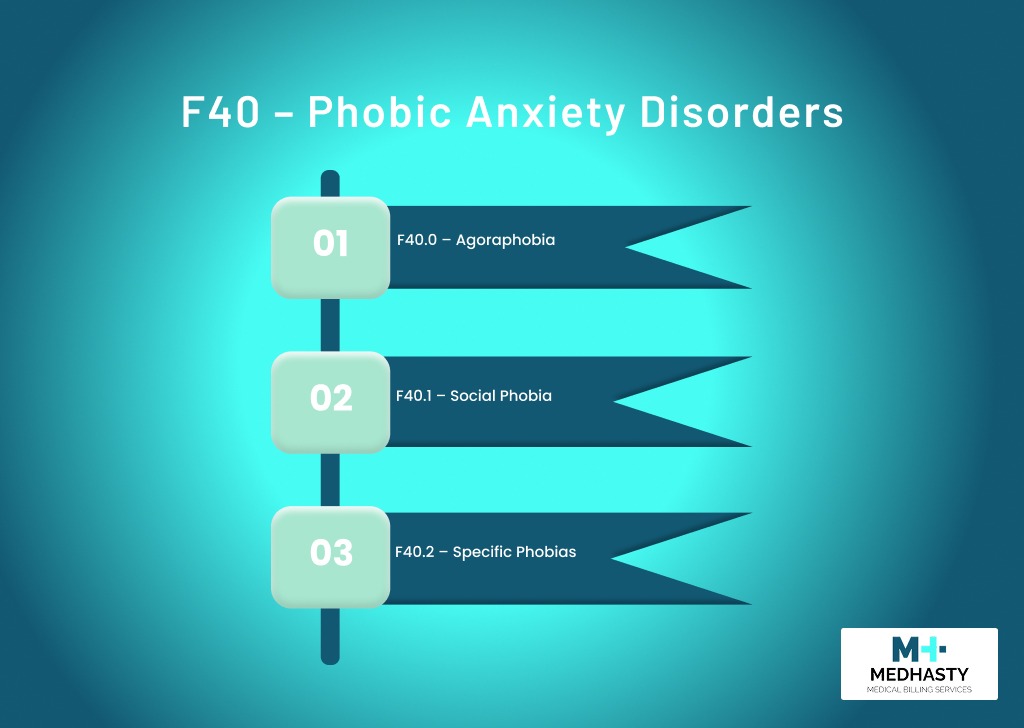
Phobic disorders are marked by excessive fear of specific objects or situations, leading to avoidance and functional impairment. Proper documentation is critical, particularly for social phobias, agoraphobia, and specific phobias.
Documentation must include: duration of at least six months, functional impairment, avoidance behavior, and physical anxiety symptoms.
This category is the most frequently billed in behavioral health:
Correct code selection requires matching DSM-5 criteria with documented symptom frequency, duration, and severity.
Although OCD is a distinct category, it often coexists with anxiety. Coding should accurately reflect primary and secondary diagnoses, especially when billing for therapy or medication management.
For these codes, timeline documentation, identifiable stressors, and functional impact are critical for payer approval.
Based on practice patterns and payer analysis, the top 5 anxiety codes are:
| ICD-10 | Disorder | Documentation Focus |
| F41.1 | Generalized Anxiety Disorder | Chronic worry, ≥3 physical symptoms, functional impairment |
| F41.9 | Anxiety Disorder, Unspecified | Initial assessments, significant anxiety not yet fully evaluated |
| F41.0 | Panic Disorder | ≥4 panic symptoms per episode, behavioral changes |
| F43.23 | Adjustment Disorder with Mixed Anxiety & Depressed Mood | Stressor identification, combined with symptom documentation |
| F40.10 | Social Phobia, Unspecified | Social situation avoidance, anxiety triggers |
Phobic anxiety disorders involve intense fear or anxiety about specific situations or objects. Patients often avoid triggers, and the fear causes measurable disruption to daily life. Documentation is critical because phobias can overlap with other anxiety disorders; payers want proof that the phobia is clinically significant.
Fear of places or situations where escape might be intricate, or help might not be available if panic-like symptoms occur. Examples include open spaces, crowded areas, public transportation, or enclosed spaces.
Key Documentation:
Why it matters: Agoraphobia often leads to multiple missed visits or therapy sessions, so proper coding ensures therapy and evaluation are reimbursable.
Fear of negative evaluation in social or performance situations. Examples: public speaking, meeting new people, and social gatherings.
Key Documentation:
Specificity is essential—use F40.10 for unspecified social phobia, F40.11 for generalized social phobia affecting most interactions.
Anxiety focused on a single object or situation (animals, heights, medical procedures, blood).
Key Documentation:
CPT billing for therapy or desensitization interventions depends on documenting functional impairment, not just fear.
F41 codes cover generalized anxiety, panic disorders, and mixed anxiety presentations. They are the most frequently billed anxiety codes in mental health practices.
Recurrent, unexpected panic attacks, often accompanied by persistent worry about additional attacks and behavior changes.
Key Documentation:
CPT psychotherapy codes are billable if the clinical documentation supports treatment of panic disorder.
Chronic, excessive worry on most days for ≥ 6 months.
Key Documentation:
GAD is the most commonly billed anxiety disorder; precise documentation improves payer acceptance and reduces the risk of denials.
Anxiety that doesn’t fit into specific categories but can be described in clinical notes.
Clearly specify what features are present and why other codes are not applicable.
F43 codes are used when anxiety is linked to a specific stressor or trauma. These disorders often involve both anxiety and depression, requiring careful documentation to support medical necessity.
Emotional or behavioral symptoms arise within 3 months of an identifiable stressor (e.g., job loss, divorce).
Key Documentation:
Both anxiety and depressive symptoms are present due to a stressor.
Key Documentation:
Because these codes are often secondary diagnoses, linking therapy or evaluation services to the primary stressor improves claim approval rates.
While claims are submitted using ICD-10-CM codes, diagnoses are established using DSM-5-TR criteria. Payers often review documentation to ensure the ICD-10 code is supported by DSM criteria.
For example:
If DSM criteria are not clearly documented, payers may argue lack of medical necessity — even if the correct ICD-10 code was selected.
Best Practice:
Document DSM symptom criteria explicitly in your assessment. This strengthens compliance, supports audits, and protects reimbursement.
Evaluation Codes
| CPT | Description | Use Case |
| 90791 | Psychiatric evaluation (no meds) | Initial therapy assessment |
| 90792 | Psychiatric evaluation with medical services | Intake with medication management |
Psychotherapy Codes (Time-Based)
| CPT | Duration | Use |
| 90832 | 16–37 min | Brief individual therapy |
| 90834 | 38–52 min | Standard individual therapy |
| 90837 | 53+ min | Extended individual therapy |
Add-On Codes
| CPT | Description | Use |
| 90785 | Interactive complexity | For patients with barriers to communication |
| 90833/90836/90838 | Psychotherapy with E/M | When therapy coincides with evaluation or management |
Group and Family Therapy Codes
| CPT | Description |
| 90846 | Family therapy, patient not present |
| 90847 | Family therapy, patient present |
| 90849 | Multi-family group therapy |
| 90853 | Group therapy (non-family) |
Crisis Intervention
| CPT | Duration |
| 90839 | First 60 min |
| 90840 | Each additional 30 min |
Documentation must include: crisis assessment, mental status exam, disposition, and recommendations.
Telehealth has become a primary delivery model for anxiety treatment. However, billing requirements vary by payer.
Medicare continues to reimburse tele-mental health services, but documentation must include:
Audio-only services may be limited by payer and state.
Common Telehealth Error:
Failing to document that the encounter was conducted via real-time interactive communication technology.
Proper telehealth coding significantly reduces denial rates for anxiety therapy claims.
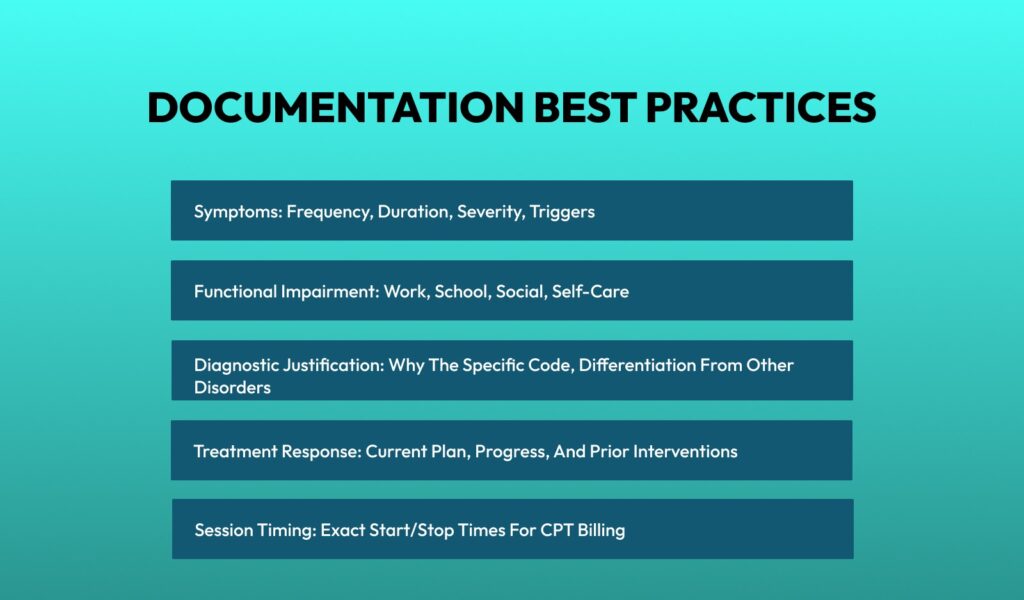
Essential Elements
Pro Tip: Use structured templates for consistency across providers and visits.
Anxiety rarely exists in isolation. Proper sequencing and documentation of comorbid conditions improves reimbursement accuracy and clinical representation.
Frequently co-occurs with GAD and panic disorder. If both conditions are actively treated, they should be coded separately.
Substances may exacerbate anxiety symptoms. Document whether anxiety is primary or substance-induced.
Sleep disturbance is a core anxiety symptom, but if treated independently, it may be coded separately.
In adults, ADHD and anxiety commonly overlap. Clarify diagnostic differentiation in documentation.
Important when anxiety presents primarily with physical complaints.
Sequencing Rule:
List the primary reason for the visit first. Secondary diagnoses should reflect active treatment relevance.
Proper comorbidity coding strengthens medical necessity and reduces payer scrutiny.
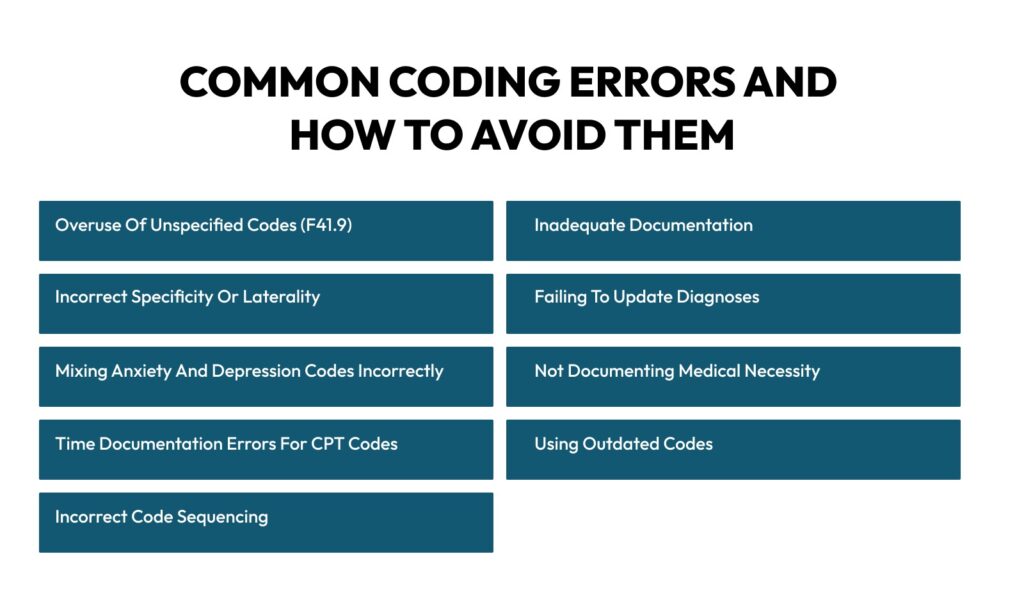
Anxiety disorder coding is deceptively tricky. Even small mistakes—such as using the wrong ICD-10 code or incomplete documentation—can lead to claim denials, audit flags, or underpayments. By understanding the common pitfalls, practices can create robust workflows and avoid repeated mistakes.
Billing F41.9 (Anxiety Disorder, Unspecified) by default instead of a more precise code, such as F41.1 (GAD) or F41.0 (Panic Disorder).
How to avoid:
Using vague statements like “patient anxious” without specifying symptoms, duration, or functional impact.
How to avoid:
Using codes that are too general, like F40.10 (Social Phobia, Unspecified) when generalized social anxiety (F40.11) is present.
How to avoid:
Continuing to bill “unspecified” codes throughout treatment, even after the assessment clarifies the disorder.
How to avoid:
Billing only an anxiety code when depression is also present, or incorrectly sequencing adjustment disorder with mixed anxiety and depression.
How to avoid:
Billing psychotherapy or evaluation CPT codes without connecting the ICD-10 diagnosis to medical necessity.
How to avoid:
Not recording start and stop times accurately for time-based psychotherapy codes (90832, 90834, 90837). Rounding or estimating session times.
How to avoid:
Billing codes from prior ICD-10-CM versions, or not updating after the October 1 ICD-10 annual updates.
How to avoid:
Listing secondary or less relevant diagnoses as the primary code.
How to avoid:
The general code for unspecified anxiety disorder is F41.9. However, F41.1 (GAD) or F41.0 (Panic Disorder) should be used when criteria are met.
F41.1.
F41.0.
F43.22.
Yes. If both conditions are documented and actively treated, they should be coded separately unless using F43.23 for adjustment disorder with mixed features.
Symptoms must persist for at least six months.
Accurate coding for anxiety disorders requires clinical understanding, detailed documentation, and awareness of compliance requirements. By:
Behavioral health providers can reduce denials, improve revenue, and maintain compliance. Anxiety coding is more than a formality—it’s the foundation for accurate reimbursement and quality care tracking.
Medhasty’s behavioral health billing specialists help practices improve clean claim rates, strengthen documentation, and reduce audit exposure.
Schedule your free billing assessment today and protect your revenue cycle.
Physical therapy billing looks simple on the surface. You treat the patient. You submit the claim. You get paid.
But anyone who has actually billed PHYSICAL THERAPY services knows that reality plays out very differently.
Time-based rules, strict documentation, modifier requirements, payer edits, and frequent denials make physical therapy one of the most heavily audited therapy specialties in the U.S. A single missed unit, an incorrect Physical Therapy pairing, or weak documentation can turn a clean visit into a delayed or denied claim.
This guide breaks down physical therapy codes, how they are billed, how payers review them, and how to protect reimbursement.
Physical therapy billing is based on time, function, and medical necessity, not solely on procedures. That difference alone changes how claims are reviewed.
Unlike surgical or diagnostic services, most physical therapy codes fall under timed therapy codes. Medicare and many commercial payers require providers to follow the 8-minute rule, not a flat unit system. This creates constant pressure to document accurately and bill precisely.
Another challenge is utilization scrutiny. Payers closely track how often specific physical therapy codes are billed together, how often they appear per visit, and how long a patient stays in therapy. Overuse patterns quickly trigger audits or payment reductions.
Industry data shows that therapy services face denial rates as high as 10–15%, mainly due to unit miscalculations, missing modifiers, or insufficient functional documentation. That makes coding accuracy a revenue issue, not just a compliance one.
Physical therapy codes generally fall into four major categories. Each category has its own billing rules and payer expectations.
These codes describe the initial assessment and follow-up assessments of a patient’s condition.
Common evaluation physical therapy codes include:
Evaluation codes are untimed and billed once per date of service. However, documentation must support the selected complexity level. Auditors often downgrade evaluations when history, examination, or clinical decision-making does not match the billed code.
Medicare allows one evaluation per episode unless a significant change in condition justifies a re-evaluation.
This category drives most Physical Therapy revenue and also causes most denials. These codes are billed in 15-minute units and must follow the 8-minute rule.
Common examples include:
Each unit must reflect direct one-on-one patient contact. Grouping time, estimating minutes, or overlapping treatments puts claims at risk.
Modalities can be timed or untimed, depending on the service.
Untimed modalities include:
Timed modalities include:
Many payers limit or bundle modalities. Medicare, for example, considers hot/cold packs bundled and non-payable.
These codes cover functional testing and performance measurement.
Examples include:
These services often require detailed reports and apparent medical necessity. Payers frequently deny them when documentation lacks measurable outcomes.
The 8-minute rule determines how many units of timed physical therapy codes can be billed per visit.
Here is how Medicare calculates units:
Each minute must be face-to-face. If a therapist performs 10 minutes of exercise and 7 minutes of manual therapy, only one unit total can be billed.
Commercial payers vary. Some follow the 8-minute rule. Others follow a per-code unit rule, allowing one unit per physical therapy code once 15 minutes is met. Verifying payer policy upfront prevents underbilling or overbilling.
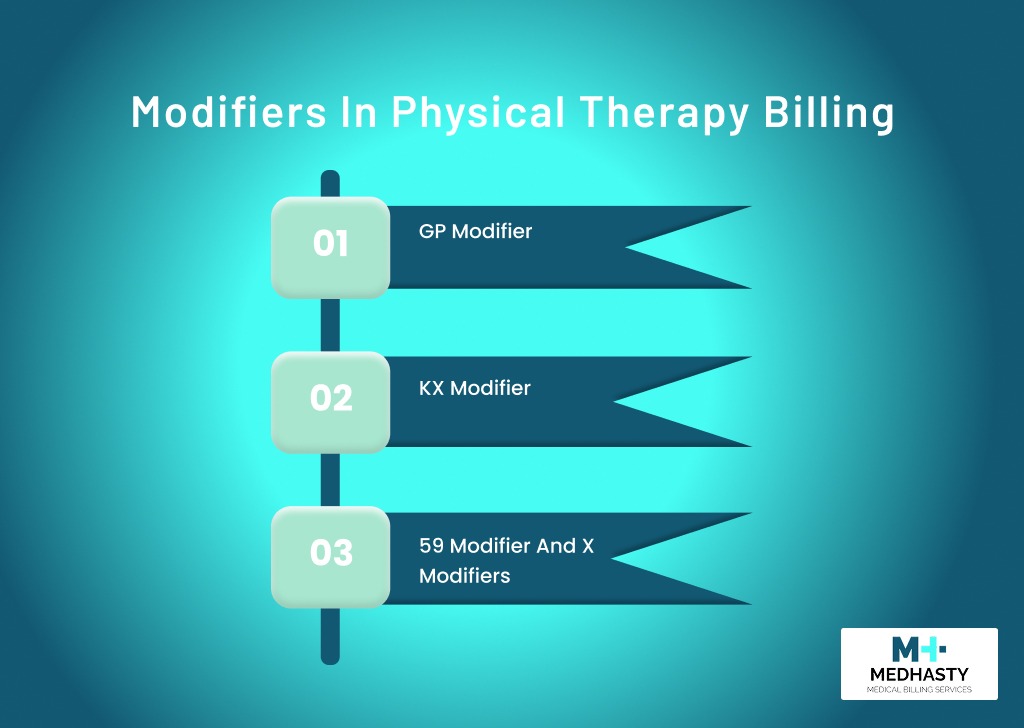
Modifiers are not optional in physical therapy billing. They are payment triggers.
The GP modifier indicates that services were provided under a physical therapy plan of care.
Medicare requires the GP modifier on all physical therapy codes, including evaluations and modalities. Missing this modifier leads to automatic denials.
The KX modifier is used when therapy services exceed Medicare’s annual therapy threshold.
By appending KX, the provider certifies that services remain medically necessary. Claims without KX after the threshold are denied outright.
Improper use of KX is a common audit target, so documentation must clearly justify ongoing care.
The 59 modifier (or XE, XS, XP, XU) is used to bypass National Correct Coding Initiative edits when two services are distinct.
For example, billing manual therapy and therapeutic exercise on the same date often requires a modifier if performed on separate body regions.
Improper modifier use raises red flags, so clinical separation must be well documented.
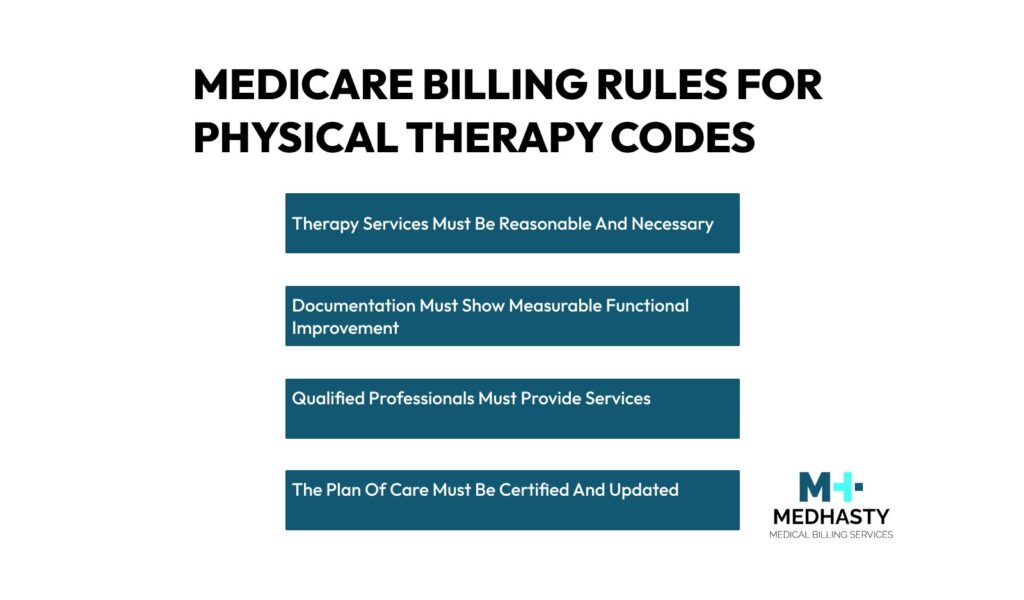
Medicare remains the strictest payer for physical therapy services.
Key Medicare rules include:
Medicare also applies MPPR (Multiple Procedure Payment Reduction). When multiple therapy codes are billed on the same day, payment for secondary codes is reduced by 50%, on average.
Understanding MPPR helps practices forecast reimbursement accurately and avoid surprise underpayments.
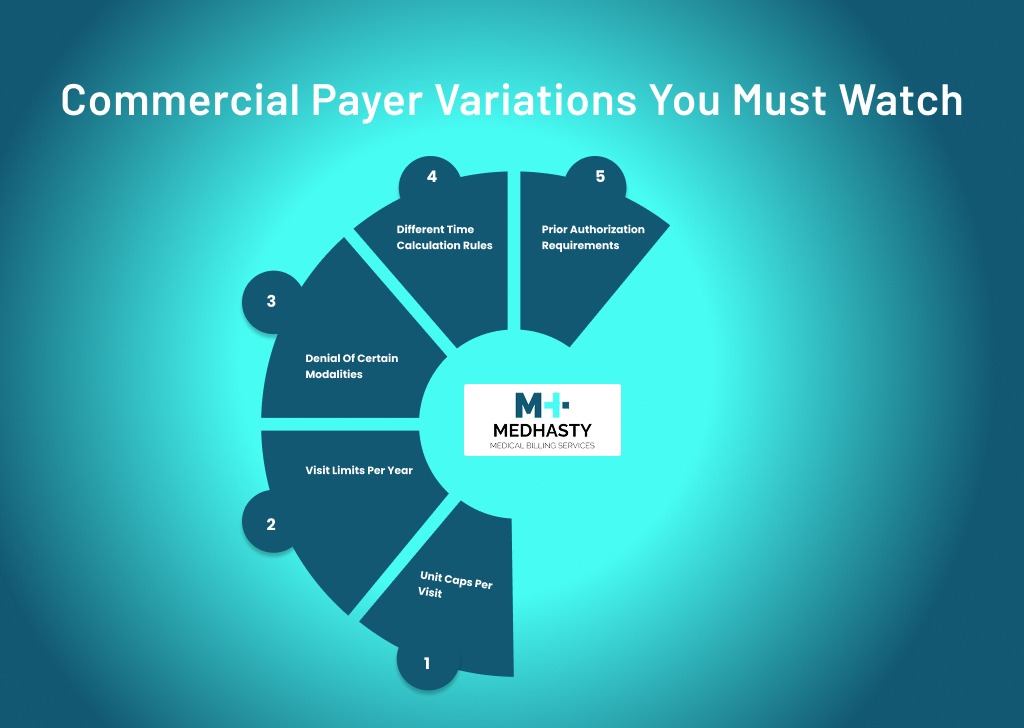
Commercial insurance plans often differ from Medicare, even when they appear similar.
Some common payer-specific issues include:
Large payers such as UnitedHealthcare, Aetna, and Cigna regularly update their therapy policies. Practices that rely on old rules often see rising denial rates without realizing why.
Physical therapy denials rarely happen by accident. In most cases, they follow the same repeat patterns across Medicare, Medicaid, and commercial payers. After working with physical therapy clinics across multiple states, one thing becomes clear. Payers deny therapy claims not because services were unnecessary, but because the story was not told correctly on paper.
Let’s discuss the most common physical therapy code denials and the practical ways to prevent them before they hit your AR.
This is the number one reason physical therapy claims get denied or downcoded.
Payers do not deny because exercises were not performed. They deny because documentation fails to explain why those exercises were medically necessary and how they relate to the patient’s functional limitations.
Many PHYSICAL THERAPY notes list activities such as strengthening, stretching, or balance training. What they miss is the connection to functional deficits, such as difficulty walking, reduced range of motion affecting daily tasks, or post-surgical limitations.
From a payer’s perspective, therapy must show skilled intervention and measurable improvement. Notes that read the same visit after visit raise red flags. Medicare, in particular, expects documentation to show progress toward goals, not just ongoing treatment.
How to prevent it:
Every CPT code in physical therapy should be billed and directly tied to a functional goal. Document baseline limitations, skilled techniques used, patient response, and progress over time. Small changes in wording make a big difference during audits.
Time-based physical therapy codes are a constant source of trouble in physical therapy billing.
Medicare follows the 8-minute rule. Many commercial payers do as well, but not all. Denials occur when the total treatment time does not match the billed units, or when time is split incorrectly across multiple physical therapy codes.
For example, billing for two units of therapeutic exercise when only 20 minutes are documented results in overbilling. On the flip side, underbilling occurs when clinics fail to bill valid units due to confusion about time calculations.
Auditors frequently request time logs when reviewing therapy claims. If minutes do not add up clearly, denials follow.
How to prevent it:
Track direct one-on-one time accurately. Allocate minutes to each physical therapy code clearly in the note. Train therapists and billers on payer-specific time rules instead of assuming all plans follow Medicare.
Data from billing audits shows that time-based errors account for nearly 20% of all physical therapy claim denials across mixed payer portfolios.
Modifiers are not physical therapy in physical therapy billing. Missing even one can stop payment entirely.
The GP modifier is required on all physical therapy services billed to Medicare. Claims without it are automatically rejected.
The KX modifier becomes mandatory once a patient exceeds Medicare’s therapy threshold. Without it, claims are denied regardless of medical necessity.
The 59 modifier, or X modifiers, are often required when billing multiple therapy codes that are usually bundled.
Incorrect modifier use is just as risky as missing one. Overuse of 59 without proper clinical separation invites audits and recoupments.
How to prevent it:
Build modifier checks into your billing workflow. Ensure GP is appended consistently. Monitor therapy threshold usage weekly. Apply 59 only when documentation clearly supports separate and distinct services.
Practices that audit modifier usage monthly see a measurable drop in post-payment takebacks.
Many payers allow billing for an evaluation and treatment on the same date, but only when documentation supports both.
Denials occur when the evaluation note does not justify additional treatment or when treatment time overlaps with evaluation time. Payers may downcode or deny physical therapy codes entirely if they believe the session was primarily evaluative.
Medicare expects a clear separation. The evaluation establishes the plan of care. Treatment addresses specific deficits after that plan is formed.
How to prevent it:
Document evaluation components fully. Clearly note when treatment begins and what services were rendered beyond the evaluation. Avoid vague language that conflates the two.
Clinics that clearly separate eval and treatment time experience fewer same-day denials.
Commercial payers frequently impose visit caps, unit limits, or prior authorization requirements on physical therapy services.
Denials happen when clinics continue treatment after benefits are exhausted or fail to track authorization expiration dates. These denials are especially frustrating because services were often medically appropriate but contractually non-payable.
According to industry reports, authorization-related denials make up 15–18% of therapy AR for commercial plans.
How to prevent it:
Verify benefits before starting care: track authorized visits and units in real time. Reauthorize early when progress supports continued therapy. Communicate limits clearly with patients to avoid write-offs.
Physical therapy is expected to improve function. When progress stalls, payers question ongoing treatment.
Medicare does not cover maintenance therapy unless strict criteria are met. Commercial payers also expect improvement or a justified explanation for slow progress.
Claims are denied when documentation repeats identical goals, treatments, and outcomes over extended periods.
How to prevent it:
Update goals regularly. Document objective improvements, even small ones. When progress slows, explain why continued skilled care is required. Re-evaluations should reflect meaningful clinical changes, not routine check-ins.
Clinics that perform timely re-evaluations significantly reduce the risk of long-duration denials.
Payers closely scrutinize modalities.
Medicare bundles hot and cold packs and considers them non-payable.
Some commercial plans limit ultrasound or electrical stimulation unless specific criteria are met. Billing these services without verifying coverage results in denials or silent write-offs.
How to prevent it:
Know payer-specific modality rules. Use G-codes or alternative codes when required. Do not rely on “we always bill it” habits.
Physical therapy coding is not about memorizing numbers. It is about understanding payer behavior, documentation expectations, and time-based billing rules that directly affect cash flow.
Practices that treat billing as an afterthought quietly lose revenue. Practices that treat it as a clinical and financial process stay profitable and compliant.
When PHYSICAL THERAPY coding is done right, claims move faster, audits drop, and therapists spend less time correcting errors. That balance is what keeps a physical therapy practice healthy for the long run.
Managing physical therapy billing requires more than knowing CPT codes. It demands accurate time-based billing, modifier compliance, payer-specific rules, and audit-ready documentation.
Medhasty Medical Billing is a Maryland-based medical billing company that helps physical therapy practices reduce denials, improve reimbursement, and stay fully compliant with Medicare and commercial payer guidelines.
Whether you’re struggling with the 8-minute rule, modifier usage, claim denials, or payer audits, our experienced billing team ensures your physical therapy claims are coded correctly, submitted cleanly, and paid faster.
Talk to Medhasty Medical Billing today to streamline your physical therapy billing and protect your revenue.
Physical therapy billing codes are CPT codes used to report evaluation, treatment, modalities, and functional testing services provided by licensed physical therapists. Most physical therapy CPT codes are time-based, meaning they are billed in 15-minute units and must meet specific documentation and payer rules. These codes allow Medicare and commercial insurers to determine coverage, reimbursement, and medical necessity for physical therapy services.
The 8-minute rule is a Medicare billing guideline used to calculate how many units of time-based physical therapy CPT codes can be billed during a single visit. Under this rule, at least 8 minutes of direct one-on-one care are required to bill one unit. Additional units are billed as total treatment time increases, following Medicare’s unit thresholds. Only face-to-face skilled treatment time counts toward unit calculation, and time must be clearly documented for each billed service.
Physical therapy billing commonly requires several modifiers to ensure claims are processed correctly. The GP modifier is required on all physical therapy services billed to Medicare to indicate they are provided under a physical therapy plan of care. The KX modifier is required when therapy services exceed Medicare’s annual therapy threshold and certifies continued medical necessity. The 59 modifier, or applicable X modifiers, may be required when billing distinct physical therapy services that are normally bundled but performed on separate body regions or during separate encounters.
Medicare covers some physical therapy modalities, but coverage is limited and payer-specific. Unattended modalities, such as hot and cold packs, are considered bundled and are not separately reimbursable by Medicare. Certain timed modalities, such as ultrasound or manual electrical stimulation, may be covered when they are medically necessary and properly documented. Coverage decisions depend on the modality, diagnosis, and supporting clinical documentation demonstrating skilled intervention.