Emergency Room Billing
ER billing is among the most complex billing environments in U.S. healthcare. Medhasty Medical Billing delivers compliant, code-accurate, and revenue-optimized emergency department billing for physician groups, hospitals, and freestanding EDs across the United States.



Our AAPC and AHIMA-certified coders are trained exclusively in the nuances of emergency medicine. We provide precise CPT code selection for all ED levels (99281-99285), procedure coding, trauma coding, critical care coding (99291, 99292), ICD-10-CM diagnosis assignment, and HCPCS coding for supplies and medications. This specialization ensures that every claim reflects the full clinical picture and supports the billed E/M level.

In the chaotic flow of an emergency department, it is alarmingly easy for billable charges to slip through the cracks. Medhasty conducts rigorous charge-capture audits, comparing clinical documentation with final charge tickets to identify and recover missing charges. We close the loop on every service rendered, from a simple splint to a complex trauma team activation.

While emergency care cannot be delayed for verification, performing real-time eligibility checks at the point of registration provides critical intelligence. Medhasty conducts pre-visit and point-of-service eligibility checks to identify patient coverage, active benefits, and any prior authorization requirements for potential admission. This proactive step dramatically reduces downstream denials related to coverage issues.

Before a single claim reaches a payer, it passes through our multi-point claims scrubbing system. This process catches coding inconsistencies, missing modifiers, and payer-specific rule violations. By targeting a clean claim rate of 95% or higher, we minimize first-pass denials and accelerate your path to payment.

ER billing denial patterns are predictable: medical necessity disputes, level-of-care disagreements, and modifier errors. Medhasty’s denial management team analyzes each denial within 24 hours, identifies the root cause, and initiates a structured appeal. With an appeal success rate exceeding 85%, we convert denials into revenue where others give up.

Aged A/R is a direct drag on your practice’s cash flow. ER practices typically see higher A/R days than elective specialties due to unscheduled visits and unknown insurance status. Medhasty provides active A/R follow-up for both insurance and patient balances, using targeted work queues to resolve aging claims and reduce A/R days to 30 or fewer.

While most emergency visits do not require prior authorization, critical nuance exists for patients who are subsequently admitted. Medhasty handles retrospective authorizations and follow-up authorizations for admitted patients, ensuring that the facility and physician receive full reimbursement for the inpatient portion of the encounter.

The billing lifecycle begins at registration. An incorrectly entered name, a transposed date of birth, or a misspelled insurance ID number will guarantee a denial. Medhasty provides best-practice guidance and auditing for front-end demographic entry, understanding that clean claims start with accurate data.

Reimbursement rates for emergency services are not static. Medhasty actively negotiates and monitors reimbursement rates specific to ER services across Medicare, Medicaid, and commercial payers. We track unannounced payer policy changes and update billing protocols proactively, ensuring your contracts are always working in your favor.

An uncredentialed provider is a 100% denial risk. Medhasty manages the entire provider credentialing process, ensuring all emergency physicians are properly enrolled with Medicare, Medicaid, and commercial networks. We handle initial credentialing, re-credentialing, and CAQH management so your providers can bill for every service they perform.

DNFB is the silent killer of ED cash flow. Medhasty implements a dedicated DNFB management workflow that identifies open encounters, assigns them for coding and charge entry, and tracks resolution within required billing windows. We target a 98% DNFB resolution rate, ensuring that what leaves the clinical floor does not stay on your billing floor.
Even experienced coding teams make specific, predictable errors in the ED environment. Identifying these is the first step to prevention:
Under-coding due to inadequate MDM documentation: The clinical work was performed, but the medical record lacks the necessary detail (e.g., specific review of systems, detailed MDM rationale) to support the billed level.
Misuse of Modifier 25: Billing an E/M service (99281-99285) on the same day as a minor procedure (e.g., laceration repair) without proper documentation that the E/M was significant and separately identifiable
Unspecified ICD-10-CM diagnosis codes: Using codes like R10.9 (Unspecified abdominal pain) when a more specific code like R10.32 (Left lower quadrant pain) is supported by the record. Payers view unspecified codes as a lack of medical necessity.
Prior authorization for specialized tests: Advanced laboratory diagnostics such as genetic testing often require authorization before testing is performed.
Missing external cause-of-injury codes: For trauma cases, failing to report ICD-10-CM codes from Chapter 20 (e.g., V00-Y99) that describe the cause, intent, and place of injury.
Incorrect modifier application for bilateral procedures: Applying modifier 50 (bilateral procedure) incorrectly or failing to use the correct modifier for multiple procedures (e.g., modifier 51 or 59).
Emergency medicine is not monolithic. Different patient populations and facility types present unique billing challenges that require specialized expertise.

Trauma cases represent the highest coding complexity and the highest audit risk. Billing for a trauma activation involves multiple procedure codes, critical care time (CPT 99291/99292), complex wound repair codes, and external cause-of-injury ICD-10 codes (e.g., V03.10XA for a pedestrian collision). Medhasty’s coders understand the distinction between Level I, II, III, and IV trauma center billing requirements, including the separate trauma team response codes (e.g., HCPCS G0390).

Psychiatric ER visits require accurate capture of ICD-10-CM codes in the F01–F99 range for mental, behavioral, and neurodevelopmental disorders. These visits often involve extended observation, which has separate coding requirements from a standard ED E/M. Billing for substance use disorder presentations—including medically managed withdrawal and administration of medications like buprenorphine—adds further complexity that our team navigates routinely.

Pediatric emergency care has distinct coding rules. Age-specific procedure codes, medication dosing calculations, and documentation requirements differ from adult care. Payer policies for pediatric ER visits—especially Medicaid and CHIP—vary significantly by state. Medhasty ensures that claims for febrile infants, asthma exacerbations, and pediatric fractures are coded correctly for the unique payer environment of pediatric emergency medicine.

Time-sensitive interventions require precise charge capture. The administration of tPA (tissue plasminogen activator) for ischemic stroke is billed separately from the ED E/M, often using specific HCPCS codes. Cardiac catheterization lab transfers involve the ED team’s stabilization procedures, which must be coded distinctly from the interventional cardiologist’s work. Medhasty’s coding ensures that the emergency physician’s critical role is fully captured and reimbursed.

Freestanding EDs (not attached to a hospital) operate under a different billing paradigm. Some commercial payers do not reimburse freestanding EDs at the same rate as hospital-based EDs, and a few restrict coverage entirely. Understanding these payer restrictions and coding accordingly is a critical billing nuance. Medhasty provides specialized coding and billing support for freestanding emergency centers to ensure they receive the reimbursement they are entitled to.

ER patient data is among the most sensitive in healthcare. Emergency presentations often involve highly protected health information related to mental health, substance use, infectious diseases, or victims of violence. Medhasty’s billing operations are fully HIPAA-compliant, with secure data transmission protocols, encrypted storage, and role-based access controls. We execute a Business Associate Agreement (BAA) with every client practice as standard practice.
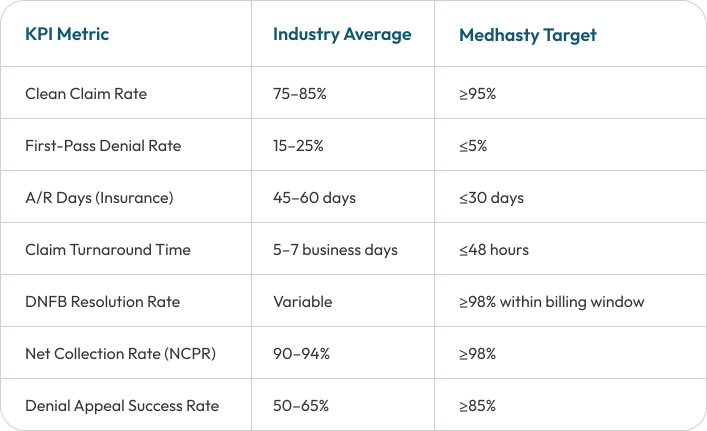
Measurable performance is the only true measure of billing effectiveness. The following table compares industry average metrics against Medhasty’s target performance for emergency room billing.

Certifications & Affiliations:
“Medhasty reduced our ED denial rate from 22% to 4% in the first 90 days. Their coding team caught documentation issues we didn’t know we had. We have seen a measurable increase in our net collection rate.”
“The DNFB management alone has paid for their services three times over. Before Medhasty, we had a chronic backlog of unbilled discharges. Now we are current and staying current.”

When evaluating emergency room billing partners, the differences matter. Here is why leading emergency medicine practices select Medhasty over national competitors.
ER-Specific Expertise: Medhasty’s billing team is not composed of generalists who happen to code emergency medicine. Our coders are trained specifically in emergency medicine billing, including critical care, trauma, psychiatric, pediatric ER, and freestanding ED scenarios. This specialization means faster coding, fewer errors, and higher net revenue.
Software Agnostic: We work within your existing technology ecosystem. Unlike competitors who require expensive and disruptive system migrations, Medhasty adapts to your workflow. Whether you use Epic, Cerner, Medisoft, or another platform, we integrate seamlessly.
Regulatory-Proactive Team: With 2025 CMS changes already in effect and commercial payers continuously revising their own policies, passive billing is dangerous. Medhasty maintains ongoing regulatory monitoring, so your billing never falls behind. We update our protocols proactively, not reactively.
Local Presence, National Scale: Rooted in Columbus, Maryland, Medhasty brings a proximity to East Coast healthcare regulatory nuance while serving ER practices across all 50 states. You get the responsiveness of a local partner with the infrastructure of a national billing organization.
HIPAA-Compliant, Fully Secure: All patient data is handled through HIPAA-compliant channels with Business Associate Agreements (BAAs) in place. Your protected health information is secure with Medhasty.
HIPAA-Compliant, Fully Secure: All patient data is handled through HIPAA-compliant channels with Business Associate Agreements (BAAs) in place. Your protected health information is secure with Medhasty.
Transparency in the process builds trust and predictable outcomes. Here is exactly how our billing partnership operates, from initial assessment to ongoing revenue cycle management.

We begin by analyzing your current billing workflow, charge capture process, denial patterns, and A/R aging report. We identify specific revenue leakage points—whether in coding, documentation, or submission—before we recommend any solution.

Medhasty works within your existing EHR and practice management software. We do not force migrations. Our team integrates seamlessly with all major platforms including Epic, Cerner, Medisoft, Athenahealth, NextGen, eClinicalWorks, and many others.

Our AAPC and AHIMA-certified ER coders review all ED charts for completeness. We assign accurate CPT and ICD-10-CM codes, apply correct modifiers, and flag any documentation gaps before claim submission.

Every claim is scrubbed against payer-specific editing rules before electronic submission. We target a first-pass acceptance rate of 95% or higher across Medicare, Medicaid, and all commercial payers.

Denied claims are analyzed for root cause within 24 hours of receipt. Our team pursues appeals aggressively using payer-specific arguments, achieving a documented appeal success rate above 85%.

We maintain active follow-up on all outstanding A/R, using targeted work queues to resolve aging claims. Payments are posted accurately, and ERA/EOB documents are reconciled daily.

You receive monthly performance reports with full KPI dashboards. No surprises. No hidden issues. Complete visibility into your billing performance.
FAQS
Medhasty Medical Billing is a company based in Columbus, Maryland that provides specialized emergency room billing services for physician groups, hospitals, and freestanding emergency departments across all 50 states in the United States. They focus on delivering compliant, code-accurate, and revenue-optimized ER billing with HIPAA-compliant operations, AAPC and AHIMA-certified ER coders, and 24/7 billing support. Their goal is to protect ED revenue in one of the most complex billing environments in U.S. healthcare.
Emergency room billing involves multiple layers of complexity that most other billing environments do not face at the same time. These include unpredictable patient volume, dual billing for both facility fees and physician professional fees, a five-level E/M coding system based exclusively on Medical Decision Making, multi-payer environments with frequently changing rules, and high exposure to DNFB or Discharges Not Fully Billed. These factors make ER billing one of the highest-risk revenue cycle environments in U.S. healthcare.
Medhasty offers a full suite of ER billing services including Emergency Room Medical Coding, Charge Capture and Charge Entry, Insurance Eligibility Verification, Claims Scrubbing and Submission, Denial Management and Appeals, A/R Management and Follow-Up, Prior Authorization Support, Patient Demographic Entry and Registration Support, ER-Specific Payer Contract Management, Provider Credentialing for ER Physicians, and DNFB Management. Each service is designed to close revenue gaps and improve cash flow for emergency departments.
Medhasty’s AAPC and AHIMA-certified coders, trained exclusively in emergency medicine, provide precise CPT code selection for all ED levels from 99281 to 99285, procedure coding, trauma coding, critical care coding using CPT 99291 for the first 30 to 74 minutes and 99292 for each additional 30-minute interval, ICD-10-CM diagnosis assignment, and HCPCS coding for supplies and medications. This specialization ensures every claim reflects the full clinical picture and properly supports the billed E/M level.
In the chaotic flow of an emergency department, billable charges can easily slip through the cracks. Medhasty conducts rigorous charge-capture audits by comparing clinical documentation with final charge tickets to identify and recover missing charges. They close the loop on every service rendered, from a simple splint to complex trauma team activation, ensuring nothing is left unbilled.
While emergency care cannot be delayed for verification, Medhasty conducts pre-visit and point-of-service eligibility checks to identify patient coverage, active benefits, and any prior authorization requirements for potential admission. This proactive step dramatically reduces downstream denials related to coverage issues even though care is never delayed.
Before any claim reaches a payer, it passes through Medhasty’s multi-point claims scrubbing system that catches coding inconsistencies, missing modifiers, and payer-specific rule violations. They target a clean claim rate of 95 percent or higher to minimize first-pass denials and accelerate the path to payment.
ER billing denial patterns are predictable and often involve medical necessity disputes, level-of-care disagreements, and modifier errors. Medhasty’s denial management team analyzes each denial within 24 hours, identifies the root cause, and initiates a structured appeal. They achieve an appeal success rate exceeding 85 percent, converting denials into revenue where others may give up.
Aged A/R directly drags on cash flow, and ER practices often see higher A/R days due to unscheduled visits and unknown insurance status. Medhasty provides active A/R follow-up for both insurance and patient balances using targeted work queues to resolve aging claims and reduce A/R days to 30 or fewer.
Medhasty handles retrospective authorizations and follow-up authorizations for admitted patients, provides best-practice guidance and auditing for front-end demographic entry to prevent denials from data errors, actively negotiates and monitors ER-specific reimbursement rates across Medicare, Medicaid, and commercial payers while tracking policy changes, manages the entire provider credentialing process including initial, re-credentialing, and CAQH management, and implements dedicated DNFB workflows to identify open encounters, assign them for coding and charge entry, and track resolution with a target 98 percent DNFB resolution rate.
Common errors include under-coding due to inadequate medical decision making documentation where the clinical work was performed but the record lacks necessary detail to support the billed level, misuse of Modifier 25 when billing an E/M service on the same day as a minor procedure without proper documentation that the E/M was significant and separately identifiable, use of unspecified ICD-10-CM diagnosis codes such as R10.9 instead of more specific codes when supported by the record, prior authorization issues for specialized tests like genetic testing, missing external cause-of-injury codes from ICD-10 Chapter 20 for trauma cases, and incorrect application of modifiers for bilateral procedures such as Modifier 50 or for multiple procedures like Modifier 51 or 59.
Trauma cases represent the highest coding complexity and audit risk. Medhasty’s coders understand billing for trauma activation involving multiple procedure codes, critical care time with CPT 99291 and 99292, complex wound repair codes, and external cause-of-injury ICD-10 codes. They handle distinctions between Level I, II, III, and IV trauma center requirements including separate trauma team response codes such as HCPCS G0390.
For psychiatric ER visits, they accurately capture ICD-10-CM codes in the F01 to F99 range for mental, behavioral, and neurodevelopmental disorders, handle extended observation coding, and manage substance use disorder presentations including medically managed withdrawal and medications like buprenorphine. For pediatric ER, they apply age-specific procedure codes, medication dosing considerations, and navigate varying state Medicaid and CHIP payer policies for conditions like febrile infants, asthma exacerbations, and pediatric fractures. For stroke and cardiac cases, they ensure precise charge capture for time-sensitive interventions such as tPA administration using specific HCPCS codes and distinguish ED stabilization procedures from interventional cardiologist work. For freestanding EDs, they address different reimbursement paradigms and payer restrictions that some commercial payers apply compared to hospital-based EDs.
Medhasty targets a clean claim rate of 95 percent or higher versus the industry average of 85 percent, a denial rate under 5 percent compared to the industry range of 15 to 20 percent, an appeal success rate exceeding 85 percent versus the industry 60 to 70 percent, A/R days of 30 or fewer against the industry 45 to 60 days, and a DNFB resolution rate of 98 percent compared to the industry 85 percent. These measurable targets demonstrate their focus on revenue optimization.
Clients choose Medhasty for their ER-specific expertise where coders are trained specifically in emergency medicine including critical care, trauma, psychiatric, pediatric, and freestanding ED scenarios rather than being generalists. They are software agnostic and integrate seamlessly with existing systems like Epic, Cerner, Medisoft, Athenahealth, NextGen, and eClinicalWorks without requiring expensive migrations. Their regulatory-proactive team monitors ongoing changes including 2025 CMS updates and payer policy revisions to keep billing current. They offer local presence in Columbus, Maryland with national scale serving all 50 states. All operations are fully HIPAA-compliant with Business Associate Agreements in place for secure handling of protected health information.
The process begins with a free ER billing audit that analyzes current workflow, charge capture, denial patterns, and A/R aging to identify revenue leakage points. Next comes onboarding and system integration where Medhasty works within the client’s existing EHR and practice management software without forcing migrations. Then charge capture and coding review occurs where certified ER coders review all ED charts, assign accurate CPT and ICD-10-CM codes, apply correct modifiers, and flag documentation gaps. This is followed by claims scrubbing and electronic submission targeting 95 percent or higher first-pass acceptance. Denied claims receive denial management and appeals with root cause analysis within 24 hours and aggressive pursuit achieving over 85 percent success. Active A/R follow-up and payment posting uses targeted work queues with daily ERA and EOB reconciliation. Finally, monthly performance reports with full KPI dashboards provide complete transparency and visibility into billing performance.
Yes, all Medhasty billing operations are conducted under strict HIPAA compliance protocols. They execute a Business Associate Agreement with every client practice and use secure data transmission protocols, encrypted storage, and role-based access controls. Emergency room patient data, which often involves highly sensitive information related to mental health, substance use, infectious diseases, or victims of violence, is handled with the highest security standards throughout the billing lifecycle.
The primary ER evaluation and management codes are CPT 99281 through 99285, assigned based exclusively on the complexity of Medical Decision Making or MDM rather than time since 2023. For critical care services, CPT 99291 applies to the first 30 to 74 minutes and 99292 for each additional 30-minute interval. Procedure codes, HCPCS codes for medications and supplies, and ICD-10-CM diagnosis codes complete the picture. MDM has three components: Complexity of Problems Addressed, Data Reviewed, and Treatment Risk. The highest level achieved in at least two of the three components determines the correct CPT code. In 2025, with stricter CMS scrutiny and numerous CPT code updates, accurate MDM documentation is more critical than ever.
DNFB stands for Discharges Not Fully Billed. It refers to ED patient encounters that have been discharged but whose claims have not yet been submitted to the payer, often due to incomplete documentation, pending coding review, or workflow bottlenecks. Unmanaged DNFB directly impacts cash flow and in high-volume EDs can represent hundreds of thousands of dollars in delayed revenue per month. Medhasty targets a 98 percent DNFB resolution rate to keep revenue moving.
In a hospital-based emergency department, two separate claims are typically generated. The hospital submits a facility fee claim on a UB-04 form billing for resources consumed such as nursing care, equipment, medications, and room usage. The emergency physician group submits a separate professional fee claim on a CMS-1500 form using CPT codes 99281 through 99285. Both are based on E/M level but evaluated differently: the hospital uses resource intensity while the physician uses Medical Decision Making. Medhasty manages both billing streams for their clients.
Medhasty targets a claim submission turnaround of 48 hours or less from the date of service documentation completion to reduce A/R aging and accelerate cash flow. Clients have reported strong results such as one emergency physician group in Texas that reduced their ED denial rate from 22 percent to 4 percent in the first 90 days with measurable increases in net collection rate, and a Florida freestanding ED practice administrator who noted that DNFB management alone paid for the services multiple times over by eliminating chronic backlogs of unbilled discharges.
Yes, Medhasty offers a free, no-obligation ER billing audit that identifies current denial patterns, charge capture gaps, and DNFB exposure, followed by a clear revenue improvement roadmap with no commitment required. Their ultimate goal is to help healthcare practices permanently increase cash flow, avoid denials, and optimize the entire revenue cycle through specialized ER billing expertise.

Let our medical billing experts optimize your revenue cycle management. We enable healthcare practices to increase cash flow and avoid denials. Permanently!