
Medical coding plays a crucial role in the healthcare revenue cycle. Accurate coding ensures healthcare providers receive proper reimbursement for the services they deliver while maintaining compliance with payer and regulatory requirements. However, even small coding mistakes can lead to claim denials, payment delays, underpayments, and significant revenue loss.
In 2026, healthcare organizations face increasing pressure from evolving coding guidelines, stricter payer audits, and growing compliance requirements. As a result, minimizing coding errors has become essential for maintaining financial stability and operational efficiency.
For healthcare providers looking to improve revenue cycle performance, understanding and preventing common medical coding mistakes is one of the most effective strategies for reducing revenue leakage and maximizing reimbursements.
Why Accurate Medical Coding Matters
Medical coding translates healthcare services, diagnoses, procedures, and treatments into standardized codes used for billing and reimbursement purposes.
Accurate coding helps providers:
- Receive appropriate reimbursement
- Reduce claim denials and rejections
- Improve compliance with payer regulations
- Streamline billing processes
- Minimize audit risks
When coding errors occur, healthcare organizations often face delayed payments, increased administrative costs, and lost revenue opportunities.
1. Using Incorrect CPT or ICD-10 Codes
One of the most common medical coding mistakes is assigning incorrect CPT or ICD-10 codes to services provided.
Coding inaccuracies may occur due to:
- Human error
- Outdated coding references
- Insufficient documentation
- Lack of coder training
Incorrect codes can cause claims to be denied, delayed, or reimbursed at lower rates than expected.
To prevent this issue, healthcare organizations should regularly update coding resources and provide ongoing education for coding staff.
Internal Link Opportunity: Link to your Medical Billing & Coding Services page.
2. Upcoding and Downcoding Errors
Upcoding occurs when a provider reports a more expensive service than what was actually performed. Downcoding happens when services are reported at a lower level than warranted.
Both situations can create serious financial consequences.
Upcoding Risks
- Compliance violations
- Payer audits
- Financial penalties
- Potential fraud investigations
Downcoding Risks
- Reduced reimbursement
- Revenue leakage
- Underreported services
Proper documentation and coding audits help ensure services are coded accurately and appropriately.
3. Missing or Incorrect Modifiers
Modifiers provide additional information about procedures and services performed. When modifiers are missing, incorrect, or improperly applied, claims may be denied or reimbursed incorrectly.
Common modifier-related issues include:
- Missing modifier usage
- Incorrect modifier combinations
- Failure to apply payer-specific modifier requirements
- Using outdated modifier guidelines
Accurate modifier application helps ensure claims reflect the full scope of services provided.
Internal Link Opportunity: Link to your Claims Management Services page.
4. Incomplete Clinical Documentation
Medical coders rely heavily on provider documentation to assign accurate codes. If documentation is incomplete, unclear, or inconsistent, coders may be unable to support the services billed.
Common documentation problems include:
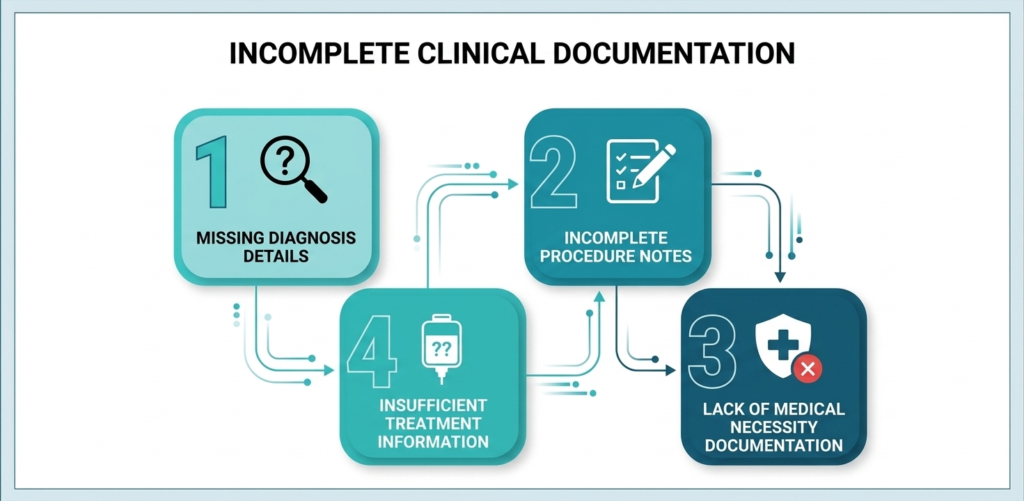
Strong clinical documentation supports accurate coding, improves reimbursement accuracy, and reduces audit risks.
5. Failure to Verify Medical Necessity
Payers often require services to meet specific medical necessity criteria before reimbursement is approved.
If coding does not adequately demonstrate medical necessity, claims may be denied even when services were appropriately provided.
Healthcare organizations can reduce these denials by:
- Verifying payer requirements
- Ensuring diagnoses support procedures performed
- Maintaining detailed clinical records
- Reviewing claims before submission
Medical necessity verification is an important component of successful revenue cycle management.
Internal Link Opportunity: Link to your Eligibility Verification Services page.
6. Unbundling Services Incorrectly
Unbundling occurs when services that should be billed together are reported separately to increase reimbursement.
While some coding combinations are appropriate, improper unbundling can trigger claim denials, audits, and compliance concerns.
Healthcare organizations should regularly review payer guidelines and coding updates to ensure bundled services are reported correctly.
Proper coding practices help protect both revenue and compliance.
7. Failure to Keep Up with Coding Updates
Medical coding guidelines change frequently. Every year, updates are made to:
- CPT codes
- ICD-10 codes
- HCPCS codes
- Payer-specific billing requirements
Using outdated codes can result in claim rejections and lost revenue.
In 2026, healthcare organizations must stay current with coding changes to maintain reimbursement accuracy and compliance.
Regular training programs and coding updates help billing teams stay informed.
How Coding Errors Impact Revenue Cycle Performance
Medical coding mistakes affect far more than individual claims.
Common consequences include:
Increased Claim Denials
Coding errors remain one of the leading causes of denied claims across healthcare organizations.
Delayed Reimbursements
Incorrect coding often requires claim corrections and resubmissions, slowing payment cycles.
Higher Administrative Costs
Billing teams spend valuable time correcting preventable coding mistakes rather than focusing on revenue-generating activities.
Compliance Risks
Repeated coding inaccuracies can increase exposure to audits, penalties, and regulatory scrutiny.
Revenue Leakage
Underpayments and denied claims directly reduce organizational revenue and profitability.
By addressing coding issues proactively, providers can strengthen overall financial performance.
The Role of Technology in Reducing Coding Errors
Modern healthcare organizations increasingly rely on technology to improve coding accuracy.
Advanced coding solutions can:
- Identify coding inconsistencies
- Detect missing documentation
- Validate medical necessity requirements
- Flag modifier issues
- Ensure compliance with payer rules
Artificial intelligence and automation tools are helping providers reduce manual errors while improving claim accuracy and reimbursement outcomes.
Organizations that invest in coding technology often experience lower denial rates and stronger revenue cycle performance.
Internal Link Opportunity: Link to your Revenue Cycle Management Services page.
Best Practices for Preventing Medical Coding Mistakes
Healthcare organizations can significantly reduce coding-related revenue loss by implementing proven best practices.
These include:
- Conducting regular coding audits
- Providing ongoing coder education
- Improving clinical documentation processes
- Monitoring coding accuracy metrics
- Staying updated on coding guideline changes
- Utilizing automated coding validation tools
- Implementing strong quality assurance programs
Organizations that continuously monitor coding performance are better positioned to improve reimbursement accuracy and reduce financial risk.
The Future of Medical Coding in 2026
As healthcare becomes increasingly complex, medical coding will continue evolving alongside payer requirements and regulatory standards.
Emerging technologies such as AI-assisted coding, predictive analytics, and automated compliance monitoring are helping healthcare organizations improve coding accuracy while reducing administrative burdens.
Providers who prioritize coding excellence will gain significant advantages through:
- Faster reimbursements
- Lower denial rates
- Improved compliance
- Reduced operational costs
- Stronger financial performance
Accurate medical coding is no longer simply a billing function—it is a strategic component of successful revenue cycle management.
Conclusion
Medical coding mistakes remain one of the leading causes of claim denials, delayed payments, compliance issues, and revenue loss in healthcare organizations. From incorrect CPT and ICD-10 codes to documentation deficiencies and modifier errors, even small mistakes can have a significant financial impact.
By investing in coder education, documentation improvement, technology solutions, and proactive auditing processes, healthcare providers can minimize coding errors and maximize reimbursement opportunities.
Healthcare organizations that focus on coding accuracy in 2026 will be better equipped to reduce revenue leakage, improve cash flow, maintain compliance, and achieve long-term financial success.