
Artificial Intelligence (AI) is rapidly reshaping the healthcare industry, and medical billing is one of the areas experiencing the most significant transformation. As healthcare organizations face increasing administrative burdens, rising claim denial rates, and growing compliance requirements, AI-driven solutions are helping providers streamline operations and improve financial performance.
In 2026, healthcare providers are leveraging AI to automate repetitive tasks, improve billing accuracy, reduce claim denials, and accelerate reimbursement cycles. These innovations are enabling revenue cycle teams to work more efficiently while minimizing costly human errors.
For healthcare organizations seeking to optimize revenue cycle management, AI has become a powerful tool for improving medical billing workflows and enhancing overall operational efficiency.
What Is AI in Medical Billing?
AI in medical billing refers to the use of machine learning, automation, predictive analytics, and intelligent algorithms to perform billing-related tasks that traditionally required significant manual effort.
AI-powered billing systems can:
- Analyze large volumes of healthcare data
- Identify billing errors before claim submission
- Automate repetitive administrative processes
- Predict denial risks
- Improve coding accuracy
- Support compliance monitoring
By automating complex billing activities, AI helps healthcare organizations improve efficiency while reducing administrative costs.
Why AI Is Becoming Essential in 2026
Healthcare billing has become increasingly complex due to evolving payer requirements, regulatory changes, and growing patient expectations.
Traditional billing processes often struggle with:
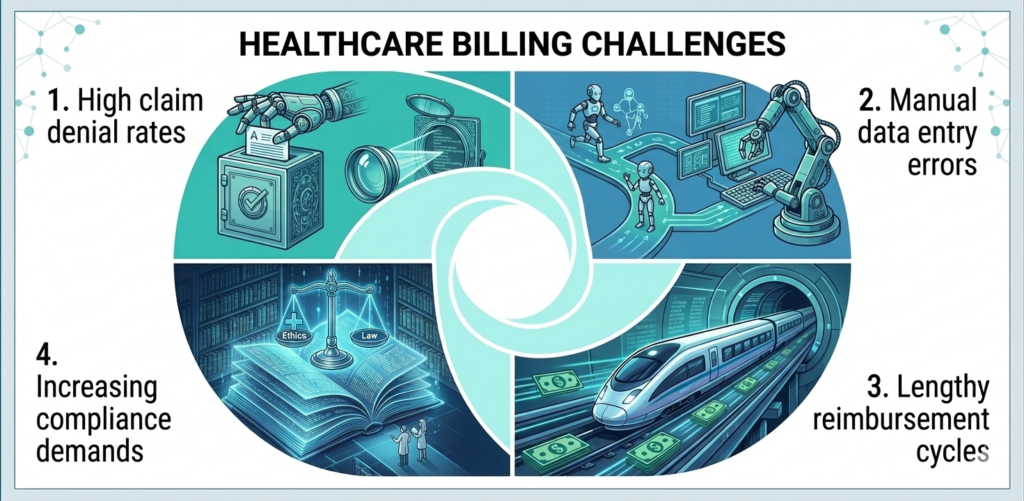
AI provides healthcare organizations with the ability to manage these challenges more effectively while improving revenue cycle outcomes.
Organizations adopting AI-powered billing solutions are often seeing measurable improvements in productivity, reimbursement speed, and claim accuracy.
1. Automated Claims Scrubbing Improves Accuracy
One of the most valuable applications of AI in medical billing is automated claims scrubbing.
Before claims are submitted to payers, AI systems can review them for:
- Coding inconsistencies
- Missing information
- Eligibility issues
- Modifier errors
- Payer-specific requirements
By identifying errors before submission, AI helps reduce claim rejections and improve first-pass claim acceptance rates.
This proactive approach minimizes rework and accelerates reimbursement timelines.
Internal Link Opportunity: Link to your Claims Management Services page.
2. AI Enhances Medical Coding Accuracy
Medical coding errors remain one of the leading causes of claim denials and revenue loss.
AI-assisted coding tools can analyze clinical documentation and recommend appropriate:
- CPT codes
- ICD-10 codes
- HCPCS codes
- Required modifiers
These systems help coders work more efficiently while reducing the risk of coding mistakes.
AI does not replace medical coders but serves as a powerful support tool that improves accuracy and consistency.
Healthcare organizations using AI-assisted coding often experience lower denial rates and improved reimbursement outcomes.
Internal Link Opportunity: Link to your Medical Billing & Coding Services page.
3. Predictive Analytics Helps Prevent Claim Denials
AI-powered predictive analytics can identify patterns that may lead to claim denials before claims are submitted.
These systems analyze historical data to predict:
- High-risk claims
- Documentation deficiencies
- Eligibility concerns
- Authorization issues
- Payer-specific denial trends
Revenue cycle teams can then address these issues proactively, reducing denial rates and improving cash flow.
Predictive denial management is becoming a critical strategy for healthcare organizations seeking to maximize reimbursement.
4. Real-Time Eligibility Verification
Insurance eligibility verification is an essential part of the billing process.
Manual verification can be time-consuming and prone to errors, often leading to denied claims when coverage issues are discovered after services are provided.
AI-powered eligibility verification systems can:
- Verify coverage instantly
- Detect policy changes
- Confirm benefits information
- Identify authorization requirements
- Reduce front-end billing errors
Real-time verification improves claim accuracy and enhances the patient registration experience.
Internal Link Opportunity: Link to your Eligibility Verification Services page.
5. Faster Prior Authorization Processing
Prior authorization requirements continue to create administrative challenges for healthcare providers.
AI is helping automate many aspects of the authorization process by:
- Reviewing payer requirements
- Gathering necessary documentation
- Tracking authorization status
- Identifying missing information
- Reducing approval delays
By streamlining authorization workflows, providers can improve operational efficiency while reducing treatment delays for patients.
6. Intelligent Payment Posting and Reconciliation
Payment posting and reconciliation can consume significant staff time when performed manually.
AI-powered systems can automatically:
- Match payments to claims
- Identify payment discrepancies
- Detect underpayments
- Flag reimbursement anomalies
- Generate financial reports
Automation helps billing teams process payments more efficiently while improving financial visibility across the revenue cycle.
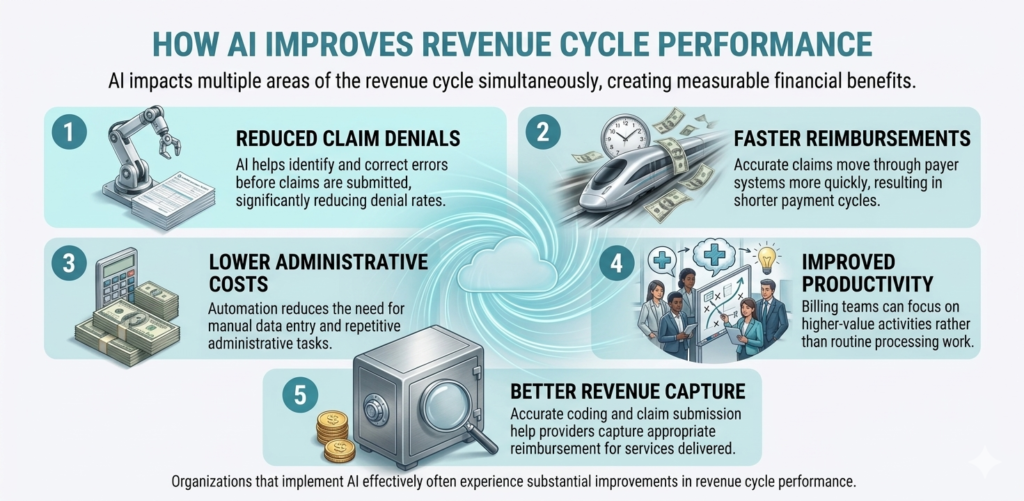
How AI Improves Revenue Cycle Performance
AI impacts multiple areas of the revenue cycle simultaneously, creating measurable financial benefits.
The Role of AI in Compliance Management
Healthcare compliance remains a major concern for providers and billing organizations.
AI can support compliance efforts by:
- Monitoring billing activities
- Identifying unusual coding patterns
- Detecting potential compliance risks
- Tracking regulatory changes
- Supporting audit preparation
These capabilities help healthcare organizations reduce compliance exposure while maintaining billing accuracy.
As regulations continue to evolve, AI-driven compliance monitoring is becoming increasingly valuable.
Challenges of AI Adoption in Medical Billing
While AI offers significant benefits, successful implementation requires careful planning.
Common challenges include:
- Initial technology investment
- Staff training requirements
- Integration with existing systems
- Data quality concerns
- Workflow adjustments
Healthcare organizations should approach AI adoption strategically to maximize long-term value and return on investment.
When implemented correctly, AI can deliver substantial operational and financial benefits.
The Future of AI in Medical Billing
AI technology continues to evolve rapidly, creating new opportunities for healthcare organizations.
Future advancements are expected to include:
- More advanced predictive analytics
- Fully automated claim review systems
- Enhanced coding assistance
- Real-time denial prevention
- Improved patient billing experiences
- Greater interoperability between healthcare systems
As AI capabilities expand, healthcare organizations will gain even greater control over billing efficiency, revenue optimization, and compliance management.
Providers who embrace AI-driven solutions today will be better positioned to compete in an increasingly complex healthcare environment.
Conclusion
AI is transforming medical billing workflows by improving accuracy, reducing administrative burdens, accelerating reimbursements, and strengthening revenue cycle performance. From automated claims scrubbing and coding assistance to predictive denial prevention and real-time eligibility verification, AI is helping healthcare organizations navigate growing billing complexities more effectively.
As healthcare continues to evolve in 2026, AI-driven billing solutions are becoming essential for organizations seeking to improve efficiency, reduce costs, and maximize revenue.
Healthcare providers that invest in AI-powered medical billing technologies today will be better equipped to achieve long-term financial success and operational excellence in the future.