
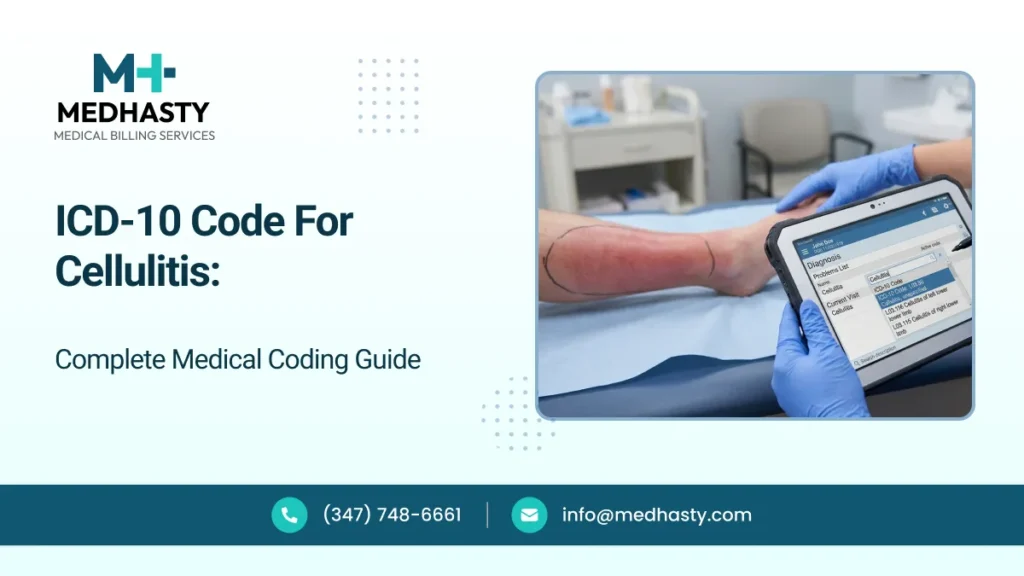
Choosing the ICD-10 code for cellulitis requires more than confirming a skin infection. Healthcare providers must know the area of the body that is affected. They need to note whether it is on the side or left side when needed. They also need to tell the difference, between cellulitis and other similar conditions. Leaving out these details can cause diagnosis coding lead to claim corrections and create delays in the billing process.
The common cellulitis codes are, in ICD-10-CM category L03 but the right code depends on where the infection is and what the provider says it is. This guide covers the FY2027 cellulitis codes the documentation that is needed the conditions that are connected and the billing issues that healthcare professionals need to be aware of.
What Is the ICD-10 Code for Cellulitis?
The ICD-10-CM code for cellulitis is L03.90. This code is used when medical records show cellulitis but do not point to a precise body part.
The majority of cellulitis diagnoses are in the L03 category – Cellulitis and acute lymphangitis. That category contains codes for infections that affect arms, legs, fingers, toes, face, neck and trunk.
For example if a doctor diagnoses cellulitis on the lower leg the correct code is L03.115, not L03.90. Likewise cellulitis, on the upper limb calls for the code L03.114.
The FY2027 ICD-10-CM code set applies to healthcare services provided from October 1, 2026, through September 30, 2027. Providers should always verify code selection against the applicable year’s official classification.
Common ICD-10 Codes for Cellulitis by Body Location
The table, below lists the common cellulitis diagnosis codes. These cellulitis diagnosis codes allow doctors, coders and billing staff to pick a diagnosis that matches the infection site described in the record.
| ICD-10-CM Code | Diagnosis Description |
|---|---|
| L03.90 | Cellulitis, unspecified |
| L03.115 | Cellulitis of right lower limb |
| L03.116 | Cellulitis of left lower limb |
| L03.113 | Cellulitis of right upper limb |
| L03.114 | Cellulitis of left upper limb |
| L03.119 | Cellulitis of unspecified part of limb |
| L03.011 | Cellulitis of right finger |
| L03.012 | Cellulitis of left finger |
| L03.031 | Cellulitis of right toe |
| L03.032 | Cellulitis of left toe |
| L03.211 | Cellulitis of face |
| L03.213 | Periorbital cellulitis |
| L03.221 | Cellulitis of neck |
| L03.311 | Cellulitis of abdominal wall |
| L03.313 | Cellulitis of chest wall |
| L03.314 | Cellulitis of groin |
| L03.317 | Cellulitis of buttock |
| L03.319 | Cellulitis of trunk, unspecified |
These descriptions are part of the FY2027 ICD-10-CM classification. The full category also contains codes for body parts and, for acute lymphangitis.
Although this table gives a reference providers should not choose a code just because of the patients symptoms. The diagnosis must follow the assessment and the medical record must back the chosen code.
Understanding Cellulitis and Its Clinical Significance
Cellulitis is an infection that touches the parts of the skin and the soft tissue below. Cellulitis normally starts when bacteria get into the body through a hole, in the skin like a cut, a wound, an insect bite or a pre‑existing skin problem.
Streptococcal and staphylococcal bacteria are culprits. The exact bacteria causing cellulitis may remain unknown especially when doctors diagnose cellulitis by examining the skin and do not take a culture sample.
Common Signs and Symptoms of Cellulitis
Patients with cellulitis may experience:
-
Redness and swelling around the affected area
-
Warmth and tenderness of the skin
-
Pain that increases with inflammation
-
Skin discoloration or tightness
-
Fever or chills in some cases
-
Rapidly spreading redness in more serious infections
These findings help doctors make the diagnosis. Symptoms by themselves do not decide the right ICD-10 code.
For example redness and swelling of the leg may show cellulitis but other conditions such, as venous stasis dermatitis or deep vein thrombosis can look the same. A clinical check helps doctors tell these conditions apart before giving a diagnosis.
Why the Infection Location Matters for Coding
Cellulitis can happen anywhere on the body. The ICD-10-CM system separates different body parts and asks for laterality in some areas.
If a doctor writes leg cellulitis ” the coder doesn’t know if it’s on the right side or the left. That’s not information.
If the note says “cellulitis of the left lower leg ” then the code L03.116 applies.
This difference is important. Using the location helps hospitals and clinics keep clear consistent medical records. It also reduces the need for follow-up questions, about the documentation.
ICD-10 Code for Cellulitis of the Lower Extremity
Lower-extremity cellulitis is a diagnosis that doctors see in primary care clinics urgent care centers, emergency rooms and hospitals. Doctors often look for swelling, redness and pain in the legs, ankles and feet when they think a patient has lower-extremity cellulitis.
ICD‑10‑CM codes infections, by the body area that is infected.
L03.115 – Cellulitis of Right Lower Limb
Use L03.115 when the physician confirms cellulitis involving the right lower limb.
This code commonly applies to infections affecting the right leg, ankle, or foot, other than sites with more specific codes, such as the toes.
For instance, a patient presents with a painful, swollen right ankle. Following examination, the provider diagnoses right lower-extremity cellulitis. The documented diagnosis supports L03.115.
L03.116 – Cellulitis of Left Lower Limb
The code L03.116 is used for cellulitis that affects the lower limb.
If the provider writes that there is an infection, in the left calf then the code L03.116 correctly represents that diagnosis. The medical record should state the anatomical location and the laterality instead of calling it just a skin infection.
ICD-10 Code for Cellulitis of the Foot
A commonly searched question concerns the ICD-10 code for cellulitis of the foot.
Unlike finger and toe cellulitis, which have dedicated code groups, cellulitis affecting the general foot region typically falls under the lower-limb codes.
| Documented Condition | ICD-10-CM Code |
|---|---|
| Cellulitis of right foot | L03.115 |
| Cellulitis of left foot | L03.116 |
| Cellulitis of right toe | L03.031 |
| Cellulitis of left toe | L03.032 |
| Cellulitis of unspecified toe | L03.039 |
For coding purposes, distinguishing the foot from an individual toe is essential.
A provider who documents right great-toe cellulitis supports L03.031, whereas cellulitis involving the right foot outside the toes generally supports L03.115.
ICD-10 Codes for Cellulitis of the Upper Extremity
Cellulitis affecting the arms, wrists, hands, and fingers requires similar attention to anatomical detail.
The appropriate codes include:
-
L03.113: Cellulitis of right upper limb
-
L03.114: Cellulitis of left upper limb
-
L03.011: Cellulitis of right finger
-
L03.012: Cellulitis of left finger
-
L03.019: Cellulitis of unspecified finger
Cellulitis of the Arm and Hand
L03.113 and L03.114 apply to infections involving the right and left upper limbs, respectively.
For example, a physician evaluates a patient with inflammation extending across the left forearm and confirms cellulitis. The diagnosis supports L03.114.
Likewise, cellulitis affecting the right hand, excluding a specifically documented finger infection, generally falls under L03.113.
Cellulitis of the Finger
Finger cellulitis has separate codes that distinguish right-sided, left-sided, and unspecified infections.
A diagnosis such as “cellulitis of the left index finger” supports L03.012.
However, the documentation should clearly establish cellulitis rather than a different localized infection, such as paronychia or a cutaneous abscess. These conditions may require different code assignments.
ICD-10 Code for Facial and Periorbital Cellulitis
Facial cellulitis deserves particular attention because infections around the eyes, nose, and mouth may involve structures that ICD-10-CM classifies separately.
L03.211 – Cellulitis of Face
L03.211 identifies cellulitis involving the face.
For example, a physician documents bacterial cellulitis affecting a patient’s cheek without identifying an infection of the eye socket or another separately classified structure. L03.211 may appropriately describe the diagnosis.
L03.213 – Periorbital Cellulitis
L03.213 applies to periorbital cellulitis, commonly called preseptal cellulitis.
This condition involves tissues surrounding the eye anterior to the orbital septum.
Providers should distinguish it from orbital cellulitis, which involves deeper orbital structures and has a different ICD-10-CM classification.
Confusing these two diagnoses can affect coding accuracy and fail to reflect an important clinical distinction.
Cellulitis of the Eyelid, Nose, and Mouth
Not every infection involving the facial region belongs under L03.211.
For example, ICD-10-CM identifies cellulitis of the eyelid, nose, and mouth under other code categories.
Providers should document the exact anatomical structure involved and review the Alphabetic Index and Tabular List before choosing a code.
ICD-10 Codes for Cellulitis of the Trunk
Cellulitis involving the abdominal wall, chest, back, groin, and surrounding regions generally belongs to the L03.31- code family.
| ICD-10-CM Code | Anatomical Location |
|---|---|
| L03.311 | Abdominal wall |
| L03.312 | Back, excluding buttock and flank |
| L03.313 | Chest wall |
| L03.314 | Groin |
| L03.315 | Perineum |
| L03.316 | Umbilicus |
| L03.317 | Buttock |
| L03.319 | Trunk, unspecified |
| L03.31A | Flank |
The separate flank code is especially important when reviewing code references instead of relying on older coding sheets.
For example when a physician confirms cellulitis of the wall after an assessment the code L03.311 may describe the infection. However if the physician identifies a complication of a procedure the billing team must also review the complication‑coding rules instead of treating every postoperative infection, as uncomplicated cellulitis.
ICD-10 Coding for Cellulitis With Related Conditions
Cellulitis sometimes occurs with diabetes, open wounds, abscesses or systemic infections. In these situations extra attention is needed because a single L03 code may not fully describe the patients condition.
Cellulitis With Diabetes Mellitus
Patients who have diabetes can get cellulitis. This is especially true when they have circulation, skin cuts or other problems that make infection more likely.
If a person has type 2 diabetes and cellulitis the code E11.628 – Type 2 diabetes mellitus with skin complications – can be used together with the code that shows where the cellulitis is located.
For instance a doctor might find that a patient has type 2 diabetes and cellulitis, on the foot. Based on the notes and the rules of ICD‑10‑CM the final codes could be:
-
E11.628: Type 2 diabetes mellitus with other skin complications
-
L03.115: Cellulitis of right lower limb
Coders must review the ICD-10-CM “with” convention and any provider documentation that establishes or rules out a relationship between the conditions. They should not automatically assign every skin infection to diabetes without reviewing the classification instructions.
Cellulitis With an Abscess
Although cellulitis and abscesses can happen at the time they are different kinds of infections.
Cellulitis is an infection that causes swelling and inflammation in the skin and the soft tissue underneath. An abscess is a pocket of pus that forms in one area.
When doctors find both conditions medical coders need to check the L02 category, which covers skin abscesses and decide if the case requires a code for cellulitis.
The medical record must clearly show if the provider treated cellulitis, an abscess or both. Just because a procedure, like incision and drainage was done doesn’t mean cellulitis is automatically a reportable diagnosis.
Cellulitis With Sepsis
Severe cellulitis can develop into an infection. When the physician confirms sepsis the order in which diagnoses are recorded becomes especially important.
According to the FY2027 ICD-10-CM guidelines if a patient is admitted with sepsis and a localized infection such as cellulitis and if sepsis qualifies as the diagnosis then the systemic infection usually receives the top sequencing spot. The coder then records the infection as an additional diagnosis.
However if severe cellulitis is the reason, for the admission and sepsis appears later the sequencing rule changes.
Providers should record when sepsis started how it is linked to the infection and any organ problems that may be related. Severe cellulitis, sepsis and organ dysfunction should all be documented.
Cellulitis Caused by MRSA
Methicillin-resistant Staphylococcus aureus (MRSA) can lead to cellulitis and other skin infections.
When the doctor confirms MRSA as the cause and the infection code doesn’t already include MRSA you may need to add B95.62, with the cellulitis code.
For example if a patient has confirmed MRSA cellulitis in the lower limb you could use L03.116 and B95.62 together.
Doctors should not call an infection MRSA just because they think it might be resistant or because they are using antibiotics that cover MRSA. The diagnosis must be supported by documentation and meet coding rules.
Essential Documentation Requirements for Accurate Cellulitis Coding
Good clinical documentation gives medical coders the information they need without requiring repeated clarification.
For cellulitis, the most useful records describe the infection and explain the provider’s assessment.
Document the Exact Anatomical Location
Rather than entering “skin infection” or “cellulitis” without further detail, physicians should specify the affected area.
A diagnosis such as “cellulitis of the right forearm” communicates significantly more information than “arm infection.”
Likewise, distinguishing between the foot and toe helps coders identify the correct code family.
Include Laterality When Applicable
Certain cellulitis codes distinguish right-sided and left-sided infections.
When documentation omits laterality, coders may need to assign a less specific code or request clarification.
For example:
| Less Specific Documentation | More Precise Documentation |
|---|---|
| Leg cellulitis | Cellulitis of left lower leg |
| Hand infection | Cellulitis of right hand |
| Finger cellulitis | Cellulitis of left index finger |
| Foot cellulitis | Cellulitis of right foot |
Precise descriptions help coding teams work efficiently while preserving the accuracy of the patient’s medical record.
Identify Associated Medical Conditions
Physicians should record conditions that influence the evaluation or treatment of cellulitis. Physicians must record conditions that may include diabetes, a chronic ulcer, an infected wound, a confirmed abscess or another diagnosed complication.
However coding teams must distinguish between conditions that simply coexist and conditions that have an established relationship as required by ICD‑10‑CM coding rules.
Record Clinical Findings and Treatment
A complete cellulitis encounter generally includes the provider’s assessment, examination findings, treatment plan, and any relevant follow-up instructions.
Documentation may describe the extent of redness, swelling, warmth, or tenderness. It may also identify laboratory findings, prescribed medications, and the need for further evaluation.
Although these details do not replace a confirmed diagnosis, they help explain the medical necessity of the services performed.
Common ICD-10 Coding Mistakes That Can Affect Cellulitis Claims
Even experienced billing teams may encounter problems when the clinical record lacks important details.
Using L03.90 When a More Specific Code Exists
Unspecified cellulitis codes serve a legitimate purpose when documentation does not identify the location. However, selecting L03.90 despite an established and documented site loses available specificity.
If the physician confirms right lower-limb cellulitis, L03.115 generally provides a more accurate description.
Confusing Cellulitis With Other Skin Conditions
Cellulitis can resemble several inflammatory or infectious skin conditions.
For instance, dermatitis, erysipelas, abscesses, and certain vascular conditions may produce overlapping symptoms.
Providers should document their final clinical assessment instead of relying on a symptom-based diagnosis when they have established a more definitive condition.
Overlooking the Correct Code Family
Some infections that clinicians commonly describe as cellulitis fall outside category L03.
Examples include cellulitis of the eyelid, nose, mouth, and external genital organs. ICD-10-CM directs these conditions to other classifications.
Reviewing the Alphabetic Index and Tabular List helps prevent inaccurate code selection.
Assigning Unsupported Additional Diagnoses
A patient may have cellulitis and several chronic medical conditions. However, their presence in the medical history does not automatically justify reporting every condition on the claim.
Medical coders must follow the reporting requirements for the applicable care setting and determine which conditions qualify as reportable diagnoses.
Incorrect Diagnosis Sequencing
The correct first-listed or principal diagnosis depends on the encounter and applicable coding guidelines.
An uncomplicated outpatient cellulitis visit may support cellulitis as the first-listed diagnosis. In contrast, an inpatient admission involving sepsis, a postoperative complication, or another serious condition may require different sequencing.
The provider’s documentation should guide the coding decision.
How Accurate Cellulitis Coding Supports Medical Billing
Selecting an appropriate cellulitis code helps connect the documented diagnosis with the healthcare services provided.
However, diagnosis accuracy represents only one part of a successful billing workflow. Medical practices must also consider procedure coding, payer policies, claim formatting, and documentation requirements.
Better Alignment Between Documentation and Claims
When providers describe the diagnosis clearly, coders can select codes that reflect the services delivered during the encounter.
For example, a physician who diagnoses left lower-leg cellulitis and documents the evaluation and treatment provides a clearer clinical record than one who simply records “leg swelling.”
Fewer Documentation Clarification Requests
Incomplete records often require coders to contact providers for additional information.
These requests can interrupt the claim preparation process, particularly in high-volume practices.
Standardizing documentation expectations helps reduce avoidable questions concerning infection location, laterality, and associated conditions.
More Consistent Claims Processing
Accurate ICD-10-CM reporting supports consistency between clinical documentation and diagnosis information submitted to insurance companies.
Still, an appropriate diagnosis code does not guarantee reimbursement. Insurers may also evaluate coverage requirements, medical necessity, eligibility, coding edits, and contractual terms.
Stronger Revenue Cycle Management
Medical practices benefit when documentation, coding, and billing teams communicate effectively.
For organizations facing repeated coding discrepancies or claim corrections, Medhasty Medical Billing can support the billing workflow through documentation review, medical coding assistance, and claim management services.
The goal is to identify preventable errors before they create additional administrative work.
Practical Examples of Cellulitis ICD-10 Coding
The following scenarios illustrate how clinical documentation influences diagnosis code selection.
Example: Right Lower-Leg Cellulitis
A patient visits an urgent care clinic because of redness, tenderness, and swelling affecting the right calf. Following an examination, the physician confirms cellulitis of the right lower leg.
Appropriate code: L03.115
The documentation identifies both the condition and the affected side, supporting a specific diagnosis code.
Frequently Asked Questions About the ICD-10 Code for Cellulitis
What is the ICD-10 code for cellulitis, unspecified?
L03.90 represents cellulitis, unspecified. Providers use this code when the diagnosis is established but the documentation does not support a more specific anatomical classification.
What is the ICD-10 code for cellulitis of the right leg?
L03.115 identifies cellulitis of the right lower limb. This code generally applies to cellulitis affecting the right leg, ankle, or general foot region, excluding sites assigned more specific codes.
What is the ICD-10 code for cellulitis of the left leg?
L03.116 identifies cellulitis of the left lower limb. Providers should document the location and affected side to support this code.
What is the ICD-10 code for cellulitis of the foot?
Cellulitis of the right foot generally uses L03.115, while cellulitis of the left foot generally uses L03.116. A toe infection may require a more specific code from L03.03-.
What is the ICD-10 code for facial cellulitis?
L03.211 identifies cellulitis of the face. However, infections affecting certain facial structures, such as the eyelid or nose, may require different codes.
Can cellulitis and diabetes be coded together?
Yes. When supported by the documentation and ICD-10-CM conventions, a patient with type 2 diabetes and an associated skin complication may require E11.628 together with an appropriate cellulitis code.
Is cellulitis the same as an abscess?
No. Cellulitis involves infection of the skin and soft tissue, while an abscess contains a localized collection of pus. Both conditions can occur together, but their coding requirements may differ.
Can providers bill cellulitis without identifying the bacteria?
Yes. A confirmed cellulitis diagnosis does not always require identification of the specific bacterial organism. Providers should report the established diagnosis without assigning an unsupported organism code.
Final Thoughts
Accurate ICD-10 coding for cellulitis begins with a clear diagnosis, precise anatomical documentation, and careful review of related medical conditions. Although L03.90 describes unspecified cellulitis, location-specific codes provide greater accuracy whenever the medical record supports them.
Healthcare providers should pay particular attention to laterality, infections involving separately classified anatomical structures, and cases involving diabetes, abscesses, or sepsis. These details help billing teams choose the appropriate diagnosis codes and reduce preventable claim discrepancies.
For healthcare practices that want to strengthen coding accuracy and simplify administrative processes, Medhasty Medical Billing offers medical billing support designed to improve documentation consistency, claims management, and revenue cycle efficiency.