
Claim denials continue to be one of the biggest challenges facing healthcare providers today. Every denied claim represents delayed revenue, additional administrative work, and increased operational costs. As payer requirements become more complex and reimbursement regulations continue to evolve, medical practices must adopt proactive denial prevention strategies to protect their financial health.
In 2026, healthcare organizations are under growing pressure to improve revenue cycle performance while maintaining compliance and delivering high-quality patient care. Preventing denials before they occur has become far more effective than managing them after the fact.
For medical practices looking to reduce revenue leakage, improve cash flow, and streamline billing operations, implementing a strong denial prevention strategy is essential.
What Is Denial Prevention?
Denial prevention refers to the proactive processes and strategies used to identify and eliminate claim issues before claims are submitted to insurance payers.
Rather than focusing solely on denial management after a claim is rejected, denial prevention aims to reduce the likelihood of denials occurring in the first place.
Effective denial prevention involves:
- Accurate patient registration
- Insurance eligibility verification
- Proper medical coding
- Complete documentation
- Claims scrubbing and validation
- Compliance monitoring
By addressing potential issues early in the revenue cycle, healthcare organizations can significantly improve reimbursement outcomes.
Why Denial Prevention Matters More in 2026
Healthcare payers continue to tighten claim review processes, making accurate claim submission more important than ever.
Common consequences of claim denials include:
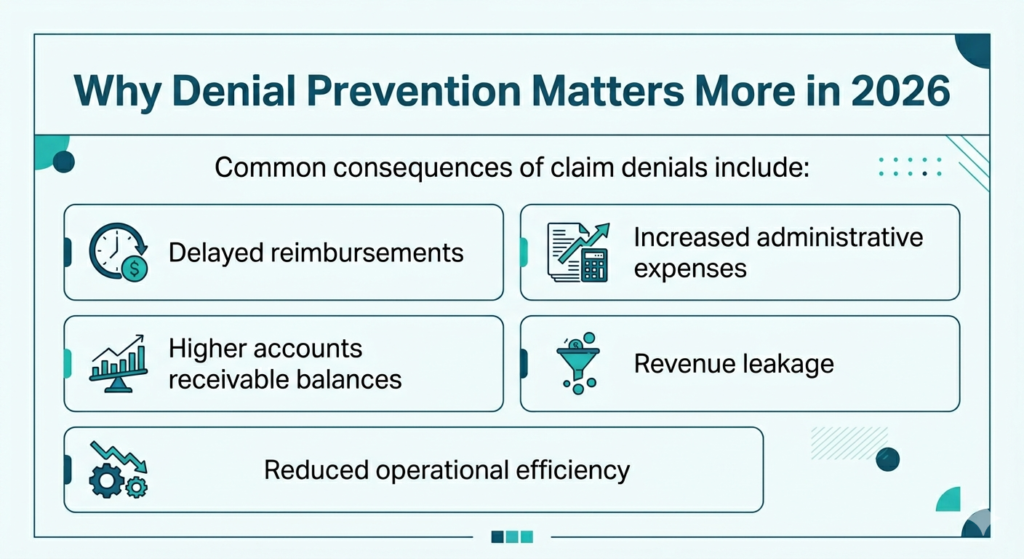
A proactive denial prevention program helps organizations improve first-pass claim acceptance rates while reducing costly rework.
Medical practices that prioritize denial prevention often experience stronger financial performance and healthier cash flow.
1. Verify Insurance Eligibility Before Every Visit
One of the most preventable causes of claim denials is eligibility-related errors.
Coverage information can change frequently due to:
- Policy terminations
- Plan modifications
- Coverage limitations
- Changes in patient benefits
Verifying eligibility before every appointment helps ensure that services are covered and reduces the risk of denied claims.
Eligibility verification should include:
- Active insurance status
- Coverage details
- Copayment requirements
- Deductible information
- Prior authorization requirements
Real-time verification tools can help practices streamline this process and improve claim accuracy.
2. Improve Patient Registration Accuracy
Incorrect patient information remains a leading cause of claim rejections and denials.
Even minor registration errors can prevent claims from being processed successfully.
Common registration mistakes include:
- Misspelled patient names
- Incorrect dates of birth
- Invalid policy numbers
- Outdated insurance information
- Inaccurate contact details
Front-desk staff should be trained to carefully verify patient information during every visit.
Accurate registration creates a strong foundation for a clean claims process.
3. Strengthen Medical Coding Accuracy
Coding errors continue to be one of the most common reasons claims are denied.
Mistakes involving CPT, ICD-10, or HCPCS codes can result in:
- Claim rejections
- Underpayments
- Compliance concerns
- Audit risks
Medical practices should invest in:
- Ongoing coder education
- Regular coding audits
- Updated coding resources
- AI-assisted coding tools
Accurate coding helps ensure claims are processed correctly the first time.
4. Ensure Complete Clinical Documentation
Strong documentation supports accurate coding and demonstrates medical necessity.
Incomplete or unclear documentation often leads to payer requests for additional information or outright denials.
Documentation should include:
- Accurate diagnoses
- Detailed treatment notes
- Procedure documentation
- Physician signatures
- Medical necessity support
Providers and billing teams should work together to ensure documentation fully supports services billed.
Proper documentation not only reduces denials but also strengthens compliance efforts.
5. Implement Claims Scrubbing Before Submission
Claims scrubbing technology helps identify potential errors before claims are submitted to payers.
Modern claims scrubbing systems can detect:
- Coding errors
- Missing modifiers
- Incomplete patient information
- Eligibility issues
- Payer-specific rule violations
By correcting these issues before submission, practices can improve first-pass acceptance rates and reduce denial volume.
Claims scrubbing has become a critical component of modern revenue cycle management.
6. Monitor Prior Authorization Requirements
Many denials occur because required authorizations were not obtained before services were provided.
Prior authorization requirements vary among payers and frequently change.
Practices should establish clear workflows to:
- Identify services requiring authorization
- Track authorization status
- Maintain documentation
- Verify payer-specific requirements
A structured authorization process helps prevent avoidable denials and treatment delays.
7. Track Denial Trends and Root Causes
Successful denial prevention requires continuous monitoring and improvement.
Medical practices should regularly analyze denial data to identify:
- Recurring denial reasons
- Problematic payer trends
- Workflow weaknesses
- Documentation gaps
- Coding issues
Tracking denial patterns allows organizations to address root causes before they impact additional claims.
Data-driven decision-making helps create a more efficient and proactive revenue cycle strategy.
How Technology Supports Denial Prevention
Technology plays an increasingly important role in preventing denials across healthcare organizations.
Modern revenue cycle management solutions can:
- Automate eligibility verification
- Perform claims scrubbing
- Monitor coding accuracy
- Track denial trends
- Generate real-time reporting
- Identify compliance risks
Artificial intelligence and automation tools help billing teams detect issues earlier and improve overall claim quality.
Organizations leveraging advanced technology often experience lower denial rates and faster reimbursements.
Benefits of a Strong Denial Prevention Strategy
Medical practices that prioritize denial prevention can achieve significant operational and financial improvements.
Reduced Claim Denials
Proactive processes help eliminate common claim errors before submission.
Faster Reimbursements
Cleaner claims move through payer systems more efficiently.
Improved Cash Flow
Reduced denials lead to more predictable and timely revenue.
Lower Administrative Costs
Staff spend less time appealing and correcting denied claims.
Enhanced Patient Satisfaction
Accurate billing processes create a smoother financial experience for patients.
A strong denial prevention strategy benefits every stage of the revenue cycle.
The Future of Denial Prevention
As payer requirements continue to evolve, denial prevention will become increasingly technology-driven.
Emerging innovations include:
- AI-powered denial prediction
- Automated claim validation
- Real-time eligibility verification
- Predictive analytics
- Advanced compliance monitoring
These tools enable healthcare organizations to identify potential claim issues before they occur and continuously improve reimbursement performance.
Practices that embrace proactive denial prevention strategies will be better positioned to succeed in the increasingly competitive healthcare landscape.
Conclusion
Claim denials remain a major source of revenue loss for healthcare providers, but many denials are preventable. By focusing on eligibility verification, patient registration accuracy, proper coding, complete documentation, claims scrubbing, and denial trend analysis, medical practices can significantly reduce denial rates and improve financial outcomes.
In 2026, denial prevention is no longer simply a billing function—it is a critical component of effective revenue cycle management.
Healthcare organizations that invest in proactive denial prevention strategies today will benefit from stronger cash flow, improved operational efficiency, reduced administrative burdens, and long-term financial stability.