

Insurance verification is one of the most important steps in the healthcare revenue cycle. Despite advances in billing technology and claims management processes, claim rejections continue to affect healthcare organizations due to inaccurate or incomplete insurance information. Many of these rejections can be prevented through a thorough and proactive insurance verification process.
In 2026, healthcare providers face increasing challenges related to payer requirements, changing coverage policies, and growing patient responsibility. Verifying insurance eligibility before services are provided has become essential for reducing claim rejections, improving reimbursement rates, and enhancing the patient experience.
For healthcare organizations seeking to strengthen their revenue cycle performance, insurance verification serves as the foundation for clean claims and successful reimbursement outcomes.
What Is Insurance Verification?
Insurance verification is the process of confirming a patient’s insurance coverage, benefits, eligibility, and financial responsibilities before healthcare services are rendered.
The verification process typically includes:
- Confirming active insurance coverage
- Verifying policy details
- Checking coverage limitations
- Identifying copayments and deductibles
- Reviewing prior authorization requirements
- Confirming payer-specific guidelines
By verifying this information before a patient visit, providers can reduce billing errors and prevent avoidable claim rejections.
Why Insurance Verification Matters More in 2026
Healthcare insurance plans continue to evolve, with frequent changes to:
- Coverage rules
- Network participation
- Benefit structures
- Authorization requirements
- Patient cost-sharing responsibilities
Failure to verify insurance information can result in:
- Claim rejections
- Payment delays
- Increased denial rates
- Higher administrative costs
- Patient billing disputes
As payer requirements become more complex, insurance verification has become a critical component of revenue cycle management.
Organizations that prioritize verification often experience higher first-pass claim acceptance rates and stronger financial performance.
1. Prevents Eligibility-Related Claim Rejections
One of the most common reasons claims are rejected is inactive or invalid insurance coverage.
Patients may experience changes in coverage due to:
- Employer plan changes
- Policy expiration
- Coverage termination
- Insurance carrier changes
- Benefit modifications
Without verification, providers may submit claims to inactive plans, resulting in immediate claim rejections.
Verifying eligibility before appointments helps identify coverage issues early and allows staff to address them before services are provided.
2. Reduces Registration Errors
Accurate patient registration is essential for successful claim processing.
Insurance verification helps identify errors such as:
- Incorrect member IDs
- Outdated policy numbers
- Misspelled patient names
- Incorrect group numbers
- Invalid payer information
Correcting these issues before claim submission significantly reduces rejection rates and administrative rework.
Strong front-end verification processes create a solid foundation for clean claims management.
3. Identifies Prior Authorization Requirements
Many insurance plans require prior authorization for specific procedures, treatments, or diagnostic services.
Failure to obtain authorization can lead to claim denials or payment delays.
Insurance verification helps billing teams determine:
- Whether authorization is required
- Documentation requirements
- Approval timelines
- Service-specific restrictions
By addressing authorization needs before treatment, healthcare organizations can reduce avoidable reimbursement challenges.
4. Improves Financial Transparency for Patients
Patients are increasingly responsible for larger portions of their healthcare costs.
Insurance verification helps providers determine:
- Copayment amounts
- Deductible balances
- Coinsurance responsibilities
- Non-covered services
This information allows healthcare organizations to communicate financial expectations clearly before treatment.
Improved transparency reduces billing disputes and enhances patient satisfaction.
5. Supports Clean Claim Submission
Insurance verification plays a major role in producing clean claims.
When eligibility, benefits, and coverage details are confirmed in advance, claims are more likely to be submitted accurately the first time.
Clean claims help providers:
- Reduce rejection rates
- Accelerate reimbursement cycles
- Improve cash flow
- Lower administrative costs
Insurance verification serves as one of the most effective tools for improving first-pass claim acceptance rates.
Common Insurance Verification Challenges
Despite its importance, insurance verification can be challenging for healthcare organizations.
Common obstacles include:
Frequent Coverage Changes
Insurance policies and benefits can change throughout the year, requiring continuous verification efforts.
Manual Verification Processes
Manual verification consumes valuable staff time and increases the risk of human error.
Complex Payer Requirements
Different insurance companies often have unique verification and authorization requirements.
High Patient Volumes
Busy healthcare practices may struggle to complete thorough verification for every patient encounter.
These challenges highlight the need for efficient verification workflows and technology solutions.
How Technology Improves Insurance Verification
Modern healthcare organizations increasingly rely on technology to streamline insurance verification.
Advanced verification tools can:
- Verify eligibility in real time
- Access payer databases automatically
- Detect coverage changes instantly
- Identify authorization requirements
- Reduce manual data entry
Automation helps healthcare organizations improve accuracy while reducing administrative burdens.
Real-time verification technology enables staff to address insurance issues before they affect claim outcomes.
Organizations utilizing automated verification systems often experience fewer claim rejections and faster reimbursements.
The Financial Impact of Effective Insurance Verification
Insurance verification directly influences revenue cycle performance.
Benefits include:
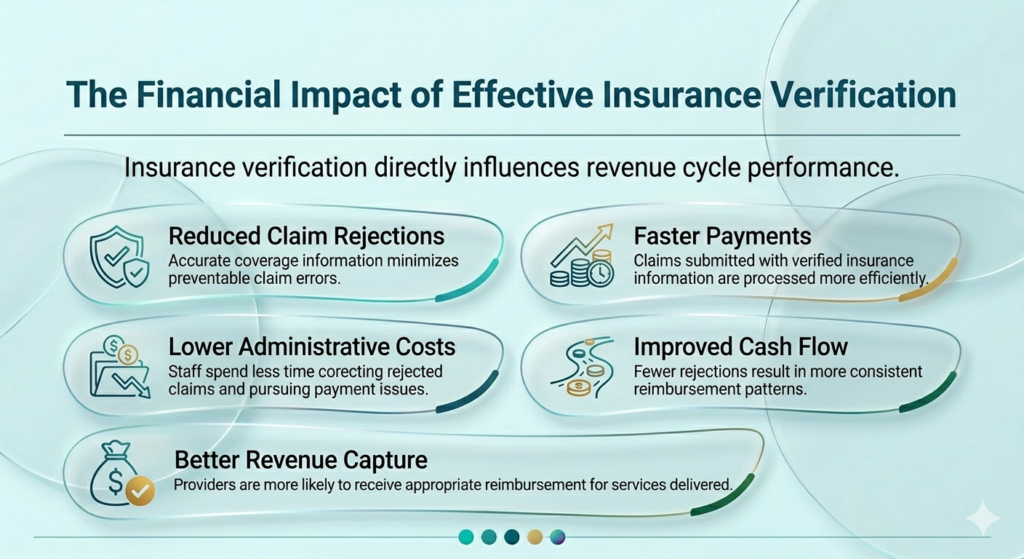
These financial benefits make insurance verification a high-value investment for healthcare organizations.
Best Practices for Insurance Verification
Healthcare organizations can strengthen verification processes by implementing several proven strategies.
These include:
- Verifying insurance before every patient visit
- Using automated eligibility verification tools
- Training front-desk staff regularly
- Maintaining accurate patient records
- Monitoring verification performance metrics
- Reviewing payer policy updates frequently
- Establishing standardized verification workflows
Organizations that consistently follow these practices can significantly reduce claim rejections and improve reimbursement outcomes.
The Future of Insurance Verification
As healthcare technology continues to advance, insurance verification is becoming increasingly automated and data-driven.
Emerging innovations include:
- AI-powered eligibility verification
- Real-time benefit analysis
- Automated authorization tracking
- Predictive reimbursement analytics
- Integrated patient financial responsibility tools
These technologies will help healthcare organizations improve accuracy, efficiency, and patient communication while reducing revenue cycle risks.
Providers that embrace modern verification solutions will be better positioned to navigate evolving payer requirements and reimbursement challenges.
Conclusion
Insurance verification plays a critical role in reducing claim rejections and improving overall revenue cycle performance. By confirming eligibility, benefits, coverage details, and authorization requirements before services are provided, healthcare organizations can prevent many of the issues that lead to rejected claims.
In 2026, as insurance plans and payer requirements become increasingly complex, effective verification processes are more important than ever.
Healthcare providers that invest in strong insurance verification workflows, staff training, and automation technologies can improve reimbursement accuracy, strengthen cash flow, reduce administrative burdens, and create a better financial experience for both patients and providers.