
Prior authorization remains one of the most challenging administrative processes in healthcare. While insurers use prior authorization to ensure medical necessity and control healthcare costs, the process often creates delays that affect providers, staff, and patients alike.
In 2026, healthcare organizations face increasing prior authorization requirements across various specialties, procedures, medications, and diagnostic services. Delays in obtaining approvals can result in postponed treatments, claim denials, increased administrative costs, and reduced patient satisfaction.
Implementing effective prior authorization strategies can help healthcare providers accelerate approvals, reduce revenue cycle disruptions, and improve overall operational efficiency.
For organizations focused on optimizing reimbursement and patient care, establishing best practices for prior authorization management has become more important than ever.
What Is Prior Authorization?
Prior authorization is the process of obtaining approval from a health insurance payer before certain healthcare services, treatments, procedures, medications, or diagnostic tests are performed.
Insurance companies typically require prior authorization to confirm:
- Medical necessity
- Coverage eligibility
- Compliance with payer guidelines
- Appropriate treatment plans
- Cost-effective care options
Without proper authorization, healthcare providers risk claim denials, payment delays, and increased administrative burdens.
A proactive authorization process helps ensure services are approved before care is delivered.
Why Prior Authorization Matters More in 2026
Healthcare providers continue to face growing complexity in payer requirements.
Factors contributing to increased authorization challenges include:
- Expanding payer regulations
- Frequent policy updates
- Specialty-specific requirements
- Increased documentation demands
- Growing use of advanced treatments and technologies
Failure to manage authorizations effectively can lead to:
- Treatment delays
- Claim denials
- Lost revenue
- Increased staff workload
- Patient dissatisfaction
Organizations that streamline authorization workflows often experience improved reimbursement outcomes and stronger revenue cycle performance.
1. Verify Insurance Eligibility Early
The prior authorization process should begin with accurate insurance verification.
Before requesting authorization, staff should confirm:
- Active insurance coverage
- Benefit eligibility
- Network participation
- Service coverage requirements
- Patient financial responsibility
Early eligibility verification helps prevent wasted effort on authorization requests that may ultimately be denied due to coverage issues.
Addressing eligibility concerns upfront improves approval efficiency and reduces claim rejections.
2. Understand Payer-Specific Requirements
Every insurance payer has unique authorization guidelines.
Healthcare organizations should maintain updated information regarding:
- Covered services
- Required documentation
- Submission methods
- Approval timelines
- Medical necessity criteria
Understanding payer-specific requirements helps staff submit complete and accurate requests the first time.
This reduces delays caused by missing information or incorrect submissions.
3. Submit Complete Documentation
Incomplete documentation is one of the leading causes of authorization delays.
Authorization requests should include all required clinical information, such as:
- Physician notes
- Diagnosis details
- Treatment plans
- Test results
- Imaging reports
- Supporting medical records
Providing comprehensive documentation helps payers make timely decisions and reduces the need for additional information requests.
Well-documented submissions significantly improve approval rates.
4. Establish Standardized Authorization Workflows
Standardized processes create consistency and reduce errors.
Healthcare organizations should develop clear workflows that define:
- Authorization responsibilities
- Documentation requirements
- Submission timelines
- Follow-up procedures
- Escalation protocols
A structured approach ensures requests are handled efficiently and consistently across all departments.
Standardization also improves staff productivity and accountability.
5. Utilize Electronic Prior Authorization (ePA)
Electronic Prior Authorization (ePA) solutions have transformed authorization management.
Compared to manual processes, ePA systems offer:
- Faster submissions
- Real-time status tracking
- Reduced paperwork
- Improved communication with payers
- Greater accuracy
Electronic workflows help providers accelerate approval timelines while reducing administrative burdens.
Many healthcare organizations report significant efficiency gains after implementing ePA solutions.
6. Monitor Authorization Status Proactively
Submitting an authorization request is only part of the process.
Organizations should actively monitor pending requests to identify delays before they affect patient care.
Regular follow-up helps staff:
- Track approval progress
- Resolve documentation issues
- Respond to payer inquiries
- Prevent authorization expirations
Proactive monitoring minimizes treatment delays and improves scheduling efficiency.
Timely follow-up often results in faster authorization decisions.
7. Train Staff on Authorization Best Practices
Prior authorization requirements change frequently.
Ongoing staff education ensures team members remain current on:
- Payer policy updates
- Documentation standards
- Coding requirements
- Submission procedures
- Regulatory changes
Well-trained staff are more likely to submit accurate requests and avoid preventable delays.
Regular training strengthens overall authorization performance.
Common Causes of Prior Authorization Delays
Understanding common obstacles can help healthcare organizations improve approval rates.
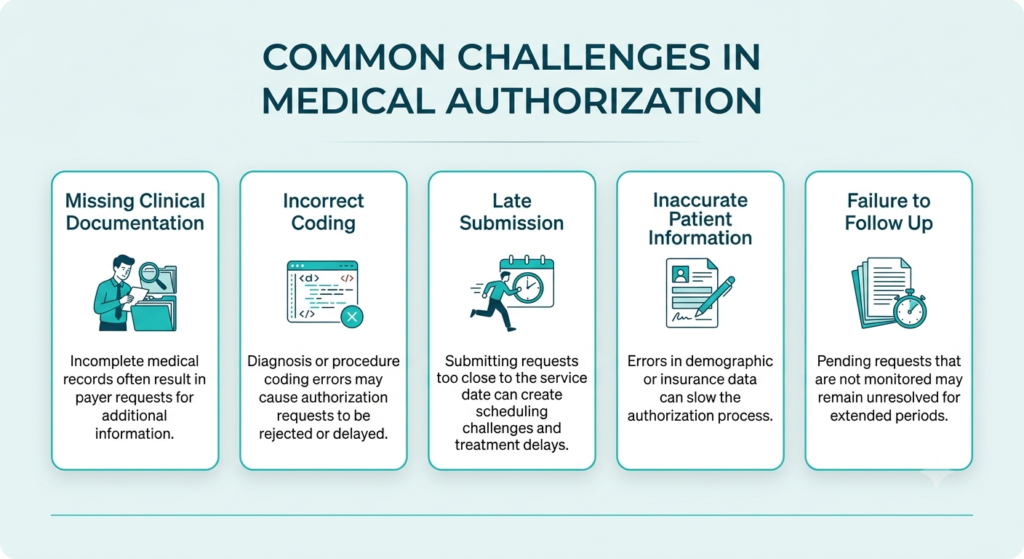
Identifying and addressing these issues helps organizations improve authorization efficiency.
How Technology Improves Prior Authorization Performance
Healthcare organizations increasingly rely on automation and technology to streamline authorization workflows.
Advanced solutions can:
- Identify services requiring authorization
- Verify payer requirements automatically
- Track authorization status in real time
- Alert staff to missing documentation
- Monitor approval timelines
- Generate performance reports
Automation reduces manual workloads while improving consistency and accuracy.
Organizations leveraging technology often achieve faster approvals and lower administrative costs.
The Financial Impact of Faster Prior Authorization Approvals
Efficient authorization management directly influences revenue cycle performance.
Benefits include:
Reduced Claim Denials
Proper authorization minimizes reimbursement issues related to coverage requirements.
Faster Reimbursement
Approved services are more likely to move smoothly through the claims process.
Lower Administrative Costs
Efficient workflows reduce time spent on resubmissions and appeals.
Improved Scheduling Efficiency
Providers can confidently schedule approved services without unnecessary delays.
Stronger Revenue Capture
Organizations are more likely to receive full reimbursement for authorized services.
These financial benefits contribute to improved operational stability and long-term growth.
Best Practices Checklist for Faster Authorizations
Healthcare organizations can improve authorization performance by consistently following these strategies:
- Verify insurance before every visit
- Review payer requirements regularly
- Submit complete documentation
- Use electronic authorization tools
- Standardize workflows
- Monitor pending requests daily
- Train staff continuously
- Track authorization performance metrics
- Communicate proactively with payers
- Audit authorization processes regularly
Consistent execution of these practices can significantly reduce approval delays.
The Future of Prior Authorization
The authorization landscape continues to evolve as healthcare technology advances.
Emerging innovations include:
- AI-assisted authorization reviews
- Automated medical necessity validation
- Real-time payer connectivity
- Predictive authorization analytics
- Integrated EHR authorization workflows
- Automated documentation gathering
These advancements will help providers reduce administrative burdens while improving approval speed and accuracy.
Organizations that embrace modern authorization technologies will be better positioned to navigate future payer requirements.
Conclusion
Prior authorization plays a critical role in healthcare reimbursement, but inefficient processes can create significant operational and financial challenges. By implementing standardized workflows, improving documentation practices, utilizing automation tools, and maintaining proactive communication with payers, healthcare organizations can achieve faster prior authorization approvals.
In 2026, as payer requirements continue to evolve, efficient authorization management has become an essential component of successful revenue cycle operations.
Healthcare providers that invest in strong prior authorization strategies can reduce claim denials, accelerate reimbursements, improve patient satisfaction, and strengthen overall financial performance.