
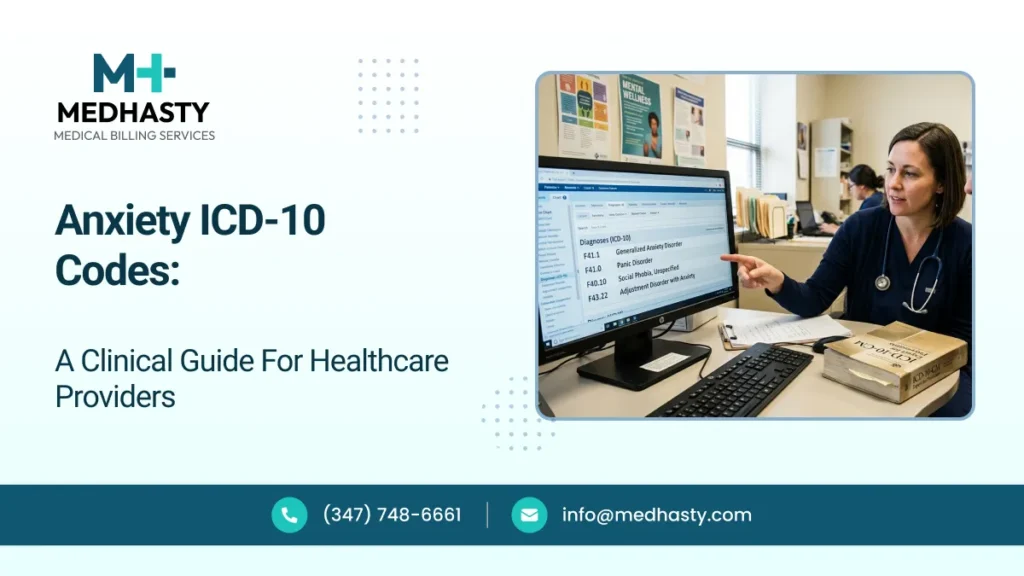
Anxiety is one of the common mental health issues seen in therapy sessions. Not every person who feels anxious has the same problem. Some patients have worry others have sudden moments of fear and some feel anxious because of difficult things happening in their lives.
These differences are important when it comes to using the ICD-10 codes for anxiety.
For example a patient who has generalized anxiety disorder needs a code than a person who has an unspecified anxiety disorder. Even though their symptoms might be similar the details, in their records show that the right code is different.
Using the code helps healthcare providers keep accurate medical records explain diagnoses clearly and show medical necessity when filing insurance claims.
This guide explains ICD‑10‑CM codes for anxiety disorders in 2027 covering ICD‑10‑CM codes conditions, ICD‑10‑CM codes documentation requirements, ICD‑10‑CM codes coding mistakes and ICD‑10‑CM codes practical billing considerations.
What Is the ICD-10 Code for Anxiety?
The ICD-10 code for anxiety is F41.9 when a healthcare provider documents an anxiety disorder without identifying a type. Many people search for an anxiety code, and sometimes the documented diagnosis is broad.
However F41.9 is not appropriate for every anxiety diagnosis. When a clinician identifies an anxiety disorder a more specific code may be required.
For example:
-
F41.9: Anxiety disorder, unspecified
-
F41.1: Generalized anxiety disorder
-
F41.0: Panic disorder
-
F41.8: Other specified anxiety disorders
-
F41.3: Other mixed anxiety disorders
These codes belong to category F41, which covers other anxiety disorders. F41 itself is a non-billable category, so claims require an appropriate billable code from within the category.
Anxiety ICD-10 Codes for 2027: Complete F41 Code List
The following table includes all five billable codes in category F41 for fiscal year 2027.
| ICD-10-CM Code | Official Description | When It Applies |
|---|---|---|
| F41.0 | Panic disorder [episodic paroxysmal anxiety] | Diagnosed panic disorder |
| F41.1 | Generalized anxiety disorder | Diagnosed GAD |
| F41.3 | Other mixed anxiety disorders | Documented mixed anxiety condition classified here |
| F41.8 | Other specified anxiety disorders | Specified anxiety presentation without a dedicated code |
| F41.9 | Anxiety disorder, unspecified | Diagnosed anxiety disorder without an identified subtype |
These codes are available in the FY 2027 ICD-10-CM code set, effective October 1, 2026, through September 30, 2027.
Understanding the Most Common Anxiety ICD-10 Codes
1. F41.9 — Anxiety Disorder, Unspecified
F41.9 is often used when a doctor says a patient has an anxiety disorder but doesn’t provide details to determine the exact type.
A patient might say they feel very nervous have trouble sleeping worry a lot or find it hard to focus. These signs alone are not enough to say it is generalized anxiety disorder or another specific type.
Example: A patient goes to a care doctor because they have been feeling nervous all the time and can’t sleep. After looking at the patient the doctor writes “anxiety disorder” and suggests more testing.
In this case F41.9 is the code that matches the diagnosis written down.
Tip for documentation: Do not just use F41.9 every time the word anxiety shows up in the records. Check the doctors notes and the Alphabetic Index. If the doctor writes about an anxiety reaction or an anxiety state that might mean a code, like F41.1.
2. F41.1 — Generalized Anxiety Disorder
F41.1 identifies generalized anxiety disorder (GAD), a condition involving persistent, excessive worry about multiple aspects of daily life.
Patients may experience:
-
Excessive worry that is difficult to control
-
Restlessness or feeling constantly on edge
-
Difficulty concentrating
-
Muscle tension and fatigue
-
Irritability or disturbed sleep
Example: A patient says they worry a lot about money, family duties and work for than six months. After a check the doctor says the patient has generalized anxiety disorder.
The appropriate diagnosis code is F41.1.
Documentation tip: Write down the confirmed anxiety disorder, the symptom history, how the symptoms affect function and the plan, for treatment. A GAD-7 score can help the doctor. It does not alone confirm generalized anxiety disorder.
3. F41.0 — Panic Disorder
F41.0 is used when a person has a diagnosed panic disorder. This condition means the person has repeated panic attacks. These attacks come on suddenly. Cause strong fear or discomfort.
Common symptoms include a heartbeat, sweating, shaking, chest pain, trouble breathing or a feeling of losing control.
For example a patient may have unexpected panic attacks. They may also worry a lot about having another attack. A psychiatrist looks at the case. Decides the person has panic disorder without agoraphobia. In this situation F41.0 is the code.
It is important to know the difference in coding. If the patient has panic disorder along, with agoraphobia then the code F40.01 should be used of F41.0.
4. F41.8 — Other Specified Anxiety Disorders
F41.8 is used when a provider writes down an anxiety disorder that does not have its own dedicated ICD‑10‑CM code.
This classification covers anxiety and depressive disorder plus some other specified anxiety presentations.
For example a clinician might diagnose anxiety and depressive disorder when neither anxiety nor depression is documented as a separate fully established disorder. In that case the documented condition can be classified as F41.8.
The key difference is that the clinician has specified the nature of the disorder. F41.8 should not be used of F41.9 just to make the claim look more specific.
5. F41.3 — Other Mixed Anxiety Disorders
F41.3 is a code that refers to mixed anxiety disorders that are grouped under this specific classification.
This code is not often used as F41.1 or F41.9 and it needs a thorough look at the recorded diagnosis as well as the ICD-10-CM Index and Tabular List.
Tip for documentation: Do not think that every patient who has anxiety and depression automatically fits under F41.3. The mixed anxiety and depressive disorder is listed under F41.8. On the hand adjustment disorder, with mixed anxiety and depressed mood has its own code, which is F43.23.
ICD-10 Codes for Social Anxiety, Phobias, and Agoraphobia
Not every anxiety‑related condition belongs under category F41. Patients diagnosed with social anxiety disorder, agoraphobia or specific phobias usually need codes, from category F40.
Social Anxiety Disorder ICD-10 Codes
Social anxiety disorder means having fear or worry in situations where people feel they are being watched, judged or assessed by others.
| ICD-10 Code | Description |
|---|---|
| F40.10 | Social phobia, unspecified |
| F40.11 | Social phobia, generalized |
For example, if a patient is diagnosed with social phobia affecting many social situations, the code F40.11 may be suitable. However, if the documentation does not identify the subtype, the code F40.10 may be a choice.
Agoraphobia ICD-10 Codes
Agoraphobia involves significant anxiety about situations where escape may feel difficult or assistance may be unavailable.
| ICD-10 Code | Description |
|---|---|
| F40.00 | Agoraphobia, unspecified |
| F40.01 | Agoraphobia with panic disorder |
| F40.02 | Agoraphobia without panic disorder |
The distinction between F40.01 and F40.02 matters because panic disorder and agoraphobia may occur together or independently.
Specific Phobia ICD-10 Codes
Specific phobias are when someone has a fear of certain things. These things can be objects, situations, animals or places.
The table below shows all the codes that can be used to bill for phobia subcategories in FY 2027.
| ICD-10 Code | Description |
|---|---|
| F40.210 | Arachnophobia |
| F40.218 | Other animal type phobia |
| F40.220 | Fear of thunderstorms |
| F40.228 | Other natural environment type phobia |
| F40.230 | Fear of blood |
| F40.231 | Fear of injections and transfusions |
| F40.232 | Fear of other medical care |
| F40.233 | Fear of injury |
| F40.240 | Claustrophobia |
| F40.241 | Acrophobia |
| F40.242 | Fear of bridges |
| F40.243 | Fear of flying |
| F40.248 | Other situational type phobia |
| F40.290 | Androphobia |
| F40.291 | Gynephobia |
| F40.298 | Other specified phobia |
Two additional codes within category F40 are:
-
F40.8: Other phobic anxiety disorders
-
F40.9: Phobic anxiety disorder, unspecified
Only a diagnosed phobic disorder qualifies as a phobia. A patient who dislikes flying or feels uneasy during an MRI does not automatically meet the requirements, for a disorder diagnosis.
Other ICD-10 Codes Related to Anxiety
Anxiety can also appear together with adjustment disorders, trauma‑related conditions, obsessive‑compulsive disorders and certain medical conditions.
These conditions should not automatically be reported using F41.9.
| ICD-10 Code | Description | Coding Consideration |
|---|---|---|
| F43.22 | Adjustment disorder with anxiety | Anxiety related to a diagnosed adjustment disorder |
| F43.23 | Adjustment disorder with mixed anxiety and depressed mood | Both anxiety and depressed mood are documented as part of the adjustment disorder |
| F43.0 | Acute stress reaction | Diagnosed acute response to severe stress |
| F43.10 | Post-traumatic stress disorder, unspecified | PTSD with unspecified subtype |
| F43.11 | Post-traumatic stress disorder, acute | Diagnosed acute PTSD |
| F43.12 | Post-traumatic stress disorder, chronic | Diagnosed chronic PTSD |
| F42.2 | Mixed obsessional thoughts and acts | OCD involving both obsessions and compulsions |
| F42.9 | Obsessive-compulsive disorder, unspecified | OCD without a specified subtype |
| F06.4 | Anxiety disorder due to known physiological condition | Anxiety disorder attributed to an established physiological condition |
| F93.0 | Separation anxiety disorder of childhood | Documented childhood separation anxiety disorder |
PTSD, adjustment disorders and OCD are diagnoses that can be made when anxiety is the main symptom. The correct coding for PTSD, adjustment disorders and OCD depends on the clinicians diagnosis, not, on worry or fear.
Anxiety Due to a Medical Condition
Sometimes a patient’s anxiety is linked to a problem they already have.
For example someone with a diagnosed endocrine disorder might start showing signs of anxiety. The doctor might say the anxiety comes from that disorder.
If the clinician decides the anxiety is caused by a known condition then code F06.4 might be used.
The doctor must clearly write down how the condition causes the anxiety. Coders can’t guess that the anxiety is due to another illness just because both are in the record. They need to follow the rules, for coding the main medical condition.
How to Choose the Correct Anxiety ICD-10 Code
Choosing an anxiety diagnosis code starts with the record, not the claim form.
The healthcare provider’s notes must clearly show the condition being treated. Medical coders then need to pick the anxiety diagnosis code that matches what’s in the record. They can’t just. Use a code that’s easy or common. The code must exactly fit the diagnosis the provider documented. This helps keep things accurate and in line with standards.
Step 1: Identify the Confirmed Diagnosis
Review the providers assessment and treatment plan.
Symptoms such, as worry, restlessness or sleep disturbance may appear in several conditions. These symptoms alone do not establish an anxiety disorder.
Step 2: Review the Documentation for Specificity
Check whether the provider has identified anxiety disorder, panic disorder, social anxiety, a specified mixed disorder or another diagnosis.
Do not assign a more specific code solely from the providers assumptions about the patients symptoms.
Step 3: Check for Related or Underlying Conditions
Look for documentation of adjustment disorders, panic disorder with agoraphobia, medical causes, or other conditions that may change the appropriate code.
Step 4: Verify the Code in the Official Classification
Use the Alphabetic Index to find the diagnosis and check the code in the Tabular List.
Look at inclusion terms Excludes1 and Excludes2. Any other important instructions, before sending the claim.
Step 5: Confirm the Diagnosis Supports the Service
The diagnosis chosen must connect to the care or treatment given. The right ICD-10 code is important. Getting paid also relies on medical necessity the service billed, the payers rules and other claim rules.
Documentation Requirements for Anxiety Disorder Coding
Accurate documentation supports both clinical continuity and reliable billing.
An anxiety-related encounter note should contain enough information to explain the provider’s diagnosis and the services performed.
| Documentation Element | Information to Include |
|---|---|
| Clinical diagnosis | Specific diagnosed anxiety disorder, when established |
| Presenting symptoms | Relevant concerns reported by the patient |
| Duration and frequency | When symptoms began and how frequently they occur |
| Functional impact | Effect on daily activities, work, relationships, or sleep |
| Clinical assessment | Relevant findings, evaluation, and diagnostic reasoning |
| Comorbid conditions | Other diagnosed disorders or underlying medical conditions |
| Treatment plan | Medication management, psychotherapy, follow-up, or referral |
| Progress | Response to treatment and clinically relevant changes |
For behavioral health services, documentation should also support the psychotherapy or evaluation service billed, including time and other required details where applicable.
Example of Documentation Supporting F41.1
A clinical record might state:
Patient reports persistent and excessive worry across multiple areas of daily life, with difficulty controlling worry, restlessness, and sleep disturbance. Symptoms have continued for eight months and interfere with occupational functioning. Following evaluation, the provider diagnoses generalized anxiety disorder and initiates a treatment plan.
This documentation provides a clearer clinical foundation for F41.1 than a brief note stating only “patient feels anxious.”
Common Anxiety ICD-10 Coding Mistakes to Avoid
Even familiar diagnosis codes can cause billing problems when they do not match the documentation.
Using F41.9 for Every Anxiety Diagnosis
Unspecified anxiety disorder is appropriate when specificity is unavailable, not when the medical record clearly identifies a different anxiety disorder.
For example, if generalized anxiety disorder is documented, F41.1 should be considered rather than automatically reporting F41.9.
Confusing Panic Attacks With Panic Disorder
A patient may experience a panic attack without having a diagnosed panic disorder.
Assigning F41.0 solely because the medical record mentions a panic episode can misrepresent the clinical findings. The provider must establish the reportable diagnosis.
Coding Anxiety Symptoms as a Confirmed Disorder
Anxiety‑related symptoms can appear when there is no definitive anxiety disorder diagnosis.
In outpatient settings uncertain diagnoses cannot usually be reported as though they are confirmed. When appropriate report the documented signs or symptoms according to the coding guidelines.
Overlooking Adjustment Disorders
Anxiety associated with a diagnosed adjustment disorder may require F43.22 rather than F41.9.
A stressful event alone does not establish an adjustment disorder. The clinician must document the diagnosis.
Misclassifying Mixed Anxiety and Depression
Mixed anxiety and depressive disorder, adjustment disorder with mixed anxiety and depressed mood, and two separately diagnosed disorders are not interchangeable.
Review the exact clinical wording before selecting F41.8, F43.23, or separate diagnosis codes.
Ignoring Exclusion Notes
Category F41 contains instructional notes addressing anxiety associated with conditions such as acute stress reactions and adjustment reactions.
An Excludes2 note indicates that the excluded condition is not included within the code, although both conditions may be reported together when they genuinely coexist and coding requirements permit. An Excludes1 note generally prohibits reporting the specified codes together, subject to the official guidance.
How Anxiety ICD-10 Codes Affect Medical Billing and Reimbursement
Anxiety diagnosis codes are used across primary care, psychiatry, psychology, and other healthcare settings.
However, selecting a valid ICD-10 code does not guarantee that an insurance claim will be approved.
Payers may also evaluate medical necessity, provider eligibility, service limitations, procedure coding and documentation requirements.
Common CPT Codes Used With Anxiety Treatment
Depending on the services actually performed, healthcare providers treating anxiety disorders may report CPT codes such as:
| CPT Code | Service Description |
|---|---|
| 90791 | Psychiatric diagnostic evaluation without medical services |
| 90792 | Psychiatric diagnostic evaluation with medical services |
| 90832 | Psychotherapy, 30 minutes |
| 90834 | Psychotherapy, 45 minutes |
| 90837 | Psychotherapy, 60 minutes |
| 90833 | Psychotherapy, 30 minutes, with an evaluation and management service |
| 90836 | Psychotherapy, 45 minutes, with an evaluation and management service |
| 90838 | Psychotherapy, 60 minutes, with an evaluation and management service |
These codes serve different purposes from ICD-10-CM diagnosis codes.
ICD-10-CM codes identify the condition being treated. CPT codes describe the professional service performed.
For example, a behavioral health provider may report F41.1 to identify generalized anxiety disorder along with CPT 90834 when a properly documented 45-minute psychotherapy service meets the requirements for that procedure code.
Psychotherapy codes, time thresholds, E/M services, telehealth requirements, and modifier rules must be evaluated separately. Never choose a CPT code solely because of the patient’s anxiety diagnosis.
Why Anxiety Claims May Be Denied
Common billing problems include unsupported medical necessity, incomplete encounter notes, invalid diagnosis-to-procedure relationships, missing authorization, and payer-specific coverage restrictions.
Other issues may include incorrect patient eligibility, duplicate submissions, or failure to meet psychotherapy documentation requirements.
A denial does not automatically mean the anxiety diagnosis code is incorrect. Billing teams should review the payer’s explanation of benefits, remittance advice, adjustment reason codes, and related policies before making corrections.
At Medhasty Medical Billing, the focus is on helping healthcare practices maintain accurate claims through careful coding review, documentation support, and timely revenue cycle management.
Best Practices for Accurate Anxiety Disorder Billing
Healthcare organizations can reduce avoidable claim errors by establishing consistent coding and documentation processes.
-
Use diagnosis-specific documentation. Encourage clinicians to identify the type of anxiety disorder when clinically established.
-
Avoid unsupported specificity. Never infer a diagnosis or subtype from symptoms, screening tools, or medication history alone.
-
Verify updated ICD-10 codes. Use the code set effective on the applicable date of service or discharge.
-
Check medical necessity requirements. Confirm that the documented condition supports the service and any relevant payer coverage rules.
-
Review psychotherapy documentation. Ensure that time, service details, and other applicable requirements support the reported procedure.
-
Address documentation gaps early. Query the provider when clinically important information is missing or unclear.
-
Monitor denial patterns. Identify recurring issues involving diagnosis selection, service coding, authorizations, and payer edits.
A reliable coding process improves the quality of medical records and reduces preventable administrative corrections. It also supports more consistent communication between providers, coding teams, and insurance payers.
Frequently Asked Questions About Anxiety ICD-10 Codes
What is the ICD-10 code for anxiety?
F41.9 is the ICD-10-CM code for anxiety disorder, unspecified. It is used when a provider documents an anxiety disorder without identifying a specific subtype. Other codes may apply when the diagnosis is more specific.
What is the difference between F41.1 and F41.9?
F41.1 represents generalized anxiety disorder, while F41.9 represents an unspecified anxiety disorder. The correct choice depends on the diagnosis documented by the healthcare provider.
What is the ICD-10 code for anxiety and depression?
There is no single code appropriate for every patient experiencing both anxiety and depression. F41.8 includes mixed anxiety and depressive disorder, while F43.23 identifies adjustment disorder with mixed anxiety and depressed mood. When separate anxiety and depressive disorders are diagnosed, the applicable codes should be evaluated individually.
What is the ICD-10 code for panic attacks?
F41.0 identifies panic disorder and includes panic attacks and panic states in its classification terms. However, an isolated symptom or panic-like episode does not automatically establish a panic disorder diagnosis. Coding must follow the clinician’s documented assessment.
What is the ICD-10 code for social anxiety disorder?
F40.10 is used for social phobia, unspecified, while F40.11 identifies generalized social phobia. Select the code that matches the documented diagnosis.
Is F41.9 a billable ICD-10 code in 2027?
Yes. F41.9 is a billable, specific ICD-10-CM diagnosis code for fiscal year 2027. However, reimbursement depends on additional factors, including medical necessity, the service performed, payer coverage policies, and documentation requirements.
Can anxiety and depression be coded together?
Yes, when both conditions are separately diagnosed, clinically relevant, and meet applicable reporting requirements. However, coders should not automatically assign two separate codes when the provider has documented a single mixed disorder.
Can a healthcare provider use F41.9 for temporary anxiety?
Not automatically. Temporary anxiety does not necessarily establish an anxiety disorder. The clinician should assess the patient and document the appropriate diagnosis or reportable symptom.
How often are anxiety ICD-10 codes updated?
ICD-10-CM receives annual updates effective October 1, and additional updates may occur during the fiscal year. Healthcare providers and billing teams should verify the applicable code set before submitting claims.
Final Thoughts
Choosing the right anxiety ICD-10 code requires more than identifying a patient’s symptoms. Healthcare providers must distinguish between generalized anxiety disorder, panic disorder, phobias, adjustment disorders, and other conditions that may present with similar complaints.
While F41.9 is commonly used for unspecified anxiety disorders, more specific codes such as F41.1, F41.0, and F40.10 provide a clearer representation of the patient’s diagnosis when supported by clinical documentation.
Accurate coding helps protect the integrity of medical records, supports medical necessity, and reduces avoidable claim corrections.
For practices managing complex behavioral health claims, Medhasty Medical Billing provides medical billing and revenue cycle support designed to simplify administrative workflows and help providers focus on patient care.
Simplify Your Anxiety and Behavioral Health Billing
Managing accurate diagnosis codes, psychotherapy claims, payer requirements, and billing follow-ups can take valuable time away from patient care.
Get expert medical billing support for your practice. Improve claim accuracy, reduce preventable billing errors, and keep your revenue cycle moving with a team that understands healthcare reimbursement.
Contact our medical billing team to discuss your practice’s needs.