
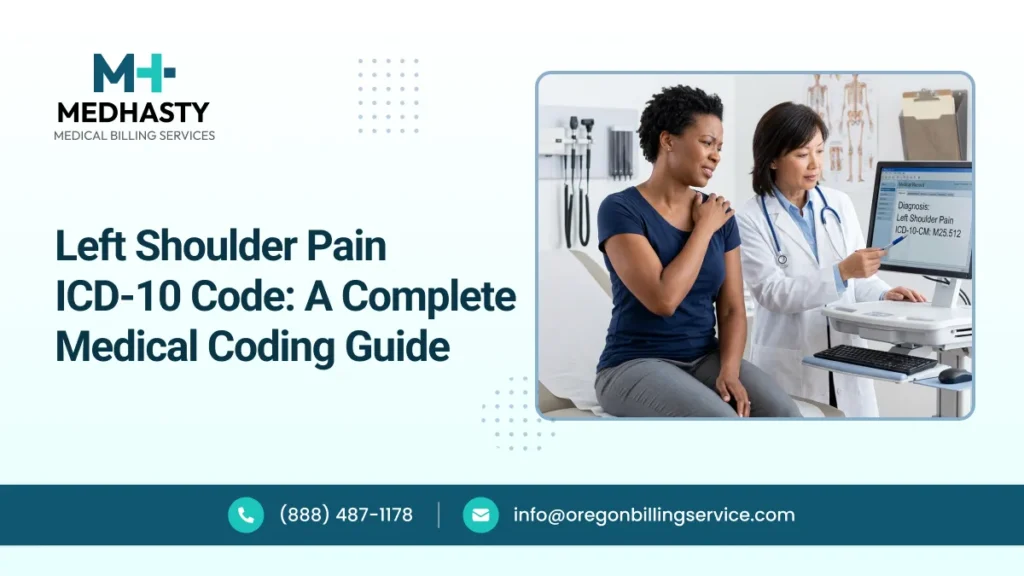
A patient comes into the clinic. Says that the left shoulder has been hurting for weeks. The patient cannot lift the arm. The patient has trouble sleeping. The patient finds even simple daily tasks difficult. You take a look at the shoulder review all their symptoms and decide if more tests are needed.
Now it’s time to code this.
Should you just report shoulder pain as a symptom? Does the medical record point to a clearer diagnosis?
The ICD-10 code M25.512 is for left shoulder pain when no specific cause has been found. Its often used when the pain is real and documented. There’s no confirmation of a tear, arthritis or other condition. This code might seem straightforward. Picking the right one can make a big difference—especially if the patient needs imaging, injections or therapy.
This guide explains how to use M25.512. It also shows when another diagnosis code may be better.. It highlights what healthcare providers should write in the records to back up their choices. Clear documentation helps ensure coding and proper care.
What Is the ICD-10 Code for Left Shoulder Pain?
The correct ICD-10-CM code for left shoulder pain is M25.512 — Pain in left shoulder.
This code belongs to the M25.5 category, which covers joint pain. It describes the location of the patient’s discomfort without identifying the condition responsible for it.
Here is a quick reference:
| Detail | Information |
|---|---|
| ICD-10-CM Code | M25.512 |
| Description | Pain in left shoulder |
| Code Category | M25.5 — Pain in joint |
| Billable Code | Yes |
| Laterality | Left |
| Seventh Character | Not required |
Think of M25.512 as a way to report what is known at the time of the visit.
For instance a patient might say that they feel pain when they lift their arm. The test will not show whether the pain comes from a tendon, a joint or tissue, around the joint. In such instances, it could be that the pain is the proper diagnosis for the situation.
In cases where the diagnosis is shown to be something such as shoulder bursitis for example then the code, for the diagnosis has to be changed.
Left Shoulder Pain vs. Right Shoulder Pain ICD-10 Codes
One small detail can make a difference when coding shoulder pain: which side is affected?
ICD-10-CM provides separate codes for left, right, and unspecified shoulder pain.
| ICD-10 Code | Description |
|---|---|
| M25.512 | Pain in left shoulder |
| M25.511 | Pain in right shoulder |
| M25.519 | Pain in unspecified shoulder |
If the medical record states the shoulder then you should select the code M25.512. Do not pick the generic code M25.519 simply because it is easier especially when the left shoulder has already been noted in the record.
What about patients who complain of pain in both shoulders?
If no more specific condition has been diagnosed, M25.511 and M25.512 may both be reported. There is no single bilateral shoulder pain code in this category.
What Causes Left Shoulder Pain?
Not every painful shoulder has the same underlying problem.
Some patients feel discomfort after doing movements or physical activity. Other patients have swelling, worn out conditions or wounds that affect the muscles and tendons near the shoulder.
This is why the medical checkup is important. Two patients can say the same things, about how they feel but end up with different diagnoses.
Rotator cuff problems
The rotator cuff helps keep the shoulder stable while allowing the arm to move. When the rotator cuff tendons become damaged patients may experience weakness, pain or difficulty reaching overhead.
A confirmed nontraumatic complete rotator cuff tear of the left shoulder may be reported with M75.122. Traumatic tears require the appropriate injury code instead.
Frozen shoulder
Frozen shoulder, also known as capsulitis brings stiffness and limits movement. Frozen shoulder makes it harder for patients to dress themselves or reach behind their back.
The ICD-10 code for adhesive capsulitis of the left shoulder is M75.02.
Shoulder bursitis
Bursitis involves inflammation of a bursa, a small fluid-filled structure that helps reduce friction around a joint.
When bursitis of the left shoulder is confirmed, M75.52 may be used.
Shoulder osteoarthritis
Osteoarthritis can slowly make it hard to move the shoulder. A person might say their shoulder feels stiff after sitting or lying down. They might also feel pain when doing tasks.
For osteoarthritis of the left shoulder the correct code is M19.012.
Shoulder impingement
Patients with shoulder impingement often feel pain when they lift their arm especially when they move it above their head.
M75.42 is the code, for syndrome of the left shoulder.
Related ICD-10 Codes for Left Shoulder Conditions
| Condition | ICD-10-CM Code |
|---|---|
| Left shoulder pain | M25.512 |
| Frozen shoulder | M75.02 |
| Left shoulder bursitis | M75.52 |
| Left shoulder impingement syndrome | M75.42 |
| Bicipital tendinitis, left shoulder | M75.22 |
| Calcific tendinitis, left shoulder | M75.32 |
| Primary osteoarthritis, left shoulder | M19.012 |
| Nontraumatic complete rotator cuff tear, left shoulder | M75.122 |
These conditions should not be assumed from symptoms alone. The medical record must support the diagnosis being reported.
When Should You Use M25.512?
The main question is whether the provider has identified the cause of the patient’s pain.
A patient comes into the clinic complaining of left shoulder discomfort that started two weeks ago. The doctor checks the shoulder thoroughly. Decides to order an X-ray. Despite the examination no clear diagnosis has been made yet.
In this situation M25.512 may be appropriate.
Now think about a visit. A patient comes back after testing and the doctor says it’s adhesive capsulitis. The coding changes because the notes now show a problem.
This difference is important when coding for outpatient visits.
A possible problem should not be listed as confirmed just because its, in the list of issues. When the doctor hasn’t made a diagnosis the symptoms that are written down are usually the information there is.
Once a problem is confirmed it’s usually better to report that diagnosis of always adding shoulder pain as a separate issue.
Acute and Chronic Left Shoulder Pain: Which Codes Apply?
Shoulder pain can start at once or go on for months. Some people can recall the moment their pain began. Others don’t know what caused it.
The code M25.512 points to the joint but it does not say if the pain is sudden or long-lasting.
Depending on how the patient’s condition’s described and why they are seeing a provider, a code, from category G89 might also fit.
| ICD-10 Code | Description |
|---|---|
| M25.512 | Pain in left shoulder |
| G89.11 | Acute pain due to trauma |
| G89.21 | Chronic pain due to trauma |
| G89.29 | Other chronic pain |
| G89.18 | Other acute postprocedural pain |
| G89.28 | Other chronic postprocedural pain |
For example if a doctor writes about long-term left shoulder pain and there is no reason for it the code M25.512 can be used together with G89.29 if needed.
The code G89 should not be used automatically.
If a patient says their shoulder has hurt for months that alone does not mean a long-term pain diagnosis should be given. The notes and the reason, for the visit help decide what code to use.
CPT Codes Commonly Used for Left Shoulder Pain
The diagnosis code is one part of a medical claim.
A patient who has shoulder pain may require an office visit, an imaging procedure, physiotherapy, or an injection as part of treatment. Therefore, every service has to be accounted for by the use of the CPT code. While the CPT code specifies the procedure performed, the ICD-10-CM code stipulates the reason for performing it.
Office visits and diagnostic imaging
| CPT Code | Service |
|---|---|
| 99202–99205 | Office/outpatient visits for new patients |
| 99212–99215 | Office/outpatient visits for established patients |
| 73020 | Shoulder X-ray, one view |
| 73030 | Complete shoulder X-ray, minimum two views |
| 73221 | MRI of upper-extremity joint without contrast |
| 73222 | MRI of upper-extremity joint with contrast |
| 73223 | MRI of upper-extremity joint without and with contrast |
For example a doctor might ask for an image of the shoulder when a person has pain that hasn’t gotten better after treatment. The doctor needs to check that the image request matches the test that was actually performed.
Shoulder injections and rehabilitation services
| CPT Code | Service |
|---|---|
| 20610 | Major joint or bursa aspiration/injection without ultrasound guidance |
| 20611 | Major joint or bursa aspiration/injection with ultrasound guidance |
| 97110 | Therapeutic exercises |
| 97112 | Neuromuscular reeducation |
| 97140 | Manual therapy techniques |
| 97530 | Therapeutic activities |
A patient receiving physical therapy may have several different services during the same appointment. That does not mean each service can automatically be billed.
The treatment notes should show what was performed, why it was necessary, and how much time was spent on timed procedures.
For Medicare outpatient therapy, the applicable timed-code unit rules also need to be followed.
What Should Be Documented for Left Shoulder Pain?
A well-written medical note does more than support code selection. It helps explain the patient’s condition and why a particular treatment was chosen.
Consider two notes:
Note A: Patient has shoulder pain. X-ray ordered.
Note B: Patient reports left shoulder pain for three weeks, with increasing discomfort during overhead movement. Examination shows tenderness and painful active range of motion. Imaging ordered to investigate persistent symptoms.
The second note tells a much clearer story.
It identifies the affected side, gives some history, describes examination findings, and explains the reason for testing.
For left shoulder pain encounters, useful documentation generally includes:
- Location: Is the discomfort in the left shoulder, right shoulder, or both?
- Onset: Did symptoms begin suddenly or develop gradually?
- Injury history: Was there a fall, accident, or other traumatic event?
- Symptoms: Is there weakness, stiffness, swelling, or limited movement?
- Examination findings: What did the provider observe?
- Assessment: Has a specific condition been confirmed?
- Treatment plan: What care was recommended, and why?
These details help support the selected code and the medical necessity of any services performed.
Example of a clinical note
Chief Complaint: Left shoulder pain.
History: Patient reports discomfort for approximately three weeks, especially when lifting the arm or reaching overhead. No known injury.
Examination: Mild tenderness over the left shoulder with pain during active range of motion. No visible deformity.
Assessment: Left shoulder pain; cause not yet determined.
Plan: Conservative treatment with follow-up evaluation if symptoms persist.
ICD-10-CM Code: M25.512
Since no specific underlying condition has been established, the symptom code reflects the documented assessment.
Common Billing Denials for Left Shoulder Pain
Even when M25.512 is correctly selected, a claim may still be denied.
The problem might involve missing documentation, an unsupported procedure, an authorization issue, or a service already included in another payment.
Here are some claim adjustment reason codes providers may encounter.
| CARC | What It Means | What to Review |
|---|---|---|
| CO-11 | Diagnosis is inconsistent with the procedure | Check the documented diagnosis and procedure performed |
| CO-16 | Missing information or a submission error | Review the accompanying remark codes |
| CO-50 | Service considered not medically necessary | Compare the clinical record with payer coverage requirements |
| CO-97 | Service included in another adjudicated service | Review bundling rules and any relevant modifiers |
| CO-197 | Authorization or notification was absent | Check the payer’s prior authorization requirements |
Suppose a patient has imaging for left shoulder pain yet the payer says that the documentation does not show medical necessity according to its policy. You might think that the imaging alone would convince the payer.
Simply changing the diagnosis code will not solve the problem. The payer still needs documentation that the imaging was medically necessary.
The provider must look at the record the imaging indication and the payers coverage requirements before deciding if a corrected claim or appeal is needed. This step can make the difference, between approval and denial.
Why Remark Codes Matter
Claim Adjustment Reason Codes explain why a payment was adjusted. These codes show the reason behind any change in the payment amount. They help you understand what went wrong or what needs to be corrected. Remittance Advice Remark Codes or RARCs give details, about the adjustment.
For example if you see a CO-16 adjustment you should check the Remittance Advice Remark Code that comes with it. That code will tell you what information is missing or incorrect. This helps you fix the issue and make sure future payments are processed correctly.
From my experience than treating all denials the same way providers should read the full Remittance Advice Remark Code before making changes.
Common Mistakes When Coding Left Shoulder Pain
Some coding problems are easy to avoid once you know what to look for.
Using an unspecified code when the side is documented
If the physician clearly records left shoulder pain, M25.512 is more appropriate than M25.519.
Coding a suspected diagnosis as confirmed
A provider may suspect a rotator cuff tear, but suspicion alone is not enough to report it as an established diagnosis in an outpatient setting.
Reporting pain separately when it is integral to a confirmed condition
When a diagnosed condition routinely causes shoulder pain, adding M25.512 may be unnecessary. Follow the applicable ICD-10-CM guidelines and any relevant coding instructions.
Overlooking injury coding requirements
Shoulder pain following a fall may involve a fracture, dislocation, or other injury. If an injury is confirmed, its code may require additional details, including an appropriate seventh character.
Using modifiers without supporting documentation
A modifier does not correct a claim simply because the provider wants separate reimbursement. The circumstances required for that modifier must actually be present.
Avoiding these mistakes begins with reviewing the clinical note rather than choosing a code based only on the appointment’s chief complaint.
How Providers Can Improve Shoulder Pain Claim Accuracy
Accurate claims are easier to prepare when the clinical documentation and coding are consistent from the beginning.
Before submitting a shoulder-related claim, review whether the documentation identifies the affected side and whether the diagnosis has been confirmed.
Next, compare the diagnosis with the procedure being billed. A therapy visit, MRI, or injection should have a clear clinical purpose.
For services that require authorization, verify the payer’s requirements before treatment whenever possible. Also review modifiers, timed treatment units, and applicable coverage limitations.
If a claim is denied, use the payer’s adjustment and remark codes to identify the problem before correcting or appealing it.
The goal is not to add more codes or create longer notes. It is to make sure the submitted information accurately describes the patient’s condition and the care provided.
FY 2027 ICD-10-CM Coding Considerations
The FY 2027 ICD-10-CM code set applies to services beginning October 1, 2026.
Providers should use the code set and official coding guidelines applicable to the date of service.
For left shoulder pain, laterality and the distinction between symptoms and confirmed conditions remain important. When the encounter involves an injury, clinicians should also document details needed to select the appropriate injury code.
Because coding instructions and payer requirements can change, it is worth reviewing current guidance before submitting claims involving more complex diagnoses or procedures.
Final Thoughts
Left shoulder pain is a common reason for medical visits, but the correct diagnosis code is not always obvious from the patient’s initial complaint.
M25.512 is the ICD-10-CM code for left shoulder pain. It is appropriate when the clinical record identifies pain in that shoulder without establishing a more specific underlying condition.
If further evaluation confirms bursitis, adhesive capsulitis, osteoarthritis, or a rotator cuff injury, the diagnosis should reflect those findings instead.
For healthcare providers, accurate shoulder pain coding comes down to understanding what the documentation actually says. A clear assessment, the correct laterality, and a well-supported treatment plan help connect the diagnosis to the services performed.
That makes the claim easier to understand and helps reduce avoidable coding and reimbursement problems.
Frequently Asked Questions
What is the ICD-10 code for left shoulder pain?
M25.512 is the ICD-10-CM code used to report pain in the left shoulder when the documentation supports a symptom-based diagnosis.
Is M25.512 a billable diagnosis code?
Yes. M25.512 is a billable ICD-10-CM code. Payment for a claim still depends on the service, documentation, coverage, and medical necessity requirements.
What is the ICD-10 code for chronic left shoulder pain?
M25.512 identifies the painful shoulder. G89.29 may also apply when chronic pain is documented and the additional code is appropriate under the coding guidelines.
Can M25.512 be used for a rotator cuff injury?
It may be used when the patient has shoulder pain but a rotator cuff injury has not been confirmed. Once the provider establishes a specific injury or condition, the appropriate diagnosis code should be selected.
What is the difference between M25.511 and M25.512?
M25.511 refers to pain in the right shoulder. M25.512 refers to pain in the left shoulder.