
Fatigue is among the frequently experienced symptoms by the patients during visits to their doctors. However, to diagnose the right ICD-10 code for the patient’s fatigue, there should be much more to just stating that the patient feels fatigue.
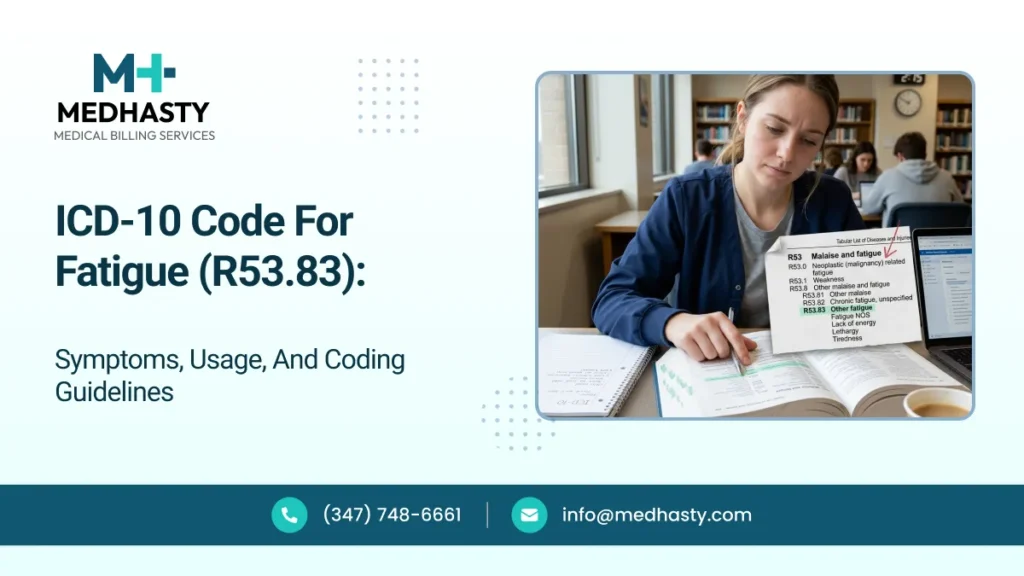
ICD-10 for fatigue is R53.83, referred to as other fatigue. The medical practitioners often diagnose the code in cases when the patient experiences fatigue, tiredness, lethargy or loss of energy.
Even though R53.83 seems easy to understand, improper use of this code may cause problems with billings. This article will discuss the criteria for using R53.83, its difference from the other ICD-10 fatigue codes, and what documentation is required by the FY2027 coding rules.
What Is the ICD-10 Code for Fatigue?
ICD-10-CM Code R53.83 is defined as Other Fatigue, and this code indicates fatigue-related conditions if the medical record reflects the same.
It falls under Chapter 18 of ICD-10-CM Codes, where the chapter deals with symptoms, signs, and abnormal clinical manifestations not classified to another chapter.
Nevertheless, R53.83 does not capture all kinds of fatigue-related conditions. There are other conditions such as chronic fatigue, cancer-related fatigue, and myalgic encephalomyelitis/chronic fatigue syndrome (ME/CFS).
Common Symptoms Associated With Fatigue ICD-10 Code R53.83
Patients describe fatigue differently. Some report persistent tiredness despite adequate sleep, while others experience reduced energy that interferes with work, exercise, or routine activities.
The following symptoms may accompany fatigue:
-
Persistent tiredness or reduced energy
-
Difficulty completing everyday activities
-
General feelings of exhaustion
-
Reduced physical endurance
-
Trouble maintaining concentration
-
Feeling unrefreshed after rest
-
Lethargy or reduced motivation
-
Difficulty sustaining usual activity levels
The presence of the above factors does not automatically warrant the use of code R53.83. The patient’s complaint needs to be analyzed by the provider to decide on whether there is a more fitting code to use.
As an illustration, if a patient complains of being tired without knowing the underlying cause, R53.83 would apply. However, if the provider documents muscle weakness, fatigue syndrome, and/or fatigue due to cancer, then other codes could be considered.
What Causes Fatigue?
Fatigue can result from temporary lifestyle factors, chronic health conditions, medication effects, or a combination of causes.
Common possibilities include:
1. Sleep Disorders
Poor sleep, insomnia, and obstructive sleep apnea can cause fatigue. Health professionals will consider sleep issues and symptoms prior to diagnosing an underlying problem.
2. Nutritional Deficiencies
Low iron content, deficiency of vitamin B12, and other nutritional deficiencies may lead to fatigue. The diagnosis is based on clinical findings and tests performed in the laboratory.
3. Endocrine and Metabolic Conditions
Hypothyroidism, diabetes, and similar conditions can cause fatigue. As soon as the diagnosis is made by the healthcare professional, the code must correspond to that diagnosis and its symptom coding guidelines.
4. Mental Health Conditions
Conditions such as depression and anxiety are often associated with fatigue and sleep problems. It is important for coders to understand that just because the individual complains of being tired does not mean there is a mental disorder.
5. Chronic Illnesses and Infections
Patients suffering from heart disease, kidney diseases, infections, and inflammation may develop fatigue symptoms. It is the duty of the provider to define the relationship between the condition and the diagnostic code.
6. Medication Effects and Lifestyle Factors
Fatigue may be caused by medication use, dehydration, physical activity, and poor sleep habits.
The reason why something is suspected does not necessarily mean that a condition can be billed. There should be some coding requirements followed in this case.
When Should Healthcare Providers Use R53.83?
Healthcare providers can use the code R53.83 where the medical record indicates fatigue as a symptom and there is no definitive diagnosis.
The code can be used in many instances.
Unexplained Fatigue During an Initial Visit
A patient consults a general practitioner because he has been experiencing fatigue for a few weeks now. The doctor assesses the patient’s symptoms and past medical history and arranges the necessary tests.
In case the physician hasn’t made any diagnosis in relation to the patient’s condition, R53.83 could be an appropriate code.
Fatigue Requiring Further Evaluation
A patient complains about fatigue and its interference with the accomplishment of usual tasks. The physician evaluates the patient’s complaints but has not found the reason yet.
In this case, fatigue can be regarded as the primary diagnosis in the outpatient setting if it primarily explains the services rendered.
Fatigue Without a More Specific Classification
If the documentation uses the terms fatigue, lethargy, tiredness, or lack of energy, but does not identify a specific disease, R53.83 could possibly apply to that situation.
However, clinicians should describe the symptom as accurately as possible rather than using a code without looking at the medical record.
Important coding guideline: CMS permits the use of symptom codes if a physician has not yet made a definitive diagnosis. When the diagnosis is established, it must be determined whether it is still appropriate to report fatigue.
Fatigue ICD-10 Codes: R53.83 vs. Other Related Codes
Not all fatigue symptoms share the same ICD-10 code. Documentation of chronicity, cancer-related fatigue, or a diagnosed fatigue syndrome can change the appropriate code selection.
| ICD-10 Code | Description | When to Consider |
|---|---|---|
| R53.83 | Other fatigue | Fatigue, tiredness, lethargy, or lack of energy without a more specific supported classification |
| R53.82 | Chronic fatigue, unspecified | Documented chronic fatigue without a diagnosed specific syndrome |
| R53.0 | Neoplastic (malignant) related fatigue | Fatigue documented as related to malignancy |
| R53.81 | Other malaise | Documented malaise or general discomfort |
| R53.1 | Weakness | Documented weakness or asthenia when the code’s criteria apply |
| G93.32 | Myalgic encephalomyelitis/chronic fatigue syndrome | A confirmed ME/CFS diagnosis |
| G93.31 | Postviral fatigue syndrome | A documented postviral fatigue syndrome |
| G93.39 | Other post infection and related fatigue syndromes | Another documented post-infection fatigue syndrome |
These codes represent distinct clinical descriptions. The final code selection must follow provider documentation, the Alphabetic Index, and all applicable Tabular List instructions.
R53.83 vs. R53.82: What’s the Difference?
Another common coding error is that of misclassifying other fatigue with chronic fatigue.
R53.83 Other fatigue – This code is usually used when there is no evidence to classify fatigue as more specific than just being other fatigue.
R53.82 Chronic fatigue, unspecified – This code is usually used when there is a documented mention of chronic fatigue but a diagnosis for a more specific syndrome is yet to be made.
It is important to understand this difference since coders are supposed to consider chronic fatigue differently depending on the duration reported by the patient.
R53.82 vs. G93.32: Chronic Fatigue Is Not Always Chronic Fatigue Syndrome
ME/CFS and chronic fatigue are two different disease processes.
R53.82 is the code for chronic fatigue, which does not have any other more defined diagnosis. On the contrary, G93.32 is used to identify an established diagnosis that has its unique diagnostic criteria.
G93.32 is the specific ICD-10-CM code that CDC uses for ME/CFS. As a result, R53.82 or R53.83 should not be used if there is documentation for the ME/CFS diagnosis.
FY2027 ICD-10 Coding Guidelines for Fatigue
Fatigue coding must be done according to the ICD-10-CM coding guidelines.
FY2027 code set is used for dates of services from October 1, 2026 to September 30, 2027.
1. Report Symptoms When No Definitive Diagnosis Exists
The healthcare practitioners may consider using code R53.83 when a patient has been reported to be experiencing fatigue without the health care practitioner confirming any other medical condition associated with the fatigue.
As such, when the doctor reports on a patient that is fatigued and orders tests to check what could have caused the condition, it will not be proper for the coders to code the suspected condition.
2. Avoid Separately Coding Routine Symptoms
In the case where a healthcare provider makes a definite diagnosis, the symptoms that go along with the diagnosis do not need their own codes.
For example, when a doctor diagnoses iron deficiency anemia and documents the fatigue associated with that diagnosis, the coder should use the definite diagnosis code and not use R53.83 to indicate the associated fatigue.
But there are situations where separate symptom coding may be needed, especially if the fatigue is not usually associated with that particular diagnosis.
3. Review Code Sequencing
The first-listed diagnosis must be based on the condition or symptom which is mostly responsible for the outpatient services delivered, under the existing guidelines.
For instance, where a patient is evaluated for fatigue without any known cause, R53.83 may fit into the role of being the first-listed diagnosis.
However, there could be cases where the medical problem explains the encounter.
4. Review Excludes Notes Before Submitting Claims
There are several exclusions that are mentioned in the ICD-10-CM code under the subcategory R53.8.
It is because of certain types of fatigue that arise due to overexertion, heat, pregnancy, recurrent episodes of depression, and other specified situations.
Additionally, the code R53.83 has an Excludes2 statement regarding exhaustion and fatigue due to a depressive episode (F32.-). In the case of Excludes2 statements, it is possible to report both codes if necessary.
Thus, it is important for billers to look at the appropriate notes instead of reporting R53.83 for all the fatigue cases.
5. Do Not Code Suspected Diagnoses as Confirmed in Outpatient Settings
The physician could consider possible causes of hypothyroidism, anemia, or other diseases while performing a fatigue assessment.
Nevertheless, it is forbidden to use outpatient guidelines to code any probable, suspected, or ruled-out diagnosis.
It is necessary to code the reason for the encounter as documented.
Especially if it comes to laboratory tests that have not been completed yet.
Documentation Requirements for ICD-10 Code R53.83
Clinical documentation helps coders identify the correct fatigue diagnosis and allows billing teams to support the services reported on a claim.
Providers should document the following details when clinically relevant:
| Documentation Element | What to Record |
|---|---|
| Chief complaint | The patient’s description of fatigue or reduced energy |
| Symptom duration | When fatigue began and whether it is ongoing |
| Severity | How strongly fatigue affects usual activities |
| Associated symptoms | Other reported symptoms or pertinent clinical findings |
| Relevant medical history | Existing conditions, medications, and relevant risk factors |
| Clinical evaluation | Examination findings and diagnostic testing ordered or reviewed |
| Provider assessment | Whether fatigue remains unexplained or a specific diagnosis has been established |
| Treatment and follow-up | Management plan, referrals, monitoring, or reassessment |
For example, the documentation statement “Patient reports fatigue” identifies a symptom but provides little context.
A more useful note might read:
Patient reports decreased energy for three weeks, with difficulty completing usual activities. The cause remains undetermined after today’s evaluation. The clinician plans further investigation based on the patient’s history and examination.
This description supports a clearer understanding of the clinical encounter without assigning an unsupported diagnosis.
Practical ICD-10 Coding Example for Fatigue
Realistic clinical scenarios can help providers and coders understand when R53.83 is appropriate and when another diagnosis code deserves consideration.
Example : Unexplained Fatigue
A 38-year-old patient visits a physician because of persistent tiredness and low energy. The provider evaluates the complaint but has not established an underlying condition.
Potential code: R53.83 – Other fatigue.
Reason: The provider documents fatigue without a more specific established diagnosis.
Common Medical Billing Errors Involving R53.83
Even when providers select a valid ICD-10 code, claim issues can arise if documentation and billing workflows do not align.
Using R53.83 for Every Fatigue Complaint
Fatigue can occur with many conditions. Billing teams should review whether documentation supports a more specific code rather than applying R53.83 automatically.
Confusing Fatigue With Weakness
Fatigue and weakness have different coding implications. For example, R53.1 identifies certain forms of weakness, while R53.83 covers other fatigue.
The coding team should follow the provider’s terminology rather than treating these symptoms as interchangeable.
Reporting an Unsupported Diagnosis
Providers sometimes investigate fatigue to determine whether a patient has anemia, thyroid disease, or another underlying condition.
Coders should not assign a suspected disease simply because the physician ordered diagnostic tests.
Adding Unnecessary Symptom Codes
Reporting R53.83 alongside a confirmed condition may be inappropriate when fatigue represents a routine manifestation of that condition.
Review the applicable ICD-10-CM guidelines before submitting both codes.
Overlooking Medical Necessity Requirements
A valid ICD-10 code does not automatically establish medical necessity for every service.
Diagnostic tests, consultations, and other services must satisfy applicable coverage requirements. Documentation should explain the clinical reason for each service, and billing staff should confirm relevant payer policies.
How Fatigue Coding Affects Medical Billing and Reimbursement
Fatigue often leads to office visits, diagnostic evaluations, laboratory testing, and referrals. However, billing these services accurately requires a clear connection between the patient’s documented condition and the care provided.
Incorrect diagnosis selection may create several problems for healthcare practices.
Claim denials and rework: A payer may reject or deny a claim because of diagnosis-related edits, missing information, or coverage requirements. Billing teams then spend additional time investigating and correcting the issue.
Medical necessity concerns: When the diagnosis does not adequately support the billed service under a payer’s policy, the claim may require additional review.
Documentation inconsistencies: Differences between the provider’s note, diagnosis codes, and submitted services can complicate claim processing and audits.
Delayed payment: Repeated coding errors and unresolved payer requests can lengthen reimbursement timelines.
To reduce these issues, healthcare practices should maintain accurate clinical documentation, review coding edits, verify payer requirements, and monitor recurring denials.
Best Practices for Accurate Fatigue ICD-10 Coding
A consistent coding process helps healthcare practices reduce preventable errors while maintaining compliant billing workflows.
-
Review the provider’s assessment. Determine whether fatigue remains an unexplained symptom or whether the provider has established a definitive diagnosis.
-
Confirm symptom specificity. Distinguish general fatigue from chronic fatigue, weakness, neoplasm-related fatigue, and diagnosed fatigue syndromes.
-
Check the current ICD-10-CM code set. Confirm the code descriptor, inclusion terms, exclusion notes, and reporting instructions for the date of service.
-
Match diagnosis codes to documented services. Review the clinical reason for office visits, testing, and other reported services.
-
Monitor fatigue-related denials. Identify recurring payer edits, documentation gaps, and medical necessity issues. Use those findings to improve staff training and claim review procedures.
Healthcare practices can also benefit from periodic medical coding audits that examine diagnosis accuracy, documentation completeness, and claim submission patterns.
How Professional Medical Billing Support Can Help
Managing fatigue-related claims becomes more complicated when providers evaluate multiple possible conditions, order diagnostic tests, or treat patients with several ongoing medical concerns.
Medhasty Medical Billing helps healthcare practices manage medical coding and revenue cycle tasks through organized claim reviews, documentation checks, denial management, and billing follow-up.
Professional billing support can help practices identify coding inconsistencies, investigate rejected or denied claims, review applicable payer requirements, and reduce unnecessary administrative work.
Instead of repeatedly correcting the same billing issues, practices can focus on maintaining accurate claims and improving their overall revenue cycle processes.
Frequently Asked Questions About Fatigue ICD-10 Codes
1. What is the ICD-10 code for fatigue?
The ICD-10-CM code for other fatigue is R53.83. It includes fatigue NOS, tiredness, lethargy, and lack of energy. However, the appropriate code depends on the provider’s clinical documentation.
2. Is R53.83 a billable ICD-10 code?
Yes. R53.83 is a valid and billable ICD-10-CM diagnosis code for FY2027. However, a billable code does not guarantee that an insurance payer will cover or reimburse a particular service.
3. What is the ICD-10 code for chronic fatigue?
The ICD-10 code for chronic fatigue, unspecified, is R53.82. A confirmed diagnosis of ME/CFS uses G93.32 instead.
4. Can R53.83 be a primary diagnosis?
Yes. R53.83 may serve as the first-listed diagnosis for an outpatient encounter when fatigue chiefly explains the services provided and the clinician has not established a more definitive related diagnosis.
5. What is the difference between R53.83 and R53.1?
R53.83 represents other fatigue, including tiredness or reduced energy. R53.1 represents certain forms of weakness. The provider’s documentation determines which code applies.
6. Can a physician bill R53.83 with another diagnosis?
Sometimes. Providers may report a fatigue symptom code with a definitive diagnosis when the symptom is not routinely associated with the diagnosed condition and documentation supports separate reporting. However, routine associated symptoms generally should not be coded separately.
7. Does R53.83 cover fatigue caused by depression?
Not automatically. The coding team must review the documented relationship between fatigue and depression, the applicable code instructions, and the relevant Excludes notes. R53.83 should not replace a confirmed psychiatric diagnosis.
Conclusion
The ICD-10 code for fatigue, R53.83, helps healthcare providers report general fatigue, tiredness, lethargy, and lack of energy when the medical documentation supports this classification.
However, accurate coding requires more than selecting a valid diagnosis code. Providers must distinguish general fatigue from chronic fatigue, weakness, cancer-related fatigue, and diagnosed fatigue syndromes. They must also document the clinical assessment and apply the current ICD-10-CM reporting guidelines.
Healthcare practices that maintain accurate documentation, review payer policies, and address recurring coding issues can improve claim accuracy and reduce unnecessary billing rework.
Need Help With Fatigue ICD-10 Coding and Medical Billing?
Inaccurate fatigue diagnosis codes, incomplete documentation, and medical necessity denials can create additional administrative work for your healthcare practice.
Medhasty Medical Billing provides professional medical coding and billing support to help practices review claim accuracy, manage denials, investigate reimbursement issues, and maintain efficient revenue cycle workflows.