
The Modified Barium Swallow Study is an important tool for detecting problems with swallowing and formulating a treatment plan. Nevertheless, billing for this service becomes complex in cases where both the radiologist and speech language therapist conduct the test together. The proper Modified Barium Swallow CPT code knowledge along with the payer guidelines will assist health care practices in reducing claim denials.
The objective of this guide is to describe CPT codes 74230 and 92611, diagnosis codes under the ICD-10-CM, billing modifiers, Medicare rules, and tips on billing.
What Is a Modified Barium Swallow Study?
An MBSS, otherwise known as VFSS, is an imaging procedure that is conducted to assess how the process of swallowing takes place as regards food or liquid movement in the oral and pharyngeal phases.
In this examination, the patient swallows either foods or liquids that have been coated with barium, and the fluoroscopy machine records moving images using X-rays.
Healthcare professionals commonly recommend the test for patients experiencing:
-
Difficulty swallowing food or liquids (dysphagia)
-
Frequent coughing or choking during meals
-
Suspected aspiration or penetration
-
Swallowing difficulties following a stroke
-
Neurological conditions affecting swallowing
-
Swallowing problems after head and neck cancer treatment
The roles of radiologists and speech language pathologists may overlap during the examination process. There is a clear distinction between their roles, and therefore, proper use of CPT codes becomes critical.
What Is the CPT Code for a Modified Barium Swallow?
The two main barium swallow CPT codes are 74230 and 92611. Each one denotes a distinct involvement in the procedure by each of the professionals.
According to the American Speech-Language-Hearing Association (ASHA), code 74230 denotes the radiology component, whereas CPT 92611 denotes the fluoroscopic swallowing examination performed by the speech-language pathologist.
| CPT code | Description | Responsible service |
|---|---|---|
| 74230 | Radiologic swallowing-function examination using moving X-ray imaging | Radiology service |
| 92611 | Fluoroscopic evaluation of swallowing function with video recording | Speech-language pathology service |
Although these codes may apply to the same patient encounter, they describe different work.
CPT Code 74230: Radiologic Examination of Swallowing Function
Code CPT 74230 describes the radiologic part of the swallowing function examination done by fluoroscopy or similar moving radiographic examination technique.
This includes the work done by the radiology department in obtaining and interpreting the images for swallowing function.
Documentation should identify:
-
The reason for the radiologic examination
-
Imaging technique and use of contrast
-
Relevant anatomical findings
-
Observed abnormalities, including aspiration when present
-
Radiologist interpretation
-
Final authenticated radiology report
Factors to consider regarding billing: The organization has to figure out if the billing will be for the worldwide radiology service, professional interpretation, or technical component.
CPT Code 92611: Motion Fluoroscopic Evaluation of Swallowing Function
CPT 92611 is the code for the swallowing evaluation by the speech-language pathologist during the fluoroscopy procedure.
The SLP usually evaluates swallowing physiology, swallowing dysfunction, airway protection, and patient’s reaction to various consistencies of foods/liquids.
The evaluation may include:
-
Oral preparation and bolus control
-
Tongue movement and oral transport
-
Pharyngeal swallowing function
-
Airway protection and aspiration risk
-
Swallowing efficiency
-
Appropriate compensatory strategies
-
Recommendations for further swallowing management
Discussion of the findings of the SLP in relation to recommendations for the patient should be included in the SLP’s report.
Key point: The use of code CPT 92611 does not mean that CPT 74230 cannot be used. Both codes can be reported where appropriate.
Modified Barium Swallow vs. Barium Swallow: Understanding the Coding Difference
The modified barium swallow is not the same as the regular barium swallow.
The main function of the modified barium swallow is to check the functions of swallowing and protection of the airway. The traditional barium swallow, known also as an esophagram, mainly looks at the esophagus.
| Feature | Modified barium swallow | Traditional barium swallow |
|---|---|---|
| Primary purpose | Evaluate swallowing mechanics and aspiration | Examine esophageal structure and function |
| Common CPT codes | 74230 and 92611 | 74220 or 74221, depending on technique |
| Main focus | Oral and pharyngeal swallowing | Esophagus |
| Common professionals | Radiologist and SLP | Radiology team |
| Typical clinical concern | Oropharyngeal dysphagia | Esophageal abnormalities |
Misrepresentation of the service by using the esophagram code for a modified barium swallow can lead to claim review.
The CMS has differentiated between the modified barium swallow study and the traditional barium swallow study in its guidance on coverage of swallowing studies.
Related CPT Codes for Swallowing Evaluation and Treatment
The medical coder must know about the other services provided around the modified barium swallow. The patient can have an assessment of his or her swallowing, along with any testing and treatment afterwards.
| CPT code | Service | Billing consideration |
|---|---|---|
| 74230 | Radiologic swallowing-function study | Radiology component of MBSS |
| 92611 | Fluoroscopic swallowing evaluation | SLP component of MBSS |
| 92610 | Clinical oral and pharyngeal swallowing evaluation | Separate noninstrumental assessment |
| 92526 | Swallowing dysfunction or feeding treatment | Therapeutic intervention |
| 92612 | Fiberoptic endoscopic evaluation of swallowing (FEES) | Different instrumental assessment |
| 74220 | Single-contrast esophagram | Not interchangeable with MBSS |
| 74221 | Double-contrast esophagram | Not interchangeable with MBSS |
ASHA identifies these services separately in its Medicare coding guidance.
Can CPT 92610 and 92611 Be Billed Together?
92610 is a code for clinical swallowing examination while 92611 is an instrumented fluoroscopic swallowing examination.
Both procedures can be important in the care of a patient, but reporting both on the same day will require one to look at the services rendered, payer guidelines, and coding edits.
As an instance, an SLP may need to perform clinical swallowing examination before instrumental testing.
If the clinical assessment is separately identifiable, medically necessary, and adequately documented, it may support separate reporting when payer policy allows.
However, routine preparatory work or evaluation activities already included in the instrumental service should not be billed twice.
ICD-10-CM Diagnosis Codes for Modified Barium Swallow Studies
Coding the proper diagnosis code is as essential as coding the right CPT code.
The claim for modified barium swallow must include the condition or symptom that validates the need for the test.
The following diagnosis codes are commonly relevant to swallowing evaluations.
| ICD-10-CM code | Diagnosis |
|---|---|
| R13.10 | Dysphagia, unspecified |
| R13.11 | Dysphagia, oral phase |
| R13.12 | Dysphagia, oropharyngeal phase |
| R13.13 | Dysphagia, pharyngeal phase |
| R13.14 | Dysphagia, pharyngoesophageal phase |
| R13.19 | Other dysphagia |
| R13.0 | Aphagia |
These classifications appear in the FY 2027 ICD-10-CM guidance for speech-language pathology, effective October 1, 2026, through September 30, 2027.
Choosing the Most Appropriate Dysphagia Diagnosis
The information collected by the provider will help to select the correct diagnosis.
For instance, if oropharyngeal dysphagia is found in the documentation, the use of R13.12 would be correct. In cases when there is dysphagia but no specification of swallowing stage, R13.10 would be appropriate.
Nevertheless, a more precise diagnosis must not be used merely based on the fact that the patient had undergone a modified barium swallow study.
Remember: The ICD-10-CM code set provides guidance on how to sequence dysphagia due to cerebrovascular disease. Check I69 codes when appropriate.
The diagnosis must reflect the clinical record, and its presence alone does not guarantee coverage.
Medicare Guidelines for Modified Barium Swallow Billing
Medical necessity, coding edits, documentation, and the actual service provided must be considered when billing Medicare.
Healthcare providers are advised to examine MAC guidelines prior to claiming.
1. Establish Medical Necessity
The medical report should justify the need for the instrumental swallowing assessment in the patient.
Some reasons might be the existence of suspected aspiration, unidentified difficulties in swallowing, or the necessity of assessing the swallowing mechanism.
The referral letter does not necessarily mean that there is enough justification provided without any clinical information.
2. Follow Applicable Utilization Rules
In accordance with CMS’s Swallowing studies billing article A56621, revised effective October 1, 2026, the following CPT codes 70370, 70371, and 74230 cannot be used more than once by a single patient on the same date.
The use of any of the above radiology codes shall be done only once per patient per day.
3. Review NCCI Edits for CPT 74230 and 92611
The billing of CPT codes 74230 and 92611 on the same day has often created problems.
However, in February 2020, CMS removed an NCCI edit that was preventing the billing of the two CPT codes on the same day. According to ASHA, both services can be reported if there is a modifier indicating a separate service.
The billing department should check current NCCI PTP edits, modifier indicators, and payer policies instead of referring to historical policies.
4. Verify the Billing Setting
Billing requirements can vary across:
-
Hospital outpatient departments
-
Independent radiology facilities
-
Physician practices
-
Rehabilitation and speech-language pathology clinics
The place of service, facility arrangements, payer contract, and professional versus technical billing responsibility can affect how claims should be submitted.
Modifiers Used in Modified Barium Swallow Billing
Modifiers offer additional details concerning the services rendered, the chargeable unit, or the event conditions.
Use of wrong modifiers may be among the factors that lead to denial of claims despite using correct CPT codes.
| Modifier | Purpose | Potential application |
|---|---|---|
| 26 | Professional component | Radiologist’s interpretation when separately reportable |
| TC | Technical component | Equipment, imaging acquisition, and related technical resources |
| 59 | Distinct procedural service | May support separately identifiable services when an applicable edit permits |
| XE | Separate encounter | Different encounter on the same date when supported |
| XP | Separate practitioner | Distinct services by different practitioners when applicable |
When Is Modifier 59 Appropriate?
Modifier 59 is useful if a coding edit necessitates the distinction of separate procedures or services.
In regard to the 92611 and 74230 code combination, the ASHA guidelines after the 2020 NCCI update indicate 92611 to be reported followed by the use of modifier 59 or subset modifier on 74230.
Nevertheless, one should never use a modifier for the sole purpose of circumventing a denial.
The billing department needs to verify if the edit allows the use of the modifier and that clinical documentation justifies the services.
When Should Modifiers 26 and TC Be Used?
Procedure code CPT 74230 might have both professional and technical billing elements.
For instance, in case where the radiologist reviews the study without billing for the technical components used, the professional element can be billed using modifier 26, when allowed.
The institution that provides the technical equipment used for the imaging process might independently bill the technical component using modifier TC.
It is important to confirm whether the reimbursement system permits such a form of billing.
Documentation Requirements for Modified Barium Swallow CPT Codes
The proper completion of clinical documentation facilitates medical necessity, accurate coding, and claims review.
The modified barium swallow report is expected to be sufficient enough to explain to the reviewer what the necessity of the test was and what was seen through the examination.
1. Patient Information and Referral
Document the patient’s identifying information, referral information, date of service and pertinent medical history.
The record must identify the clinical justification for the requested examination.
2. Medical Necessity
Describe the signs, symptoms, physical findings, or medical diagnosis that warrants an instrumental assessment of swallowing.
If appropriate, mention the presence of any aspiration issues, any changes in swallowing, and why a physical examination cannot provide an adequate answer to the clinical question.
3. Examination Technique
Documentation should be done for fluoroscopic technique, contrast medium, patient position, and amount of test material utilized.
4. Swallowing Function Findings
The SLP’s assessment must take into account pertinent observations such as control of mouth, pharyngeal clearing, protection of airway, penetration, aspiration, and compensatory mechanisms evaluated.
5. Radiologist Interpretation
Radiology report should state the finding from the image and provide a genuine interpretation of the image.
6. Clinical Recommendations
Record the findings and recommendations, which may include diet recommendations, swallow techniques, further testing, or therapy, among others, that were drawn from the clinical findings.
7. Provider Authentication
Documentation should name the professionals involved and conform to the guidelines and signature requirements of the payer.
It is essential for CMS to stress the significance of objective documentation that would justify the necessity of speech-language pathology services.
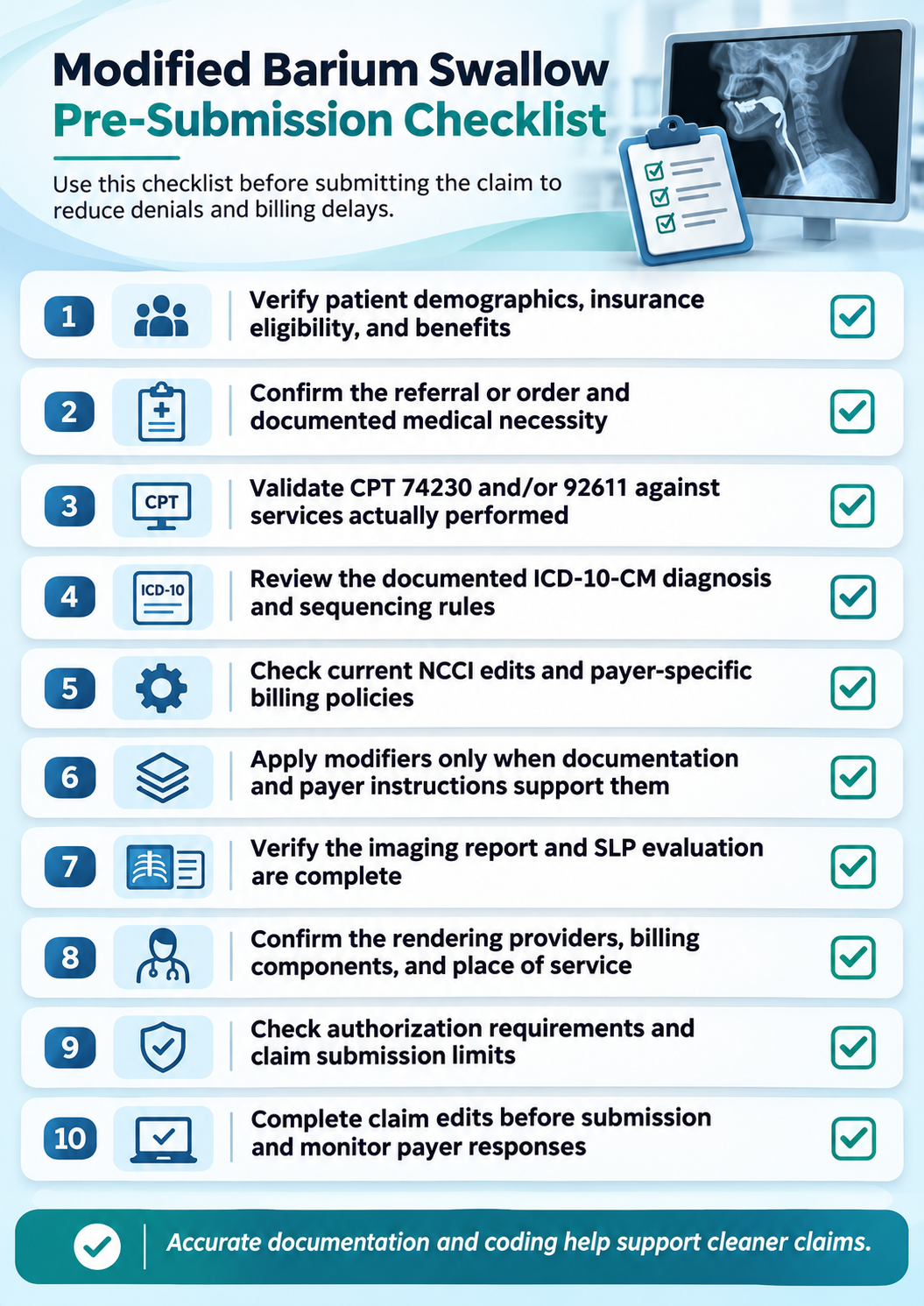
Modified Barium Swallow Pre-Submission Billing Checklist
Before submitting a modified barium swallow claim, use this checklist to identify missing information and prevent avoidable billing errors.
Common Modified Barium Swallow Billing Errors and How to Prevent Them
Medical billing professionals are sometimes prone to difficulties even when filing claims for instrumental swallow studies.
Knowledge of persistent errors will help health care facilities improve the revenue cycle process.
Incorrect CPT Code Selection
Coding CPT 74220, rather than 74230, in a modified barium swallow exam is a way to distort the procedure.
Prevention: Verify the true procedure and review the radiology report before selecting the code.
Duplicate Reporting of Services
Over-billing for a single service without proper documentation may lead to duplicate claim edits.
Prevention: Evaluate all claims linked to the encounter, including radiology and SLP claims separately.
Missing Medical Necessity Documentation
The patient’s case could be reviewed in case the clinical history fails to document the necessity of doing tests instrumentally.
Prevention: Make sure that the justification for the test is stated in the ordering documentation and clinical evaluation.
Incorrect Modifier Usage
The inappropriate addition of modifier 59 or any other modifier without the right justification will lead to a denial or non-compliance claim.
Prevention: Check the applicability of the payer edits before adding the modifier.
Incomplete Clinical Reports
Incomplete interpretation by the radiologist, inadequate swallowing study, and/or absence of signature on the report will make it difficult for claims to be processed.
Prevention: Incorporate a document check prior to submission of the claims.
Unresolved Claim Denials
When a claim is denied, the claim will be left unpaid if the underlying reason for denying that particular payment claim is not investigated by the staff.
Prevention: Monitor denial codes, identify patterns, resolve any error identified, and seek appeal if necessary.
In case you handle complicated diagnostic and rehab services, Medhasty Medical Billing can help you with your medical billing needs.
How to Improve Reimbursement for Modified Barium Swallow Studies
Effective reimbursements start much earlier than when the billing staff forwards the claims form.
Healthcare institutions have the opportunity to improve their billing process through better cooperation of clinical and administrative staff.
Standardize Clinical Documentation
Utilize consistent templates for documentation that include the clinical rationale, findings, interpreting physicians, and suggestions.
The template should help achieve accurate clinical reporting without replacing professional judgment.
Verify Coverage Before the Examination
Before scheduling the test, where feasible, make sure that the patient’s eligibility, authorization, and coverage constraints have been checked.
This will help the staff handle any administrative concerns prior to delaying the claim processing.
Coordinate Radiology and SLP Billing
Clarify roles for the provision of radiological services, SLP assessments, billing by professionals, and technical billing.
Effective coordination prevents double submissions and ensures consistency in claims information.
Audit Denials Regularly
Review denied claims by CPT code, payer, denial reason, and place of service.
Look for patterns involving:
-
Medical necessity
-
Missing authorization
-
Modifier errors
-
Duplicate services
-
Diagnosis coding
-
Provider enrollment or credentialing
Correcting the underlying cause can help prevent similar problems in future claims.
Monitor Payment Accuracy
Consider the possibility of underpayment and solve it using a systemized accounts receivable follow-up process.
Revenue cycle tip: Claim process may not guarantee payment, but it enables practitioners to discover mistakes that could have been avoided.
How Medical Billing Support Helps Radiology and Speech Therapy Practices
In regards to modified barium swallow billing, teamwork is essential between several specialists and departments. If the processes are not connected properly, lack of information can cause delays in filing the claim.
A specialized medical billing team can help healthcare organizations:
-
Validate CPT, ICD-10-CM, and modifier selection
-
Review claims for required documentation
-
Verify payer coverage and authorization requirements
-
Manage claim submission and payment posting
-
Investigate denials and submit appropriate appeals
-
Monitor outstanding accounts receivable
-
Identify recurring billing errors
These services can be particularly useful for rehabilitation clinics, diagnostic imaging facilities, hospitals, and multidisciplinary practices that frequently perform swallowing assessments.
Frequently Asked Questions About Modified Barium Swallow CPT Codes
1. Which is the primary CPT code for modified barium swallow?
Code CPT 74230 refers to radiologic swallowing function study, whereas CPT 92611 refers to fluoroscopic swallowing examination by speech language pathologist. Depending upon what service was rendered and billed.
2. Are CPT codes 74230 and 92611 billable together?
Yes, these can be billed together on the same day if both radiology and SLP services were provided, documented, and comply with all payer guidelines. These separate services have been accepted under Medicare NCCI guidelines, along with the proper usage of modifiers. Billing professionals should check the current edit before billing.
3. Which ICD-10 code is often applied to a modified barium swallow?
It could be one of the dysphagia ICD-10 codes such as R13.10 and R13.12, based on the patient’s diagnosis. The billing specialist needs to choose a code in accordance with the patient’s medical records and apply appropriate sequencing rules.
4. Is a modified barium swallow covered by Medicare?
A modified barium swallow study can be reimbursed by Medicare based on specific coverage criteria, documentation, and billing rules.
5. Explain the difference between CPT 92610 and CPT 92611?
CPT 92610 refers to a clinical swallowing function assessment of the mouth and throat that does not include the instrumental swallowing test. CPT 92611 is an instrumental fluoroscopic swallowing test by an SLP.
Conclusion
For accurate billing of a modified barium swallow, however, more needs to be done than simply selecting a procedure code. Providers will have to differentiate between the imaging component and speech-language pathology component, prove medical necessity for the service, pick proper diagnoses, and abide by relevant modifiers and payer guidelines.
A grasp of CPT codes 74230 and 92611 can make things easier for practitioners who want to have consistent coding, detect any unnecessary errors in claims submission, and have a well-organized billing process.
Turn Complex Swallowing Study Claims Into a More Reliable Billing Process
CPT coding, documentation, and insurance coverage may be hard to reconcile sometimes. Even minor mistakes could mean that you end up with unpaid claims, administrative complications, and more workload for your employees.
Medhasty Medical Billing takes care of medical billing, denial management, payment collections, and revenue cycle management for healthcare practitioners.