Electronic Health Records (EHR) have become a cornerstone of modern healthcare operations. While EHR systems are often associated with improving patient care and clinical documentation, their impact on revenue cycle management is equally significant.
As healthcare organizations continue to face increasing administrative demands, reimbursement challenges, and evolving payer requirements, EHR integration has emerged as a powerful tool for improving revenue cycle performance. By connecting clinical workflows with billing and financial processes, integrated EHR systems help healthcare providers reduce errors, streamline operations, and accelerate reimbursements.
In 2026, healthcare organizations that leverage fully integrated EHR solutions are better positioned to improve financial outcomes while delivering high-quality patient care.
What Is EHR Integration?
EHR integration refers to the seamless connection between electronic health records and other healthcare systems involved in patient care, billing, scheduling, insurance verification, claims management, and revenue cycle operations.
An integrated EHR system allows information to flow automatically between departments, reducing manual data entry and improving data accuracy.
Integrated systems typically connect:
- Patient registration
- Clinical documentation
- Scheduling systems
- Insurance verification tools
- Coding platforms
- Claims management software
- Billing systems
- Payment processing solutions
By creating a unified workflow, healthcare organizations can improve both operational efficiency and financial performance.
Why EHR Integration Matters More in 2026
Healthcare providers are dealing with increasingly complex reimbursement requirements, stricter payer scrutiny, and growing patient financial responsibility.
Disconnected systems often create challenges such as:
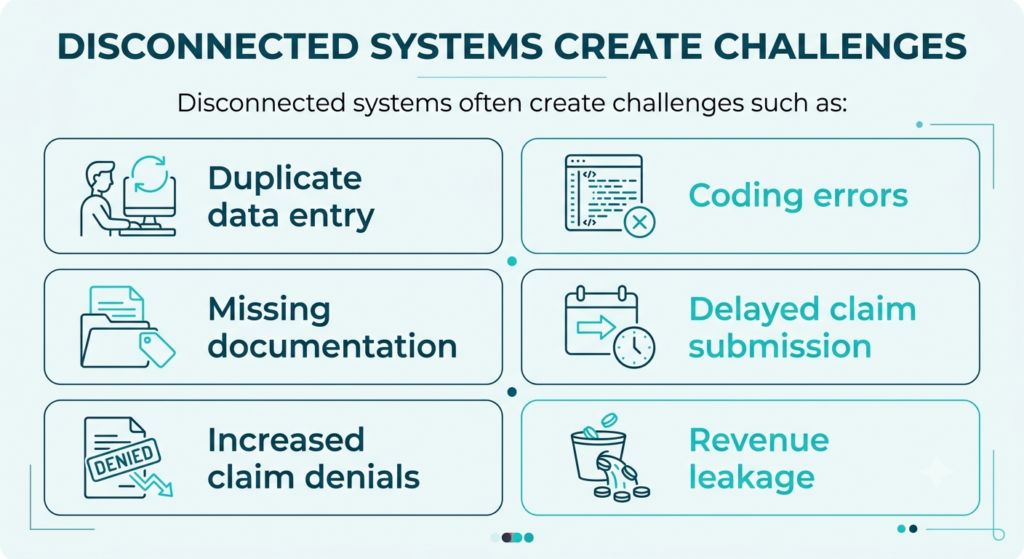
EHR integration helps eliminate these inefficiencies by ensuring accurate information is available across the entire revenue cycle.
Organizations with integrated systems often experience faster reimbursements, fewer denials, and improved cash flow.
1. Improves Documentation Accuracy
Accurate clinical documentation is essential for successful reimbursement.
When EHR systems are integrated with billing and coding platforms, providers can ensure that documentation supports the services billed.
Benefits include:
- Complete patient records
- Accurate diagnosis documentation
- Better procedure tracking
- Reduced documentation gaps
- Improved coding accuracy
Comprehensive documentation helps minimize claim errors and supports compliance with payer requirements.
2. Reduces Charge Capture Errors
Missed charges can significantly impact healthcare revenue.
Integrated EHR systems automatically capture clinical services and transfer relevant information to billing workflows.
This helps organizations:
- Reduce missed charges
- Improve billing accuracy
- Prevent revenue leakage
- Increase reimbursement opportunities
Automated charge capture ensures providers are properly compensated for the services they deliver.
3. Accelerates Claim Submission
Timely claim submission is critical for maintaining healthy cash flow.
Without integration, staff may spend significant time manually transferring information between systems.
EHR integration enables:
- Automated claim creation
- Faster billing workflows
- Reduced administrative delays
- Improved claim turnaround times
Faster claim submission often results in quicker reimbursement and reduced accounts receivable days.
4. Enhances Coding Accuracy
Medical coding directly affects reimbursement outcomes.
Integrated EHR systems provide coders with access to complete clinical documentation, helping them assign accurate diagnosis and procedure codes.
Advantages include:
- Reduced coding errors
- Improved compliance
- Better reimbursement accuracy
- Lower denial rates
Accurate coding supports clean claim submission and minimizes revenue cycle disruptions.
5. Supports Clean Claim Generation
Clean claims are essential for efficient reimbursement.
Integrated EHR platforms help ensure claims contain accurate information before submission.
This includes:
- Patient demographics
- Insurance information
- Clinical documentation
- Diagnosis codes
- Procedure codes
By reducing errors at multiple stages of the revenue cycle, EHR integration increases first-pass claim acceptance rates.
Healthcare organizations benefit from fewer rejections and reduced administrative rework.
6. Improves Insurance Verification Processes
Insurance verification is one of the most important front-end revenue cycle activities.
Integrated EHR systems can connect directly with eligibility verification tools, allowing staff to confirm coverage in real time.
This helps providers:
- Verify eligibility before appointments
- Identify coverage limitations
- Confirm benefits
- Detect authorization requirements
Accurate insurance information reduces claim rejections and improves reimbursement outcomes.
7. Reduces Claim Denials and Rejections
Claim denials remain a major challenge for healthcare organizations.
Many denials occur due to:
- Missing documentation
- Incorrect patient information
- Coding errors
- Eligibility issues
- Authorization problems
Integrated EHR systems help address these issues before claims are submitted.
By improving data accuracy throughout the revenue cycle, organizations can significantly reduce denial rates and improve collection performance.
Common Revenue Cycle Challenges Without EHR Integration
Healthcare organizations that rely on disconnected systems often face several operational challenges.
Duplicate Data Entry
Staff may need to enter the same information into multiple systems, increasing labor costs and error risks.
Communication Gaps
Departments may struggle to access consistent information, leading to workflow inefficiencies.
Delayed Billing Processes
Manual workflows often slow down claim preparation and submission.
Increased Denials
Missing or inconsistent information can result in rejected or denied claims.
Revenue Leakage
Incomplete charge capture and billing errors may cause providers to lose revenue.
These challenges can negatively impact both financial performance and patient satisfaction.
How Automation Strengthens EHR Integration
Modern EHR platforms increasingly incorporate automation capabilities that improve revenue cycle management.
Advanced integrations can:
- Automate eligibility verification
- Trigger authorization workflows
- Generate coding suggestions
- Flag missing documentation
- Identify billing errors before submission
- Monitor reimbursement trends
Automation reduces manual workloads while improving overall accuracy and efficiency.
Healthcare organizations can process more claims with fewer resources while maintaining compliance.
The Financial Benefits of EHR Integration
The impact of EHR integration extends throughout the revenue cycle.
Key benefits include:
Faster Reimbursements
Accurate and timely claim submission improves payment turnaround times.
Lower Administrative Costs
Automation reduces manual tasks and staff workload.
Improved Cash Flow
Fewer delays and denials lead to more predictable revenue streams.
Increased Revenue Capture
Better documentation and charge capture reduce missed billing opportunities.
Stronger Compliance
Integrated systems help maintain documentation and coding standards required by payers.
Together, these benefits contribute to a healthier financial foundation for healthcare organizations.
Best Practices for Successful EHR Integration
Healthcare organizations can maximize the value of EHR integration by following several best practices.
These include:
- Selecting interoperable systems
- Standardizing workflows across departments
- Training staff regularly
- Monitoring key revenue cycle metrics
- Automating repetitive tasks
- Conducting regular system audits
- Keeping integrations updated
Organizations that prioritize these practices often achieve stronger financial and operational results.
The Future of EHR-Driven Revenue Cycle Management
Healthcare technology continues to evolve rapidly, making EHR systems even more valuable to revenue cycle operations.
Emerging innovations include:
- AI-assisted coding
- Predictive denial management
- Automated claims scrubbing
- Real-time reimbursement analytics
- Advanced revenue forecasting
- Intelligent workflow automation
These technologies will further improve revenue cycle efficiency while helping providers adapt to changing payer requirements.
Healthcare organizations that invest in modern EHR integration strategies will be better equipped to achieve long-term financial success.
Conclusion
EHR integration plays a vital role in improving revenue cycle performance by connecting clinical and financial workflows into a single, efficient system. By improving documentation accuracy, reducing billing errors, supporting clean claims, and streamlining reimbursement processes, integrated EHR platforms help healthcare organizations strengthen their financial health.
In 2026, as healthcare reimbursement becomes increasingly complex, EHR integration is no longer just a technology upgrade—it is a strategic investment in revenue cycle success.
Providers that embrace integrated EHR solutions can reduce denials, accelerate payments, improve operational efficiency, and create a stronger financial future while continuing to deliver exceptional patient care.