
Running a medical practice in Maryland involves much more than treating patients.
Additionally, providers must also manage insurance claims, coding, payment posting, accounts receivable, denial management, and constantly changing billing requirements.
When these responsibilities are handled entirely in-house, outsourcing medical billing Maryland can reduce staff time and revenue-cycle costs.
For many Maryland healthcare practices, outsourcing medical billing can be a practical way to improve financial performance.
Moreover, it allows providers and their teams to focus more on patient care.
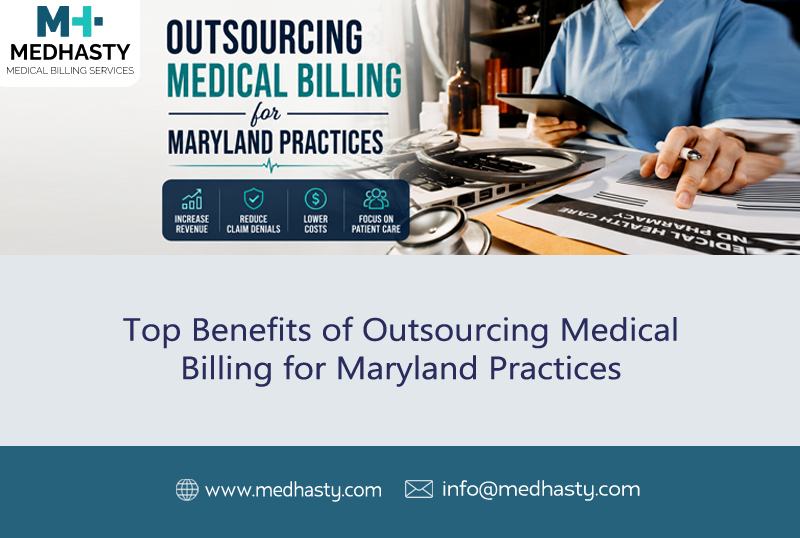
Outsourcing medical billing Maryland offers several benefits for practices.
Additionally, professional billing support can improve revenue, reduce administrative pressure, and create a more efficient practice.
1. Improve Revenue Collection
One of the biggest advantages of outsourcing medical billing is the potential to improve collections.
Professional billing teams focus specifically on the revenue cycle, from claim preparation and submission to payment posting and follow-up. They can identify unpaid claims, monitor outstanding balances, and follow up on reimbursement issues.
A structured billing process can help practices:
- Submit cleaner claims
- Reduce avoidable billing mistakes
- Follow up on unpaid claims
- Track outstanding accounts receivable
- Identify missed reimbursement opportunities
- Improve overall cash flow
For a busy Maryland practice, having a dedicated billing team focused on these activities can make a significant difference.
2. Reduce Claim Denials
Claim denials can quickly become a major source of lost revenue.
Common causes include incorrect patient information, coding errors, missing documentation, eligibility problems, authorization issues, and incorrect payer requirements.
Outsourced medical billing specialists can review claims before submission and identify potential problems. When a claim is denied, they can investigate the reason, make appropriate corrections, and submit the claim for reconsideration or appeal when appropriate.
A proactive denial-management process can help practices:
- Identify recurring denial patterns
- Correct billing errors
- Improve claim accuracy
- Track payer-specific issues
- Reduce preventable denials
- Recover revenue from outstanding claims
Reducing preventable denials means fewer claims get stuck in the reimbursement process.
3. Lower Administrative Costs
Maintaining an internal billing department can be expensive.
A practice may need to pay for:
- Billing staff salaries
- Employee benefits
- Training
- Billing software
- Hardware and technology
- Continuing education
- Staff replacement during turnover
- Management and administrative overhead
Outsourcing converts many of these fixed expenses into a more predictable service cost.
For small and mid-sized Maryland practices, this can be especially valuable because they may not have enough billing volume to justify maintaining a large in-house billing department.
4. Give Your Staff More Time for Patient Care
Healthcare staff already have demanding responsibilities.
When front-office employees or clinical staff spend too much time dealing with billing problems, their productivity can suffer.
Outsourcing allows your internal team to spend more time on important activities such as:
- Patient scheduling
- Insurance verification
- Patient communication
- Documentation
- Practice administration
- Supporting physicians and providers
Instead of making your employees divide their attention between patient services and complex billing tasks, you can allow specialized billing professionals to manage the revenue cycle.
5. Access Experienced Billing Professionals
Medical billing is constantly evolving.
Payers update their requirements, coding rules change, and reimbursement processes can become increasingly complex. Keeping an internal team fully trained can require considerable time and resources.
An experienced medical billing company provides access to professionals who work with billing and revenue-cycle processes every day.
This can be particularly helpful for practices dealing with:
- Complex claims
- Multiple insurance companies
- Coding challenges
- Denials and appeals
- Prior authorization requirements
- Aging accounts receivable
- Payment discrepancies
Instead of relying on one or two employees to handle every billing issue, practices can benefit from specialized expertise.
6. Improve Accounts Receivable Management
Outstanding accounts receivable can put significant pressure on a medical practice’s cash flow.
A professional billing team can monitor unpaid claims and aging balances to determine where attention is needed.
Effective A/R management may include:
- Identifying aging claims
- Prioritizing high-value outstanding balances
- Following up with insurance companies
- Investigating claim status
- Correcting billing issues
- Resubmitting eligible claims
- Monitoring payments through resolution
The goal is simple: reduce unnecessary delays between providing healthcare services and receiving appropriate reimbursement.
7. Improve Billing Accuracy
Even a small billing mistake can delay reimbursement.
Errors may occur during patient registration, insurance verification, coding, charge entry, claim submission, or payment posting.
Outsourcing gives practices access to professionals whose primary responsibility is revenue-cycle accuracy.
Better billing accuracy can help reduce:
- Incorrect patient information
- Coding-related errors
- Duplicate claims
- Missing charges
- Incorrect payer information
- Claim submission problems
- Payment posting discrepancies
A more accurate billing process can contribute to a healthier revenue cycle.
8. Stay Better Prepared for Billing and Compliance Changes
Healthcare billing requires attention to constantly changing rules and requirements.
Practices must keep up with coding updates, payer policies, documentation requirements, and other billing-related changes.
A professional billing partner can help practices maintain processes that are aligned with current billing requirements and identify areas that may require attention.
However, outsourcing does not transfer the practice’s legal or compliance responsibilities. Healthcare providers should carefully evaluate a billing company’s experience, security practices, contracts, and compliance processes before choosing a partner.
9. Gain Better Revenue Cycle Visibility
A good medical billing service should provide more than claim submission.
Practices should be able to understand how their revenue cycle is performing.
Useful reports and metrics may include:
- Total collections
- Accounts receivable aging
- Days in A/R
- Claim denial rate
- Clean claim rate
- Payment trends
- Outstanding claims
- Collection performance
These insights can help physicians and practice managers identify weaknesses and make better financial decisions.
10. Scale More Easily as Your Practice Grows
As a practice grows, its billing workload usually grows as well.
Adding providers, locations, specialties, or patient volume can increase the number of claims and administrative tasks that need to be managed.
An outsourced billing partner can provide additional billing support without requiring the practice to build an entirely new internal department.
This scalability can be useful for Maryland practices that are:
- Adding new physicians
- Opening another location
- Expanding services
- Increasing patient volume
- Entering new markets
11. Reduce the Impact of Staff Turnover
Employee turnover can disrupt an in-house billing department.
When an experienced biller leaves, the practice may face:
- Recruitment costs
- Training expenses
- Temporary productivity losses
- Unprocessed claims
- Delayed follow-ups
- Increased A/R
With an established outsourcing partner, billing knowledge and processes are less dependent on a single employee.
This can provide greater continuity for the practice’s revenue cycle.
12. Improve Patient Experience
Billing problems don’t only affect practices—they can also affect patients.
Confusing statements, incorrect balances, insurance issues, and unresolved billing questions can create frustration.
A well-managed billing process can help improve the accuracy and consistency of patient billing while allowing your front-office staff to focus more on patient communication.
The result can be a smoother experience for both patients and staff.
Why Maryland Practices Should Consider Outsourcing Medical Billing
Maryland practices operate in a competitive healthcare environment where efficient financial management matters.
Physicians need to focus on delivering quality healthcare, but the business side of a practice cannot be ignored. Poor billing processes can lead to delayed payments, growing A/R, unnecessary administrative costs, and lost revenue.
Outsourcing can provide a practical solution by giving practices access to dedicated billing expertise without the expense and management burden of building a large internal billing operation.
Is Outsourcing Medical Billing Right for Your Maryland Practice?
Outsourcing may be worth considering if your practice is experiencing:
- Increasing claim denials
- Slow insurance payments
- Growing accounts receivable
- Billing staff shortages
- High administrative costs
- Frequent billing errors
- Difficulty keeping up with payer requirements
- Limited visibility into revenue-cycle performance
- Provider or staff time being consumed by billing issues
If several of these challenges sound familiar, a professional medical billing partner may help identify opportunities to improve your revenue cycle.
How to Choose a Medical Billing Company in Maryland
Not every billing company offers the same level of service. Before selecting a partner, Maryland practices should evaluate:
Experience
Look for experience with your specialty, payer mix, and practice size.
Technology
Ask what billing, reporting, claim-tracking, and security systems the company uses.
Denial Management
Find out whether the company actively analyzes and works denied claims.
Reporting
Make sure you will receive clear and useful revenue-cycle reports.
Communication
Your billing partner should provide reliable communication and clearly defined points of contact.
Security and Compliance
Ask about data protection, HIPAA-related safeguards, access controls, and business associate arrangements where applicable.
Transparent Pricing
Understand exactly what services are included in the billing agreement and how fees are calculated.
The Bottom Line
Outsourcing medical billing can offer Maryland practices several important advantages, from better revenue-cycle management and fewer preventable billing problems to lower administrative costs and improved staff productivity.
The right billing partner can allow physicians and their teams to spend less time dealing with complex reimbursement tasks and more time focusing on patients.
For Maryland practices looking to strengthen their financial performance, professional medical billing services can be an important part of a more efficient and sustainable revenue cycle.
If your practice is struggling with claim denials, delayed payments, aging A/R, or administrative billing workloads, Medhasty Medical Billing Services can help you explore opportunities to improve your billing and revenue-cycle processes.