
Compromised medical billing can result in exposure of thousands of patients’ information, disruption of claims process, delay of reimbursements and, ultimately, financial jeopardy for the whole medical practice. Even one fraud email can cause significant security issues.
Cybersecurity in medical billing enables healthcare organizations to keep their patients’ information safe, be HIPAA compliant and avoid any potential disruptions in the revenue cycle. Every process in billing process needs appropriate data security measures.
Healthcare organizations need to consider cybersecurity to be an important aspect of revenue cycle management and not just a technology issue.
What Is Cybersecurity in Medical Billing?
Medical Billing Security involves all the measures put in place to ensure that patients’ data, billing system software, finances, and other transactions are secure from any kind of theft or cyber attacks.
Medical billing teams regularly handle sensitive information, including:
-
Electronic protected health information (ePHI)
-
Patient demographics and contact details
-
Insurance policy and identification numbers
-
Medical diagnoses and treatment records
-
Electronic claims and remittance advice
-
Patient payment and financial information
-
Healthcare provider credentials
Effective medical billing data security protects the confidentiality, integrity, and availability of this information throughout the revenue cycle.
Healthcare providers working with Medhasty Medical Billing can discuss how billing workflows, data access, and revenue cycle responsibilities align with their organization’s security requirements.
Why Is Cybersecurity Important in Medical Billing?
An attack on computer systems that store electronic health records does not necessarily have to affect the whole system to disrupt operations. An access breach on billing systems, clearinghouse portal, or payment systems will be quite disruptive.
Strong cybersecurity practices help healthcare organizations:
-
Protect confidential patient information.
-
Reduce financial fraud and unauthorized transactions.
-
Maintain HIPAA compliance.
-
Prevent interruptions in claim submission.
-
Minimize recovery costs and revenue losses.
-
Protect patient confidence and organizational reputation.
In its October 2026 cybersecurity newsletter, the HHS Office for Civil Rights emphasized incident response, reliable data backups, and the importance of documenting security incidents and their outcomes.
For medical practices, cybersecurity is both a compliance responsibility and a financial safeguard.
Common Cybersecurity Threats in Medical Billing
Understanding where security vulnerabilities occur helps billing managers prioritize preventive measures before an incident affects their operations.
| Cybersecurity threat | Impact on medical billing |
|---|---|
| Ransomware | Blocks access to billing systems and patient records |
| Phishing attacks | Compromises employee login credentials |
| Data breaches | Exposes confidential patient and insurance information |
| Insider threats | Enables unauthorized access or misuse of billing data |
| Payment fraud | Diverts payments or alters financial information |
| Third-party breaches | Disrupts clearinghouse and billing vendor operations |
| Unpatched software | Creates vulnerabilities in billing applications |
| Credential theft | Enables unauthorized access to payer portals |
1. Ransomware Attacks
Ransomware can lock up billing files, deny access to patient records, and make it impossible for employees to file claims or process payments.
The HHS guidance on ransomware and HIPAA discusses ways that ransomware attacks could trigger data breach notification requirements under certain conditions.
Healthcare providers need to have proper backup systems in place.
2. Phishing and Social Engineering
Cybercriminals can pose as insurance agents, clearinghouse staff, or healthcare administrators for gathering sensitive information.
The billing staff needs to confirm suspicious credential requests, payments, and attachments on their own.
3. Insider Security Threats
Employees and contractors can reveal patient information through accidental release, over-privilege access to systems, and intentional misuse.
Individual user account control, limited access, and monitoring mitigate this risk.
4. Third-Party Vendor Vulnerabilities
The healthcare entities rely on the billers, clearinghouses, payment gateways, and software providers. A security threat for any organization may affect several phases of the revenue cycle.
It is important to consider the security measures of the vendor along with the cost and operational effectiveness of the vendor.
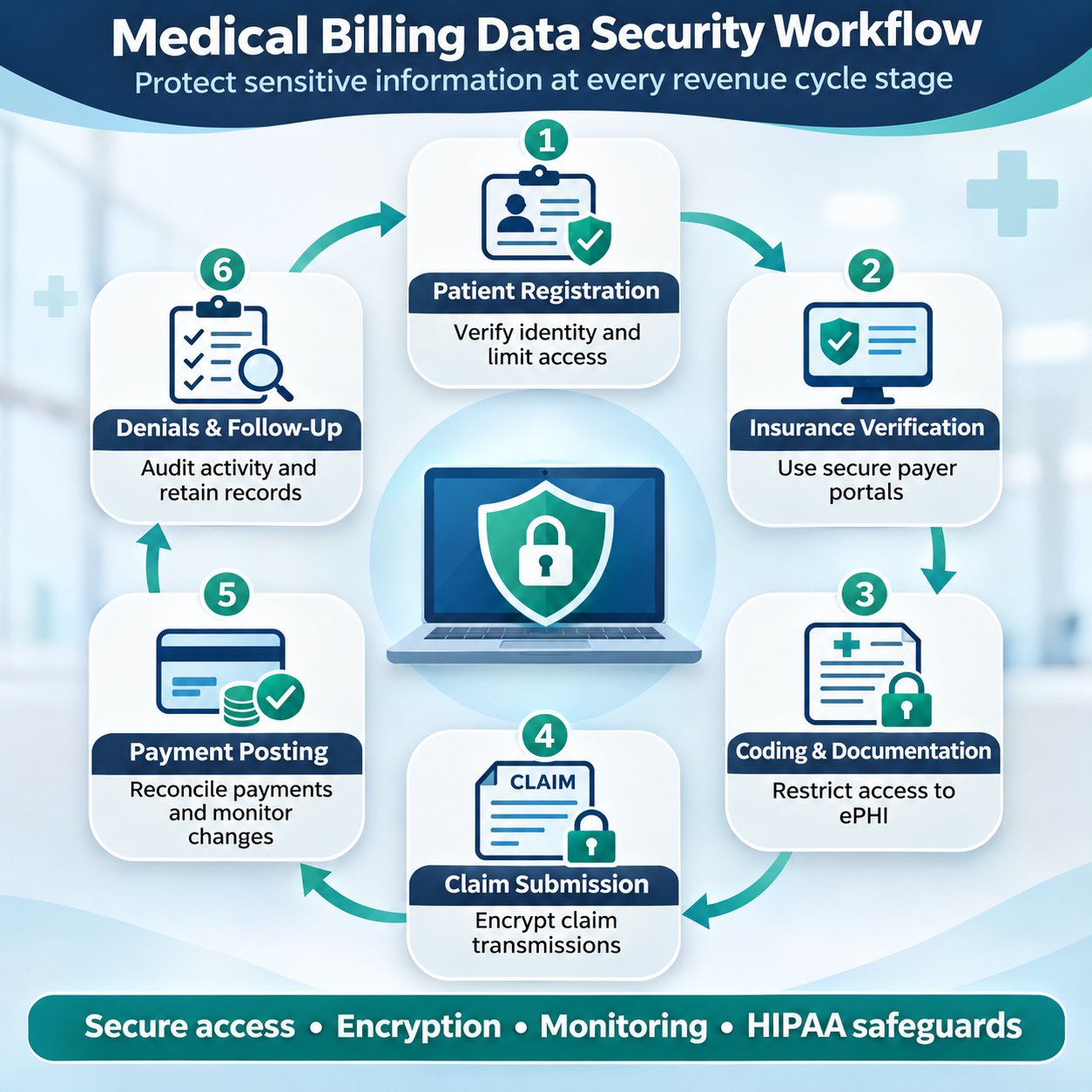
Where Patient Data Faces the Greatest Security Risks
Medical billing involves multiple data exchanges. Each exchange introduces potential security vulnerabilities.
HIPAA Compliance and Cybersecurity in Medical Billing
The Health Insurance Portability and Accountability Act (HIPAA) provides the federal mandate to protect healthcare information.
The HIPAA Security Rule mandates regulated healthcare organizations and business associates to adopt proper security measures for electronic protected health information.
| HIPAA safeguard | Practical billing application |
|---|---|
| Administrative safeguards | Risk assessments, staff training, security policies |
| Physical safeguards | Secure workstations, controlled facility access |
| Technical safeguards | Authentication, access controls, audit logs and transmission security |
Administrative Safeguards
Security risk assessment should be done, along with security responsibility assignment, workforce access, and contingency planning in healthcare facilities.
Physical Safeguards
Procedures must prevent any unauthorized access to billing computers, servers, storage media, and physical records that contain sensitive information.
Technical Safeguards
The use of technical controls will allow the organization to ensure that they have systems that can authenticate users, log system activities, and ensure that their electronic information is secure from any form of access.
The compliance of HIPAA requires constant risk management. Acquiring the best billing software is not the only way to ensure compliance.
10 Cybersecurity Best Practices for Medical Billing
Healthcare providers can strengthen patient data protection by implementing the following practical security measures, consistent with the HHS Healthcare Cybersecurity Performance Goals.
1. Conduct Regular Security Risk Assessments
Assess weaknesses in billing systems, employee logins, payer portals, connected devices, and third-party applications.
Note the security weaknesses, delegate responsibility for fixes, and examine controls each time you adopt new technologies or switch billing companies.
2. Implement Multi-Factor Authentication
Passwords alone cannot provide adequate protection against credential theft.
Implement multi-factor authentication (MFA) across:
-
Electronic health record systems
-
Practice management software
-
Insurance portals
-
Clearinghouse accounts
-
Employee email accounts
-
Remote working environments
Prioritize phishing-resistant authentication methods wherever supported.
3. Encrypt Sensitive Patient Information
The process of encryption ensures that unauthorized people cannot read the confidential information.
It is necessary to protect the patient’s data while transferring and storing it. It is advised not to share any medical or insurance information via unprotected communication mediums.
4. Establish Role-Based Access Controls
Not all billing personnel need access to all the patient records or the financial transactions.
Grant permissions based on roles, conduct periodic audits on privileged accounts, and restrict access immediately upon leaving the organization.
5. Train Medical Billing Staff
Employee personnel are vital for creating a defense mechanism for potential cyber attacks on the health care industry.
Security education should be done on a regular basis and should include email, payment phishing scams, passwords, patient data security, and incident reporting policies.
Create specific billing examples rather than just security education in general.
6. Maintain Secure Data Backups
Backup is crucial when dealing with ransomware, hardware problems, and data loss in healthcare facilities.
It is necessary to keep backups that are isolated and encrypted and check whether the employees are capable of restoring the billing information.
It is important to include the claim submission history, outstanding balances, remittance and payment transactions in the plan.
7. Update Billing Software and Operating Systems
The use of old software can create vulnerabilities to known risks for healthcare institutions.
Install security updates, retire software that is not supported anymore, and keep track of all the software that is being used within the revenue cycle.
8. Monitor Billing System Activity
Audit logs help healthcare organizations identify unusual activities before they develop into larger security incidents.
Monitor:
-
Repeated failed login attempts
-
Unusual patient record downloads
-
Unauthorized permission changes
-
Unexpected payment modifications
-
Suspicious remote access
Assign responsibility for reviewing alerts and investigating irregularities.
9. Evaluate Third-Party Billing Vendors
Outsourcing the process of billing for medical services does not absolve a healthcare organization from its obligations to protect the data.
Evaluate the data security policies of your vendor, the process of handling any incidents that occur, the process for managing access control, and the disaster recovery process.
Make sure that you have an adequate BAA if the law calls for it.
10. Develop a Cybersecurity Incident Response Plan
Develop a documented incident response plan which clearly defines the individual responsible for managing security incidents, communicating with vendors, assessing regulatory requirements, and restoring billing processes.
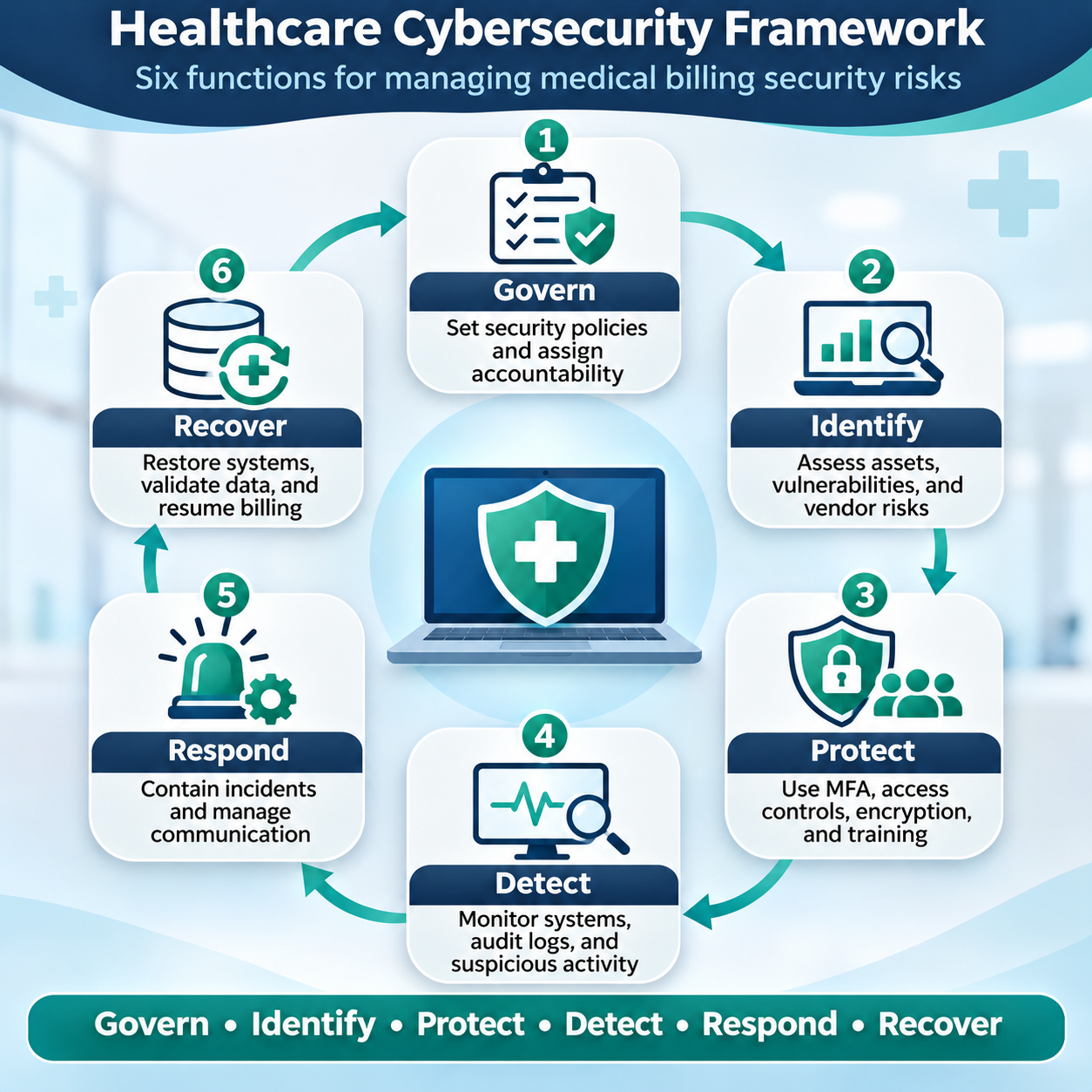
The NIST Cybersecurity Framework 2.0 provides a structured approach to managing cybersecurity risks through six core functions.
Healthcare Cybersecurity Framework
How Cyberattacks Affect Healthcare Revenue Cycle Management
There could be financial ramifications for cybersecurity breaches which go beyond the expenses incurred from repairing the computer network.
With billing systems down, there could be challenges in verifying insurance coverage, making claims, managing accounts receivable, and collecting payments.
| Revenue cycle function | Potential financial impact |
|---|---|
| Insurance verification | Increased eligibility-related denials |
| Medical coding | Documentation and coding backlogs |
| Claim submission | Delayed reimbursement |
| Payment posting | Inaccurate financial records |
| Denial management | Missed appeal deadlines |
| Accounts receivable | Increased AR days |
| Patient collections | Delayed patient payments |
Practices should incorporate cybersecurity controls into their medical billing audit checklist to identify operational weaknesses before they contribute to revenue losses.
How to Maintain Medical Billing Operations During a Cyberattack
A cybersecurity incident should not leave your practice without a plan for managing outstanding claims.
Develop a billing continuity strategy that addresses the following operational priorities.
| Priority | Recommended action |
|---|---|
| Unsubmitted claims | Maintain an approved, secure pending-claim register |
| Timely filing | Track approaching payer submission deadlines |
| Existing claims | Reconcile clearinghouse and payer acknowledgments |
| Payments | Verify deposits against available remittance records |
| Denials | Identify time-sensitive appeals |
| System restoration | Validate restored billing data before resubmission |
After restoring billing operations, confirm the status of previously transmitted claims. Automatically resubmitting every outstanding claim may create duplicate submissions and additional denials.
Follow established medical claim denial prevention strategies to reduce avoidable billing errors during recovery.
Emerging Cybersecurity Risks in Medical Billing
Healthcare organizations must adapt their security practices as billing technology and cybercriminal tactics evolve.
AI-Powered Phishing
The criminals may resort to the use of AI technology to craft believable emails, impersonating business communications, and healthcare executives.
Verify all payments and information disclosures independently.
Unsecured Artificial Intelligence Tools
Unintentionally, billing staff could make patient information vulnerable when they upload the clinical notes or claim information to unauthorized AI applications.
Have established policies for AI tools approved, processing patient information, vendor agreements, and data retention.
Remote Medical Billing Security
Managed devices, secured connections, personal credentials, and controlled access to the patient’s records are all necessary for remote billing departments.
Never store sensitive billing information on personal computers or send such files via personal emails.
Healthcare Payment Fraud
Fraudulent claims to modify the electronic fund transfer details may divert insurance payouts to unauthorized accounts.
It is necessary to have an independent verification along with dual authorizations for banking transactions.
How to Respond to a Medical Billing Data Breach
A prompt, coordinated response can reduce the operational and financial consequences of a security incident.
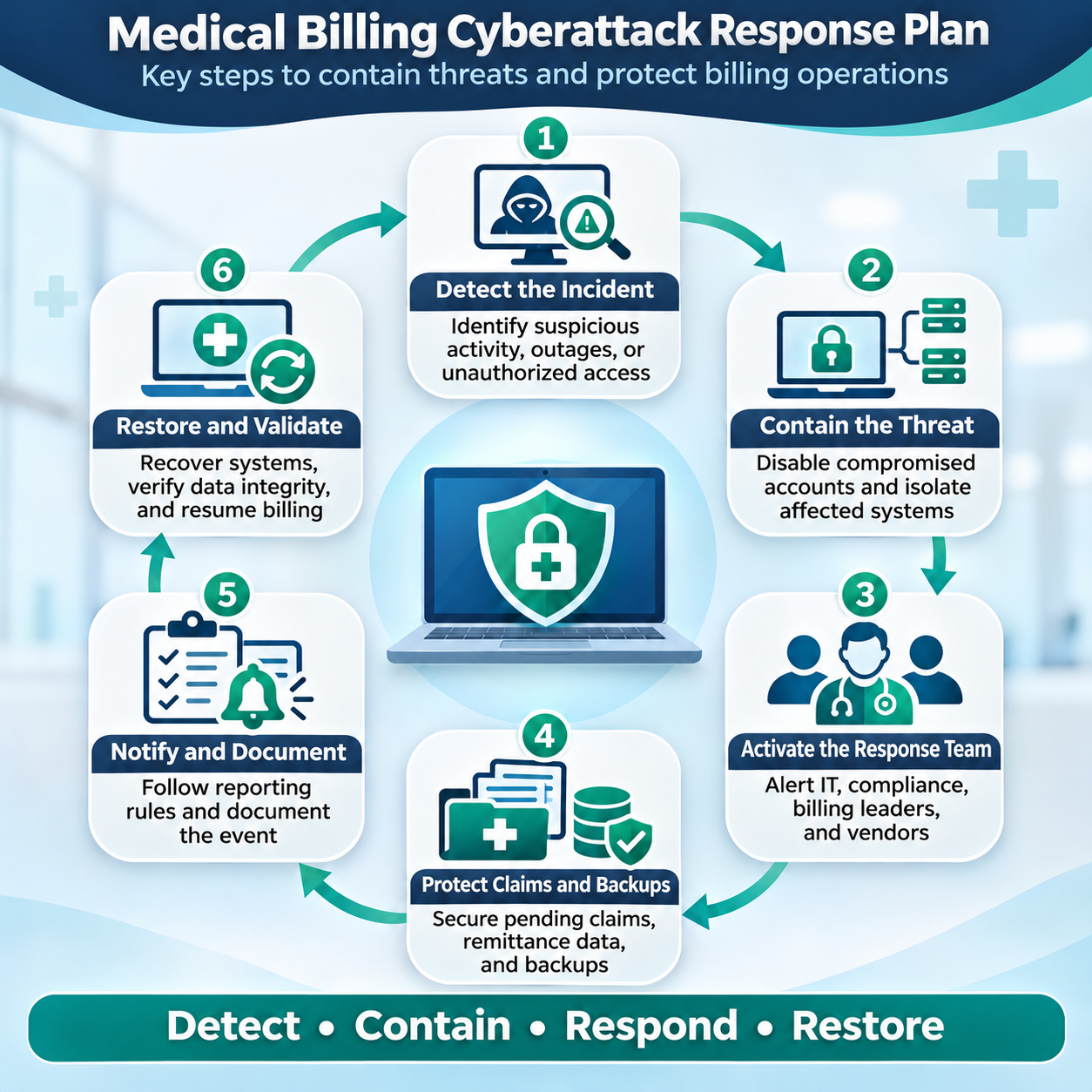
Under the HIPAA Breach Notification Rule, covered entities generally must notify affected individuals of reportable breaches of unsecured PHI without unreasonable delay and no later than 60 days after discovery.
Business associates must also notify affected covered entities within applicable deadlines. State laws and contractual agreements may impose additional or shorter reporting requirements.
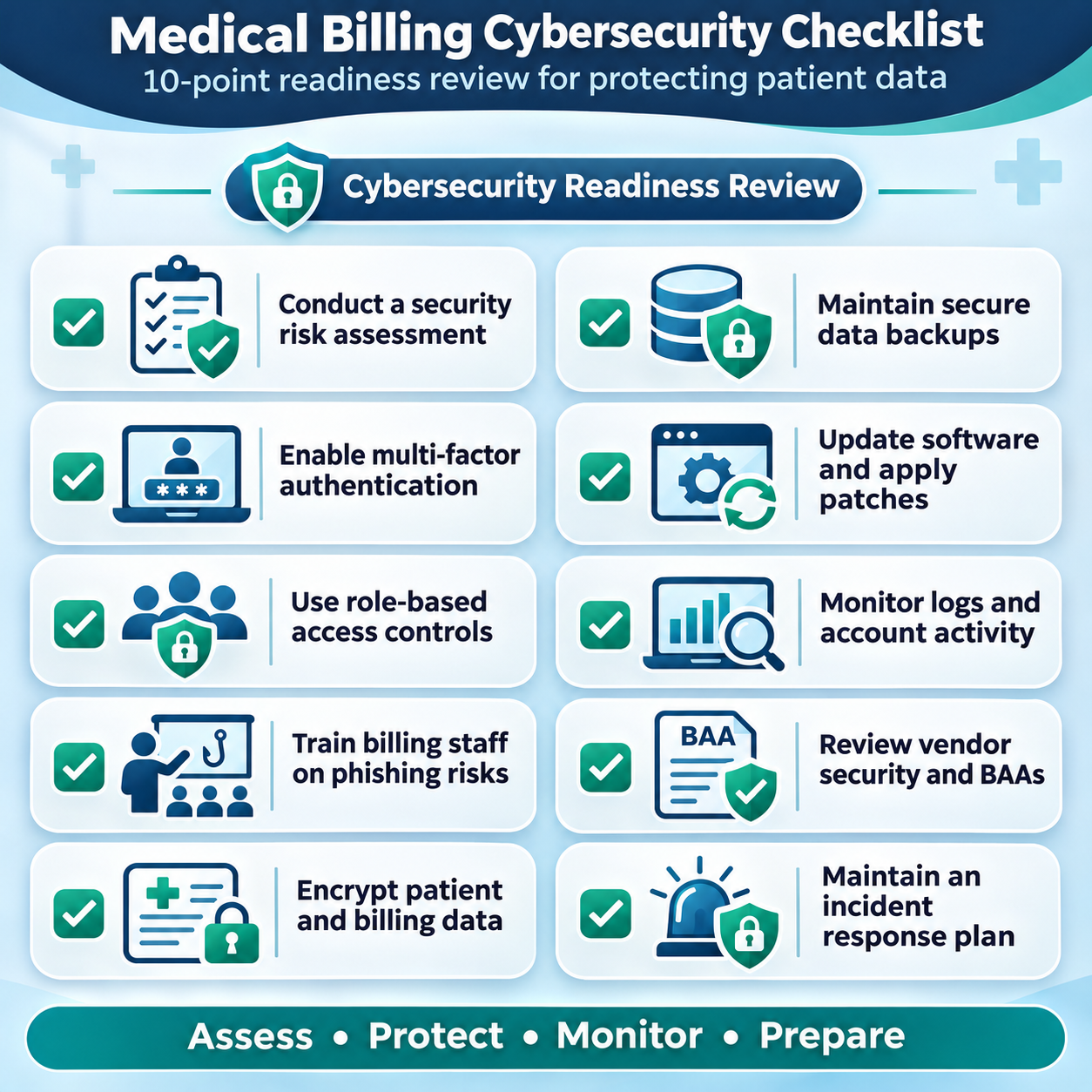
Medical Billing Cybersecurity Checklist
Use the following checklist to evaluate your practice’s security readiness and identify areas that require immediate attention.
How to Measure Cybersecurity Performance in Medical Billing
Practice administrators should track measurable security indicators instead of relying solely on written policies.
| Security metric | Recommended internal target |
|---|---|
| MFA adoption | 100% of supported billing accounts |
| Workforce security training | 100% participation |
| Access termination | Immediate upon employment termination |
| Backup restoration testing | Quarterly or according to assessed risk |
| Applicable vendor BAA coverage | 100% |
| Security incident documentation | 100% of identified incidents |
| Critical vulnerability remediation | Within risk-based remediation deadlines |
These suggested operational targets help practices identify weaknesses and measure improvements. They do not independently establish HIPAA compliance.
How to Choose a Secure Medical Billing Company
Before outsourcing your revenue cycle, evaluate how the billing company handles confidential information and responds to cybersecurity threats.
Ask potential billing partners the following questions:
-
How do you protect electronic patient information?
-
Do you provide an appropriate Business Associate Agreement?
-
How do you manage employee access permissions?
-
What security training do billing employees receive?
-
How do you monitor and report security incidents?
-
How do you maintain claim processing during system outages?
-
What procedures govern data return and deletion after contract termination?
A reliable billing partnership requires transparent security responsibilities, documented procedures, and effective communication.
Conclusion
The relationship between cybersecurity and medical billing is vital for patient privacy, stability, regulatory compliance, and revenue cycle performance. Healthcare organizations simply cannot afford to divorce cybersecurity from the actual medical billing process.
Risk assessments, strong authentication protocols, employee education, reliable backups, and vendor management all help medical practices manage their cyber risks and continue with billing seamlessly.
It becomes much easier to protect sensitive information and prevent unnecessary disruptions by incorporating cybersecurity into revenue cycle management.
Protect Your Data. Strengthen Your Revenue Cycle.
Partner with Medhasty Medical Billing to discuss your billing security requirements, improve revenue cycle workflows, and reduce avoidable operational risks.
Frequently Asked Questions
What is cybersecurity in medical billing?
Cybersecurity in medical billing refers to the measures put in place to secure patient information, claim forms, medical billing applications, and financial information from any unauthorized access and cyber attacks.
What are the main cybersecurity threats in medical billing?
Ransomware, phishing, credential theft, internal threats, payment fraud, and third-party data breach constitute the key cybersecurity threats in medical billing.
How does HIPAA ensure protection of medical billing information?
HIPAA mandates covered entities and their business associates to put adequate measures in place to safeguard protected health information.
How can medical billing companies protect their clients against data breach?
Data breaches can be prevented by medical billing companies by means of using encryption, multi-factor authentication, limiting access to data, training employees, monitoring for security, performing risk assessments regularly, and testing incident response plans.
Is medical billing outsourcing good for improving cybersecurity?
The cybersecurity of outsourced medical billing depends on whether providers choose appropriate vendors who have adequate security controls and compliance procedures.
What could happen to the billing if a cyberattack occurs?
Cyberattacks cause late submission of claims, increase accounts receivable, interfere with payment postings, and raise timely filing problems. It is essential to have a tested business continuity plan in place.