
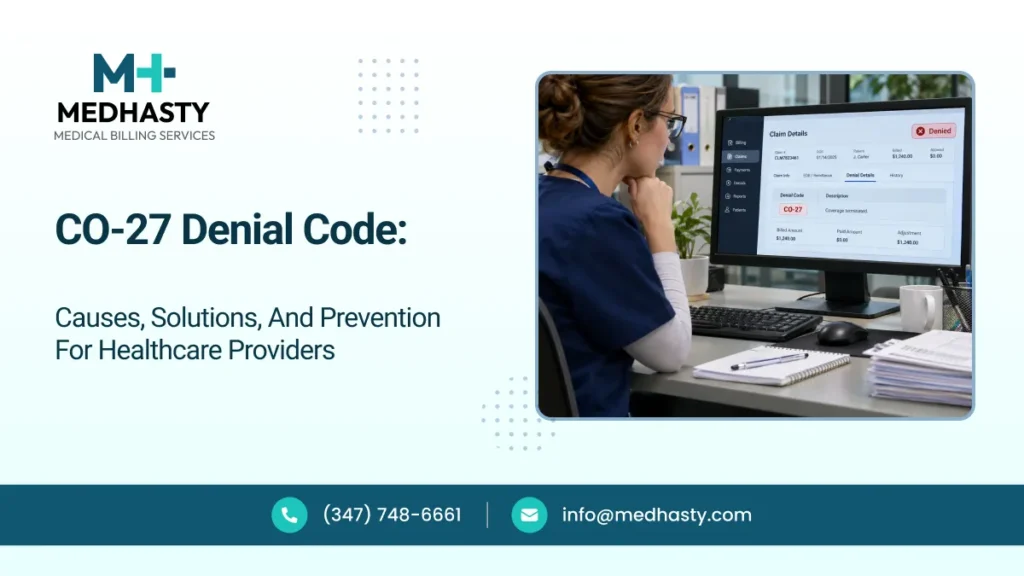
CO-27 rejection codes indicate that a patient’s insurance coverage had expired prior to the date of service for which payment is being made and the insurance company has rejected the claim based on this reason.
Although in some instances this may be true, there are other scenarios where CO-27 rejection codes appear owing to inaccurate or outdated patient insurance information.
This article is dedicated to the explanation of the term “CO-27,” reasons for its occurrence, steps required to resolve the issue and ways to avoid future claims denials.
What Is the CO-27 Denial Code in Medical Billing?
A code of CO-27 indicates that the insurer believes the coverage of the insured has expired before receiving the health services.
According to the official X12 Claim Adjustment Reason Codes, the meaning of CARC 27 is:
Expense incurred after coverage expiration.
This code is made up of two codes:
CO (Contractual Obligation): It indicates an adjustment that is assigned to the provider by regulation or contractual agreement.
27 (Claim Adjustment Reason Code): It indicates that the service was rendered after the insurance coverage expiration.
Upon assigning the CO-27, the provider should conduct a check on the expiration dates and determine the next steps.
Note: CO-27 adjustment does not automatically indicate an automatic right to transfer the unpaid balance to the patient. It is based on the remittance group code, payer agreement, and other insurance coverage policies.
CO-27 Denial Code Example
Consider a hypothetical primary care practice that submits a $250 office visit claim.
| Claim Detail | Information |
|---|---|
| Date of service | October 15, 2026 |
| Insurance termination date | September 30, 2026 |
| Billed amount | $250 |
| Denial code | CO-27 |
| Payer’s reason | Coverage ended before the service |
| Next action | Verify eligibility and review alternative coverage |
The reason the claim is denied is due to the payer having information that the insurance coverage was terminated 15 days prior to the visit.
On the other hand, let’s say the patient has changed insurance carriers on October 1. The billing process can still be done to obtain payment by confirming new insurance coverage and filing the claim.
This is why a CO-27 denial requires investigation rather than an immediate write-off.
Why Do Healthcare Providers Receive CO-27 Denials?
Coverage termination denials often begin with information that the practice did not update before providing services.
The most common causes include the following.
1. Insurance Coverage Terminated Before the Appointment
The patient could be without insurance cover due to changes at work, cancellation of coverage, non-payment of premiums, or any other qualifying event.
Where there was no coverage on the service date, the payer could reject the claim with CO-27.
2. Incorrect Insurance Information During Registration
There can be situations where the patients bring forward their old insurance cards without being aware that their plan has been changed.
The data entry staff at the reception desk will input the information from the old plan, and thus, the claim gets processed against the canceled plan.
3. Failure to Verify Eligibility Before Treatment
The practice that depends completely on the information provided by insurance collected in the previous visit fails to consider any new policies.
This is because, for instance, the insurance policy of a particular individual may have been effective in September but ceased to be effective in October.
A strong insurance verification process helps identify these changes before claim submission.
4. Delays in Updating Insurance Records
Employer plans, Medicaid programs, and private health insurance carriers can update their records in case of changes in coverage.
In the event of inaccurate or untimely payer records, the patient’s coverage may seem inadequate on the face of it, despite all proof provided by the patient.
5. Incorrect Dates of Service
An incorrect date in the medical claim may cause the medical procedure to seem like it was carried out past the date of termination of coverage of the plan.
For instance, a medical procedure conducted on September 28 might be denied with CO-27 if the date in the medical claim is October 2, yet the policy expired on September 30.
6. Unreported Secondary or Replacement Insurance
Patients can change their place of employment, sign up for Medicare, or have another insurance that will cover them without notifying the practice.
In such cases, processing a claim with the old insurance company that was dropped might result in a denied claim.
7. Retroactive Insurance Termination
Some coverage changes may even apply on a retroactive basis, provided that the law and coverage rules allow such application.
A coverage that was previously considered as eligible may be rejected or modified due to the updated termination date by the payer.
It is the responsibility of the billing department to analyze the coverage history and decide whether the retroactive change is legitimate or not.
CO-27 vs. PR-27: What Is the Difference?
Both CO-27 and PR-27 use the same underlying reason code: coverage ended before the date of service.
The difference involves how the payer assigns financial responsibility.
| Feature | CO-27 | PR-27 |
|---|---|---|
| Group code | CO – Contractual Obligation | PR – Patient Responsibility |
| Denial reason | Coverage terminated | Coverage terminated |
| Assigned responsibility | Provider/contractual adjustment | Patient responsibility adjustment |
| Patient billing | Generally not permitted for the CO amount | May be permitted, subject to applicable rules |
| Provider action | Investigate coverage and contractual liability | Verify coverage and patient liability before billing |
The CMS Health Care Payment and Remittance Advice guidance explains how group codes identify financial responsibility for unpaid claim amounts.
Providers should not treat CO-27 and PR-27 as interchangeable. Always review the electronic remittance advice (ERA), explanation of benefits (EOB), payer contract, and relevant billing protections before deciding who owes the balance.
How to Fix CO-27 Denial Code: Step-by-Step Solutions
Just because CO-27 was denied, this doesn’t automatically imply that the practice will suffer financial losses. The key is to find out if the patient was properly covered by insurance at the time of service.
This is the workflow that should be followed:
CO-27 Denial Resolution Workflow
-
Review the ERA or EOB
Identify CO-27, the affected service lines, adjustment amounts, and any accompanying remark codes.
-
Confirm the date of service
Compare the submitted date with clinical records and charge documentation.
-
Recheck insurance eligibility
Verify the effective and termination dates for the specific service date.
-
Contact the payer
Request clarification if the coverage information conflicts with available records.
-
Identify the correct resolution
Determine whether to correct the claim, bill another insurer, request reprocessing, or appeal.
-
Track the claim until closure
Record the reference number, next action, deadline, and final payment or adjustment.
Step 1: Review the Denied Claim
Begin with the payer’s remittance information and not your assumption of why there was non-payment.
Verify the patient’s name, insurance policy number, payer identification number, service dates, and status of claim. Look into the remittance advice remark code (RARC) accompanying the adjustment.
This will aid you in determining whether there is a legitimate cancellation of coverage or erroneous submission of claims.
Step 2: Verify Coverage for the Actual Service Date
Use the eligibility requirements of the date of the service, and not just the denial review date.
For Medicare, the HETS system by CMS uses 270/271 to provide information regarding Medicare eligibility. Commercial or Medicaid eligibility is handled using the respective payer systems.
Examine the effective date of the policy, the termination date, benefits available under the plan, and any other coverages.
Step 3: Contact the Insurance Payer
If it seems that the patient has active coverage, contact the payer’s provider service department.
Inquire from the representative on the termination date, history of enrollment, and whether or not the claim is eligible for reprocessing.
Make sure you get the name of the representative and the call reference number.
Step 4: Correct the Claim or Submit to the Appropriate Payer
In case of an erroneous date of service or erroneous insurance information on the claim, comply with the guidelines for submission of a correct claim provided by the payer.
In case of any other form of active insurance coverage of the patient, revise the registration information and file the claim through the new carrier.
Review the filing time limit of the new payer. Denial of the claim by the previous payer does not automatically extend the filing deadline of another payer.
Step 5: Appeal When the Denial Is Incorrect
An appeal may be appropriate when documentation demonstrates that the service date was covered but the insurer continues to deny payment.
Depending on payer requirements, supporting documentation may include:
-
Evidence of eligibility on the date of service
-
Insurance enrollment or reinstatement confirmation
-
Corrected claim information
-
Original ERA or EOB
-
Payer correspondence and reference numbers
For Original Medicare, a first-level redetermination generally must be requested within 120 days of receiving the initial claim determination. Commercial and Medicaid deadlines differ, so verify the applicable procedure before filing.
Which CO-27 Denials Can Be Recovered?
Not every CO-27 denial requires the same response. This decision table helps billing teams determine where to focus their efforts.
| Situation | Recommended action |
|---|---|
| Coverage was active on the service date | Request payer reprocessing with eligibility evidence |
| Incorrect service date was submitted | Correct the claim using payer instructions |
| Patient changed insurance plans | Verify and bill the correct insurer |
| Coverage was reinstated retroactively | Obtain confirmation and request claim review |
| Policy genuinely ended with no other coverage | Determine contractual and legally permitted financial responsibility |
| Payer records conflict with documentation | Escalate through payer review or appeal |
The key is to separate recoverable denials from claims with no valid coverage. Doing so prevents unnecessary appeals and helps the accounts receivable team prioritize claims with a reasonable path to payment.
How to Prevent CO-27 Denials Before They Occur
The best time to address a termination-related denial is before the patient arrives for treatment.
A few changes to front-end billing operations can prevent repeated eligibility errors.
Verify Insurance Before Every Appointment
Perform an eligibility verification before any scheduled appointments, especially if the patient hasn’t been seen for some time.
Reverification will be especially essential at the start of a new year or in case of the change of the patient’s employment or insurance coverage.
Confirm Insurance Changes During Check-In
Inquire from your repeat customers if there has been any change in their insurance cover.
It should be made convenient for the registration staff to update all the information before billing.
Build Eligibility Alerts Into Billing Workflows
For systems that support such functionality, set up alerts for terminated policies, missing eligibility responses, and coverage discrepancies.
The flagged accounts must be manually reviewed prior to filing a claim.
Recheck Coverage When Claims Are Delayed
For those claims that are not submitted for a long time, one should check the insurance coverage relevant to the original date of service.
It will help to find the changes in insurance data.
Monitor CO-27 Denial Trends
Monitor these denials by payer, location, provider, and registration team.
For instance, an office that has received multiple CO-27 denials from a certain insurance company needs to establish if the reason behind the denial has something to do with payer enrollment information, eligibility transactions, or incorrect insurance information.
These trends might indicate problems with operations that claim correction will not fix.
CO-27 Denial Prevention Checklist for Billing Teams
Pre-Submission Claim Review
Interactive eligibility checklist
How CO-27 Denials Affect Practice Revenue
A coverage termination denial creates more work than the initial claim submission.
The billing team must review the account, investigate eligibility, contact the insurer, identify possible alternative coverage, and potentially submit an appeal.
For practices handling hundreds or thousands of monthly claims, repeated eligibility denials can contribute to:
-
Delayed collections: Claims remain unpaid while teams investigate coverage.
-
Higher administrative costs: Staff spend additional time correcting preventable problems.
-
Growing accounts receivable: Unresolved denials increase outstanding balances.
-
Missed filing deadlines: Delays can eliminate otherwise valid payment opportunities.
-
Patient billing disputes: Incorrect liability decisions can create unnecessary collection issues.
Let us assume that you have a practice with an average of 40 CO-27 denials per month at $180 each.
This equals to $7,200 of monthly denied charges for review but not necessarily lost revenue of $7,200. The amount which can be collected depends on the patient’s insurance coverage, negotiated rate and claims processing.
The bottom line of denial avoidance is savings on unnecessary workload and opportunity to collect.
Turn Coverage Denials Into Better Billing Decisions
Effective denial management should not just fix individual denials but also point out areas where insurance verification, registration, and follow-up processes are flawed.
Medhasty Medical Billing helps healthcare practices with insurance verification, claim management, denial follow-up, and revenue cycle management services.
Denial prevention process can be implemented in healthcare practices to improve front-end processes and prevent re-billing mistakes.
All that is required is simple – to detect coverage issues early on, investigate valid claims and prevent unnecessary loss.
Stop Letting Coverage Errors Delay Your Revenue
Medhasty Medical Billing can help practices solve eligibility issues, handle denials, and make rightful claims before revenue is lost.
Frequently Asked Questions About CO-27 Denial Code
1. What is CO-27 denial code?
The CO-27 indicates that the insurance company found out that the insurance coverage of the patient was cancelled prior to the date of service. The CO group code denotes that it was not a patient’s responsibility adjustment but it was the contractual adjustment.
2. What is the solution for CO-27 denial?
It can be resolved by checking the date of service, the termination date of the policy and confirming whether the patient had insurance coverage.
3. Is the patient eligible to receive the CO-27 denial as a charge?
The practice cannot directly pass the CO contractual adjustment to the patient in most cases. It is necessary to check the payer agreement and regulations first to see if the provider can issue a patient statement.
4. How does CO-27 differ from CO-26?
CO-27 suggests that expenses were incurred after the end of the coverage. CO-26 suggests that expenses were incurred before the coverage started. These two codes refer to the patient coverage in relation to the date of service, but cover different sides of the coverage period.
5. Is it possible to appeal the CO-27 denial?
Yes, if there are grounds for appealing the payer’s coverage decision. The evidence may include documents indicating that coverage was still active or reinstated, service dates corrected, and the payer made an error in its records.
Final Thoughts
The CO-27 denial code indicates the problem with coverage termination; however, this does not mean that the claim is uncollectible all the time.
Healthcare organizations should confirm the eligibility on the actual date of service, check the payer details, find other coverages, and dispute the incorrect decisions if there is proper documentation to do so.
Furthermore, regular insurance checks and denial follow-ups may allow organizations to avoid facing the same problem with their further claims.
Revenue cycle management begins with collecting the right insurance information and ends only after resolving each claim.