
The code assigned to hypoxia is R09.02 and it is formally known as hypoxemia. This code will be assigned to any patient that suffers from hypoxia or lower blood oxygen levels in the absence of a more specific diagnosis.
Despite R09.02 seeming relatively simple, mistakes can still happen regarding hypoxia, hypoxemia, and hypoxic respiratory failure. Accurate documentation and professional medical billing and coding services help healthcare practices avoid these complications.
This guide describes codes for hypoxia ICD-10, documentation, coding, scenarios, and billing that will help you to submit your claims effectively.
What Is the ICD-10 Code for Hypoxia?
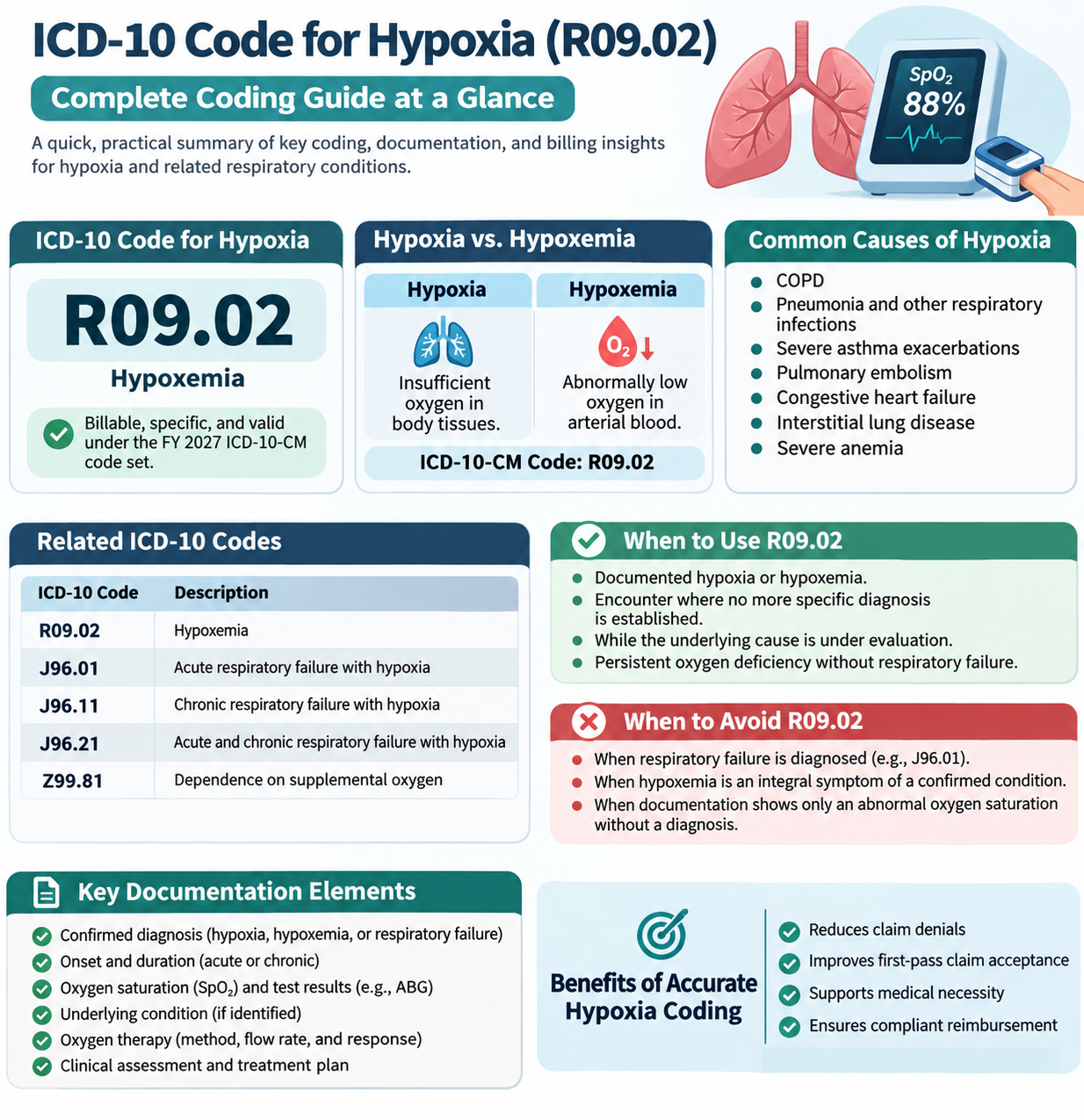
R09.02 is a billable and specific ICD-10-CM code which coders can assign for hypoxia or hypoxemia if coding guidelines allow.
The code stays valid within the FY 2027 ICD-10-CM code set starting from October 1, 2026, to September 30, 2027.
| Coding information | Details |
|---|---|
| ICD-10-CM code | R09.02 |
| Official description | Hypoxemia |
| Clinical terms | Hypoxia and hypoxemia, NOS |
| Code category | R09 |
| Subcategory | R09.0 – Asphyxia and hypoxemia |
| Billable code | Yes |
| Code type | Symptom or clinical finding |
| Applicable settings | Inpatient and outpatient, as appropriate |
The AAPC ICD-10-CM code directory provides the official code description and applicable exclusion notes.
R09.02 does not establish the underlying cause of oxygen deficiency or indicate that a patient has respiratory failure.
Understanding Hypoxia and Its Clinical Significance
Hypoxia is characterized by the inability of the body’s tissues to receive adequate amounts of oxygen required for their physiological functioning. The development of this condition may be associated with respiratory disorders, impaired blood flow, low oxygen levels, among other diseases.
Patients suffering from hypoxia may often be seen by healthcare specialists in the emergency rooms, pulmonologists’ offices, ICUs, and primary care facilities.
Common Causes of Hypoxia
-
Chronic obstructive pulmonary disease (COPD)
-
Pneumonia and other respiratory infections
-
Severe asthma exacerbations
-
Pulmonary embolism
-
Congestive heart failure
-
Interstitial lung disease
-
Severe anemia
-
High-altitude exposure
-
Sleep-related breathing disorders
Identifying the underlying condition helps providers determine the most appropriate diagnosis and gives coding teams a clearer basis for claim submission.
Common Signs and Symptoms of Hypoxia
Clinical manifestations in patients suffering from hypoxia include dyspnea, tachypnea, confusion, agitation, cyanosis, or a fast heartbeat. Presentation of symptoms depends on the type and severity of the disease.
Some of the methods used for the assessment of oxygenation include pulse oximetry, arterial blood gas testing, among others.
But one should always remember that billing departments must not come up with a diagnosis just from test results alone.
Hypoxia vs. Hypoxemia: What Is the Coding Difference?
Although hypoxia and hypoxemia share the same general ICD-10-CM code, they describe different clinical conditions.
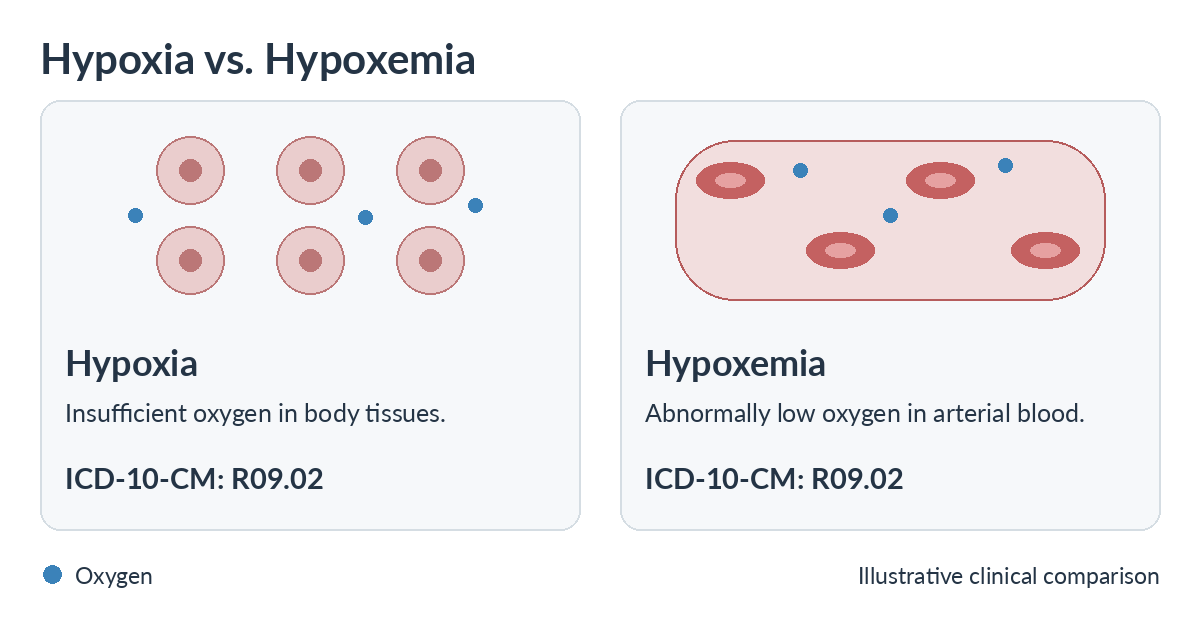
| Clinical feature | Hypoxia | Hypoxemia |
|---|---|---|
| Affected area | Body tissues | Arterial blood |
| Primary concern | Inadequate tissue oxygenation | Reduced arterial oxygen |
| Clinical assessment | Tissue perfusion and oxygen delivery | Pulse oximetry and arterial blood gas |
| General ICD-10 code | R09.02 | R09.02 |
| Underlying causes | Respiratory, circulatory or cellular disorders | Frequently respiratory or cardiopulmonary disorders |
According to the National Library of Medicine, hypoxemia can contribute to tissue hypoxia. However, hypoxia can also occur without hypoxemia.
Coders must review the complete clinical documentation rather than assume that both conditions always occur together.
Related ICD-10 Codes for Hypoxia and Respiratory Conditions
Healthcare providers should select diagnosis codes that reflect the patient’s documented condition, severity, and reason for the encounter.
The following table covers frequently encountered hypoxia-related ICD-10-CM codes.
| ICD-10 code | Description |
|---|---|
| R09.02 | Hypoxemia |
| J96.01 | Acute respiratory failure with hypoxia |
| J96.11 | Chronic respiratory failure with hypoxia |
| J96.21 | Acute and chronic respiratory failure with hypoxia |
| J96.00 | Acute respiratory failure, unspecified whether with hypoxia or hypercapnia |
| R06.02 | Shortness of breath |
| R06.03 | Acute respiratory distress |
| R06.89 | Other abnormalities of breathing |
| R06.82 | Tachypnea, not elsewhere classified |
| R23.0 | Cyanosis |
| G47.34 | Idiopathic sleep-related nonobstructive alveolar hypoventilation |
| G47.36 | Sleep-related hypoventilation in conditions classified elsewhere |
| G93.1 | Anoxic brain damage, not elsewhere classified |
| P84 | Other problems with newborn |
| I27.23 | Pulmonary hypertension due to lung diseases and hypoxia |
| Z99.81 | Dependence on supplemental oxygen |
These codes represent different clinical circumstances and should not automatically appear together on a claim. Always verify the applicable Alphabetic Index entries, Tabular List instructions, and diagnosis-specific documentation.
Acute Hypoxia vs. Chronic Hypoxia ICD-10 Codes
The duration of hypoxia does not automatically change the diagnosis code. However, a confirmed diagnosis of respiratory failure requires greater coding specificity.
Acute Hypoxia ICD-10 Code
Utilize code R09.02 for confirmed acute hypoxia in the absence of other confirmed diagnoses.
For instance, a patient presents to the emergency department with hypoxic oxygen desaturation and acute hypoxia is documented by the physician. If the physician fails to confirm the existence of respiratory failure or any other condition, then R09.02 can be used.
Chronic Hypoxia ICD-10 Code
R09.02 can also be used for chronic hypoxia in cases where there is no supporting documentation to identify a more specific condition.
When the patient has a need for long-term oxygen support, Z99.81 can be used in addition as a status code depending on documentation.
Acute Hypoxic Respiratory Failure ICD-10 Code
Assign J96.01 if the provider identifies acute respiratory failure with hypoxia.
A diagnosis of hypoxia, presence of low oxygen saturation levels, or use of supplemental oxygen is not sufficient to use this code.
Chronic Hypoxic Respiratory Failure ICD-10 Code
Use code J96.11 for chronic respiratory failure with hypoxia. Acute on chronic respiratory failure with hypoxia will be coded as J96.21.
This knowledge is useful in preventing undercoding as well as inappropriate upcoding.
When Should Healthcare Providers Use R09.02?
Healthcare providers and coding teams should consider R09.02 when clinical documentation establishes hypoxia or hypoxemia and applicable reporting rules support symptom coding.
Appropriate situations may include:
-
Unexplained hypoxemia during an outpatient evaluation.
-
Documented hypoxia while diagnostic investigations remain underway.
-
Clinically significant hypoxemia that meets separate reporting requirements.
-
Persistent oxygen deficiency without a documented diagnosis of respiratory failure.
-
Outpatient encounters where the physician cannot confirm the suspected underlying disease.
For instance, a pulmonologist evaluates a patient for unexplained oxygen desaturation and orders additional diagnostic testing. If the provider establishes hypoxemia but cannot confirm its cause, R09.02 may accurately represent the encounter.
When Should Coders Avoid Using R09.02?
Using R09.02 inappropriately can trigger claim reviews and documentation-related denials.
Coders should avoid assigning this code when:
-
The provider establishes hypoxic respiratory failure that accounts for the hypoxia.
-
Hypoxemia represents an integral symptom of a confirmed diagnosis and does not qualify for separate reporting.
-
The medical record contains only an abnormal oxygen saturation reading without an established diagnosis.
-
A condition-specific neonatal, neurological, or sleep-related code better represents the diagnosis.
-
An applicable exclusion note prohibits reporting the code combination.
Understanding R09.02 Excludes1 and Excludes2 Notes
The parent categories R09 and R09.0 contain important coding restrictions that also apply to R09.02.
| Exclusion type | Condition | Code |
|---|---|---|
| Excludes1 | Respiratory failure | J96.- |
| Excludes1 | Acute respiratory distress syndrome | J80 |
| Excludes1 | Birth asphyxia | P84 |
| Excludes1 | Carbon monoxide-related asphyxia | T58.- |
| Excludes1 | Traumatic asphyxia | T71.- |
| Excludes1 | Hyperventilation | R06.4 |
| Excludes2 | Hypercapnia | R06.89 |
Excludes1 means that the listed conditions usually should not be reported together as a set. There is an exception to the rule when there are unrelated conditions that can be reported.
Excludes2 suggests that the listed condition is not part of the code but can exist together with it.
ICD-10-CM Coding Guidelines for Hypoxia
Accurate documentation of hypoxia involves more than just choosing an appropriate diagnosis code from the EHR. The billing staff has to follow the guidelines provided, check the encounter data, and know the link between the symptoms and diagnosed condition.
1. Code the Confirmed Diagnosis
If the underlying illness is confirmed by the provider, then see if the illness itself is responsible for the hypoxia.
Symptoms accompanying the illness need not be reported separately unless otherwise specified by the guidelines.
2. Follow Outpatient Coding Rules
Outpatient coding guidelines mandate that uncertain conditions not be coded as established conditions.
In a case where a patient is suspected to have pneumonia but has established hypoxemia, the coding process should code for the symptoms and diagnosis rather than the unestablished condition of pneumonia.
3. Follow Inpatient Coding Requirements
Qualifying hospital admissions are subject to special requirements when the diagnosis is uncertain on discharge.
Moreover, secondary diagnoses have to meet certain reporting requirements, including that they required clinical evaluation, therapy, diagnostic procedures, additional monitoring, or longer hospitalization.
4. Do Not Infer Respiratory Failure
A coder must never code hypoxia to respiratory failure on the basis of oxygen levels, arterial blood gases, and oxygen administration alone.
In case there is conflict or lack of specificity in the diagnostic statement, the query should be written by the provider in compliance with standards.
5. Determine the Correct Diagnosis Sequence
Purpose, location of care, and appropriate coding guidelines will dictate the diagnostic sequencing process.
R09.02 can be the primary diagnosis used in the case of outpatient visits when diagnosing unexplained hypoxemia. On the other hand, inpatient visits will necessitate the selection of the principal diagnosis according to the circumstances of admission and the study results.
Review the current CMS ICD-10-CM Official Guidelines for Coding and Reporting before finalizing complex respiratory claims.
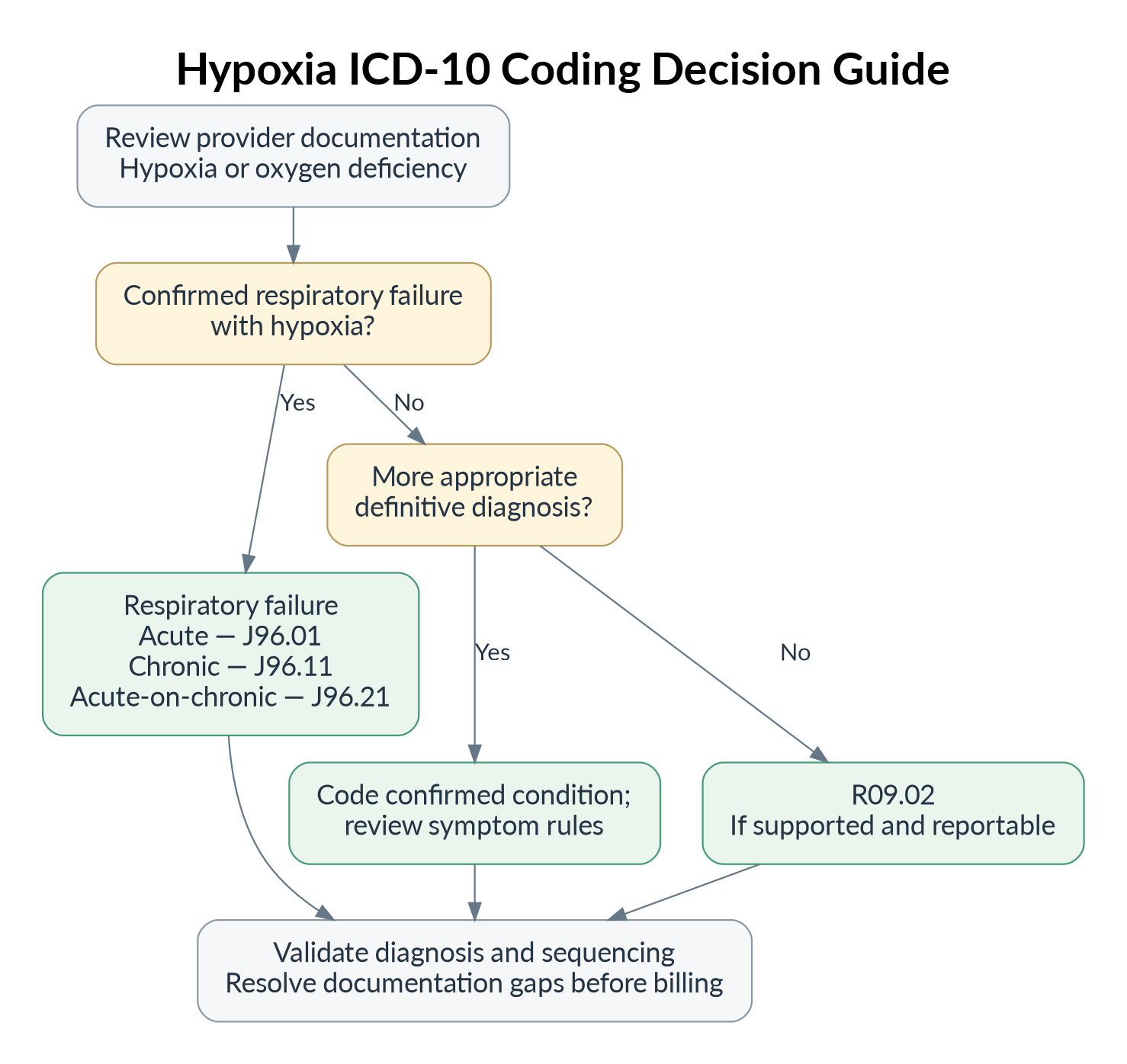
Hypoxia ICD-10 Coding Decision Guide
Use this decision pathway to identify an appropriate code before claim submission.
Clinical Documentation Requirements for Hypoxia Coding
Incomplete documentation makes it difficult for coders to distinguish temporary oxygen desaturation from a clinically significant respiratory condition.
Healthcare providers should document the following information:
| Documentation element | Required clinical details, as applicable |
|---|---|
| Confirmed diagnosis | Hypoxia, hypoxemia, or respiratory failure |
| Onset and duration | Acute, chronic, intermittent, or persistent |
| Oxygen saturation | SpO2 readings and measurement conditions |
| Diagnostic findings | Arterial blood gas results and relevant investigations |
| Underlying condition | Confirmed respiratory, cardiac, or systemic disease |
| Oxygen therapy | Delivery method, flow rate, and treatment response |
| Clinical assessment | Severity and associated respiratory symptoms |
| Treatment plan | Monitoring, medication, respiratory support, and follow-up |
Clear documentation helps coding professionals justify diagnosis selection and respond to payer requests for additional clinical evidence.
Medhasty Medical Billing supports healthcare providers through professional medical coding services that identify documentation gaps, validate diagnosis codes, and review claims before submission.
CPT and HCPCS Codes Associated With Hypoxia
Though ICD-10-CM codes specify the patient’s disease, the CPT and HCPCS codes describe the diagnostic processes, interventions, and medical apparatus used in the process of care delivery.
There are codes that healthcare organizations will use when caring for patients with hypoxia.
| CPT/HCPCS code | Service or equipment |
|---|---|
| 94760 | Single pulse oximetry measurement |
| 94761 | Multiple pulse oximetry measurements |
| 94762 | Continuous overnight oximetry |
| 82803 | Blood gas analysis |
| 36600 | Arterial puncture for blood sampling |
| 94640 | Inhalation treatment for acute airway obstruction or diagnostic purposes |
| 94618 | Pulmonary stress testing, such as a six-minute walk test |
| E1390 | Oxygen concentrator |
| E0431 | Portable gaseous oxygen system, rental |
The presence of R09.02 does not automatically establish medical necessity for every service in this table. Billing teams must verify payer coverage, procedure bundling, documentation requirements, and service-specific billing restrictions.
The CMS respiratory therapy and oximetry billing guidelines explain applicable Medicare contractor coverage and billing requirements.
Does R09.02 Support Medicare Coverage for Oxygen Therapy?
R09.02 may support the documented medical need for supplemental oxygen. However, Medicare requires additional clinical evidence before covering home oxygen equipment.
Under the Medicare National Coverage Determination 240.2, qualifying Group I findings include:
-
Arterial oxygen partial pressure (PaO2) of 55 mmHg or less at rest.
-
Arterial oxygen saturation of 88% or less at rest while breathing room air.
-
Qualifying oxygen measurements during sleep or exercise under specified conditions.
Other coverage pathways may apply depending on clinical findings and individual circumstances.
Healthcare providers should maintain qualifying test results, medical necessity documentation, appropriate orders, and relevant treatment records.
Important: Medicare oxygen coverage thresholds do not independently establish a diagnosis of hypoxia or respiratory failure. Clinical diagnosis and insurance coverage remain separate considerations.
Common Hypoxia Coding Errors That Cause Claim Denials
Respiratory claims can encounter reimbursement problems when diagnosis codes fail to reflect the provider’s assessment or support the billed services.
| Common coding error | Recommended solution |
|---|---|
| Reporting R09.02 alongside related J96.01 | Review exclusion notes and remove redundant symptom coding |
| Coding respiratory failure from SpO2 alone | Obtain appropriate provider documentation |
| Reporting a suspected disease in outpatient care | Report confirmed conditions and applicable symptoms |
| Using R09.02 for oxygen dependence alone | Review whether Z99.81 better describes the status |
| Missing medical necessity documentation | Link services to supported diagnoses and clinical findings |
| Incorrect diagnosis sequencing | Review the encounter purpose and coding guidelines |
| Billing pulse oximetry separately without checking edits | Verify bundling and payer-specific payment rules |
| Using outdated diagnosis codes | Validate codes against the applicable ICD-10-CM release |
Regular claim audits and effective denial management services help practices identify recurring coding errors before they develop into larger revenue cycle problems.
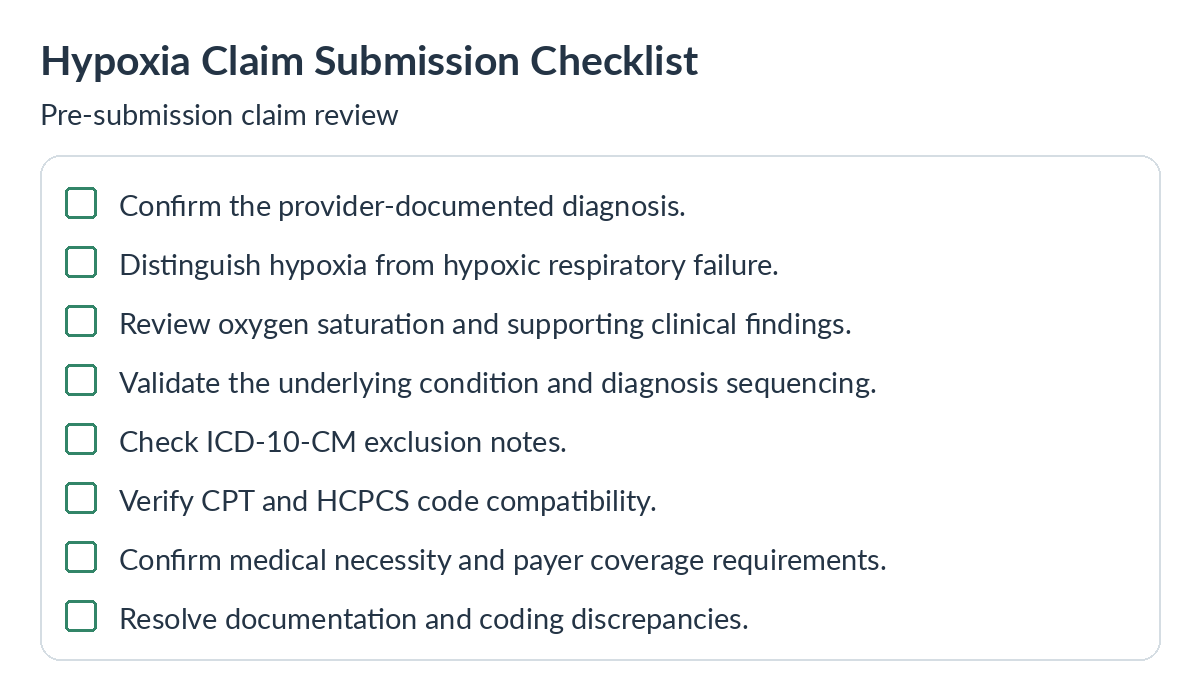
How Accurate Hypoxia Coding Protects Practice Revenue
A respiratory claim can contain valid procedure codes and still face denial because the diagnosis fails to support the billed service.
Accurate hypoxia coding helps healthcare organizations:
-
Reduce diagnosis-related claim denials.
-
Improve first-pass claim acceptance.
-
Support medical necessity during payer reviews.
-
Reduce unnecessary claim corrections.
-
Minimize compliance and audit risks.
-
Improve reimbursement consistency.
Practices should also monitor denial patterns across respiratory services. Repeated medical necessity denials, diagnosis discrepancies, or procedure bundling errors may indicate weaknesses in the coding and claim review process.
Turn Respiratory Coding Accuracy Into Revenue Protection
The time of your providers is wasted on assessing patients, addressing breathing complications, and writing up treatment records. Your coding mistakes must not diminish the worth of their effort.
Medhasty Medical Billing assists healthcare facilities to handle their complicated respiratory billing claims through coding reviews, ICD-10-CM coding, claims cleaning, denial management, and reimbursements collection.
Billing experts of Medhasty Medical Billing coordinate with your clinical processes to detect areas with revenue potential.
Get Your Free Medical Billing Assessment
Frequently Asked Questions
1. Which ICD-10 code is used for hypoxia?
The code used in the ICD-10-CM for hypoxia and hypoxemia is R09.02. The name of this code is hypoxemia. When there is another condition that overrides this one, it will be better to use another code based on the documentation.
2. Which ICD-10 code is used for acute hypoxia?
The code used in the ICD-10 for acute hypoxia is R09.02. However, in the case where there is acute respiratory failure with hypoxia, use the code J96.01.
3. Could both R09.02 and J96.01 codes be assigned on the same claim form?
Generally, the answer is no since an applicable Excludes1 note does not allow this. However, there is an exception under certain circumstances.
4. What is the ICD-10 code for low oxygen saturation?
The ICD-10 code R09.02 can be used if the provider mentions hypoxemia or hypoxia associated with low oxygen saturation. The coder should never diagnose the condition using only a pulse oximetry measurement.
5. What is the ICD-10 code for nocturnal hypoxia?
ICD-10 code G47.34 can be used for sleep hypoxia supported by the Alphabetic Index and Tabular List. Sleep hypoxemia with a classification of the disease causing this condition can be coded as G47.36.
6. What is the ICD-10 code for oxygen dependence?
Z99.81 is the status code indicating oxygen dependence. It does not replace the underlying condition that causes the need in oxygen.
Conclusion
Code R09.02 for hypoxia is critical when determining the presence of oxygen deprivation for respiratory claims. Nonetheless, proper selection of the right code is determined by factors such as clinical documentation, underlying causes, exclusions, and encounter-specific coding guidelines.
Healthcare practitioners can prevent unnecessary denials by differentiating hypoxia from respiratory failure, proper documentation of medical necessity, and validation of the accuracy of diagnostic codes to procedures prior to claim submissions.
Continuous coding review process ensures practice revenue protection and compliance.